
RiseGuide Team

To create a personal development plan, start by looking honestly at where you are now, pick one area you want to grow in, and turn it into a few specific goals. Then decide the actions or habits that move you toward each goal, note what and who can help, and set a timeline with regular check-ins to review your progress. Writing it down is what makes it stick, so use the free personalized template below: answer a few short questions and you will get a plan built around what matters most to you, whether that is building habits, learning something new, or reaching bigger goals.
Most people want to grow in some direction, but "get better" is too vague to act on. A personal development plan turns that vague wish into something concrete: where you are, where you want to be, and the steps between the two. It works for any part of life, from a skill you want to learn to a habit you want to build or a goal at work. This guide covers what a personal development plan is, what goes in it, how to write one step by step, and a free template you can fill in today, matched to the kind of growth you care about most.
A personal development plan, sometimes shortened to PDP, is a simple written plan for how you want to grow and how you intend to get there. It names the area you want to improve, the goals inside it, the actions you will take, and how you will track progress. It is yours, so it can be about your career, your health, a relationship, a skill, or a habit.
The real value is the thinking it forces. Writing a plan down turns good intentions into specific commitments you can act on and check. In one study from Dominican University, people who wrote down their goals and shared progress updates achieved more than those who only thought about them. A personal development plan gives you that structure without needing to be long or complicated.
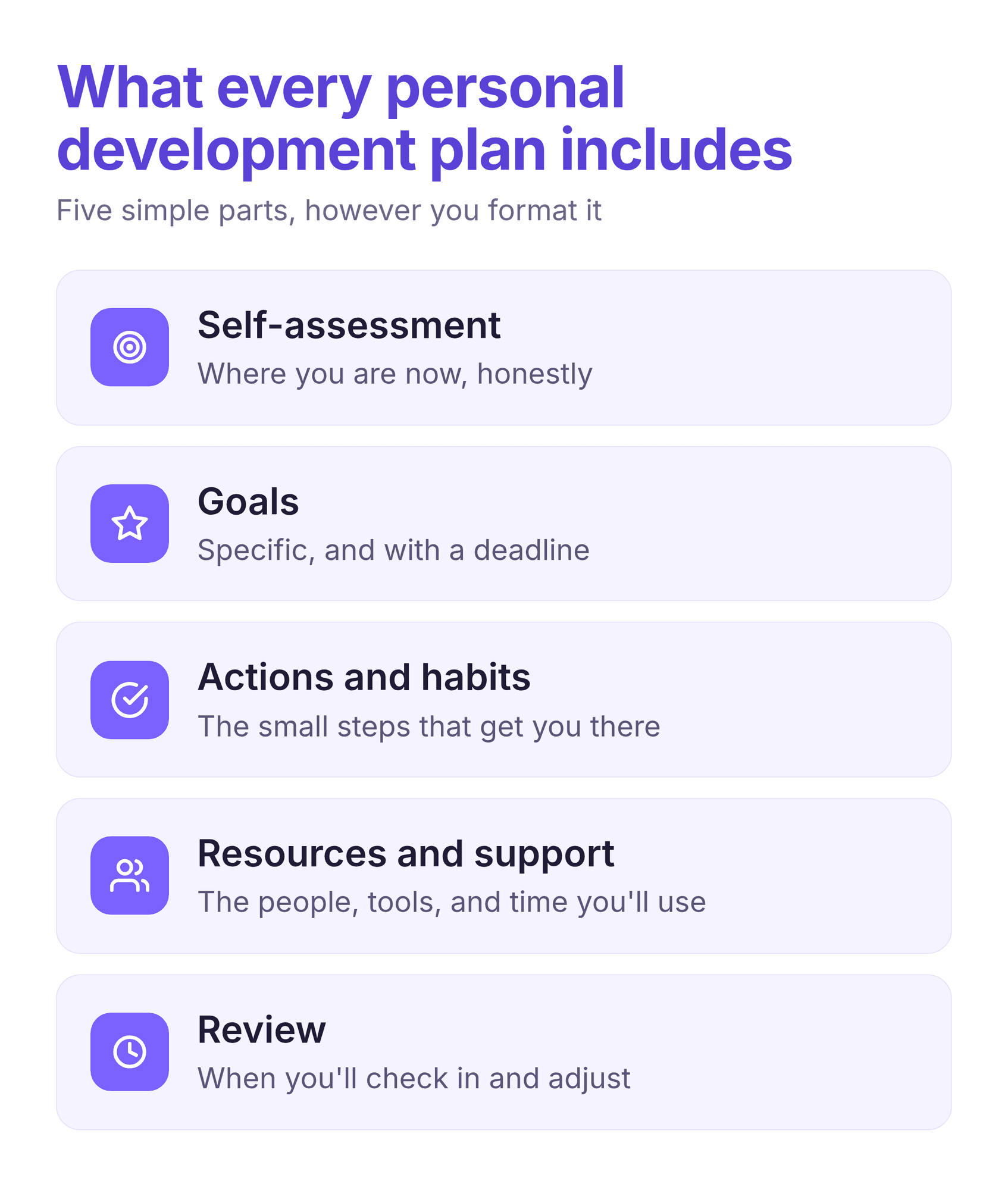
A good personal development plan has a handful of parts that answer simple questions. You do not need fancy sections, just honest answers to each one. These are the five components most plans share.
The first is a self-assessment: where are you now, and what are your strengths and gaps? The second is your goals: what specifically do you want to achieve, and by when? The third is the actions and habits that will get you there, broken into steps small enough to actually do. The fourth is your resources and support: the people, tools, courses, or time you will use. The fifth is a review schedule: when you will check progress and adjust. Every strong plan covers these five, whatever format it takes.
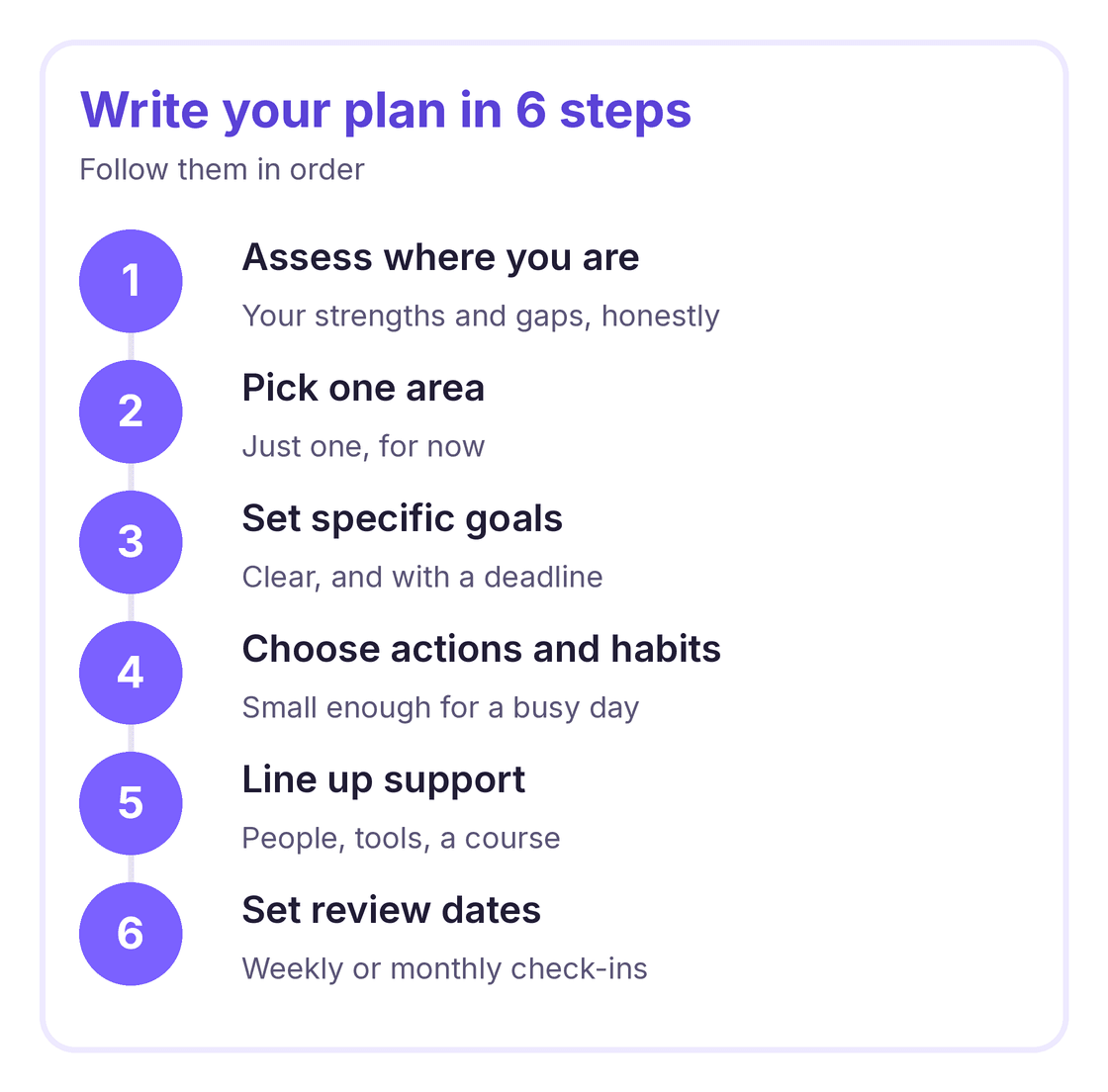
Writing a personal development plan is a short, ordered process. Follow these steps in order, because each one builds on the last, and you will have a working plan in an afternoon.
Start with an honest look at your current situation. What are you good at, what feels like a gap, and what do you want more of in your life or work? A quick self-assessment keeps the rest of the plan grounded in reality rather than in wishful thinking. If you are not sure where to focus, notice what you keep wishing were different.
You cannot grow in every direction at once, so choose one area for now. It might be a skill, a habit, your health, a relationship, or a career move. Narrowing to one area is what makes a personal development plan work, because your effort is concentrated instead of spread thin. You can always start a new plan later.
Vague goals like "get fitter" are hard to act on. Make each goal specific and time-bound so you know exactly what you are aiming at and when. This is where the SMART goals approach helps: instead of "read more," you write "read one book a month for the next six months." Clear goals are easier to plan around and easier to measure.
Under each goal, list the actions that move you toward it, and turn the repeatable ones into habits. Keep them small enough that you will actually do them on a busy day. If your goal is about consistency, building the right habits matters more than any single big push; if it is about learning, a few solid study habits will carry you further than motivation alone.
Growth is easier when you are not doing it alone. Write down what will help you: a course, an app, a book, a mentor, or a friend you can check in with. Naming your support in advance means you reach for it when things get hard, instead of letting the plan fade. Telling someone your plan also adds a little accountability, which the research above found makes a real difference.
Give your plan a timeline and pick regular points to review it, weekly or monthly. At each check-in, look at what is working, what is not, and what to adjust. Plans are meant to change as you learn, and slow progress is normal, so this is also where you remind yourself why you started and stay motivated when results are slow to show.
Once you know the parts, filling them in is the easy bit, and this is where a template saves you time. Most personal development plan templates online are one generic grid, which is a problem, because a plan for building a habit looks nothing like a plan for learning a new skill or reaching a big goal.
So we made a free personal development plan template that adapts to you. Answer a few short questions about what you want to grow and how you like to work, and you will get one of three versions matched to your answers: a habits version for building or breaking daily routines, a learning version for mastering a skill or subject, and a goals version for bigger milestones and career moves. Each one is a single page you can print or fill in on screen, with the right prompts for that kind of growth rather than a one-size-fits-all form. If you want the habit to actually stick after you download it, short daily lessons in an app like RiseGuide can keep you moving between review dates.
Answer a few questions and get your own personal development plan template.
A personal development plan is one of the simplest tools for turning "I want to grow" into steady, visible progress. Look at where you are, pick one area, set specific goals, choose small actions, line up your support, and review often. The plan will change as you go, and that is the point. Answer the questions in the template above, get the version that fits how you want to grow, and fill in your first plan today.
The five components are a self-assessment of where you are now, specific goals for where you want to be, the actions and habits to get there, the resources and support you will use, and a review schedule to track and adjust your progress.
A simple personal development plan example: focus area, communication at work; goal, speak up once in every meeting for three months; actions, prepare one point and rehearse it; resources, a short course and a supportive colleague; review, a weekly five-minute check. The template above gives you a ready structure to fill in your own.
The 70:20:10 rule suggests that most growth, about 70 percent, comes from real experience and doing the work, 20 percent from other people such as feedback and mentoring, and 10 percent from formal learning like courses. It is a reminder to build practice and people into your plan, not just reading.
As long as it is useful and no longer. One page is plenty for most people. A plan you will actually read and update beats a detailed document you write once and forget.
A quick weekly or monthly check works for most goals. Regular reviews let you adjust while the plan is still relevant, and they keep the plan from drifting out of date.