RiseGuide Team

To stay motivated when you don't feel like it, stop waiting to feel ready and act first, because doing a little usually brings the motivation that showing up was supposed to require. Start with a version of the task so small it feels almost silly to skip, make an if-then plan for the moment you know you'll stall, and pair the task with something you enjoy so it's easier to begin. Set up your space so starting is the easy choice, expect low days instead of treating them as failure, and reconnect the task to a reason that actually matters to you. None of these depend on feeling inspired first.
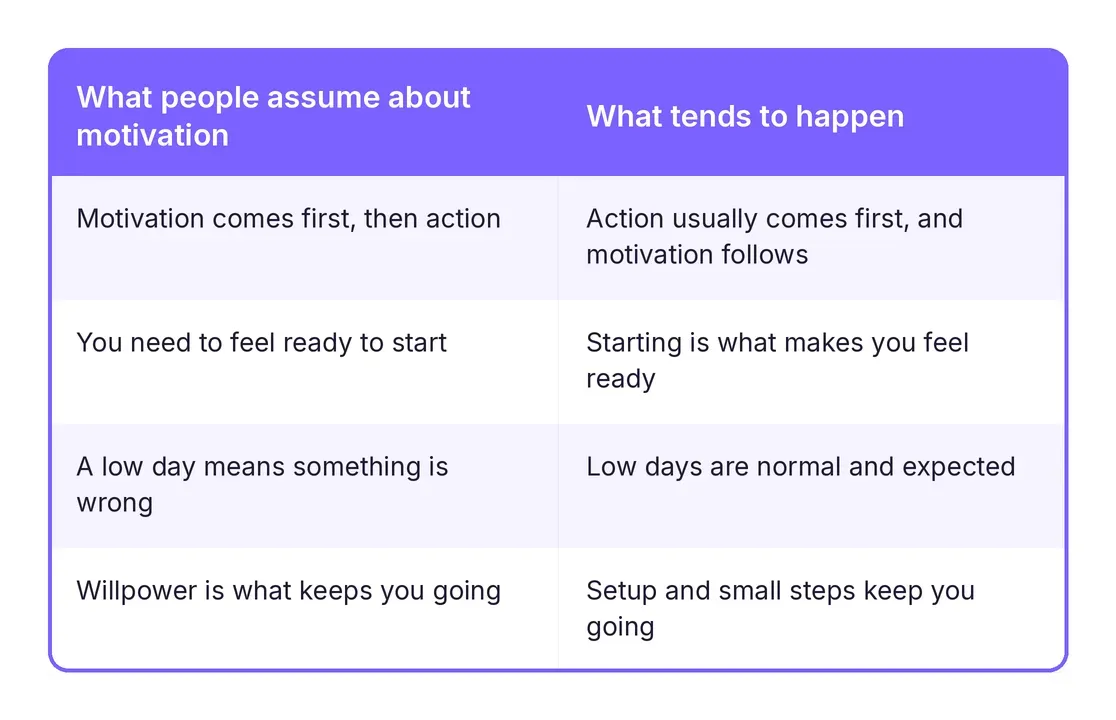
Motivation is unreliable by nature. Some mornings you wake up ready to work toward a goal, and other days the same goal feels like too much before you've even started. Most of us assume motivation has to show up first, with action following once we feel ready. It often runs the other way: a small action gets you going, and the motivation arrives after you've begun. Once you know that, staying motivated becomes something you can set up on purpose, even on days you feel flat. The techniques here work for the everyday things people struggle to start — a workout, a study session, cleaning the kitchen — and for the longer goals that are easy to drift away from.
Motivation is a feeling, and like any feeling it rises and falls with your energy, your mood, your sleep, and how interesting the task is. Expecting it to stay high all the time sets you up to feel like something is wrong with you when it dips. A clearer picture of why it fluctuates makes the low days easier to work with.
Motivation usually follows action instead of leading it. The willingness to keep going tends to show up once you're already moving, which is why the hardest moment is the one before you begin. You can see a small version of this in everyday movement. In a 2025 study, researchers who tracked more than 350 young adults found that swapping half an hour of sitting for light activity like a walk or light chores lifts your mood the next day. Waiting to feel motivated before you move keeps you stuck, because for many tasks the feeling arrives only after you start.
Some tasks drain your drive before you begin because they're vague, too big, or disconnected from anything you care about. "Get in shape" or "write the report" gives your brain nothing to grab onto, so it stalls. A lack of motivation is often a sign that the task is vague or too big and needs breaking down. Naming the specific next action usually does more than trying to force the feeling.
How to stay motivated when you don't feel like it
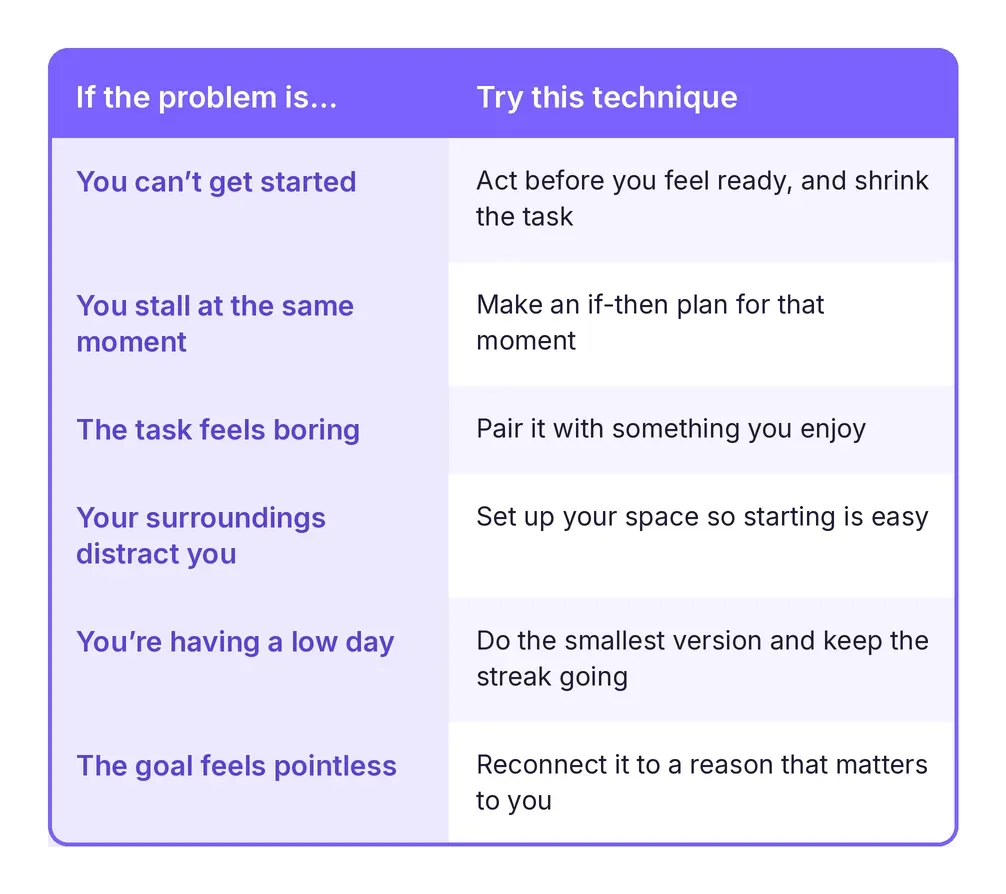
The techniques below work whether or not you feel inspired. Real self motivation is less about a feeling and more about setup. If you've been trying to figure out how to motivate yourself or how to find motivation and nothing seems to stick, it's usually because the advice depends on a feeling you can't summon on command. Each technique here lowers the effort it takes to begin, or gives you a reason to keep going when the feeling isn't there. Pick the two or three that fit the task in front of you rather than trying all at once.
If you're wondering how to get motivated on a flat day, the most reliable move is to start before the motivation arrives. Tell yourself you'll do two minutes of the task and nothing more. Put on your shoes and step outside, open the document and write one sentence, wash a single dish. Two minutes is short enough that the part of you looking for an excuse has little to argue with, and starting is usually the hardest part. Whitnie Wiley, an executive coach and one of our experts, writes about shifting into action when planning turns into a way to avoid beginning.
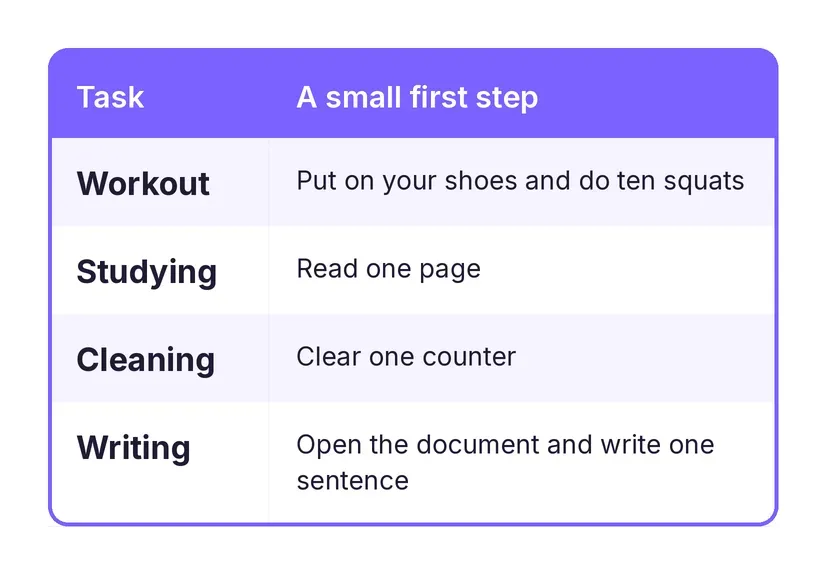
When you don't feel like doing something, the size of it is often what stops you. Cut the task down until the first step feels almost too easy. A full workout becomes ten squats. Studying becomes reading one page. Cleaning the house becomes clearing one counter. The small version gets you moving, and momentum tends to carry you past the original starting point. On the days you only do the small version, you still kept the habit alive, which matters more than any single session.
Make an if-then plan for the moment you'll stall
Deciding in advance what you'll do removes the negotiation that happens when motivation is low. Name the trigger and the response: "If it's 7 a.m., then I put on my running clothes," or "If I finish lunch, then I study for 20 minutes." These are called if-then plans, and a 2024 review of 642 tests found they reliably help people follow through on what they meant to do. The plan does the deciding for you, so you're not relying on willpower at the exact moment it's weakest.
You're more likely to start a task you've been avoiding when it comes with something you like. Save a specific podcast for the treadmill, make your favorite coffee only while you study, listen to an audiobook while you clean. The enjoyable part gives you a reason to show up, and over time the task itself starts to feel less heavy. Keep the pairing consistent so your brain links the two.
Motivation is easier to find when your environment does some of the work. Lay out your gym clothes the night before. Put your phone in another room while you study. Leave the book you're reading on your pillow. Every extra step between you and the task is a chance to talk yourself out of it, so remove as many as you can, and add a few small steps in front of the things that pull your attention away.
No one stays motivated every day, and treating a low day as failure usually makes the next one harder. Some days you'll do less, and that's part of the process rather than a sign you've fallen off. Juliann Wiese, a master certified coach and one of our experts, describes these dips as the wobbles, a normal response rather than proof you're doing something wrong. On a no motivation day, keep the streak alive with the smallest possible version of the task, and let the bigger efforts happen when your energy returns.
Motivation fades fastest when a goal feels like an obligation with no clear payoff. Spend a minute connecting the task to something you actually care about — studying so you can change careers, exercising so you can keep up with your kids, saving so you have options later. A reason that's personal holds up better than one you took on because you felt you should. John Lentini, a leadership coach and one of our experts, describes discipline as one dial you can deliberately turn up rather than a trait you're born with, which means the drive to keep going is something you build.
How to stay motivated to exercise, study, or clean
The same techniques apply to the specific tasks people most often stall on. For how to stay motivated to exercise, lay your clothes out the night before and start with the smallest version, so beginning takes almost nothing — the same goes for how to stay motivated to workout at home, where the friction is usually setup, not effort. For how to stay motivated to study, pair the session with something you like and shrink it to one page; if how to stay focused and motivated is the harder part, put your phone in another room so the environment does the work. For chores, clear one counter instead of facing the whole kitchen. The task changes, but the move is the same: make starting easy and let the drive follow.
Motivation will keep coming and going, and that's normal. What helps is a reliable way to start that doesn't depend on how you feel. Act before you're ready, shrink the task, plan for the moment you'll stall, pair it with something you like, and treat low days as part of the work. Most of the progress comes from showing up on ordinary days, including the ones when you don't feel like it.
If the hard part is keeping this going on your own, RiseGuide can give it some structure. It's a self-improvement app built from the insights of experts, with bite-size lessons of around 15 minutes on discipline, mindset, and other areas, so getting started each day takes less effort. Start your journey.
Start before you feel ready with a two-minute version of the task, shrink the task so the first step is easy, make an if-then plan for when you expect to stall, pair the task with something you enjoy, and set up your surroundings so beginning takes less effort. These work because none of them wait for motivation to appear first.
A lack of motivation usually comes from a mix of low energy, poor sleep, stress, or a task that's vague, too big, or disconnected from anything you care about. When the drive is missing, it's worth checking whether the task is clearly defined before assuming the problem is you.
Forcing motivation rarely works, since it's a feeling you can't switch on. What works better is making the task easy to start and removing the daily decision: a tiny first step, an if-then plan, and a setup that reduces friction. Action tends to bring the motivation, so the dependable move is to start small and let the feeling follow.
For most people it's waiting to feel ready. Motivation often arrives after you begin, so putting off the task until you feel like it keeps you stuck. Vague, oversized goals come a close second, because they give you nothing concrete to start on.