RiseGuide Team

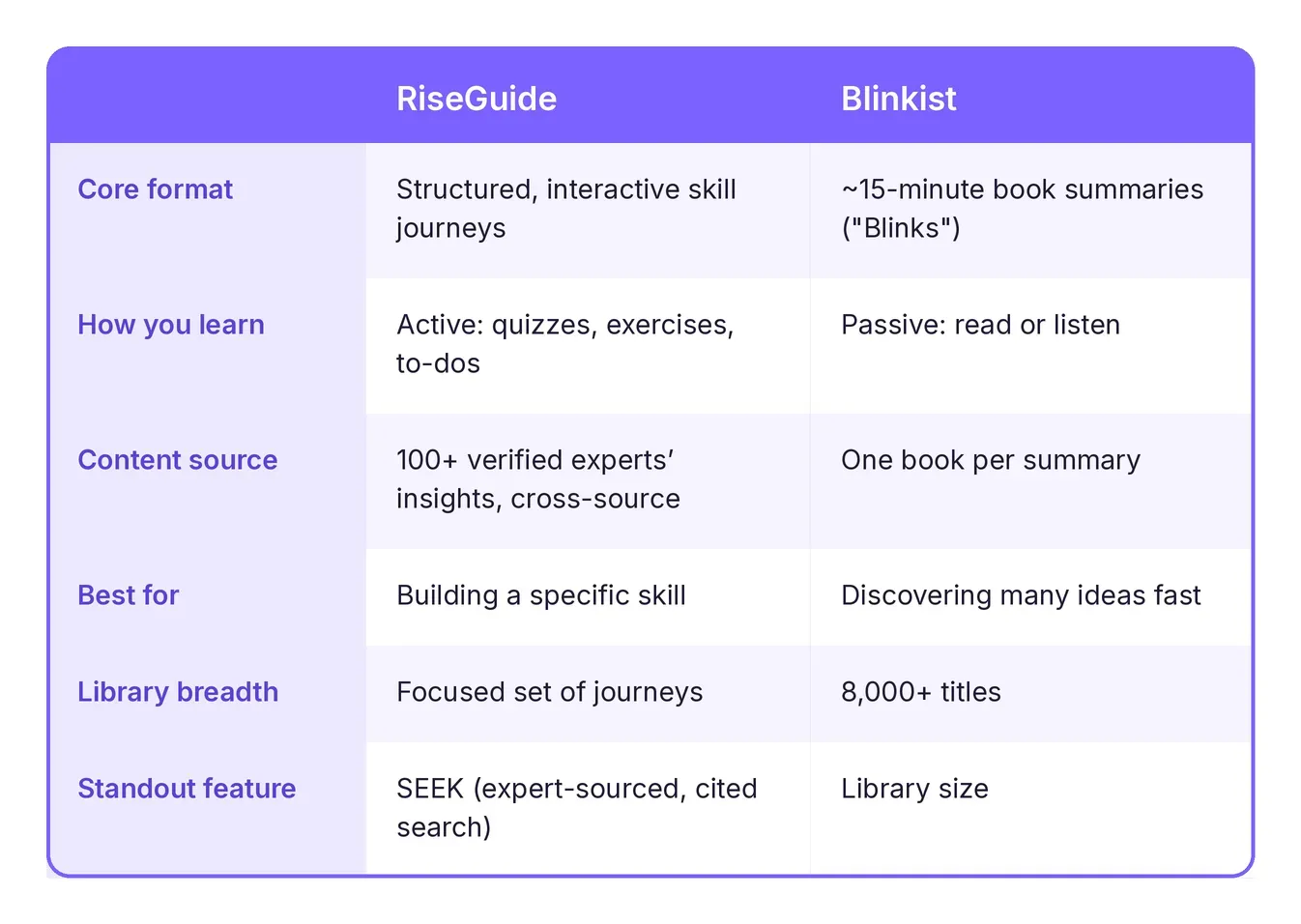
Blinkist gives you broad exposure to a lot of books in very little time. If your goal is to browse across many ideas and decide what's worth a deeper look, it's hard to beat. RiseGuide is narrower on purpose. Instead of summarizing a single book, it builds a structured journey on one skill from the insights of experts who've studied it, with exercises that turn each lesson into something you actually do. If you want to discover ideas, Blinkist. If you want to build a specific skill, especially communication, RiseGuide.
There are two honest ways to learn something faster than reading the whole book. You can read a tight summary of it, or you can work through a short course that makes you practice the skill until you’re natural. Blinkist is the best-known name in the first camp. RiseGuide sits in the second. Most comparisons online line Blinkist up against other summary apps, which tells you which summary tool to pick but never answers the question underneath: do you want to learn the idea, or do you want to learn a skill?
That's the the difference between these two, and it's what post is built around. Both are good at what they set out to do, they just set out to do different things.
This is the most common complaint people have about self-education: you finish a book, feel sharper for a week, then can't recall a single framework a month later. And the solution is in the way the material is delivered and whether you ever use it.
Blinkist's answer is compression. It distills a book into a roughly 15-minute "Blink" you can read or listen to, so you cover more ground and meet more ideas. That breadth is its strength. The limit is that a summary is still something you consume and put down. Hearing a clear explanation of an idea feels like learning, but recognition isn't the same as recall, and neither is the same as being able to apply it under pressure.
The research on this is fairly settled. A large analysis of studies across science teaching found that students in passive lecture formats failed at about 1.5 times the rate of those in active-learning settings, where people had to work with the material rather than just take it in.
"The results raise questions about the continued use of traditional lecturing as a control in research studies, and support active learning as the preferred, empirically validated teaching practice." — Freeman et al., Proceedings of the National Academy of Sciences
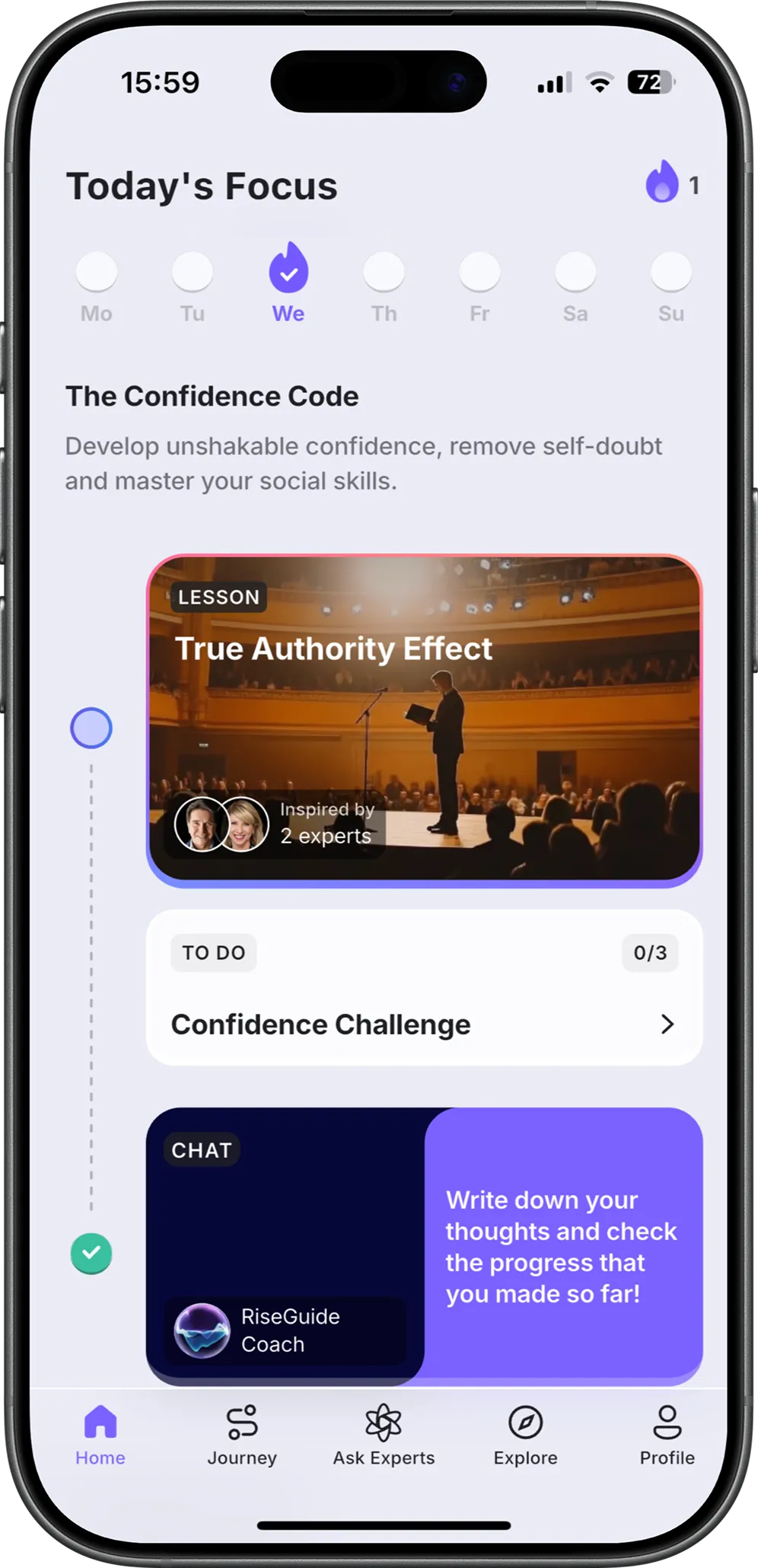
RiseGuide is built around that finding. A RiseGuide lesson is built from the insights of different experts on the topic, and it asks you to do something with them: a quiz, a to-do, a short exercise tied to your own life. The point is to make one idea stick by having you act on it. Spacing those lessons out over days, rather than cramming them, is also closer to how memory actually forms.
So the two formats are doing different jobs. A summary is built to get an idea in front of you quickly. An interactive lesson is built to make you work with it. Which one helps more depends on whether your problem right now is finding ideas or applying one you already have.
Communication is where the difference between the two stops being abstract. "Improve your communication" isn't information you're missing. You already know you should tell better stories, manage your nerves, and read the room. Knowing it has never been the hard part.
On Blinkist, communication shows up as summaries of the popular books on the topic, scattered across the library. You can absorb the big argument of each one in 15 minutes. What you can't do is practice. A summary of a book on public speaking won't tell you whether your own pacing is too fast or your filler words are creeping back in.
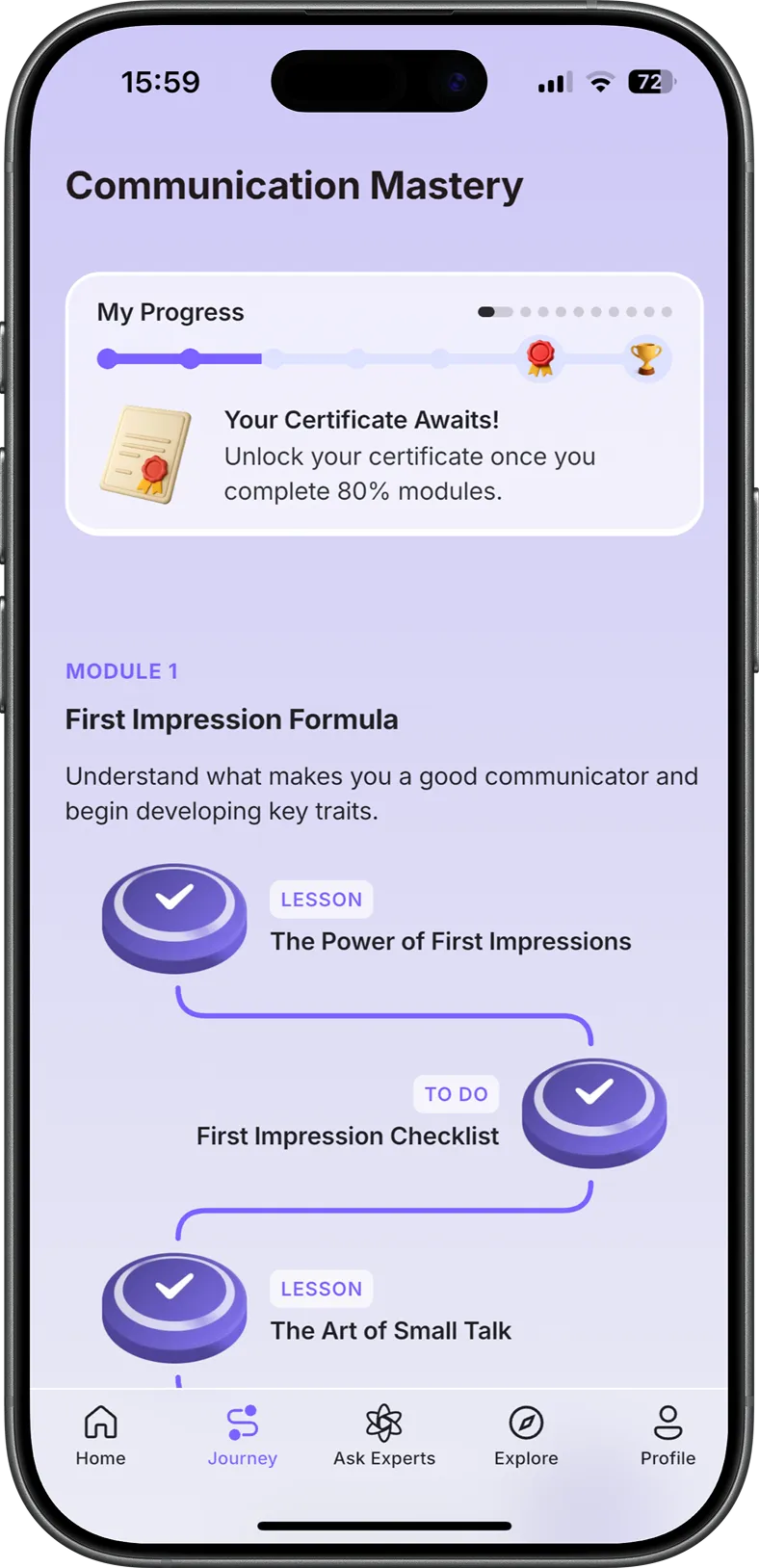
RiseGuide's Communication Mastery journey is designed around the practice, not the theory. It covers speaking, body language, voice control, storytelling, first impressions, and social intelligence as a sequence you work through, with exercises after each lesson. The content is pulled from verified expert sources rather than one author's single book, so you're learning the through-line across many people who've studied this, not just one argument. So the two approaches fit different moments: a summary to get the gist of a communication book, a journey when you want to actually practice the thing.
If communication is the skill you most want to fix, that's the natural place to start. You can begin the Communication Mastery journey here and see whether the practice-first format clicks for you.
Blinkist is the right pick if you read to discover. If you like sampling a dozen books before committing to one, want a steady feed of new ideas during a commute, or treat summaries as a filter for what to read in full, it does that better than RiseGuide and isn't trying to do anything else. It has a deep library of 8,000-plus titles, strong audio, offline access, and a brand people already trust.
If your honest answer to "what do I want from this" is broad exposure to a lot of thinking, Blinkist is the better tool. There's no need to overcomplicate that.
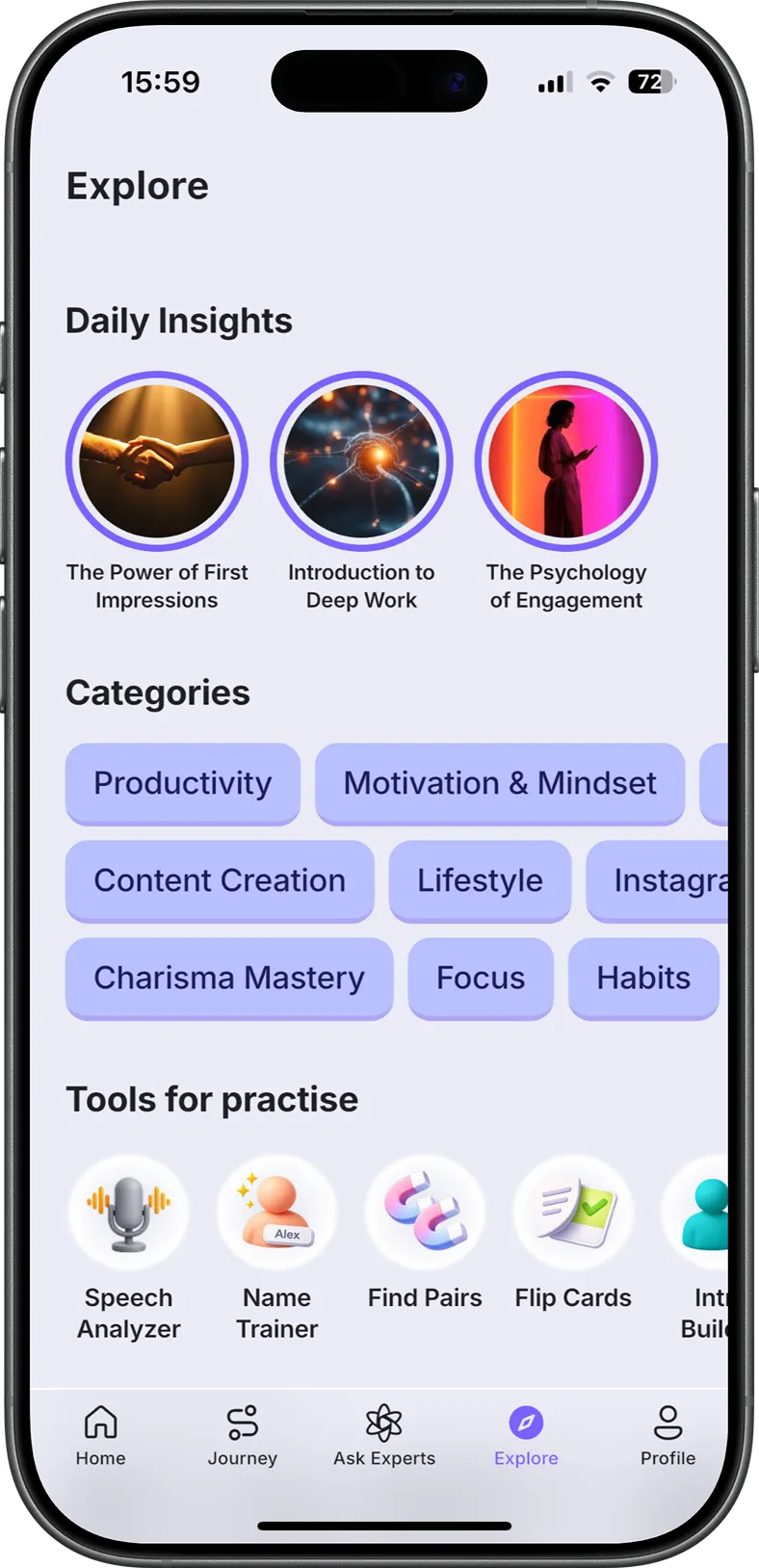
RiseGuide is the better fit if you've already got plenty of ideas and what's missing is follow-through. People who want to build one skill rather than browse many, who've read the books and still don't feel different, and who specifically want to get better at communication will get more out of the structured-journey format. The app pulls from over 100 experts, distilling thousands of hours of their work into 15-minute lessons that are interactive by design.
There's also SEEK, a search engine that answers your questions only from a verified database of expert sources, with citations back to the original. In a stretch where most tools generate plausible-sounding text from anywhere, having answers tied to named, checkable experts is a different proposition.
Blinkist and RiseGuide are built at different scales, and that's the point of each. Blinkist is a broad catalogue you can browse across. RiseGuide is a set of focused journeys that take one skill and go all the way through it. Which scale suits you is just a question of what you're after.
It all comes back to the question from the top. If you want to know more, Blinkist will get you there with less friction and a far bigger library. If your aim is to know more, Blinkist covers far more ground with less friction. If your aim is to practice one thing until it changes how you act, that's what the journey format is built for. Both are reasonable things to want, and a lot of people want both at different times.