RiseGuide Team

To break bad habits, work with the way the habit runs instead of leaning on willpower. Find the cue and the reward that keep it going, change your environment so the cue is harder to hit, replace the old routine with a new action that gives you a similar payoff, add friction that makes the habit slower to start, write a specific if-then plan for the moment you're tempted, and treat the occasional slip as information rather than failure. Do those six things for one habit at a time, and it gets weaker while the replacement gets stronger.
A bad habit is usually a behavior your brain has repeated so many times that it now runs on autopilot, often to get a small reward like relief, comfort, or a quick bit of stimulation. That's why breaking bad habits through sheer willpower rarely lasts: you're fighting a routine your brain treats as the easy default. Learning how to break bad habits, or how to get rid of bad habits for good, is really about working with that wiring instead of against it, and the steps here walk through how to do that.
Two things make a bad habit stubborn, and understanding both is what makes the rest of this easier. Knowing why turns the problem from "I have no self-control" into something you can actually work on.
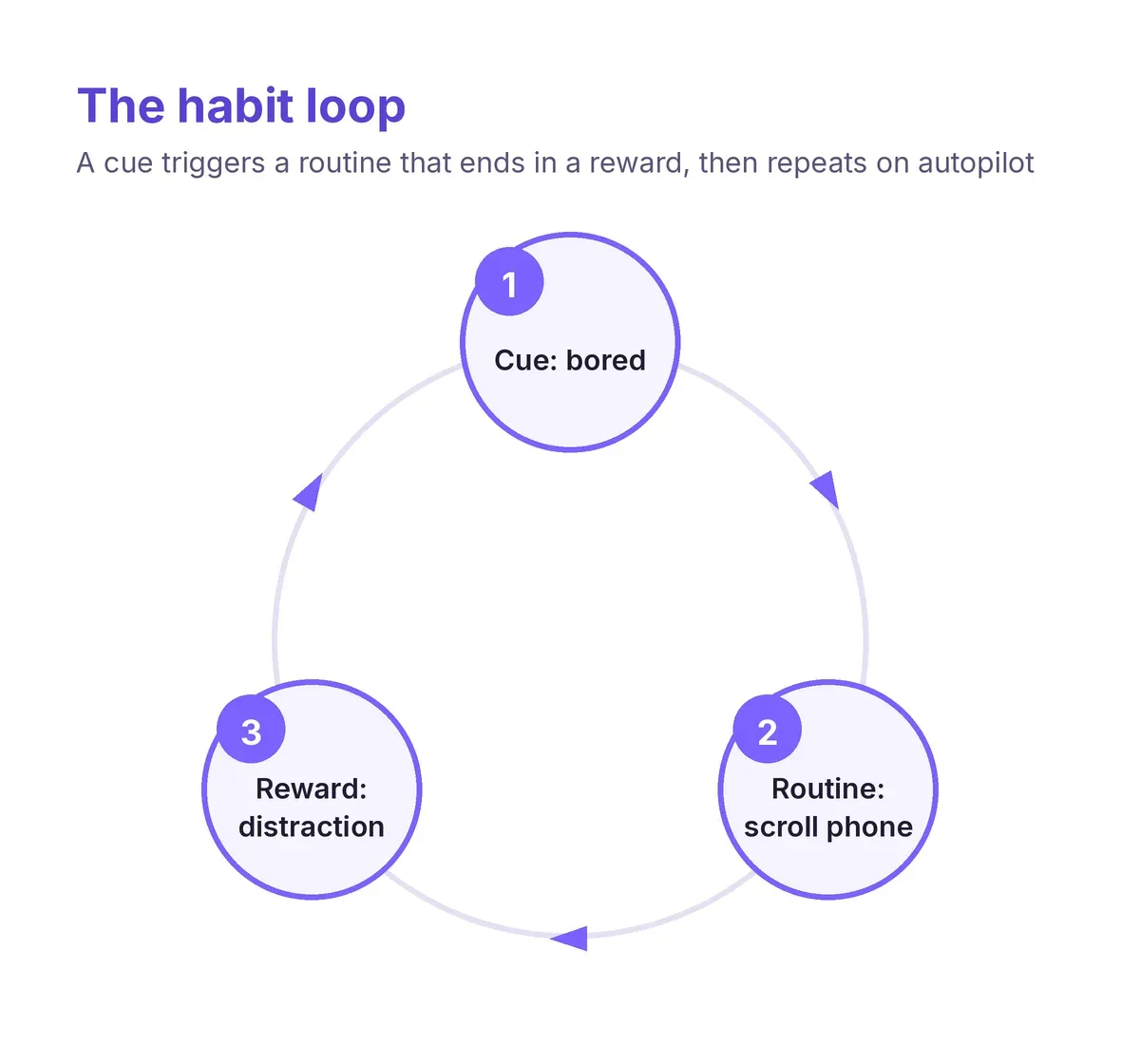
The first is that your brain automates repeated behavior. Charles Duhigg described the pattern as a habit loop in his book The Power of Habit: a cue triggers a routine, and the routine ends in a reward. After enough repetitions, the cue alone sets the routine going before you've decided anything. You reach for your phone the second you feel bored; you open the snack cupboard the moment you walk into the kitchen. The behavior stops feeling like a choice and starts feeling like a reflex.
The second reason is that the reward is real. A bad habit sticks around because it does something for you in the moment — it eases stress, fills an awkward silence, or breaks up a dull stretch of time. If you only try to remove the behavior, you're left with the craving and nothing to answer it, so you slide back. That's also why the same slip tends to happen at the same time of day.
Here is how to break a bad habit in a way that works with your brain instead of against it. The order matters: start by understanding the loop, then change the pieces around it. Pick one habit to begin with, because spreading your attention across five at once is the quickest way to keep all five.
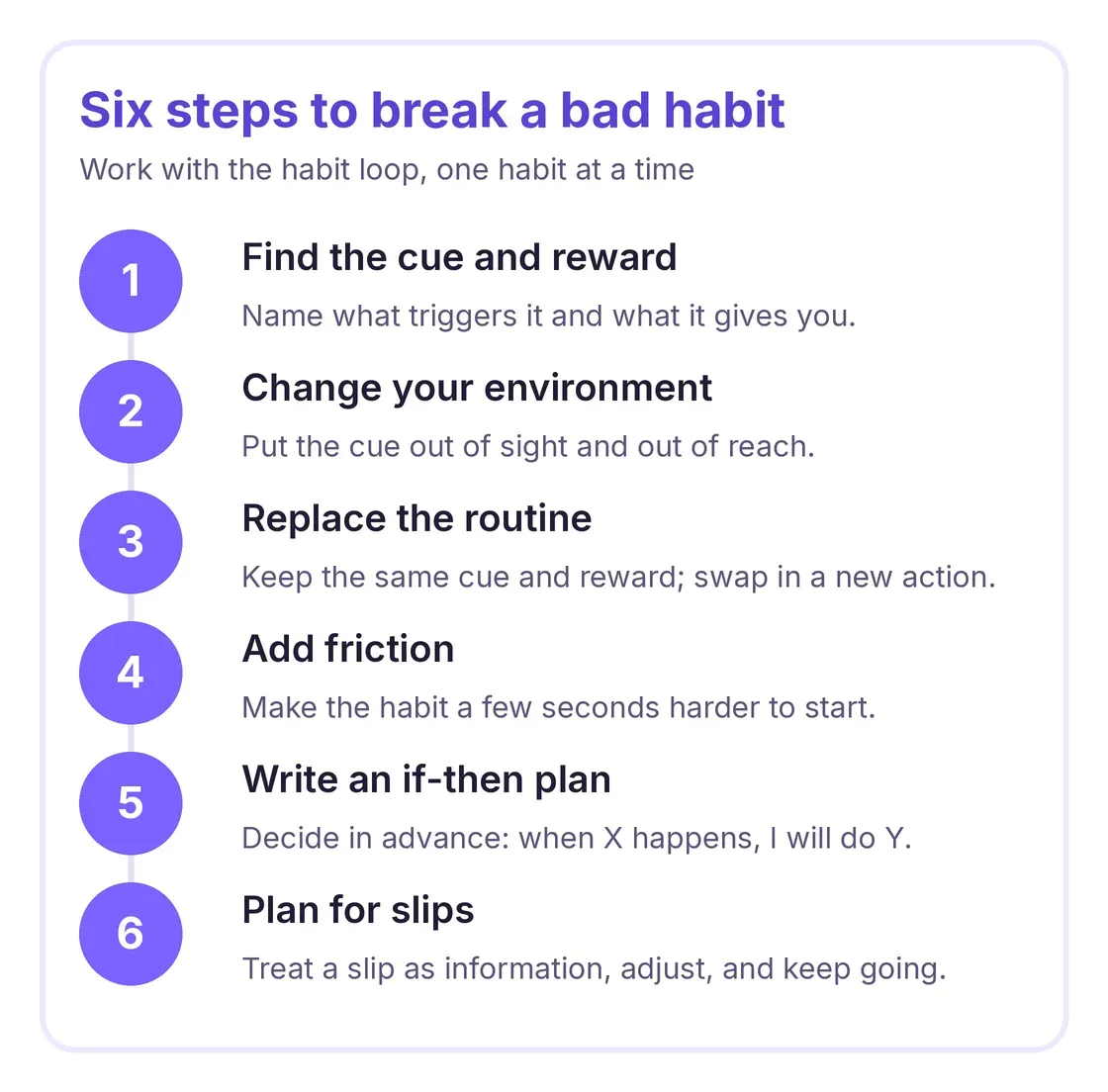
Before you change anything, watch the habit for a few days like a curious observer instead of a judge. Each time it happens, note what came right before it and what you got out of it. Cues usually fall into a handful of types: a time of day, a place, a feeling, the people around you, or the action you just finished. The reward is whatever the habit gives you — calm, energy, company, or a break from something boring.
Once you can name the cue and the reward, you know what any replacement has to deliver. A habit you can describe in one sentence ("when I feel stressed at work, I check my phone to get a short break") is much easier to change than a vague sense that you're "always on your phone."
You don't have to rely on discipline if the cue never shows up. James Clear, in Atomic Habits, points out that the space around you shapes a lot of your behavior, which is why he writes, "You do not rise to the level of your goals. You fall to the level of your systems." Set up your systems so the bad habit is out of sight and out of reach.
If you snack when the cookies are on the counter, move them to a high shelf or stop buying them. If you scroll in bed, charge your phone in another room. Each small change removes a cue, and a cue you never meet is a routine you never run.
This step is the one that's easiest to skip. Keep the same cue and aim for the same reward, but put a new routine in the middle. If your phone habit is really about taking a break, plan a different break you can take at that cue — stand up and stretch, refill your water, or trade the scroll for a chapter of one of these productivity books.
Add a few seconds of effort between the cue and the routine. Log out of the app after each use, delete it from your home screen, unplug the TV, or leave your card at home when you're trying to cut back on spending. None of these make the habit impossible; they add just enough friction that you get a moment to choose. Where step 2 hides the cue, this step slows the routine.
Decide in advance exactly what you'll do when the cue shows up, in the form "when X happens, I will do Y." Psychologists call these implementation intentions, and they work because you've already made the decision before the craving hits, so you're not negotiating with yourself in the moment. "When I sit down at my desk, I will put my phone in a drawer" beats "I'll try to use my phone less today." Make the plan specific to the cue you found in step 1.
You will slip, and that's part of the process. A slip is a single event; treating one missed day as a total collapse is what turns it into a week off. Notice which cue caught you, adjust the plan, and get back to the replacement routine the next time that cue comes around.
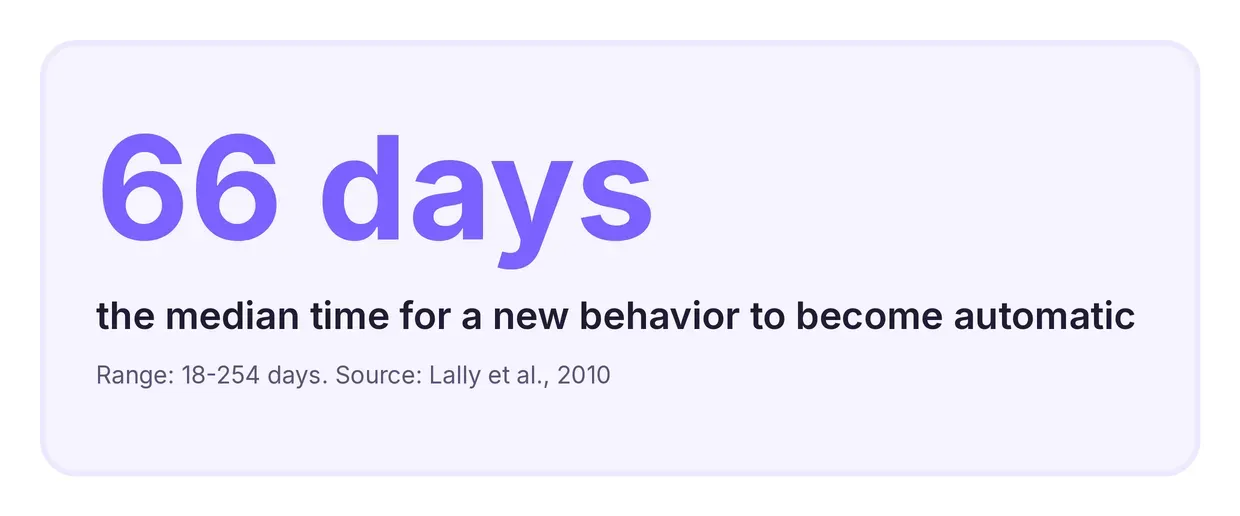
It also helps to be patient with the timeline. Change usually takes weeks, not days: in one often-cited study, it took a median of 66 days for a new behavior to become automatic, and people ranged from 18 to 254 days. Staying steady through the wobbly early weeks is its own skill. Juliann Wiese, a Master Certified Coach and one of our experts, writes about staying steady through setbacks:
"Every time you stay upright through a wobble instead of freezing or fleeing, you teach yourself that uncertainty is survivable."
Take one habit you want to change and run it through the six steps this week: name its cue and reward, remove the cue where you can, pick the replacement routine, add a little friction, write the if-then plan, and decide ahead of time how you'll handle the first slip. That's the core of how to stop bad habits for good — change the cue, swap the routine, and give the slips less power over what you do next.
Longer than the popular "21 days" line suggests, and it varies a lot from person to person. In the study above, new behaviors became automatic in a median of about two months, with a wide range depending on the habit and the person. Expect several weeks of steady practice, and judge your progress by how often you run the replacement routine, not by hitting a specific day count.
Common examples of bad habits people try to break are excessive phone or social media use, procrastination, mindless snacking, hitting snooze with a ragged sleep schedule, and nervous habits like nail-biting. They share the same structure — a clear cue, a quick reward — which is why the same six steps work across very different habits.
It depends on the habit and on you. Cold turkey can work when a habit has no safe smaller version and the cue is easy to cut out entirely. For most everyday habits, gradually replacing the routine tends to hold up better, because you keep the reward while changing the behavior instead of white-knuckling through the craving.
Sometimes, but it's harder. If you take the routine away and leave the cue and the craving in place, you'll feel the gap and often drift back. Giving the cue a new routine that delivers a similar reward is what makes the change stick.