RiseGuide Team

The best self improvement books are the ones that match what you actually want to change, so pick by problem rather than chasing a single "best" title. The 12 below, with who each is for:
If you only read one, start with Atomic Habits for practical change or Man's Search for Meaning for perspective.
There are a lot of self-help books out there, and it's hard to tell in advance which will actually help. Each book below has stayed useful for years, makes a specific point, and gives you something to do, not just something to feel. One good book you finish and act on beats ten you skim, so pick the area that feels most stuck right now, read that one, and try a single idea from it before moving on.
A book earns a spot on your shelf when it matches a real problem you have, not just a topic that sounds good. Before you pick one of these personal development books, get specific about what you want to be different in a month. More consistent mornings is a habits problem, speaking up at work is a confidence problem, and feeling pulled in ten directions is a focus problem. The right book is the one aimed at what you name.
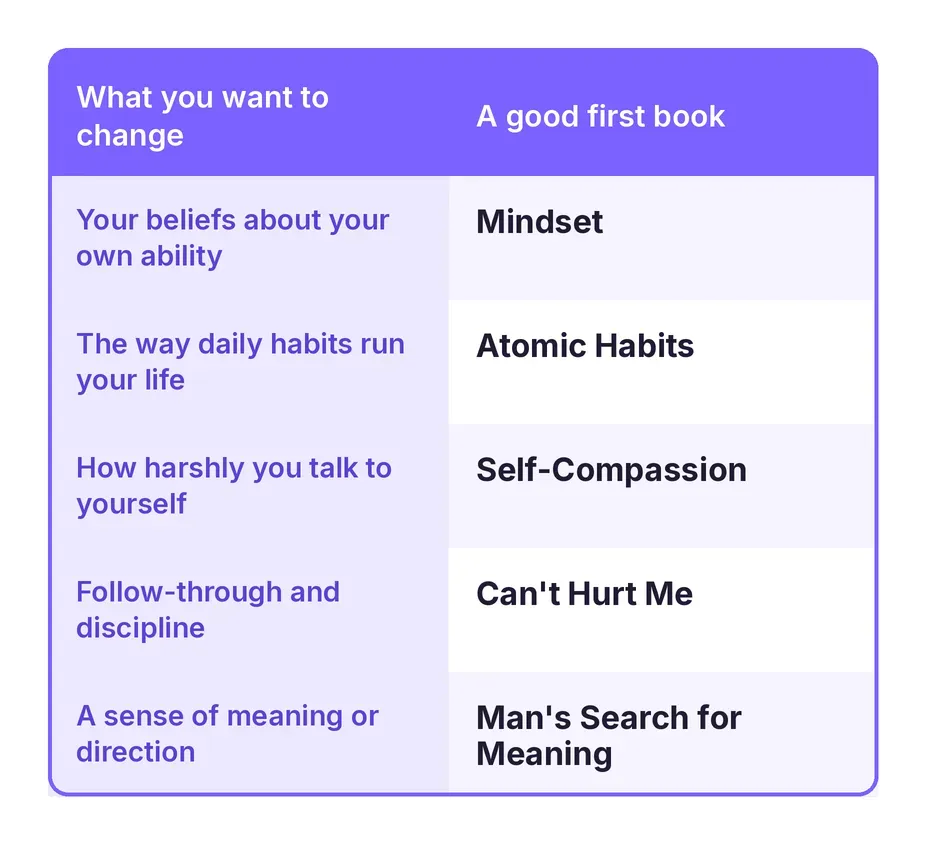
A lot of change starts with the story you tell yourself about what's possible and what things mean. These three books work on that layer.
Carol Dweck is a Stanford psychologist, and Mindset lays out her research on two ways of seeing ability. With a fixed mindset, you treat talent as set: you either have it or you don't. With a growth mindset, you treat ability as something you build through effort and practice. The distinction sounds small, but it changes how you handle a hard class, a setback at work, or feedback you didn't want to hear. Its practical core is simple: pay attention to effort and strategy, not just results, and treat "I can't do this" as "I can't do this yet."
"Becoming is better than being." — Carol Dweck, Mindset
Best for: anyone who avoids things they're not immediately good at.
Worth knowing: the core idea is simple and gets repeated; the value is in applying it, not in new information later in the book.
Don Miguel Ruiz draws on Toltec teaching to offer four commitments that cut down a lot of daily suffering: be impeccable with your word, don't take anything personally, don't make assumptions, and always do your best. It's a short book with a calm tone, and it works well if you replay conversations, read into what people meant, or hold yourself to a running commentary of criticism.
"Be impeccable with your word." — Don Miguel Ruiz, The Four Agreements
Best for: overthinkers who take things personally and read into what others meant.
Worth knowing: it's framed in Toltec spirituality and light on step-by-step method, so it lands more as a mindset shift than a program.
Meditations wasn't written to be published. It's the private notebook of a Roman emperor reminding himself how to live, which is part of why it still reads as honest almost two thousand years later. The through-line is Stoic: separate what you control from what you don't, and put your energy only into the first. It's a book to keep nearby and reread a page at a time rather than finish in a weekend.
Best for: readers who want a Stoic touchstone to return to a page at a time.
Worth knowing: it's a translated personal notebook, so it's repetitive and non-linear; the reading experience depends a lot on which modern translation you pick.
Knowing what to do is the easy part; changing your daily behavior is where growth shows up. These two books explain how habits form and how to change them without relying on willpower.
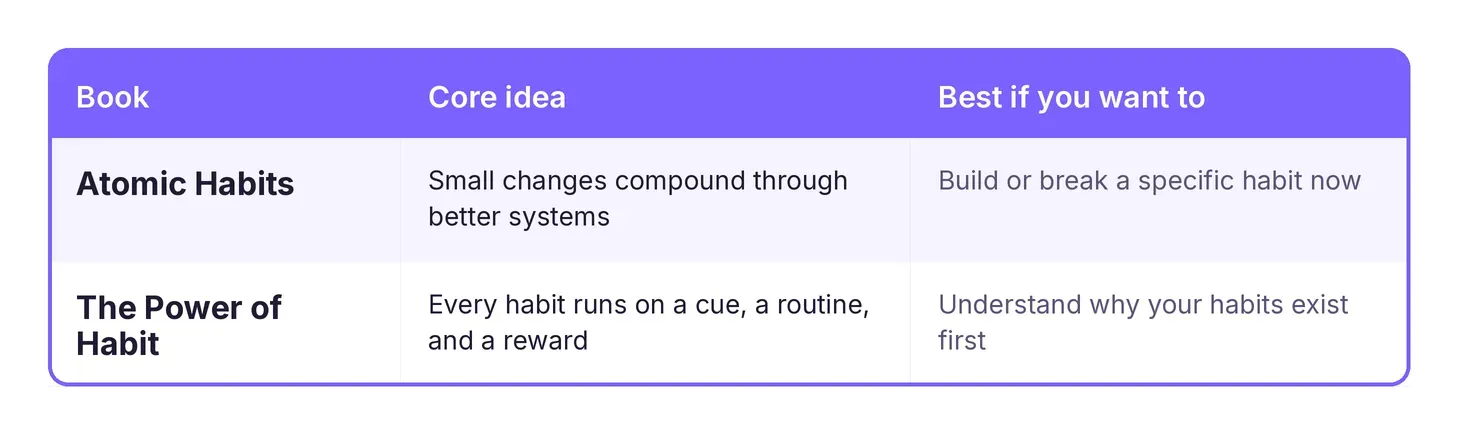
Atomic Habits is the most practical book on this list, and the one most people should read first if they want a concrete change. James Clear's argument is that small habits compound: a 1% improvement repeated daily adds up far more than the occasional big push. He gives you specific levers — make a habit obvious, easy, and satisfying; stack a new habit onto one you already do; shape your environment so the good choice is the default.
"You do not rise to the level of your goals. You fall to the level of your systems." — James Clear, Atomic Habits
Best for: anyone who wants a start-today method for building or breaking one habit.
Worth knowing: it's method over story; if you want the science of why habits form, pair it with The Power of Habit.
Where Clear tells you what to do, Charles Duhigg explains why habits have such a grip on you. The Power of Habit breaks every habit into a loop of cue, routine, and reward, then shows how to keep the cue and reward while swapping the routine for something better. It leans on stories and research, so it's a good pick if you want to understand your own patterns before you try to change them.
"Change might not be fast and it isn't always easy. But with time and effort, almost any habit can be reshaped." — Charles Duhigg, The Power of Habit
Best for: readers who want to understand why a habit sticks before trying to change it.
Worth knowing: it's more explanation than instruction, and some of the business case studies run long.
 If you want to turn a book's ideas into daily reps instead of notes you forget, a short daily practice helps. RiseGuide's bite-size journeys are built for that: a few minutes a day on one skill at a time, drawn from the same kind of expert thinking these books come from. For getting things done specifically, our roundup of the best productivity books goes deeper than this general list can.
Some of the most useful self help books help by easing the pressure you put on yourself, so you have enough goodwill left to keep going. These three work on self-worth.
Brené Brown is a research professor who spent years studying shame and vulnerability, and The Gifts of Imperfection turns that research toward everyday self-worth. Her point is that you can stop earning your worth through achievement and start treating it as a given. The book is warm and grounded, and it fits anyone who ties their value to being productive, liked, or perfect.
"Owning our story and loving ourselves through that process is the bravest thing that we'll ever do." — Brené Brown, The Gifts of Imperfection
Best for: people who tie their worth to being productive, liked, or perfect.
Worth knowing: it's reflective rather than a step-by-step program, so you supply the follow-through.
This one is older, but it remains the most complete book on self-esteem, which is why it's still recommended decades later. Psychologist Nathaniel Branden argues that real self-esteem comes from practice, not affirmations, and names six of them: living consciously, self-acceptance, self-responsibility, self-assertiveness, living purposefully, and personal integrity.
Best for: readers who want a complete method they can work through, not a pep talk.
Worth knowing: it reads like a manual and is denser than a story, so it asks more of you as a reader.
Kristin Neff is a researcher who helped build the field of self-compassion, and this book is the clearest guide to it. Her case is that being kind to yourself works better than beating yourself up, and that self-criticism mostly keeps you stuck. She breaks self-compassion into three parts: treating yourself as you would a friend, remembering that struggle is part of being human, and staying honest about hard feelings without drowning in them.
Best for: anyone whose inner voice is harsher than anything they'd say out loud.
Worth knowing: the core idea repeats; the exercises do more of the work than the reading does.
Motivation comes and goes. These two books are about doing the work anyway — one through sheer grit, one through understanding what stops you.
David Goggins went from an overweight, struggling young man to one of the toughest endurance athletes alive, and Can't Hurt Me is his account of how. It's a hard, direct memoir about pushing past what you think is your limit — his "40% rule" says most of us stop when we've used only a fraction of what we've got.
"The most important conversations you'll ever have are the ones you'll have with yourself." — David Goggins, Can't Hurt Me
Best for: when you want a push rather than comfort.
Worth knowing: it's intense and blunt and describes real hardship, so the tone won't suit every reader.
Steven Pressfield gives a name to the force that stops you from doing your work: Resistance. The War of Art is a short, sharp book about why you procrastinate on the things that matter most, and why showing up daily beats waiting to feel inspired.
"The most important thing about art is to work. Nothing else matters except sitting down every day and trying." — Steven Pressfield, The War of Art
Best for: anyone with a project they keep not starting — a business, a book, a habit.
Worth knowing: it names the problem more than it hands you a system, so it motivates more than it instructs.
The books here work on the widest layer: why you're doing any of this, and how to carry a quieter mind through it.
Viktor Frankl was a psychiatrist who survived Nazi concentration camps, and this book is both his account of that and the therapy he built from it. His central finding is that people can endure almost anything if they have a reason — that meaning, not comfort, is what keeps us going. It's brief, serious, and one of the few books that changes how readers see their own troubles.
"When we are no longer able to change a situation, we are challenged to change ourselves." — Viktor Frankl, Man's Search for Meaning
Best for: perspective on hardship and a sense of direction.
Worth knowing: the first half describes life in the camps, so it's heavier reading than a typical self-help book, though it's short.
Michael Singer's book is about the voice in your head, the constant inner commentary, and the difference between having thoughts and being run by them. The Untethered Soul teaches you to notice that voice, step back from it, and stop treating every worry as an order. Juliann Wiese, a Master Certified Coach and one of our experts, covers a related idea in her piece on resilience in uncertainty.
"There is nothing more important to true growth than realizing that you are not the voice of the mind — you are the one who hears it." — Michael A. Singer, The Untethered Soul
Best for: overthinkers who want a calmer relationship with their own mind.
Worth knowing: it gets spiritual in places and is light on concrete exercises.
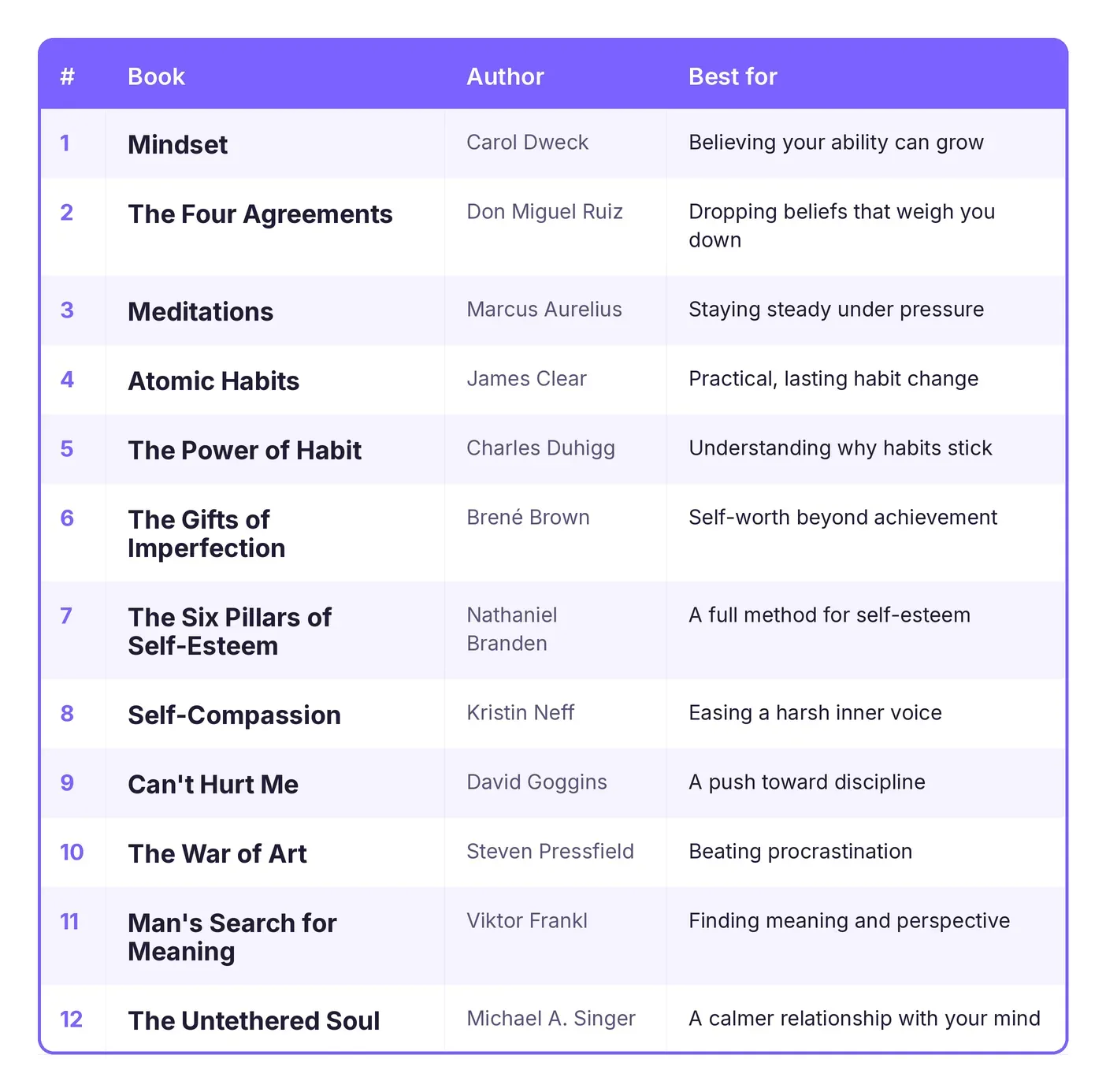
Don't try to read all twelve at once. Pick the group that matches what feels stuck right now, read one book, and act on a single idea from it before you pick up the next. If you want research and a clear method, start with Mindset or Atomic Habits; if you want a story that shifts how you see things, start with Man's Search for Meaning or The Gifts of Imperfection. What you get from these best books for personal growth depends on what you do with them, not how many you read. If you'd rather work on a skill a few minutes a day than only read about it, our self-improvement apps roundup is a good next stop.
If you want a short starting shortlist, Atomic Habits for changing what you do, Mindset for how you think about ability, and Man's Search for Meaning for perspective cover the most ground between them. From there, add the book that matches your next goal.
There isn't one book that works best for everyone, because "effective" depends on the problem you're solving. For building habits and making concrete change, Atomic Habits is the most widely recommended and the easiest to apply. For a shift in outlook, Man's Search for Meaning tends to stay with readers longest.
The strongest best self improvement books usually pair one book on mindset with one on habits, since how you think and what you do daily are the two levers with the most reach. Mindset plus Atomic Habits is a good starter pair; add Self-Compassion if self-criticism is what holds you back.
Among life changing books, Man's Search for Meaning is the one readers name most often, because it reframes hardship rather than just offering tips. It's short, and its impact tends to outlast the time it takes to read.