RiseGuide Team

The best productivity books are the ones that match the specific problem you're having, so pick by problem rather than by ranking:
If you want one place to start: Atomic Habits if you know what you want to change and can't stay consistent, Deep Work if your attention is the bottleneck, and Four Thousand Weeks if you've already tried systems and the pressure only grew.
Productivity books answer different questions, even though they share a shelf. One set is about starting and repeating a behavior. Another is about holding attention long enough to do difficult work. A third is about choosing what deserves your hours in the first place. And a newer group argues that the volume of work is the problem, and no system will fix a workload that has no ceiling.
That's why a list ordered from best to worst isn't much use. A book about protecting focus won't help someone who already focuses well and has simply agreed to too much. The 12 books below are grouped by the problem each one addresses, so you can go to the group that describes your week.
Start from the friction, not the bestseller list. Ask what breaks down first on a normal day: getting started, staying on one thing, deciding between competing priorities, or keeping up with the sheer amount coming in. Each of those has a book written specifically about it, and reading the wrong one feels like good advice that doesn't apply.
Then read one at a time and take a single practice from it. Most of these books contain one named method - habit stacking, the daily Highlight, the ABCDE list - and that method is the part that changes anything. Knowledge compounds through repetition rather than volume, which is the case we made in our post on the reading habit that builds wisdom. Finishing three books and applying nothing leaves you where you started.
One practical note on editions: several of these have been revised, and the revisions matter. Getting Things Done was rewritten in 2015, Eat That Frog! reached its fourth edition in 2025, and Indistractable was updated in 2025 with material on remote work.
These three cover the mechanics of doing something repeatedly, and the specific problem of not starting at all.
Clear's argument is that outcomes are lagging measures of habits, so you build systems instead of chasing goals, and you change behavior by changing identity rather than targets. The mechanism is a four-part loop of cue, craving, response and reward, which he turns into the four laws of behavior change: make it obvious, make it attractive, make it easy, make it satisfying. To break a habit you invert each one.
The most-used practice in the book is habit stacking, which attaches a new behavior to one you already do without thinking: "After [current habit], I will [new habit]." Alongside it sits the two-minute rule, where you shrink a new habit down to a version that takes under two minutes so the starting cost disappears. We looked at the systems-over-goals argument in more depth in our piece on James Clear on habit formation.
"You do not rise to the level of your goals. You fall to the level of your systems." - James Clear, Atomic Habits
Best for: people who know exactly what they want to change and keep losing consistency. It's the most operational book on this list, with formulas and short chapters, and more than 25 million copies in print as of 2025.
Worth knowing: the four laws work best on small, repeatable behaviors. Where a habit is anchored in stress or a life circumstance rather than a missing cue, environment design alone won't move it.
Duhigg reports on the same loop from a different angle: cue, routine, reward, reinforced over time by craving. Because habits are encoded rather than deleted, his golden rule of habit change is substitution - hold the cue and the reward steady, and swap the routine in the middle. He then widens the lens to keystone habits, the small number of behaviors that pull others along with them, and to how habits work inside companies and movements.
The appendix gives the practical version: identify the routine, experiment with rewards, isolate the cue, have a plan. The reward-experiment step is the distinctive one, since you test different rewards after the same cue and note which actually ends the craving.
"There is, unfortunately, no specific set of steps guaranteed to work for every person." - Charles Duhigg, The Power of Habit
Best for: readers who want to understand the machinery before they change anything, and anyone thinking about habits at team or organizational scale rather than personal routine.
Worth knowing: this is journalism first. The stories are memorable and the instructions are thin, so it pairs well with a more procedural book rather than standing in for one.
Tracy's premise is a single discipline: identify the largest and most avoided task on your list, do it first thing in the morning, and stay on it until it's finished. Priorities run on his ABCDE method - label every task A for serious consequences, B for mild ones, C for none, D for delegate and E for eliminate, then number the A tasks and work them in order.
The rule that carries the method is that you never touch a B while an A is unfinished. At around 140 pages it can be read in a sitting, and the fourth edition added a chapter on habit formation.
"In reality, your 'frog' is your biggest, most important task. It is the one you are most likely to procrastinate on if you don't do something about it." - Brian Tracy, Eat That Frog!
Best for: procrastinators who want a short, blunt manual rather than a theory of work - students, new managers and self-employed people setting up a first system.
Worth knowing: it's repetitive by design, and it synthesizes established time-management thinking rather than citing research. It also assumes you decide the shape of your own morning.
Attention is a separate problem from consistency, and these three treat it that way - one builds the capacity, one removes the pull, and one redesigns the day around a single priority.
Newport splits knowledge work into deep work, which he defines as professional activity performed in distraction-free concentration that pushes your cognitive limits, and shallow work, the logistical tasks you can do while distracted. His hypothesis is that the ability to concentrate is becoming rarer at the same time it's becoming more valuable, which makes it a career advantage. The book runs on four rules: work deeply, embrace boredom, quit social media, drain the shallows.
The most transferable practice is the shutdown ritual. At the end of the workday you capture loose tasks, read through your lists, look at the next two weeks of calendar, sketch tomorrow's plan, and then say a fixed phrase to mark the end. After that, work thoughts get declined rather than argued with. Our post on Cal Newport on deep work goes through the four scheduling philosophies and the environment setup.
"To produce at your peak level you need to work for extended periods with full concentration on a single task free from distraction." - Cal Newport, Deep Work
Best for: writers, engineers, researchers, analysts and founders whose results depend on hard thinking, and who have some say over their calendar.
Worth knowing: roughly the first half is the argument rather than the method, and the recommendations assume a degree of scheduling freedom. If your role is the interruptions - support, operations, frontline management - the rules need heavy adaptation.
Eyal locates distraction in internal discomfort rather than in technology, so the fix starts one layer earlier than app blockers. His organizing distinction is traction, action that moves you toward what you want, against distraction, action that moves you away from it. The book then works through four parts: master internal triggers, make time for traction, hack back external triggers, and prevent distraction with pacts. Part two replaces the to-do list with timeboxing, where your values become a fully scheduled calendar.
The named practice worth stealing is the ten-minute rule. When the urge to check something arrives, you agree that you may give in, but only after ten minutes of sitting with the discomfort and observing it. Most urges don't survive the wait.
"The antidote to impulsiveness is forethought." - Nir Eyal, Indistractable
Best for: people who already own the basics and keep relapsing into phone and inbox checking, and who want a psychological explanation rather than an abstinence plan.
Worth knowing: the book puts the responsibility on the user and says relatively little about how products are deliberately designed to be habit-forming, which is a criticism Eyal has faced directly.
Knapp and Zeratsky name two forces that consume a day: the Busy Bandwagon, meaning reactive overwork, and Infinity Pools, meaning apps and feeds that never run out. Against them they offer a four-part daily loop - Highlight, Laser, Energize, Reflect. You choose one priority, protect it from distraction, use your body to hold energy, then note what worked and adjust tomorrow.
It's deliberately a menu rather than a program. The book supplies more than 80 small tactics and tells you to keep only the handful that fit you. The core move is picking a daily Highlight, one task of roughly 60 to 90 minutes, chosen by urgency, satisfaction or joy, then writing it down and blocking it in the calendar.
"If, at the end of the day, someone asks you, 'What was the highlight of your day?' what do you want your answer to be?" - Jake Knapp and John Zeratsky, Make Time
Best for: readers who have bounced off rigid methodologies and want small environmental changes they can adopt one at a time.
Worth knowing: the tactics presume you can restructure your own working day, so shift workers and anyone whose schedule is set for them will find part of the book out of reach. The section on food and exercise is also lighter than the rest.
Reading about focus and building it are two different tasks. If the part you keep losing is the daily repetition, RiseGuide's micro-learning lessons are built from the insights of experts and run in short daily sessions with exercises, so the ideas get practiced rather than noted down and forgotten. It sits alongside the reading rather than replacing it. If you'd rather compare a few options first, we've covered the best microlearning apps. Or just start your journey with RiseGuide.
Focus doesn't help if you've committed to more than any week can hold. These three deal with the decisions upstream of the work.
Allen's premise is that the mind is poor storage, so every open commitment has to live outside your head in a system you trust. The revised edition names five steps: capture what has your attention, clarify what each item means, organize it where it belongs, reflect on it regularly, and engage. Clarifying always ends by defining a concrete physical next action, and the whole thing stays trustworthy through the weekly review.
The best-known piece is the two-minute rule, applied during the clarify step. It exists because there's a threshold below which tracking an item costs more than finishing it.
"If an action will take less than two minutes, it should be done at the moment it's defined." - David Allen, Getting Things Done
Best for: managers and knowledge workers taking in commitments from many directions at once, where the problem is volume and tracking rather than motivation.
Worth knowing: this is the heaviest setup on the list, and it needs real time before it pays back. Cal Newport's essay The Rise and Fall of Getting Things Done makes the sharpest counter-argument: a personal system helps you absorb unbounded incoming work without reducing it, so the overload tends to return.
McKeown contrasts two operating modes. The nonessentialist thinks everything is important and tries to do both; the essentialist accepts trade-offs and asks which few things really matter. The practice runs in three parts: explore, which means creating space to work out what counts, eliminate, which means cutting the trivial many with clear criteria and a well-made no, and execute, which means removing friction from the things that survived.
His decision tool is the 90 percent rule. Identify the single most important criterion for a choice, score the option out of 100, and if it lands below 90, treat the score as zero and decline. It exists to stop you accumulating a calendar full of 60s and 70s.
"The Way of the Essentialist involves doing less, but better, so you can make the highest possible contribution." - Greg McKeown, Essentialism
Best for: people whose success has produced more opportunities than they can absorb, and anyone who needs language and permission for declining things. It has sold more than two million copies.
Worth knowing: the advice assumes real authority over your own commitments, which junior or precarious employees often don't have. Reviewers also find the anecdotes repetitive relative to the length.
Covey's claim is that effectiveness comes from character and principles rather than from technique and image, and that change works from the inside out. The seven habits move along a maturity continuum: be proactive, begin with the end in mind and put first things first take you from dependence to independence; think win-win, seek first to understand and synergize handle interdependence; sharpen the saw renews the other six.
The habit that gets used most in productivity terms is the third, with its time management matrix. You sort commitments by urgency and importance, then deliberately grow the quadrant that's important but not urgent, planning weekly rather than daily. Habit two supplies the other well-known exercise, writing a personal mission statement you can hold decisions against.
"If you wait to be acted upon, you will be acted upon." - Stephen R. Covey, The 7 Habits of Highly Effective People
Best for: readers who want a foundation rather than tactics, and teams that need shared vocabulary for how they work together.
Worth knowing: it's long, abstract and heavy on its own terminology, and the principles are asserted as natural laws rather than evidenced. The corporate examples are visibly of their late-1980s moment. Note the author is Stephen R. Covey; the teen edition is by his son, Sean.
The newest group on this list questions the premise of the rest of it. All three argue that the amount of work, not your handling of it, is what needs changing.
An eighty-year life runs to roughly four thousand weeks, and Burkeman's argument is that most time management denies that limit. His efficiency trap explains why getting faster doesn't help: clearing more work reliably attracts more work, so the finish line moves. His alternative is a limit-embracing attitude, where you accept that you'll neglect most of what you could do and start choosing that neglect on purpose.
The appendix holds ten tools, and the most usable is the fixed-volume approach. You keep an open list of everything and a closed list capped at around ten items, and nothing new joins the closed list until something leaves it. The companion tool is to serialize, taking one significant project at a time through to completion.
"The more you try to manage your time with the goal of achieving a feeling of total control, and freedom from the inevitable constraints of being human, the more stressful, empty, and frustrating life gets." - Oliver Burkeman, Four Thousand Weeks
Best for: people who have already tried systems and found the treadmill only sped up, and anyone whose real problem is the guilt of unfinished work rather than a missing technique.
Worth knowing: it's a philosophical essay first and a manual second. Several reviewers found the diagnosis stronger than the practical advice, and if you want a procedure you'll find the last section light.
Newport names the thing most offices actually measure: pseudo-productivity, where visible busyness stands in for useful work because the real output is hard to quantify. His replacement rests on three principles - do fewer things, work at a natural pace, obsess over quality - and he argues them through the working lives of Galileo, Jane Austen, Georgia O'Keeffe and the writer John McPhee rather than through studies.
Two practices carry most of the weight. Cap your active projects at two or three and hold everything else in a documented list you pull from only when a slot opens. Then take your honest estimate of how long a project will take and double it.
"This philosophy rejects busyness, seeing overload as an obstacle to producing results that matter, not a badge of pride." - Cal Newport, Slow Productivity
Best for: academics, writers, consultants, freelancers and senior individual contributors with control over their own workload, plus managers deciding how much to load a team. It was named a best book of 2024 by the Economist and NPR.
Worth knowing: the autonomy assumption is the standard criticism, and it's fair. Reviewers in the Times and the Financial Times both noted that few employees, and fewer people with caring responsibilities, can set their own pace.
Abdaal inverts the discipline model and argues that feeling good causes productivity rather than rewarding it, since positive mood broadens thinking and keeps motivation going. The book is built in three parts of three. Energize covers the three energizers, play, power and people. Unblock covers the three causes of procrastination - unclear goals, missing courage and vagueness - with clarity, courage and concreteness against them. Sustain covers three routes into burnout and their antidotes.
The named tool is NICE goals, offered in place of SMART ones: near-term, input-based, controllable and energizing. Rather than committing to a yearly outcome, you commit to a short-horizon input you control and don't dread. The Play chapter adds a reframing question worth keeping - what would this look like if it were fun?
"An approach that focused on my wellbeing first, and used that wellbeing to drive my focus and motivation second." - Ali Abdaal, Feel-Good Productivity
Best for: students, early-career professionals and anyone who has bounced off grind-and-discipline advice. It's also the gentlest entry point if you've never read a productivity book.
Worth knowing: it synthesizes well-known psychology rather than adding new research, and readers who follow Abdaal's videos will recognize much of it. The vantage point of a self-employed creator shows in some of the advice.
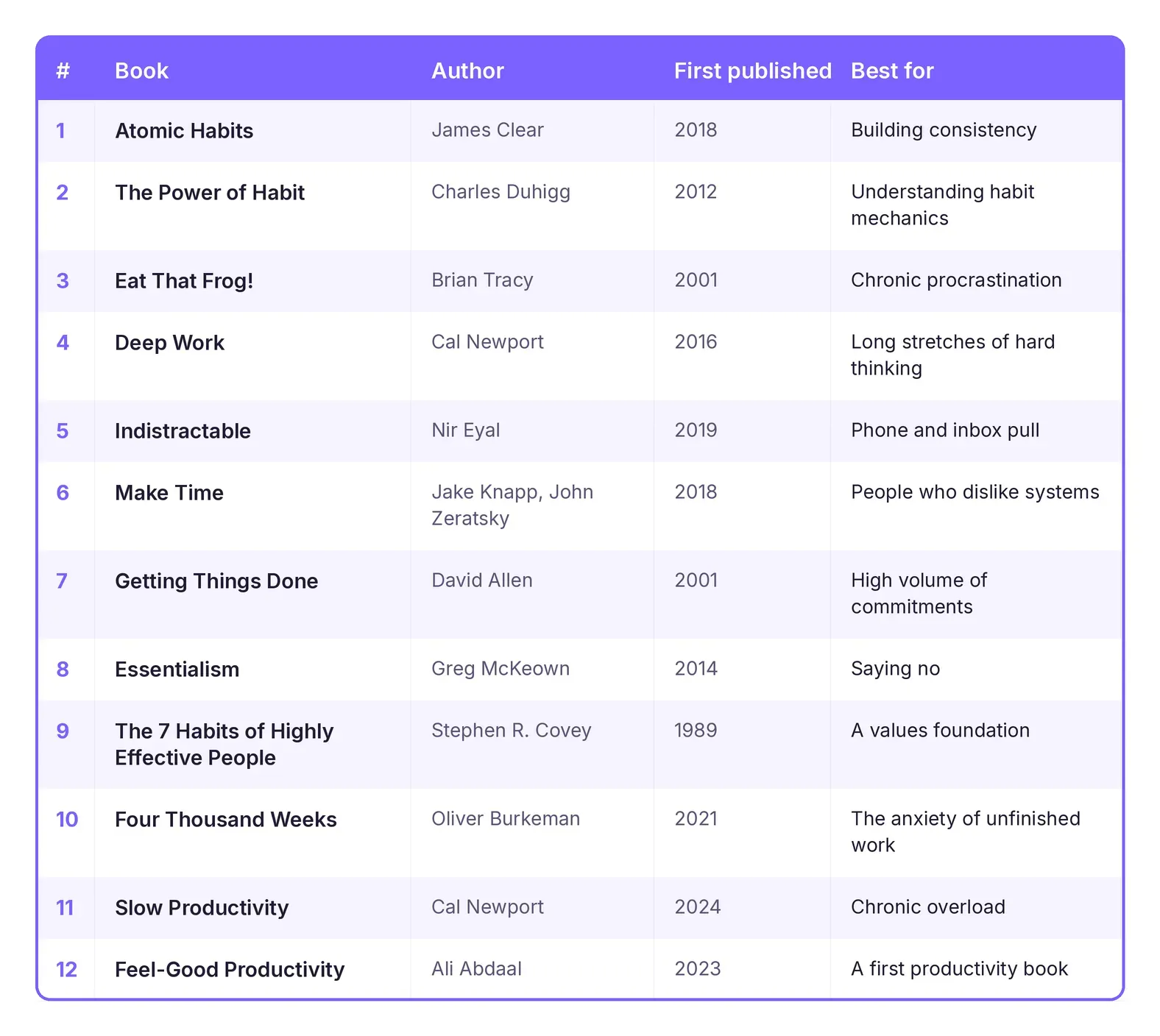
If you've never read one, start with Feel-Good Productivity or Atomic Habits. Both are structured, concrete and quick to apply, and they won't ask you to rebuild your working life before you see anything change.
If your days are already organized and your attention is the weak point, Deep Work explains why concentration is worth defending and Indistractable explains why you keep breaking it. Read them in that order. For a lighter version of the same territory, Make Time gives you one protected priority a day without a methodology attached.
If the problem is that too much is coming in, the choice depends on where the volume originates. Getting Things Done is the right answer when commitments arrive from many directions and nothing is being tracked. Essentialism is the right answer when you can see what's overloading you and can't decline it. And if you've tried both and the pressure kept rising, Four Thousand Weeks and Slow Productivity are the two books that question whether the workload was ever finishable.
Whichever you pick, retention is the part that decides whether reading was worth the hours. Explaining an idea in your own words is the most reliable test of whether you have it, which is the basis of the Feynman technique — a useful habit to run after each chapter of any of these.
Atomic Habits by James Clear is the most widely recommended and the easiest to act on, which makes it the safest single pick. It's the strongest choice if your difficulty is consistency. If your difficulty is concentration, Deep Work will do more for you, and if it's overcommitment, Essentialism will.
The two most useful recent titles are Slow Productivity (2024) and Feel-Good Productivity (2023), and both argue against the effort-and-discipline model that shaped the older classics. Among the best productivity books 2026 readers are still buying, the 2018 to 2021 group — Atomic Habits, Make Time, Four Thousand Weeks — holds up better than most of what's published each year.
They work when you extract one method and repeat it, and they don't when you read them for the feeling of progress. Every book here contains a named practice, and that practice is the entire return on the reading. Duhigg is honest about the limits of this, noting there's no set of steps guaranteed to work for every person, so expect to adapt rather than follow.
Eat That Frog! is the shortest and most direct answer, built around doing your largest task first and prioritizing with the ABCDE method. Indistractable is the better choice if procrastination shows up as reaching for your phone, since it treats the urge as discomfort avoidance rather than laziness. Feel-Good Productivity handles the version where the task feels heavy before you begin.