RiseGuide Team

To set a SMART goal, write it so it is Specific, Measurable, Achievable, Relevant, and Time-bound: say exactly what you'll do, attach a number so you can track it, keep it realistic for your time and resources, connect it to something you actually care about, and give it a deadline. So instead of "read more," you'd write "read one book a month for the next six months." The method works because clear, measurable goals tend to push you further than a vague "do your best," and it's easy to adjust: some people add an E and R for Evaluate and Reflect, and others switch to OKRs or WOOP when a goal is bigger or fuzzier.
Most goals fall apart at the wording stage. "Get fit," "save money," "be a better manager" all sound fine, but none of them tell you what to do on Monday morning or how you'd know you succeeded. That's the problem SMART goals were made to fix. SMART is an acronym: each letter is a test your goal has to pass before you commit to it. Run a fuzzy intention through those five checks and you end up with something concrete enough to act on and clear enough to measure.
The idea comes from management, but it works just as well for personal plans, from health and money to learning a new skill. Below is what each letter means, examples you can copy, a simple way to write your own, and an honest look at where SMART falls short.
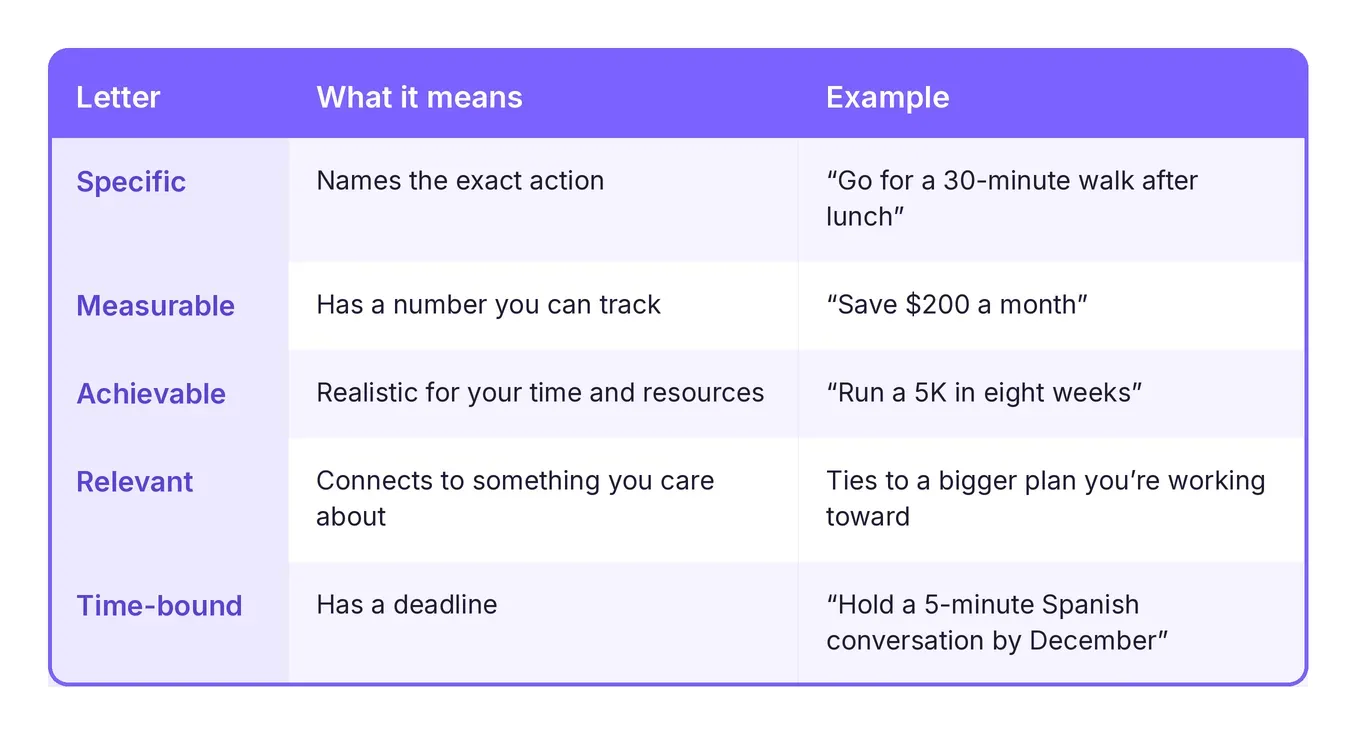
SMART stands for Specific, Measurable, Achievable, Relevant, and Time-bound. The SMART goal acronym was first laid out by George T. Doran in a 1981 issue of Management Review, though his original words were slightly different (Assignable and Realistic instead of today's Achievable and Relevant). The version most people use now looks like this. In one line, that's the SMART goals definition: a goal written to pass all five of those checks.
Specific — A specific goal names exactly what you'll do, not a general direction. "Exercise more" is a direction; "go for a 30-minute walk after lunch" is specific. A good test: could someone else read your goal and know precisely what action it asks for? If it leaves room for interpretation, tighten it. The more specific the goal, the less you have to decide in the moment, which is usually where good intentions stall.
Measurable — A measurable goal has a number in it, so you can tell whether you're on track and when you're done. "Save money" becomes "save $200 a month." "Read more" becomes "read one book a month." The measure doesn't have to be money or count; it can be time, frequency, or a yes/no milestone. What matters is that at any point you can answer the question, "how far along am I?"
Achievable — An achievable goal is one you can actually reach with the time, skills, and resources you have right now. The point is honesty about your starting point, so you set a target that stretches you without setting yourself up to quit in week two. If "run a marathon next month" isn't realistic from where you're starting, "run a 5K in eight weeks" might be, and you can raise the bar once you're there.
Relevant — A relevant goal connects to something you genuinely care about or to a bigger plan you're working toward. This is the letter people skip, and it's the one that keeps you going when motivation dips. Before you lock a goal in, ask why it matters to you. If the honest answer is "it doesn't, really," you'll drop it the first busy week, no matter how well-written it is.
Time-bound — A time-bound goal has a deadline. Open-ended goals slide, because there's always a reason to start tomorrow. A date creates a little useful pressure and gives you a point to check your progress against. "Learn Spanish" has no end; "hold a five-minute conversation in Spanish by December" tells you when to measure and roughly how much to do each week to get there.
The five parts of a SMART goal
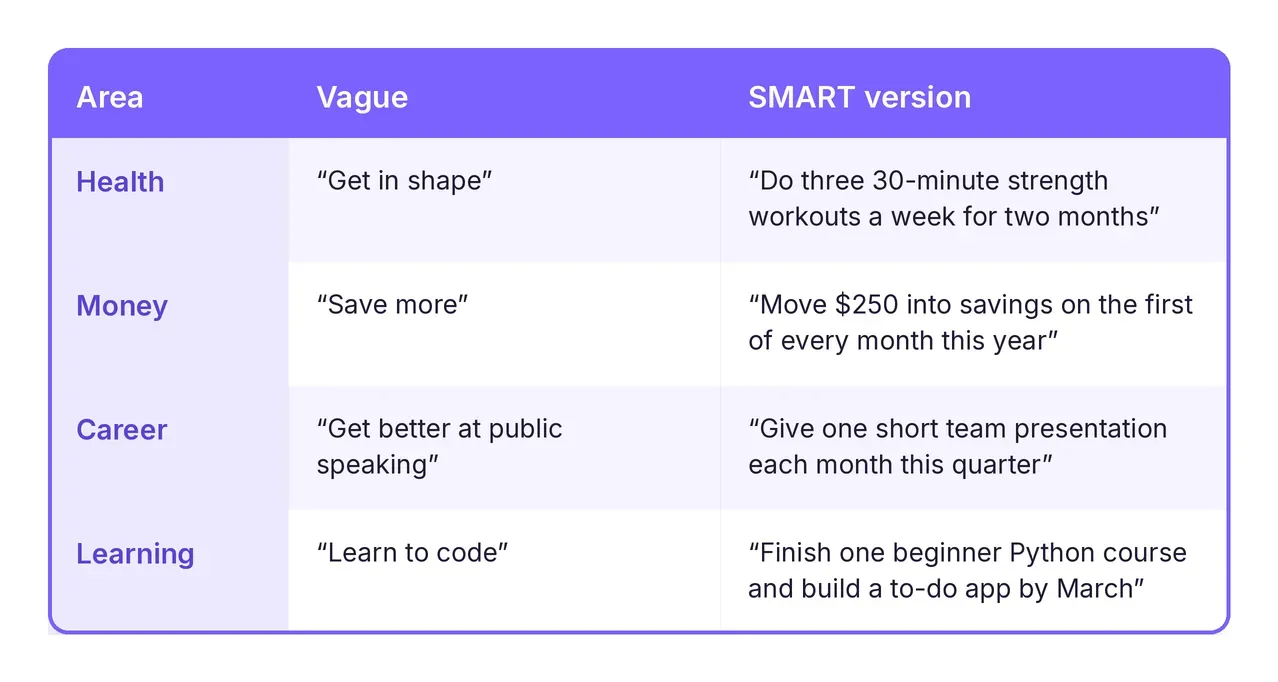
The fastest way to understand SMART is to watch a weak goal turn into a strong one. Here are a few SMART goals examples across different parts of life, with the vague version first and the rewrite after.
Health. Vague: "Get in shape." SMART: "Do three 30-minute strength workouts a week for the next two months." It names the action, counts it, fits a normal schedule, ties to getting stronger, and has an end date to review.
Money. Vague: "Save more." SMART: "Move $250 into savings on the first of every month for the rest of the year." You know exactly what to do, exactly how much, and exactly when.
Career. Vague: "Get better at public speaking." SMART: "Give one short presentation at a team meeting each month this quarter." Small, specific, repeatable, and measurable by whether you did it.
Learning. Vague: "Learn to code." SMART: "Finish one beginner Python course and build a small to-do app by the end of March." A clear finish line replaces an endless "someday."
The vague goals are wishes, and the SMART versions are plans you could start today and check off later.
Vague goal vs SMART goal
Writing a SMART goal works best as a short sequence, because each check builds on the last. Here's how to write SMART goals from a rough idea.
Run those six passes and a wish turns into a goal you can act on. The hardest part is usually starting, not the writing. Whitnie Wiley, one of our experts, writes about how over-planning can become a way of avoiding action altogether, and the fix is to take one small step rather than wait for the plan to feel perfect.
If you'd rather start from a fill-in-the-blank, use this SMART goals template: "I will [specific action] [measurable amount] by [date], because [it matters to you]." Fill every blank and you've run all five checks at once. Keep it where you'll see it, or turn it into a goal setting worksheet with a column for each letter so you can track more than one goal at a time.
SMART isn't just tidy; there's real research behind the parts that matter most. Decades of work by psychologists Edwin Locke and Gary Latham found that specific, difficult goals lead to higher performance than vague "do your best" encouragement, as long as the person is committed to the goal and gets feedback on their progress. That's the Specific and Measurable letters doing their job: a clear target focuses your effort, and a way to measure it gives you the feedback that keeps you adjusting.
The Relevant letter maps to that commitment piece. A goal you care about is one you'll stick with, which is why motivation that comes from waiting to "feel like it" tends to run out. Demetra Moore, one of our experts, makes the case for building mental fitness so you can keep going without depending on a burst of motivation. SMART supports that by making the next action small and obvious, so showing up takes less willpower.
If following through is the part where your goals usually fall apart, that's a skill you can build like any other. RiseGuide's micro-learning journeys on discipline and mindset are built from the insights of experts and break the work into short daily lessons, which fits the same logic as a SMART goal: small, specific, repeatable.
SMART is a strong default, but it isn't the only way to set a goal, and it has real limits. Because it rewards what's measurable and achievable, it can nudge you toward safe, easy targets and away from ambitious ones that are harder to quantify. It's also built for goals with a clear endpoint, so it fits "save $3,000 by June" better than open-ended aims like "become a more patient parent."
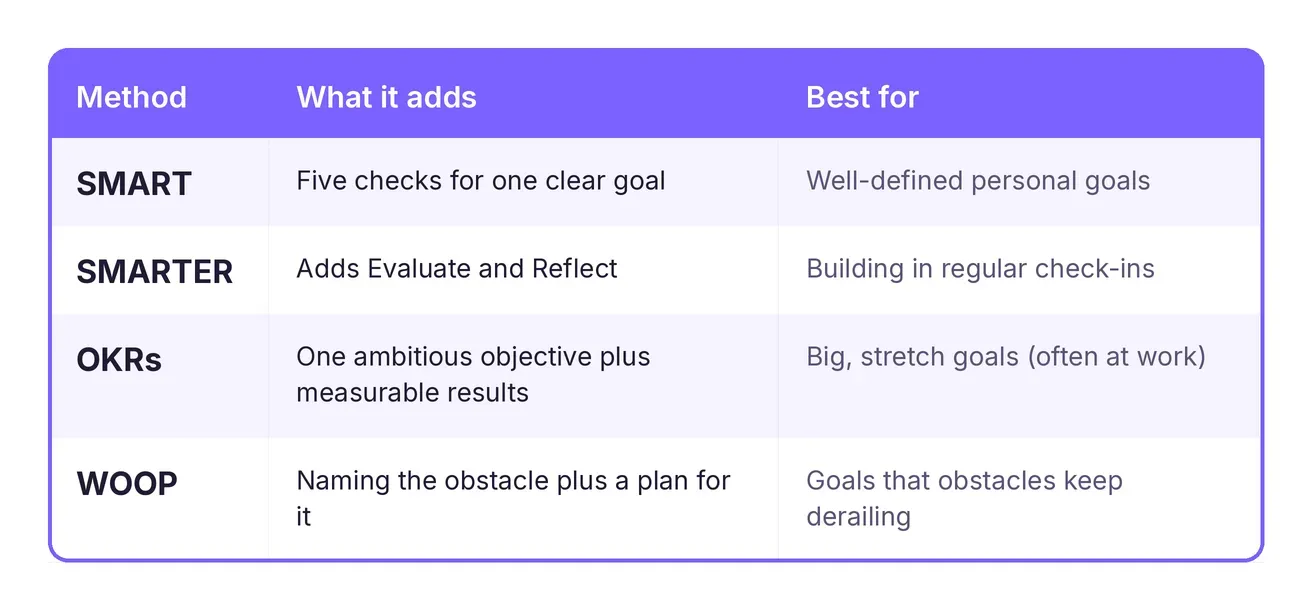
A few common alternatives fill those gaps. SMARTER adds two letters, Evaluate and Reflect, so you build in regular check-ins instead of only looking at the deadline. OKRs (Objectives and Key Results), popular in companies, pair one ambitious objective with a few measurable results, which suits big, stretch goals better than plain SMART. And WOOP (Wish, Outcome, Obstacle, Plan), developed by psychologist Gabriele Oettingen, adds a step most goal methods skip: naming the obstacle in your way and deciding in advance how you'll handle it.
Sticking with a goal when progress is messy is its own skill, whichever method you use. John Lentini, one of our experts, describes discipline, mindset, and resilience as the dials of self-leadership you can turn when a goal gets hard, rather than treating follow-through as something you either have or don't. If you want to go deeper on the systems side, our roundup of the best productivity books covers approaches that pair well with SMART.
SMART and its alternatives
SMART goals give you a quick, reliable way to turn a vague wish into something you can start and measure. Write the goal so it's specific, put a number on it, keep it realistic, tie it to something you care about, and give it a deadline. When a goal is bigger or harder to measure, borrow from SMARTER, OKRs, or WOOP instead of forcing it. The wording is only ever step one, so once your goal passes the five checks, the useful thing is to take the first small action this week.
SMART stands for Specific, Measurable, Achievable, Relevant, and Time-bound. Each letter is a check your goal should pass: name the exact action, add a way to measure it, keep it realistic, connect it to something that matters, and set a deadline.
Start with a rough goal, make it specific, add a measure, confirm it's achievable, confirm it's relevant to you, and set a deadline. Working in that order turns a general intention into a plan you can act on.
"Do three 30-minute workouts a week for the next two months" is a SMART goal. It's specific (30-minute workouts), measurable (three a week), achievable (fits a normal schedule), relevant (getting stronger), and time-bound (two months).
They make goals concrete enough to act on and clear enough to track. Research on goal setting shows specific, measurable goals lead to better follow-through than vague ones, so the format itself improves your odds.
SMART is a checklist for writing one clear goal. OKRs pair one ambitious objective with a few measurable key results and are built for stretch targets, often at work. SMART suits well-defined personal goals; OKRs suit bigger, more ambitious aims.