RiseGuide Team
 FREE GUIDE with any plan: the First Impression FormulaClaim the offer

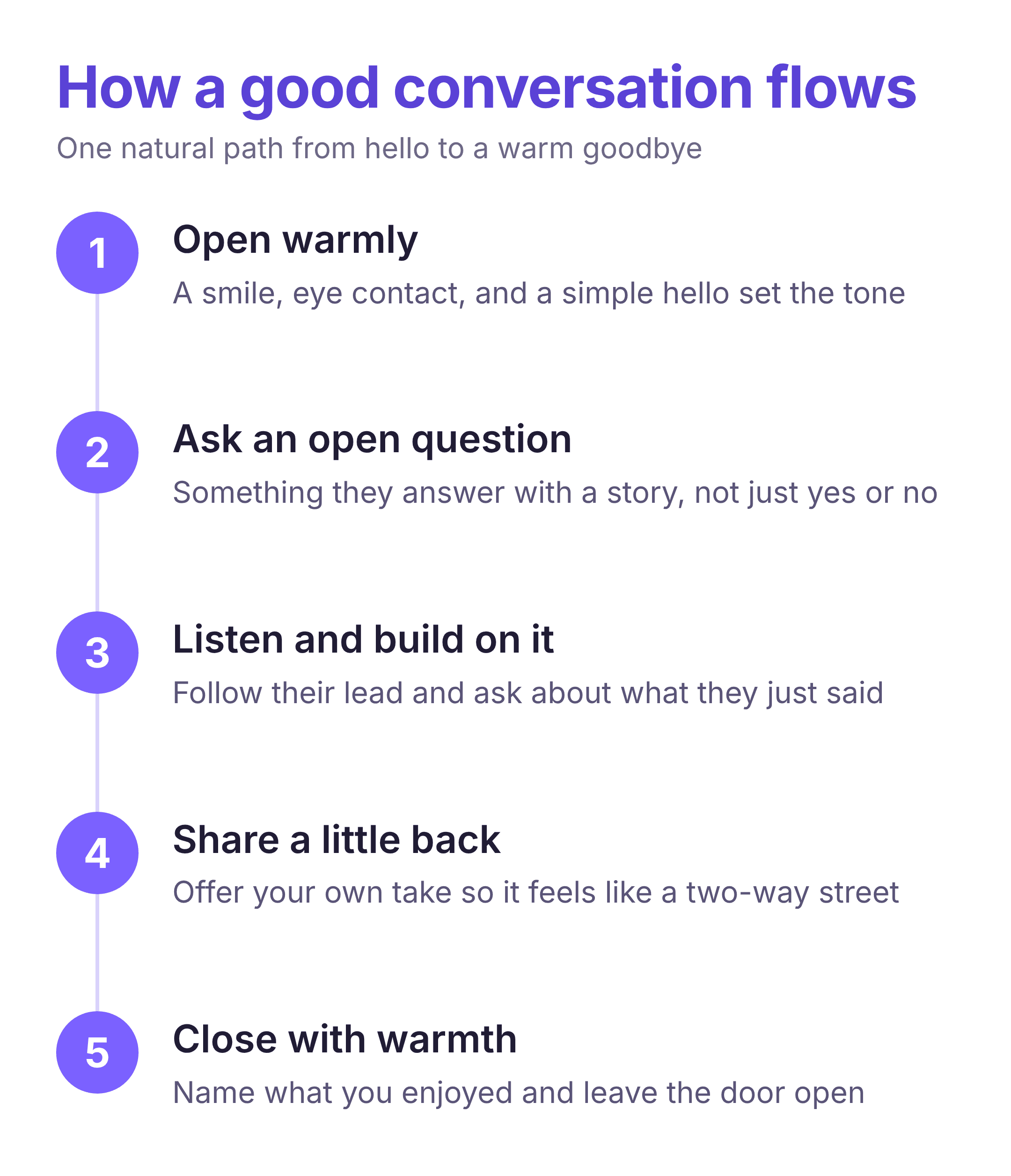
Talking to anyone comes down to a handful of repeatable moves: open with warmth before you speak, start with an easy opener, and lead with genuine curiosity by asking open questions. From there, listen to understand instead of planning your reply, look for common ground, and match the other person's energy and pace. The two that carry most conversations are giving a little of yourself so the exchange feels balanced, and making the other person feel appreciated by using their name and noticing something specific. None of this needs a big personality, and the same moves work with a close friend or a stranger.
Some people seem to know how to talk to anyone without a second thought, while the rest of us plan an opening line and still freeze. Easy conversation is mostly a set of small habits you can build. You do not need a louder personality or clever lines ready to go. You need a few reliable moves to lean on when your mind goes blank.
It also helps to remember that other people usually want the connection more than they show. In a well-known experiment, researchers found that Chicago commuters who struck up a chat with a stranger on the train reported a more positive ride than those who sat in silence, even though most had expected the opposite. We tend to underestimate how open the people around us are. The techniques here give you a practical way to act on that, so you can talk to people you have just met without the usual dread.
Most of the difficulty is in your head, not in the other person. When you walk into a conversation worried about how you come across, your attention turns inward, and it gets harder to notice what the other person is actually saying or to think of a reply. The self-focus feeds itself.
The second reason is practice. Talking is a skill, and like any skill it gets rusty when you avoid it. If you have had a stretch of fewer face-to-face chats, the first few will feel clumsy, and that is normal rather than a sign that you are bad at it. The fix is not a personality change. It is a handful of techniques you can repeat until they feel automatic.
These work in almost any setting, from a work hallway to a party where you know one person. Try two or three at a time rather than all at once, and keep the ones that feel natural to you.
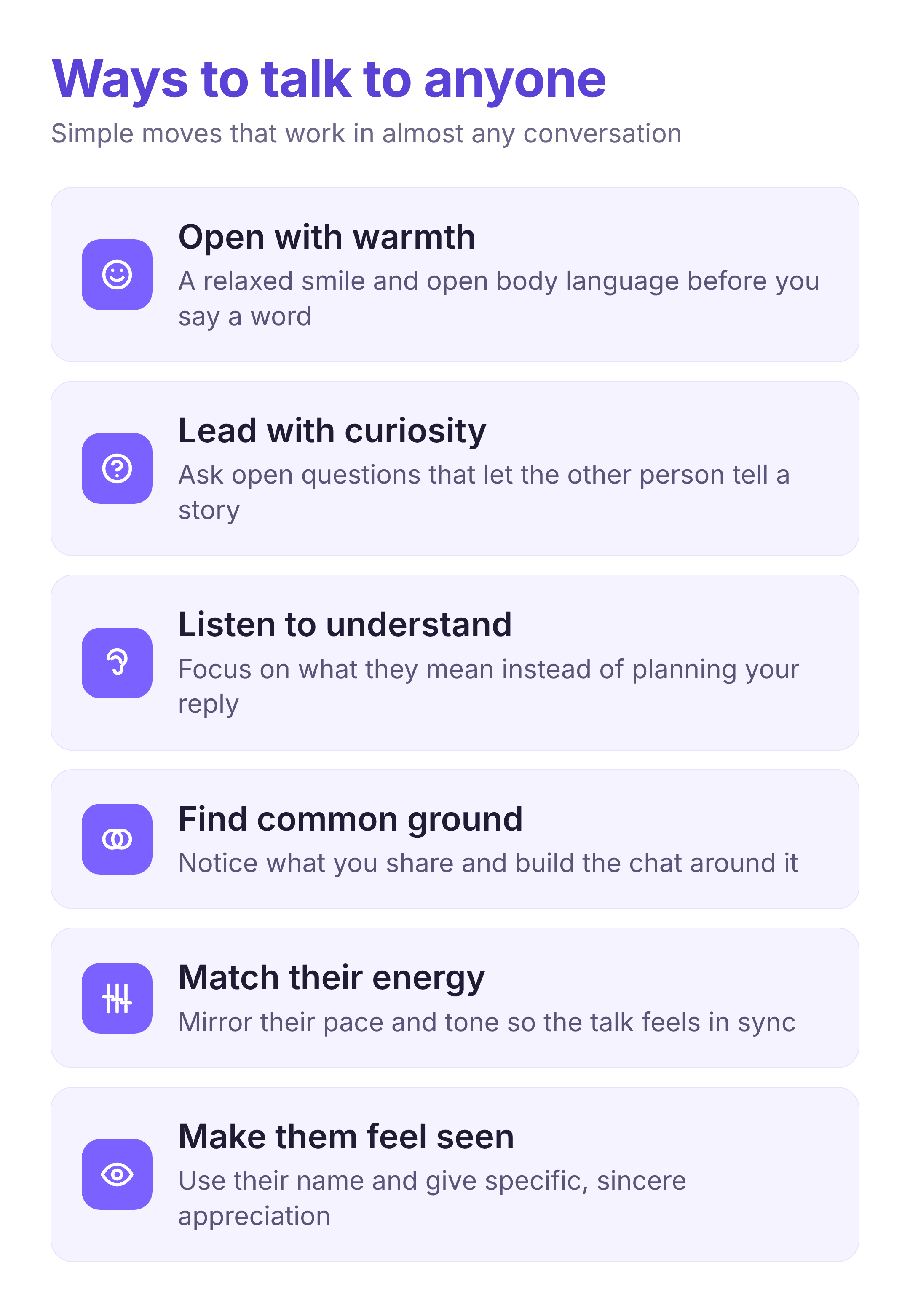
People read your face and posture before they hear a word, so the warmth has to start there. Uncross your arms, turn toward the person, make soft eye contact, and let a real smile land a beat after you meet their eyes instead of switching it on like a light. A warm opening tells the other person they are safe to engage, which is most of the work done. If you want to build that natural warmth and presence, our guide to being charismatic goes deeper. This is also where you set a good first impression, and our team's guide to first impressions goes deeper on those first few seconds.
Acting warm also changes how you feel. Communication coach Leil Lowndes, who wrote How to Talk to Anyone, puts it simply:
"When you act as though you like someone, you start to really like them."
You do not need a brilliant first line. A simple observation about where you both are, a sincere compliment, or a light question about the situation is enough to get moving. The goal is just to open a door. If you freeze on the opener, our list of conversation starters gives you lines to borrow, and our guide to small talk covers the low-stakes chat that warms a conversation up.
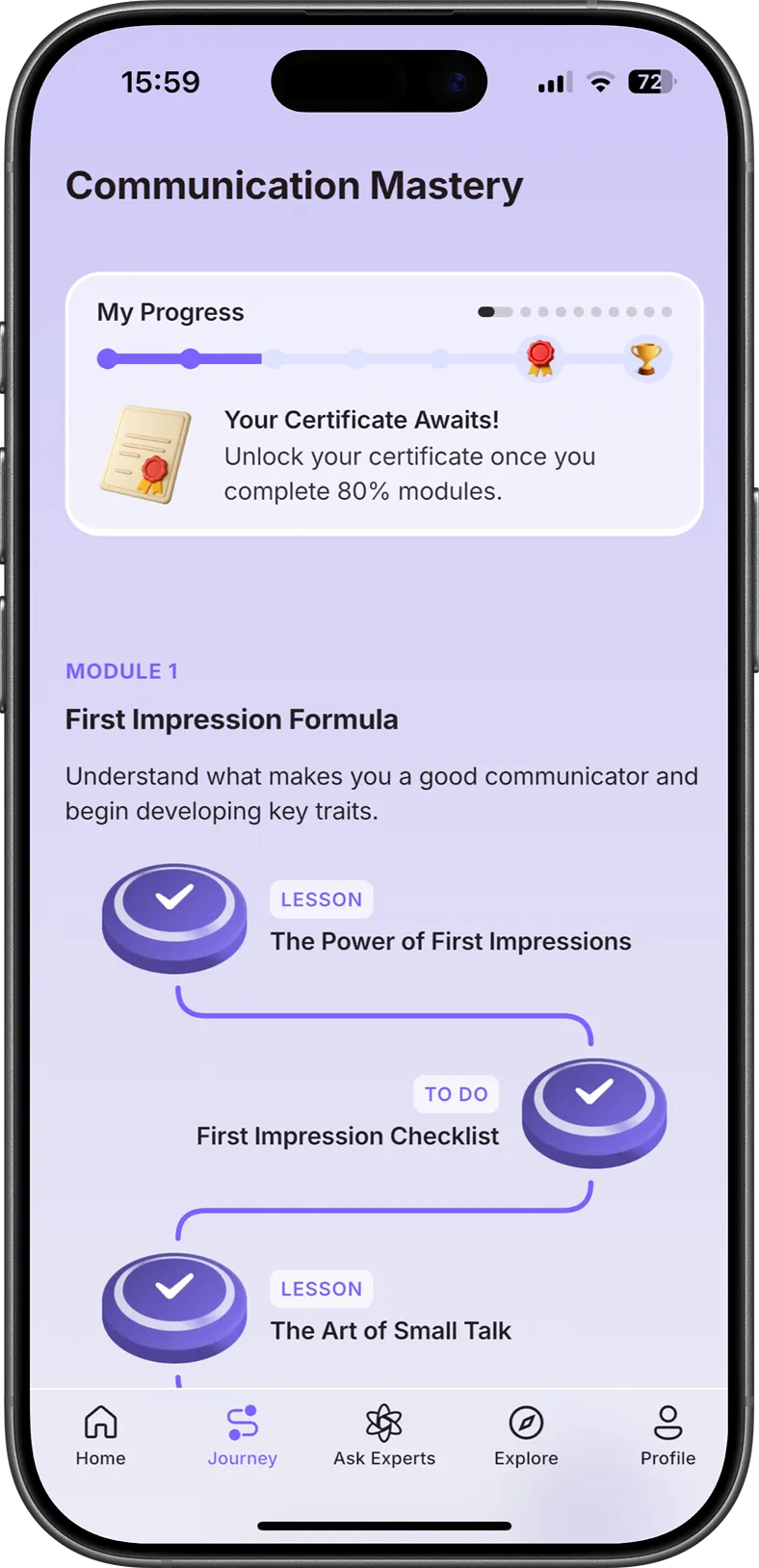
The people we find easy to talk to are usually the ones who seem interested in us. You can be that person by asking open questions, the kind someone answers with a story rather than a yes or no. A useful shortcut is to ask about family, work, or what they do for fun, then follow up on whatever they light up about. Our team also pulled together questions to ask for almost any situation. If communication is the area you want to build first, RiseGuide's Communication Mastery journey is built from expert insights and turns moves like these into short lessons you practice a few minutes at a time.
Curiosity only works if you actually listen to the answer. Most of us spend a reply half-written in our heads while the other person is still talking, and it shows. Give them your attention, let there be a short pause before you respond, and build your next question out of what they just said. People can feel the difference, and it is the fastest way to make a conversation feel real. Our guide to listening skills breaks the habit down further.
Shared ground is what turns a polite exchange into a conversation. Listen for the small overlaps, a hometown, a show you both watch, a frustration you both have, and steer gently toward them. You do not have to force big things in common. Naming one small thing you share is usually enough to make the other person relax.
A conversation feels easy when both people are roughly in step. If the other person is calm and quiet, a loud, fast approach will feel like a lot, and if they are animated, a flat reply can read as disinterest. Pay attention to their pace, volume, and tone, and move toward them. Done lightly, this just means meeting them where they are so the talk feels comfortable for both of you.
Questions keep a conversation going, but a string of them starts to feel like an interview. Offer small pieces of yourself along the way, a quick reaction, a short story of your own, an honest opinion. When you share something real, you give the other person permission to do the same, and the conversation becomes a two-way exchange. If silences still make you nervous, our team's guide to keeping it going can help.
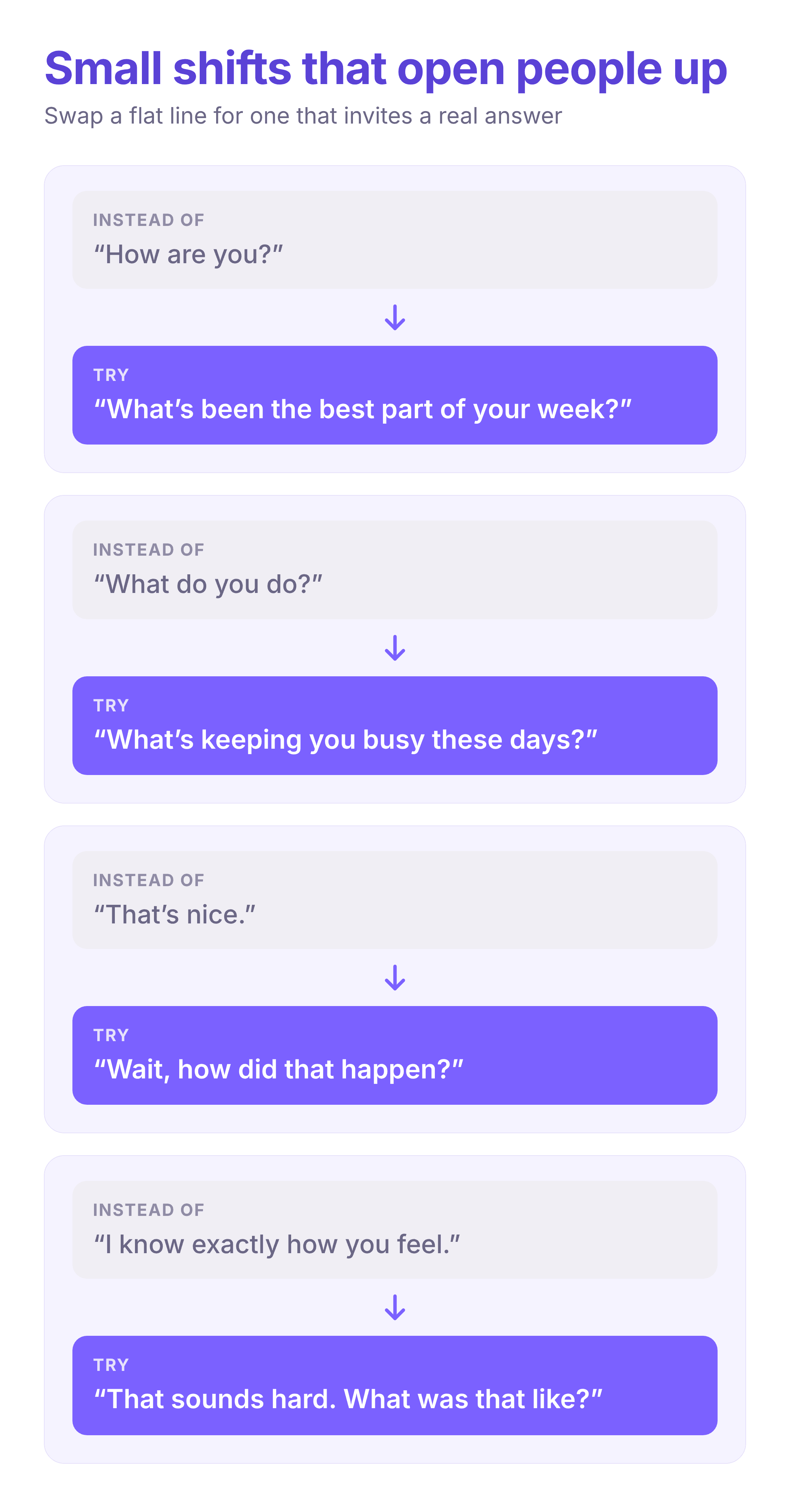
People remember how a conversation made them feel. Use their name once or twice, since it signals you are paying attention, and when you compliment them, be specific about what you noticed rather than reaching for a generic line. Ending well matters too. Naming one thing you enjoyed about the chat leaves the door open for the next one.
You do not need a script or a new personality to have good conversations. Treat these as how to talk to anyone tips you keep coming back to, not rules you must follow. Pick a couple that fit you, use them in your next few chats, and let the rest become habits over time. The more ordinary conversations you have, the less any single one feels like a test.
Usually it is self-focus and lack of practice rather than a flaw in you. When you are worried about how you sound, your attention turns inward and it gets harder to listen or respond. Having fewer conversations makes the next one feel clumsy. Both ease with repetition and a few reliable techniques to fall back on.
There is no single trick, but if you had to pick one thing, it would be genuine curiosity paired with real listening. Ask open questions, pay attention to the answers, and build on what the other person says. Most of the other techniques grow out of those two.
Learning how to talk to strangers is mostly about lowering the stakes. Open with something you both share in the moment, a line about the place, the event, or the wait, and keep it light. The research above suggests people are more open to a friendly exchange than we expect, so a short, warm comment is rarely unwelcome.
The key to how to talk to anyone about anything is that you do not need to be an expert on the topic. When someone brings up something you know little about, curiosity carries you: ask them to explain it, say honestly that it is new to you, and let them teach you. People enjoy sharing what they care about, and your interest matters more than your knowledge.
Open with warmth, ask open questions, and listen more than you speak. Look for one thing you have in common, match the other person's energy, and share a little about yourself so it feels balanced. Close by naming something you enjoyed. Those few moves cover most conversations.