RiseGuide Team

To improve your listening skills, give the speaker your full attention instead of planning your reply, put your phone out of sight, and show you are following with small signals like eye contact and a nod. Reflect back what you heard in your own words before you answer, ask open questions instead of jumping in with advice, and pause for a second when they finish. Active listening is a skill you build with repetition, so start on low-stakes conversations, notice the habits that pull your attention away, and treat each talk as a chance to understand the other person rather than wait for your turn.
Most of us were taught to read, write, and speak, but almost no one was taught to listen. We spend more of the day listening than on any of those, yet it gets the least practice. The result shows up in ordinary moments: a partner who feels unheard, a friend who slowly stops sharing, a conversation you walk away from unable to recall half of. Listening is a skill you can build, and learning how to improve listening skills comes down to changing a handful of habits you already control. This guide walks through why listening breaks down, what active listening actually involves, the moves that make the biggest difference, and a few exercises to practice them.
Listening feels automatic, so it is easy to assume it just happens on its own. It does not. Sound expert Julian Treasure notes that we spend roughly 60 percent of our communication time listening, yet we keep only about 25 percent of what we hear. The distance between hearing words and actually taking them in is where most listening problems live, and a few common habits are usually to blame.
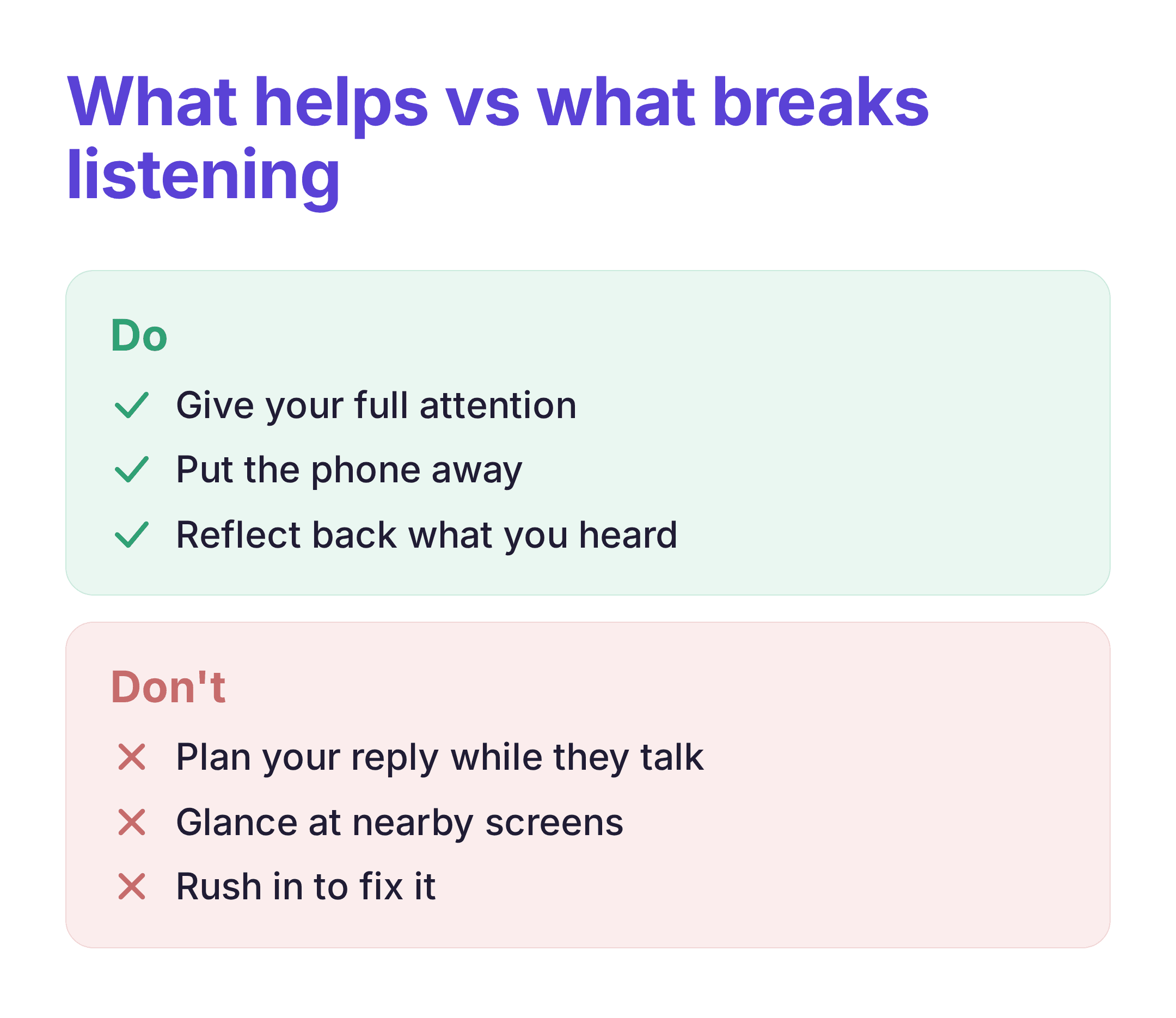
The first is planning your reply. While the other person is still talking, part of your mind is already writing your response, so you take in less and less of what they are actually saying.
"Most people do not listen with the intent to understand; they listen with the intent to reply." — Stephen R. Covey, The 7 Habits of Highly Effective People
The second is competition for your attention. Even a phone lying face-down on the table pulls at your focus, and a single glance is enough to lose the thread. The third is assuming you already know where the sentence is going, so you fill in the gaps with your own guesses and stop hearing theirs. The fourth is listening to fix: you hear a problem and jump straight to advice before the person has finished explaining it.
Active listening means giving the speaker your full focus, taking in what they mean, and responding in a way that shows you understood, rather than hearing the words while you wait to talk. The opposite is passive listening, where the sound reaches you but little of it registers. Active listening is a deliberate kind of attention, and it improves the same way any attention habit does, with practice.
The habits below are the core of how to improve active listening in everyday conversations. None of them are complicated, and you do not need to be naturally talkative to use them.
These moves work in any conversation, from a quick catch-up to a hard talk. They ask for attention and a little restraint, and they get easier the more you use them. Effective listening skills are built here, one habit at a time.
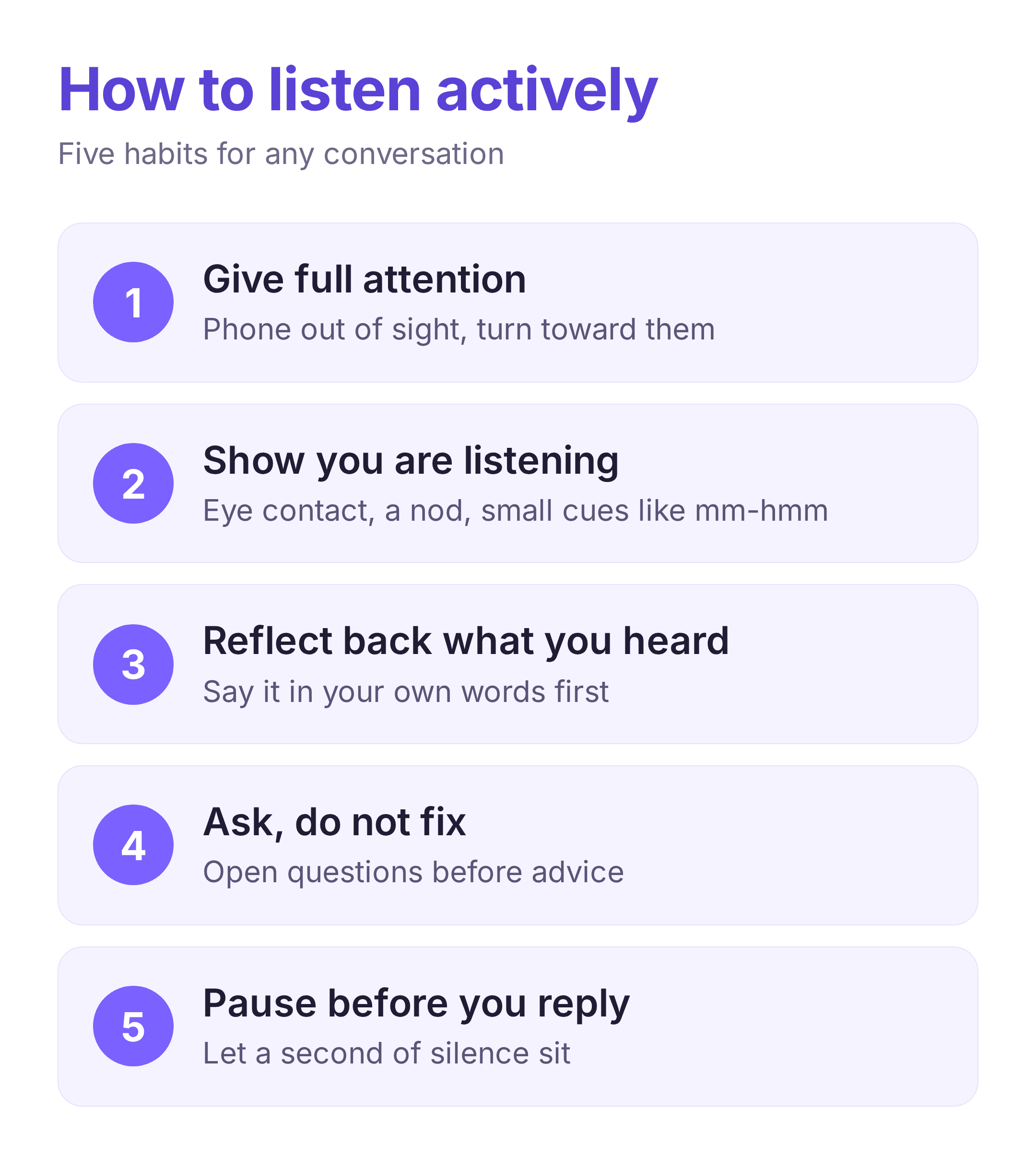
Put the phone out of sight rather than face-down on the table, and turn toward the person. Doing one thing at a time sounds obvious, but it is the single biggest change most people can make. If you catch your mind drifting, bring it back to their words instead of your own.
Listening is easier to sustain when you signal it. Eye contact, a nod, and short cues like "mm-hmm" or "go on" tell the speaker you are with them, and they keep you anchored in the conversation too. Pay attention to their signals as well. Randy Charach, a performer who reads audiences for a living and one of our experts, shows how much reading a room depends on small cues like breath and hesitation.
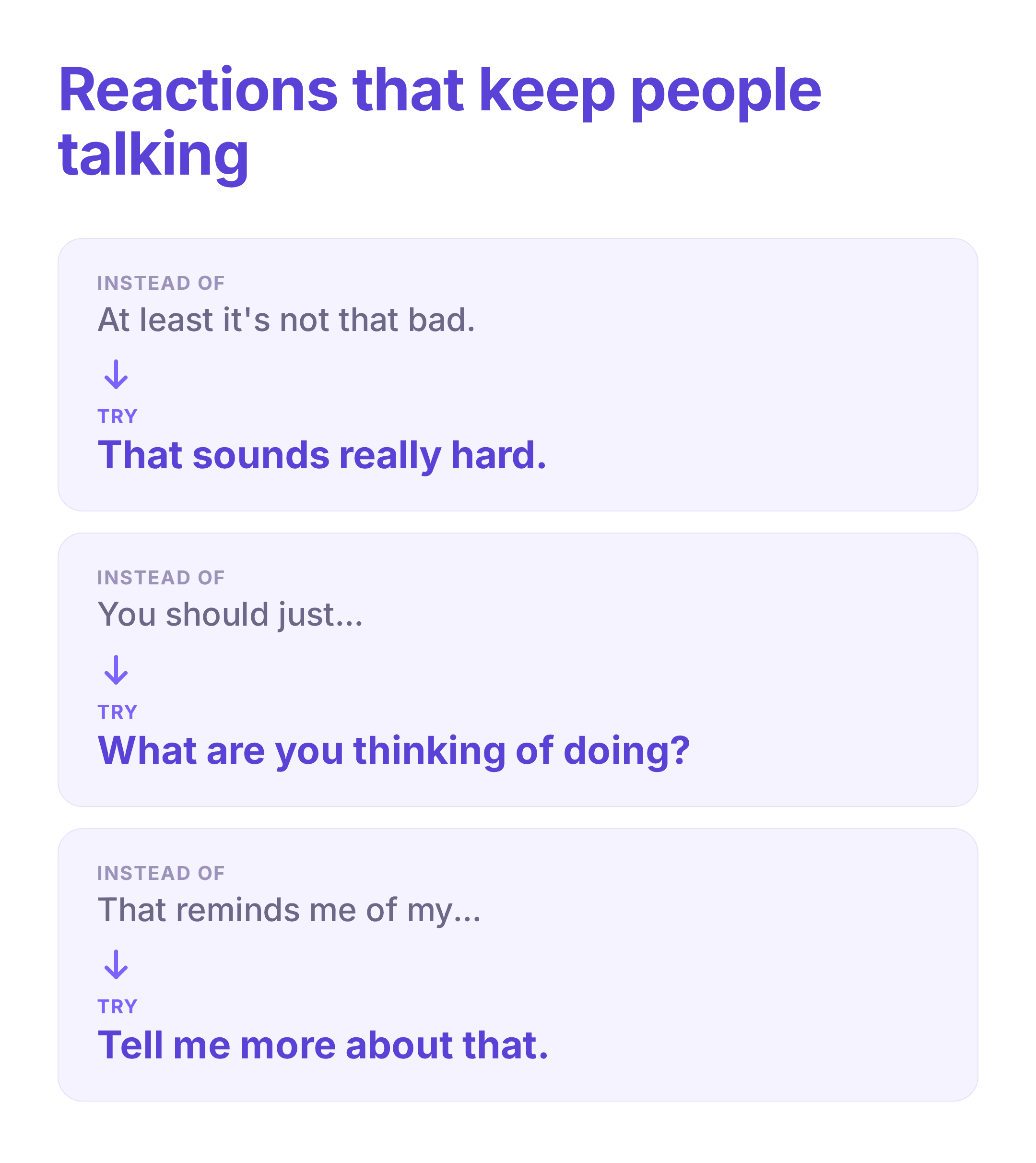
Before you respond, say back what you understood in your own words: "So it sounds like the deadline is the part that is stressing you out." This does two things. It confirms you got it right, and it tells the speaker they were understood, which makes them more likely to keep going. Negotiation expert William Ury argues that real listening means stepping into the other person's frame of reference instead of waiting to make your own point.
When someone shares a problem, the urge to solve it is strong. Hold off. Ask an open question first, like "What are you thinking of doing?" or "What is worrying you most?" Questions keep the other person talking and often help them work the problem out themselves. Listening well does not mean staying silent while someone talks over everyone, either. Jennifer Layman, a communications consultant and one of our experts, has practical ways to handle a conversation dominator so the quieter voices get heard.
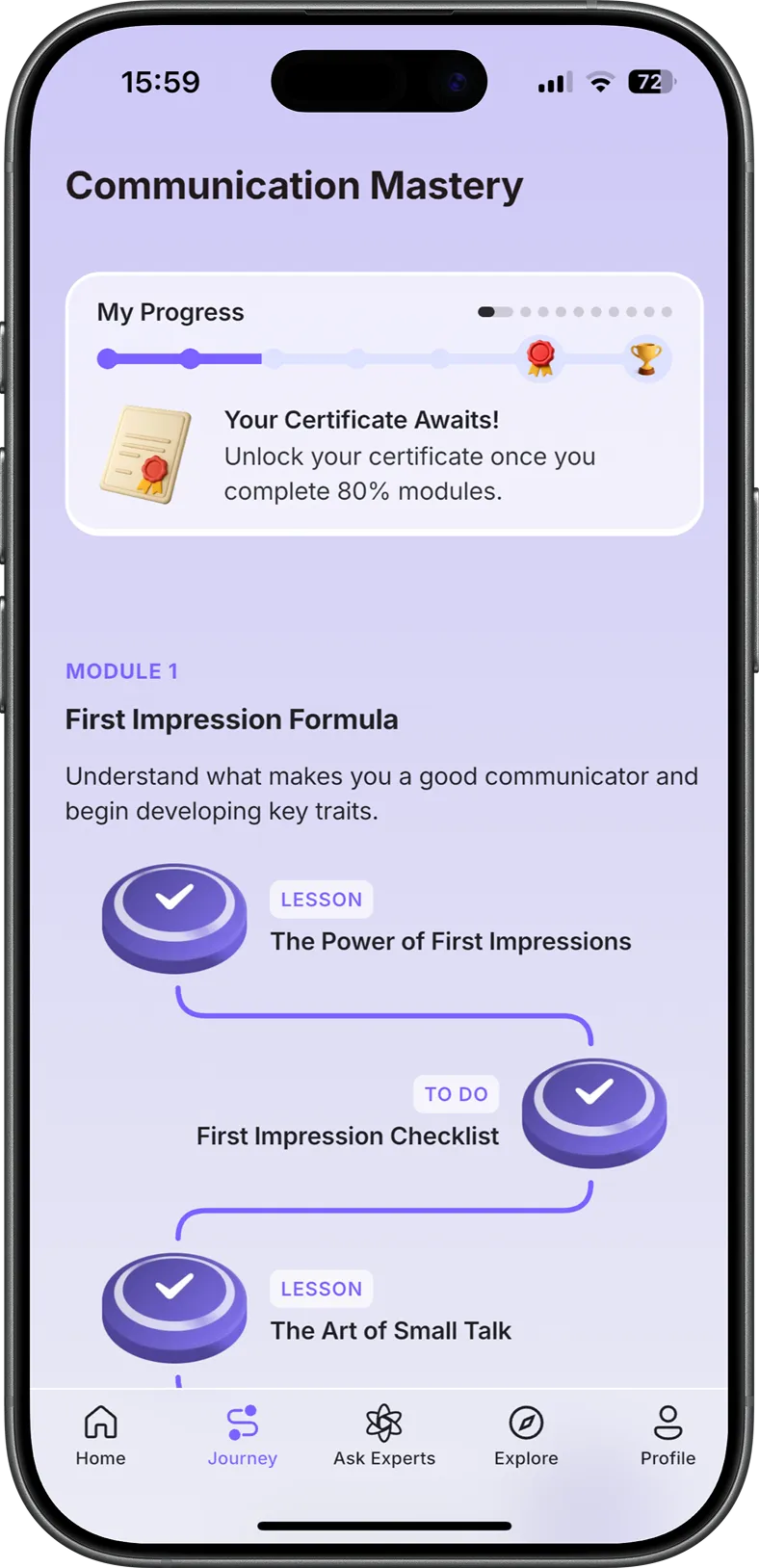
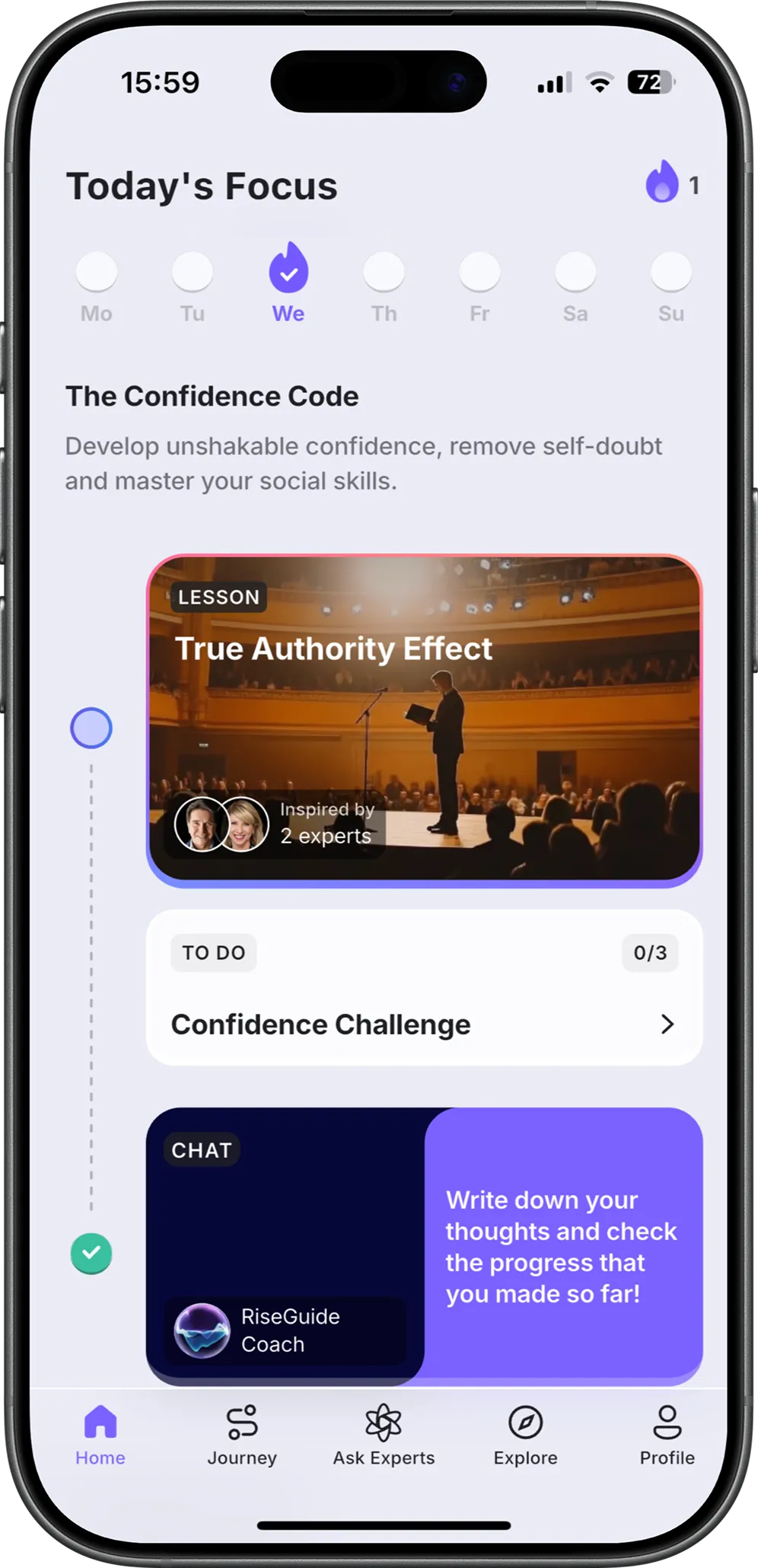
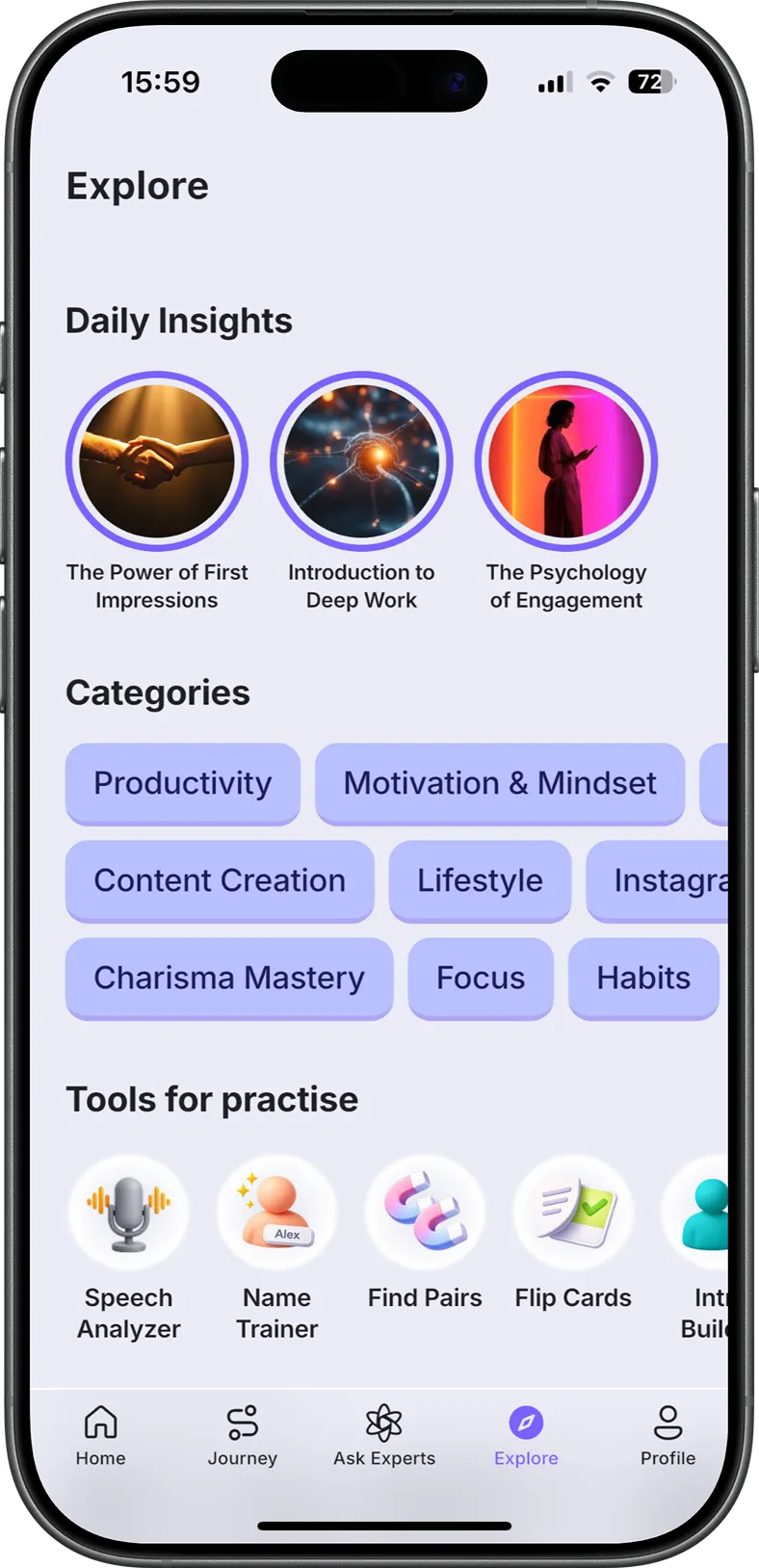
When the person finishes, let a second of silence sit before you speak. The pause gives you time to actually consider what they said, and it often gives them room to add the thing they were really trying to say. If you want to build these habits in a structured way, the Communication Mastery journey in RiseGuide turns moves like these into short daily lessons, and its Small Talk Simulator lets you practice responding without rushing to fix. It is built from the insights of communication experts, so you are practicing what works rather than guessing.
Listening is only one side of a conversation. Ian Hawkins, a speaking coach and one of our experts, covers what great communicators get right on the speaking side, and the two skills reinforce each other.
You do not improve by reading about listening; you improve by practicing in real conversations. These active listening exercises are small enough to fit into a normal day, and each one targets a specific habit from the section above.
Celeste Headlee, a journalist and one of our experts, has more on becoming a better listener in everyday conversations if you want to go deeper on the mindset behind these habits.
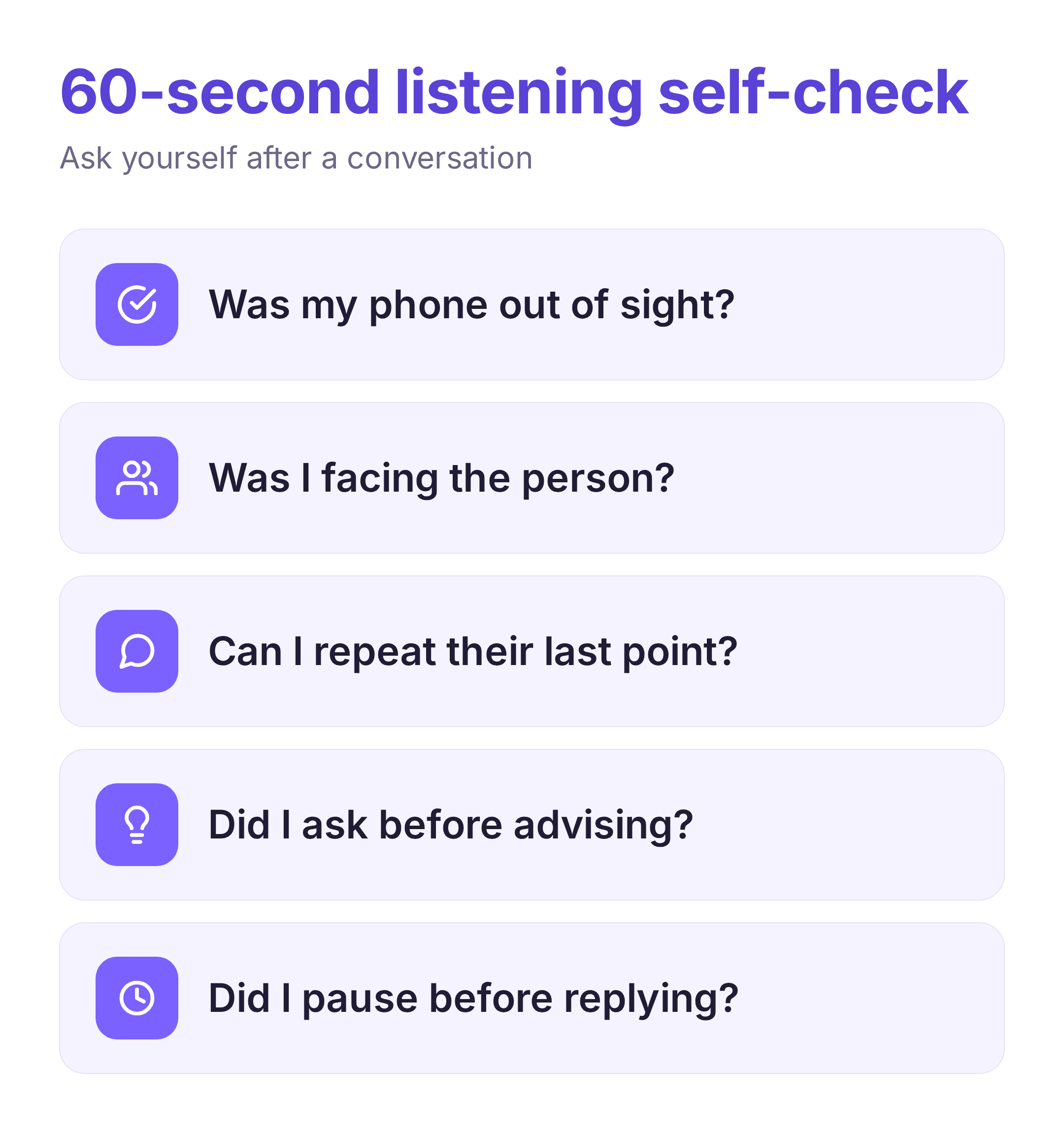
Listening well is a set of small, repeatable choices: fewer distractions, more reflecting back, more real questions, and a short pause before you speak. Anyone can get better at it with practice, no matter how quiet or busy they are. Pick one habit from this guide and use it in your next conversation, then add the next one when it starts to feel natural.
For most people, poor listening comes down to a few habits. Planning your reply, checking your phone, and jumping to advice all pull attention away from the speaker. Change those habits and your listening improves quickly.
Start with the exercises above and keep them small. Reflect back what you heard in one daily conversation, ask a question before giving your opinion, and put your phone away when someone is talking. Repetition is what turns these into automatic behavior.
Good listening skills include giving full attention, reflecting back what you heard, asking open questions, staying comfortable with short silences, and reading the speaker's tone and expressions alongside their words.
Active listening is important because it makes people feel understood, cuts down on misunderstandings, and builds trust. In relationships and at work, feeling genuinely heard is often what people remember most about a conversation.
You think far faster than people speak, so your mind has spare capacity that easily wanders. Add distractions and the urge to respond, and staying fully present takes real effort. That is normal, and it is exactly what the habits and exercises above are designed to train.