RiseGuide Team

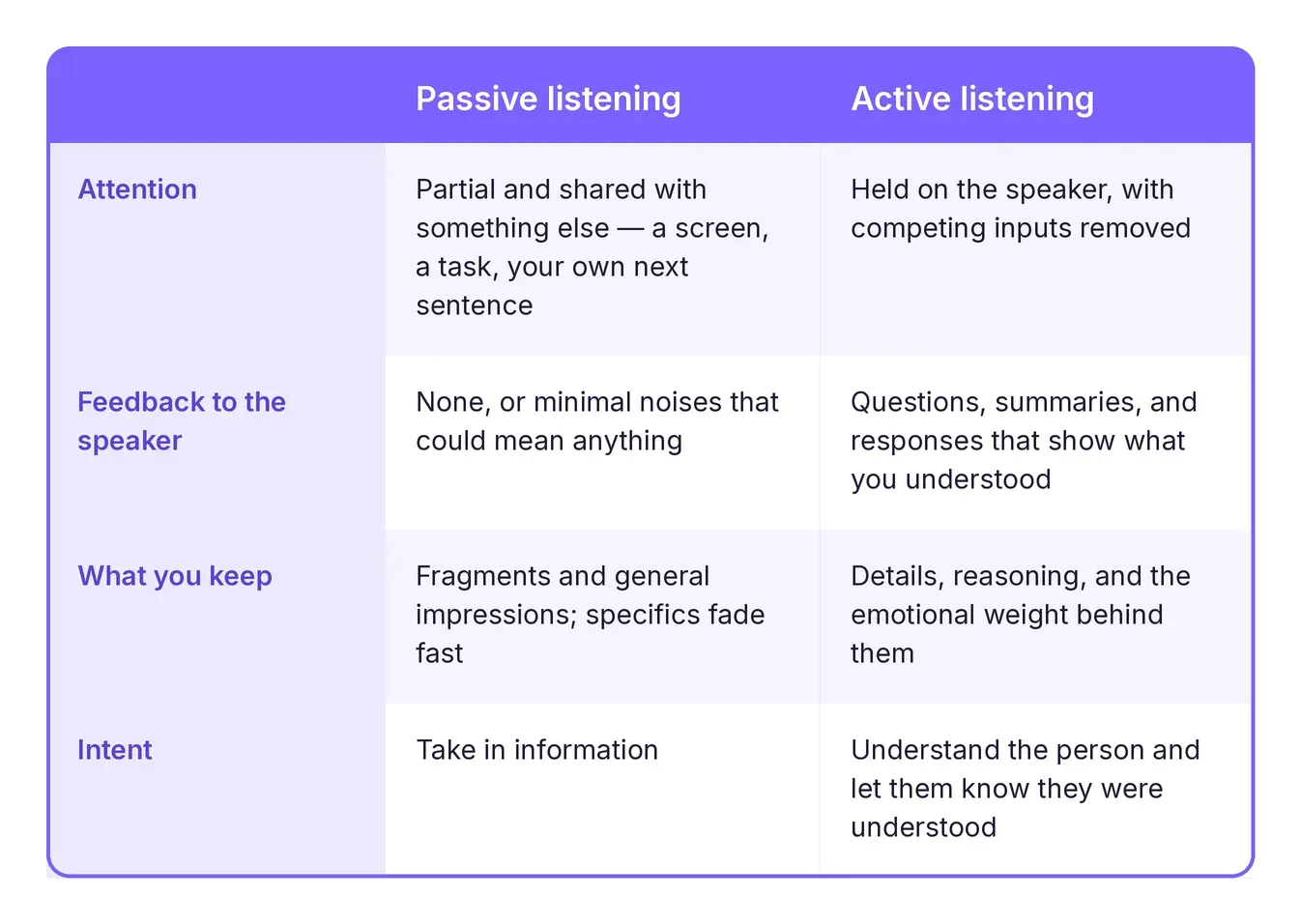
Passive listening means taking in what someone says without giving anything back to them: no questions, no summary, no sign that you followed. It differs from active listening on four points — how much attention you give, whether the speaker gets a response, how much you remember afterward, and what you are listening for. Passive mode suits one-directional information, like a recorded lecture, a podcast on your commute, or a meeting update outside your area. It works badly in conversations where the other person needs something from you: a disagreement, a one-on-one, a friend thinking out loud about a problem. To move into active listening, decide which mode a conversation needs before it starts, hold your own reply back while the other person is speaking, track why they are telling you this, then summarize what you heard and ask one question about it.
You listen in several different ways over a single day. Music while you clear your inbox, a colleague's update on a project you have nothing to do with, a friend describing a hard week. Each one gets a different amount of you, and most of that gets decided without you thinking about it.
Passive and active listening describe the two ends of that range. What separates them is whether the speaker gets anything back from you. Once you can tell them apart, the mode you are in becomes something you pick rather than something that happens to you.
Passive listening is receiving what someone says without responding to it. You hear the words, you may follow the content perfectly well, and the speaker gets nothing in return: no questions, no reflection of what they said, no signal that any of it landed.
It is the mode most of us are in for a large share of the day. A podcast while you cook. An audiobook in traffic. A conference talk from the twentieth row. An all-hands where two hundred people are on mute. Music in a café you stopped noticing an hour ago. None of these ask you to respond, so you don't.
In conversation, it shows up differently. Eye contact drifts to the middle distance. Replies get short and generic. No follow-up questions come. You realize a minute later that you could not repeat the last thing that was said, even though you were sitting right there. Hearing is still happening in all of these cases - what has dropped away is the part where you do something with what you heard.
Sound and communication expert Julian Treasure has argued that this mode has become the default rather than the exception.
"We are losing our listening. We spend roughly 60 percent of our communication time listening, but we're not very good at it." - Julian Treasure, in his TED talk 5 ways to listen better
The term active listening comes from psychologists Carl Rogers and Richard Farson, who introduced it in a paper written for managers in 1957. Their argument was that listening only looks like the inert half of a conversation.
"Despite the popular notion that listening is a passive approach, clinical and research evidence clearly shows that sensitive listening is a most effective agent for individual personality change and group development." - Carl Rogers and Richard Farson, Active Listening
Set active listening vs passive listening side by side and four things separate them.
When passive listening is fine, and when it isn't
Treating passive mode as a defect to eliminate would be a mistake. Nobody can hold full attention for eight hours, and spending it on input that doesn't need it leaves you with nothing for the conversations that do. The useful question is whether the mode fits the situation.
One-directional information is the clearest case. A recorded lecture, a webinar, an audiobook, a podcast, a company briefing on a department you have no involvement with. Nobody is waiting for your response, and you can rewind if something matters. The same goes for background sound that exists to keep you company rather than to inform you.
Learning material sits in a middle position. Listening to a lecture passively will get you a general shape of the topic, which is sometimes all you need. When you want to keep the content, active methods do considerably more for retention than replaying an audio file a second time.
Anywhere the other person needs a response, passive mode damages the conversation. That includes disagreements, where the other side reads your silence as either agreement or dismissal. It includes one-on-ones, feedback conversations, and any moment when someone is upset. It includes instructions and handoffs, where the cost of a missed detail arrives later. And it includes first conversations with people you don't know yet, where small talk has no chance of turning into anything if only one person is doing the work.
The awkward part is that nobody tells you. In a 2024 set of studies published in the Journal of Experimental Psychology: General, speakers correctly judged whether their partner was listening only about 70% of the time, and when listeners reported that their minds had wandered, close to 80% of their partners still felt heard. Outside observers watching video clips did worse than the speakers. Getting away with passive listening is easy, which means the absence of complaints tells you very little about how much you took in or how the other person will remember the conversation.
None of this requires a script or a set of gestures. These are separate techniques, and you can use any of them on its own.
1. Decide the mode before the conversation starts. Ten seconds of thought about what this particular conversation needs prevents most accidental passive listening. A status update and a colleague telling you they are struggling do not get the same setting.
2. Hold your own answer back while the other person is talking. Much of what feels like listening is rehearsal for your own turn. Psychologist Michael P. Nichols, who wrote The Lost Art of Listening, described the internal move it takes to stop doing that.
"Genuine listening means suspending memory, desire, and judgment - and, for a few moments at least, existing for the other person." - Michael P. Nichols, The Lost Art of Listening
3. Track why they are telling you this. The facts of a story are usually the least interesting part of it. Someone describing a difficult meeting may be asking for advice, or may want confirmation that they weren't unreasonable. Getting that wrong is how a well-intentioned response lands badly.
4. Summarize before you answer. One sentence starting with "so" gives the speaker a chance to correct you while it is still cheap. It also makes it obvious, to both of you, when you have been half-following.
5. Ask one question you don't know the answer to. Questions that test your own guess are a form of talking. Questions that open something up are the part passive listening never gets to.
6. Take away the second input. Phone face down, laptop closed, music off. Split attention is the mechanism behind most passive listening, so removing the competitor solves more than willpower does.
7. Say something when you drift. Admitting you lost the thread and asking for the last part again is far less damaging than nodding through it and answering the wrong question. If your habit runs the other way and you cut in before people finish, that has its own fix.
Techniques can be performed on the surface while your attention sits somewhere else, which is why Nichols put empathy at the center rather than any particular behavior.
"The essence of good listening is empathy, which can be achieved only by suspending our preoccupation with ourselves and entering into the experience of the other person." - Michael P. Nichols, The Lost Art of Listening
If you want to build the habit deliberately rather than hoping it appears in your next hard conversation, structured practice helps - whether that is a course, feedback from someone who will tell you the truth, or one of the apps built for communication skills.
Listening is one of the skills covered in the Communication Mastery journey in RiseGuide, broken into 15-minute interactive lessons built from the insights of experts.
Passive listening is a reasonable setting for a large part of what reaches your ears, and trying to bring full attention to all of it would leave you with less for the conversations that need it. What causes problems is using it by default, in situations that were asking for a response. Checking which mode a conversation deserves, before you are three minutes into it, covers most of the distance.
Passive listening means hearing and taking in what someone says without responding to it — no questions, no summary, no visible sign of understanding. The listener receives; the speaker gets nothing back.
Attention, feedback, retention, and intent. A passive listener gives partial attention, returns nothing to the speaker, keeps only fragments of what was said, and is there to take in information. An active listener holds attention on the speaker, feeds back questions and summaries, retains details and reasoning, and is trying to understand the person well enough that the person can tell.
Not by itself. It fits one-directional input such as lectures, podcasts, briefings that don't concern you, and background sound. It becomes a problem in conversations where someone needs a response, which is where most people use it without meaning to.
An audiobook during a commute, a webinar you have muted, music while you work, a lecture you are half-following, and a meeting where you are mentally drafting your own update while a colleague presents theirs.
Partly, and less than the popularity of the method suggests. In a study of Finnish adults exposed to Chinese lexical tones for two hours a day over four days, brain responses showed the listeners had become better at detecting differences between the sounds, even though they were not attending to them and behavioral gains did not yet show up in testing. The researchers suggested passive exposure as preparation for active study rather than a replacement for it.