RiseGuide Team

To learn anything faster, work with how your memory works instead of fighting it. Explain each new idea in your own words so you really get it, quiz yourself from memory instead of rereading, spread your review out over several days instead of cramming, mix related topics together instead of doing one at a time, and keep an eye on what you actually remember so you know what to go back to. The methods that feel harder while you do them, like quizzing yourself and spacing things out, are usually the ones that make learning stick. That saves you time, because you are not relearning the same thing over and over. And if you want to truly master something, put extra practice into the parts you are worst at.
Most of us were taught what to learn, but never really how to learn it. That is why so many smart, motivated people still highlight whole chapters, read their notes again and again, and forget most of it a week later. Researchers have studied this for decades, and they keep finding the same surprising thing: the study methods that feel the most productive are often the least effective. Two of those researchers, Robert and Elizabeth Bjork, call the methods that actually work "desirable difficulties". These are approaches that feel slower and harder while you use them, but they help you remember far more later on. So learning faster is really about learning something well the first time, so you do not have to keep going back and relearning it. The steps below work for almost anything you want to pick up, and they are also a simple guide to how to learn effectively, not just quickly.
The order of these steps matters. It is hard to space out or mix up material you do not understand yet, so each step sets up the next one. The first time you learn something new, go through them in order. After that, keep repeating the middle steps as you practice. You do not need any special talent or fancy tools for this. It is really about using the same study time in a smarter way. The steps work whether you are learning a language, an instrument, a bit of code, or a soft skill like communication. Here is how to learn anything faster, one step at a time.
When you first start with something new, it is tempting to just read it over and over until it feels familiar. But feeling familiar with something is not the same as understanding it, and that is the trap of rereading. Active learning means actually doing something with the information instead of just looking at it again. You can explain it in plain words, write it out from memory, or pretend you are teaching it to someone who knows nothing about it. The Feynman technique, named after physicist Richard Feynman, is a good example. You take an idea and try to explain it as simply as you can. Every time you get stuck or start using jargon, you have found a gap in what you understand. Then you go back, fill that gap, and try explaining it again. Putting things in your own words takes more effort than rereading, and that effort is exactly what helps it stick.
Once you understand something, the best way to remember it is to pull it out of your memory instead of reading it again. This is called active recall, or retrieval practice. You close the book and try to remember what you learned, maybe by answering a question, redrawing a diagram, or saying the steps out loud, and only then check if you got it right. It feels harder than rereading, and studies show it works much better. A research review of retrieval practice found a solid, medium-sized effect on learning (Hedges' g = 0.50), and the benefit even carried over to new problems, not just the exact things people practiced (a transfer effect of about d = 0.40). Each time you remember something, you get better at finding it again later. That is why flashcards, practice questions, and writing down everything you can recall on a blank page work so well.
Cramming feels productive because everything is fresh in your head by the end of a long session. The problem is that it does not stay fresh for long. Going all the way back to Hermann Ebbinghaus, researchers have shown that we forget new information quickly at first, then more slowly. This is known as the forgetting curve. Spaced practice is the answer. Instead of one big session, you review the same material in shorter sessions spread out over days and weeks, coming back to each idea just as you are about to forget it. Every time you review at the right moment, you forget a little less and hold on to it for longer. This works across all kinds of subjects, though how much it helps depends on what you are studying. A 2025 review of studies in mathematics found a small-to-medium benefit for spacing over cramming (g = 0.28). An easy way to start is to review new material the next day, then a few days later, then a week later, then a month later.
Most people study in blocks, finishing one topic completely before moving on to the next. Interleaving means mixing things up instead, switching between related problems or topics in the same session. It feels messier and slower, which is why a lot of people skip it. Researchers who study how students plan their own learning point out that "students struggle to create an optimal study order" and tend to stick with one topic at a time, even though mixing topics works better. Interleaving helps because it forces you to keep figuring out which method fits which problem. That is the same thing you have to do in real life, when problems do not show up neatly in order. If you are learning guitar chords, mix them up instead of drilling one for an hour. If you are doing math, put different types of problems on the same page.
The people who learn fastest tend to keep an eye on their own learning. They notice the difference between what they really know and what just feels familiar, and they change their approach when something is not working. Psychologists call this metacognition, and it is one of the most useful habits you can build. A 2024 review of self-regulated learning, covering 5,519 learners, found a solid and steady effect on results (g = 0.65). In plain terms, this means giving yourself honest feedback. After you study, ask yourself what you could remember and what you could not, and use those gaps to decide what to review next. It also helps to get an outside opinion, because people usually think they are doing better than they are. It is the same blind spot that can trip up even high performers when no one gives them honest feedback. A test score, a study buddy, or a self-quiz a few days later will tell you a lot more than your own gut feeling.
Being good at something is not the same as mastering it. To get really good, you usually need deliberate practice. That means putting your effort into the specific things you cannot do yet, getting quick feedback, and adjusting, instead of just repeating what you are already comfortable with. The idea comes from Anders Ericsson's research on top performers. It is worth being honest about what practice can and cannot do, though. A 2019 study that took another look at Ericsson's original data found that deliberate practice explained only about a quarter of the difference between expert violinists. So other things, like when you started and your own circumstances, matter too. Still, when it comes to the parts of a skill that separate good from great, working on your weak spots on purpose beats piling on more comfortable practice.
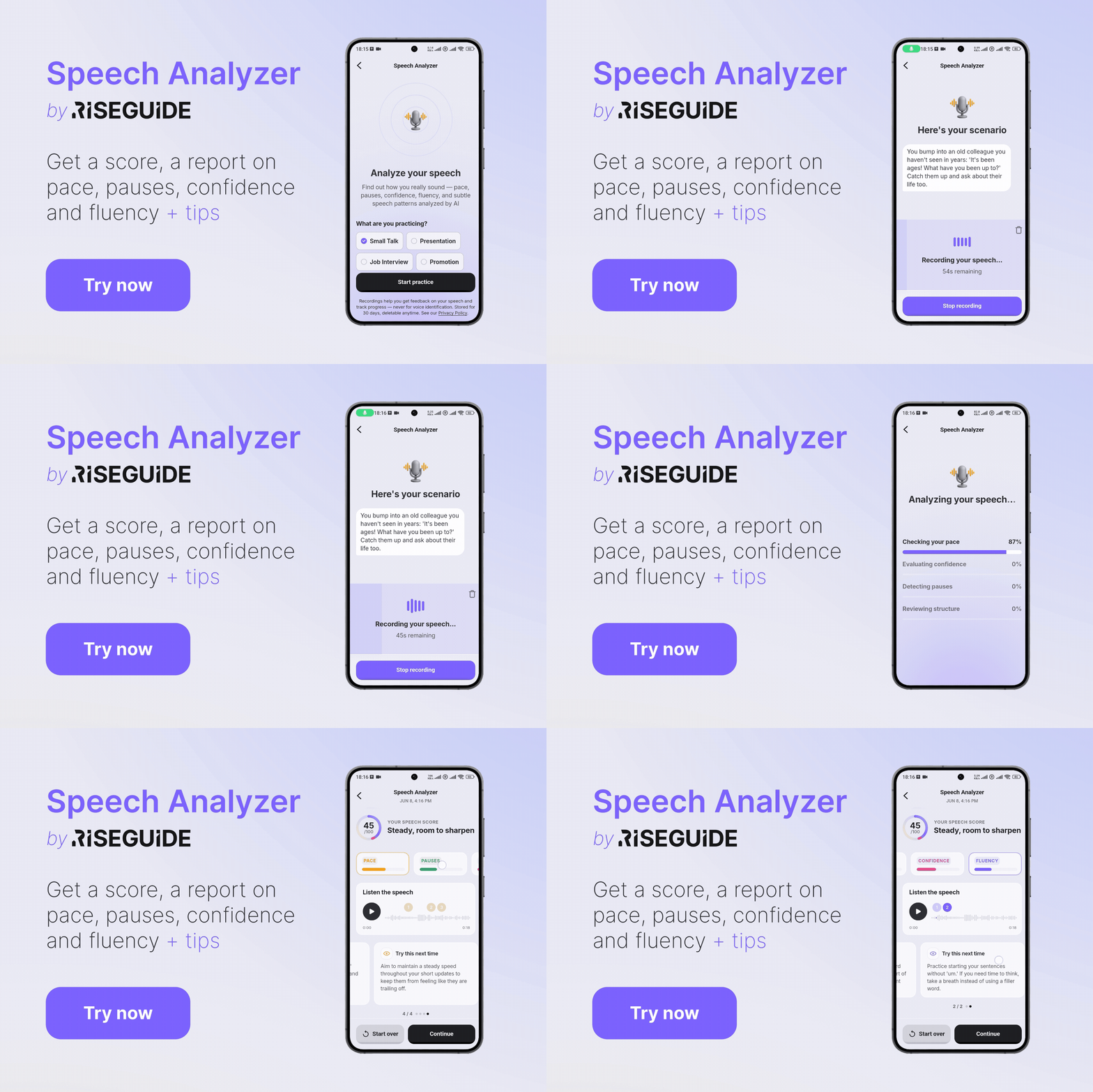
Two of these steps, spacing and self-testing, are the easiest to skip and the hardest to keep up on your own, because they only pay off after a few weeks. This is where a microlearning habit can help. Short lessons, spread out over time, that quiz you as you go will handle the spacing and the testing for you. If you happen to be working on communication, which is one of the most common skills people want to improve, RiseGuide is built around this kind of rhythm and gives you the lessons in a few minutes a day. It is just one option, and the best self-improvement apps all use some version of the same idea. It is only worth it if building a daily habit is the part you have been struggling with.
Knowing the method is only half the job. The other half is dropping the habits that quietly eat up your time. Most of them feel productive, which is exactly why they are so hard to give up.
Rereading and highlighting are the usual suspects. They make the material feel familiar, but that feeling tends to vanish the moment you have to remember it without looking. Cramming has the same problem, just over a longer stretch. It might get you through a test the next morning, but very little of it sticks around a few weeks later. Both are the easy, comfortable version of the recall and spacing habits above.
Then there is the learning-styles myth. This is the popular idea that you are a "visual" or an "auditory" learner, and that you should match everything you study to your one style. It is one of the most common beliefs in education, and also one of the least supported. After going through the research, a group of psychologists found there is "no adequate evidence base" for teaching to someone's supposed style. You are better off matching the method to the material, like using diagrams for visual things and practice for skills, than matching it to a label. The goal is to learn smart, which just means using what actually works instead of what feels nice.
A lot of advice on how to learn quickly promises unrealistic results, so it helps to set a fair expectation. The good news is that getting decent at something usually happens faster than people think. Josh Kaufman made the "first 20 hours" idea popular: with around 20 hours of focused practice, you can go from knowing nothing to being reasonably good. Progress feels fastest in this early stage, because you are starting from zero and improving quickly.
Real mastery is a different story. That takes months or years, not hours, and it is where deliberate practice and honest feedback really count. Keeping both of these in mind is a big part of how to learn faster without burning out. It helps you stay motivated early on, and stay patient later when the quick wins slow down.
Learning faster comes down to following a better order: understand the material properly, quiz yourself on it, space out your reviews, mix related topics together, and keep track of what you actually remember. Add deliberate practice when you are aiming for real mastery. A lot of these methods take more effort than rereading or cramming, and that is a big reason people skip them. But the time you spend quizzing yourself and spacing things out usually gets you further than the same time spent just reading. A good way to start is to pick one skill you have been meaning to learn and try these steps on it this week.
If communication is the skill you are starting with, RiseGuide's Communication Mastery journey is built around these same ideas, with short, spaced lessons that quiz you as you go, a few minutes a day. Start your journey.
The fastest way to learn anything new is to spend your time on active recall and spacing instead of rereading. First understand the idea by explaining it in your own words. Then quiz yourself on it from memory, and come back to it over the next few days. There is no way of how to learn things fast that skips understanding, but doing it this way usually means you learn something once instead of three times.
Promises about how to learn anything 10x faster are usually overblown. You can definitely learn much faster than average with better methods, but the speed comes from cutting out wasted effort, like rereading, cramming, and relearning things you forgot, not from some magic multiplier. A fair expectation is clearly faster progress, not an exact ten times.
Mostly, yes. Skills are far more trainable than people think. Things like your genes, your age, and your situation affect how far and how fast you can go, especially at the very top level. But for the level of skill most people actually want, almost anyone can learn almost anything with the right method and enough focused practice.
Usually it is the method, not you. If you are rereading and highlighting, you are building a familiarity that falls apart under pressure, and that can feel like you just cannot learn. Trying to cram in too much at once, with distractions and no breaks, does the same thing. Switch to active recall and spacing, keep your sessions shorter, and give the material some time, and that stuck feeling usually fades.
For a decent level, often around 20 hours of focused practice. For real mastery, much longer, more like months or years of deliberate work. How long it takes to learn something really depends on how complex the skill is, and even more on how good your practice is, not just how many hours you put in.