RiseGuide Team

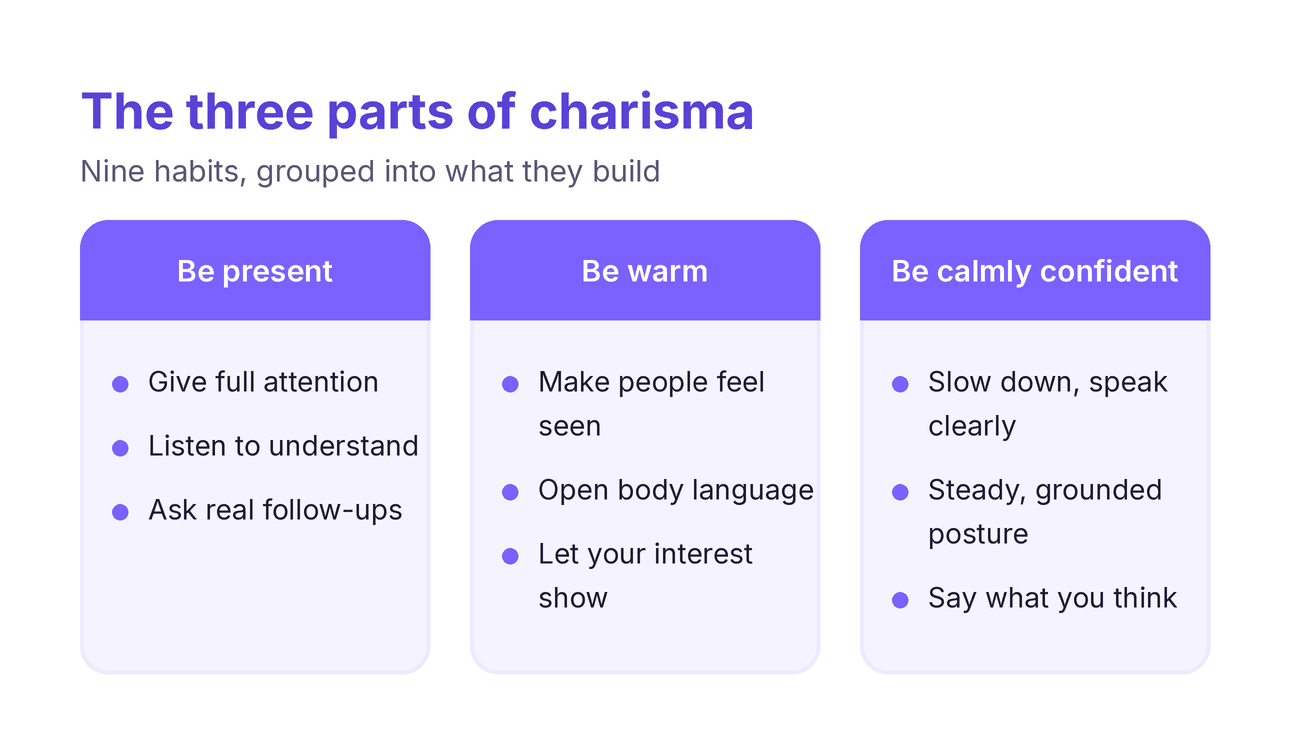
To be more charismatic, you build a few everyday habits that make people feel comfortable, interesting, and understood around you. It comes down to three things you can practice: being fully present (give people your full attention, listen to understand instead of waiting to talk, and ask questions that go somewhere), leading with warmth (make people feel seen, use open body language, and let your real interest show), and carrying calm confidence (slow down when you speak, hold steady posture, and say what you honestly think). None of this needs a big, loud personality.
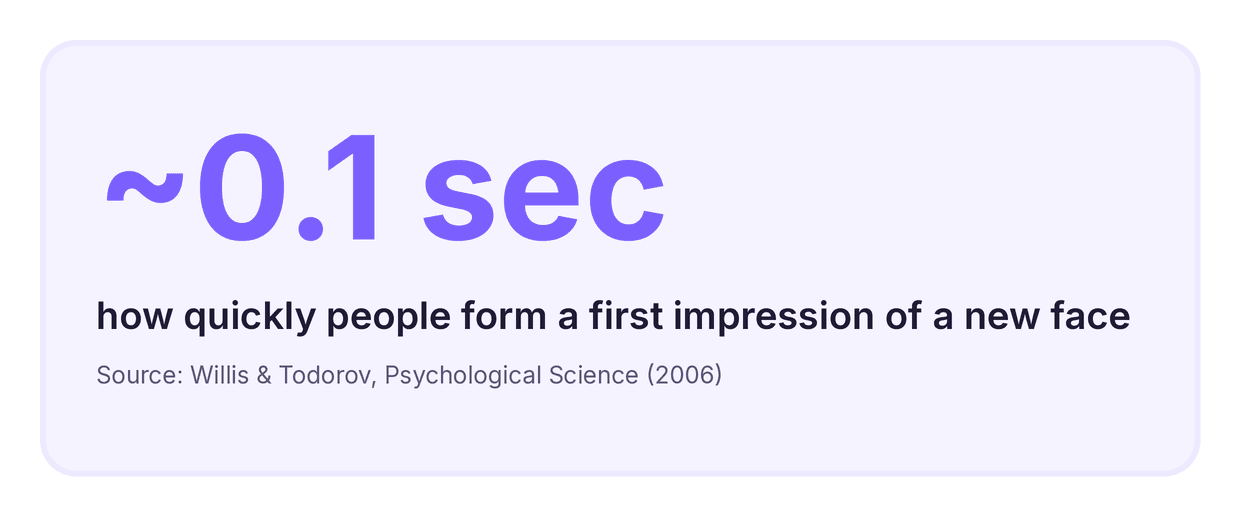
Some people walk into a room and others just want to be near them. We tend to call that charisma and assume it's something you're born with. Most of it is learned. Researchers who study this have found that charisma can be trained: when people practice a specific set of speaking and body-language habits, others rate them as more charismatic and more worth following. First impressions form fast, too. In one well-known study, people judged a face in about a tenth of a second. So the way you show up in the first few minutes carries real weight, and you can shape it.
This guide breaks how to be charismatic into nine habits you can practice, grouped into three parts: being present, being warm, and being calmly confident. You don't need all nine at once. Pick the part where you feel weakest and start there.
A charismatic person usually isn't doing anything mysterious. They're doing a handful of small things consistently, and those things add up to a feeling other people can't quite name. Most of that feeling comes from three ingredients: presence (they're actually here with you), warmth (they seem to like you and mean you well), and calm confidence (they're comfortable in their own skin). When all three are present, people relax, open up, and enjoy the time with you.
It helps to separate charisma from personality. Being loud, funny, or the center of attention is a different thing. Plenty of quiet people are deeply magnetic because they make everyone around them feel important. If you want the full picture of the trait itself, here's what charisma is — the definition, the traits, and the research. This post stays practical: the habits that build it.
The reason this matters is simple. Charisma isn't a fixed trait you either have or lack, so anyone can learn how to have more of it. You build it the same way you build any skill, by practicing the pieces until they feel normal.
Presence is the foundation, and it's the part most people skip. When you give someone your complete attention, they feel it, and that feeling is rare enough to stand out. These three habits are about being there in a conversation instead of half-listening while you plan your reply.
The single fastest way to seem charismatic is to make the person in front of you feel like the only person in the room. Put your phone away, turn your body toward them, and let the rest of the room fade for a minute. Most people are scanning for someone more interesting or rehearsing what they'll say next, and others can tell. When you resist that and stay with the person, you become the exception they remember.
Full attention also means letting small silences sit. You don't have to fill every gap. A short pause after someone finishes shows you're taking in what they said rather than waiting for your turn.
Most of us listen just enough to find our opening. Charismatic people listen to understand, then respond to what was said. The difference is obvious to the other person even if they can't name it.
A simple way to practice: before you answer, briefly reflect back what you heard. "So the move went well, but the new commute is wearing you down." That one sentence tells the other person you were with them the whole way. It also slows you down enough to give a real response instead of a generic one.
Good questions are the engine of a good conversation, and they make you more likable. People who ask more questions, especially follow-up questions that build on the last answer, come across as more responsive and are better liked for it. A follow-up shows you were listening and you want to know more.
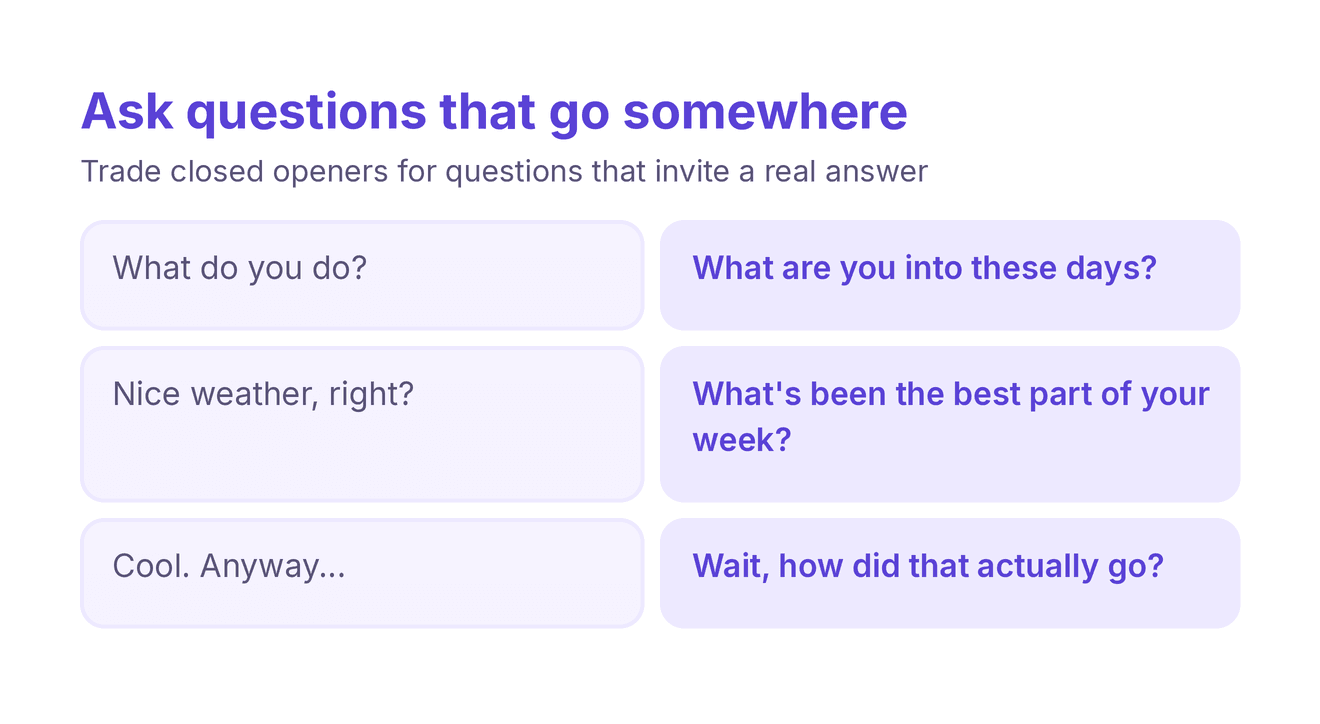
Trade "what do you do?" for questions that invite a real answer: what someone's excited about lately, what a project is actually like, what changed their mind about something. Then follow the thread they seem most alive talking about. If starting conversations is the hard part for you, these small talk openers can help until this feels natural.
Presence makes people feel heard. Warmth makes them feel liked. Together they're most of what people mean by charisma. Warmth can't be faked for long, so these habits are about letting real goodwill show instead of hiding it behind a neutral face.
Use someone's name when you talk to them. Remember the small things they mentioned last time, and bring one up. "How did your dad's surgery go?" or "did you end up taking that trip?" tells a person they registered with you, which is a quiet form of respect most people rarely get.
You don't need a perfect memory for this. Jot a note after meeting someone if you want. The point is to treat people as continuous, not as strangers you meet fresh each time.
A lot of warmth is nonverbal. Uncross your arms, keep your shoulders loose, and let your face respond to what people say. Make steady eye contact without staring, and let a real smile happen when something is funny or good. People read these signals faster than your words, and closed or blank body language can undo a warm sentence.
The goal is open and relaxed, not performed. If you want to get better at reading and sending these signals, here's how to read body language — what different cues mean and how to read them in clusters rather than one at a time.
Charismatic people are generous with their attention and their reactions. When someone shares good news, they light up for them. When someone's struggling, they show they care. Real reactions matter more than flattery here, which people see through anyway. Let your responses reach your face and voice instead of keeping everything flat and cool.
Enthusiasm is easy to hold back because it feels safer to seem unbothered. But a warm, interested reaction is a gift, and people are drawn to those who give it freely.
The last piece is how you hold yourself. Confidence here means being settled enough that other people feel safe around you. It isn't about dominating a room or being the loudest voice. Nervous, rushed energy makes people tense, while calm, grounded energy puts them at ease.
When people are nervous they speed up, trail off, and pack in filler words. Slowing down does the opposite. A steadier pace, with pauses where they belong, makes you sound more sure of what you're saying, even when you're still figuring it out.
Try leaving a beat of silence before you answer a real question. It reads as thoughtful, not slow, and it gives your words more weight. Cutting a few "ums" and "you knows" helps too, and a short pause is a better placeholder than a filler word anyway.
Stand and sit like you're comfortable being there. Feet planted, spine easy, hands still rather than fidgeting. You don't have to puff up or take up the whole couch. Steadiness is what reads as confidence, while constant fidgeting or shrinking reads as unease and makes others uneasy in turn.
Stillness matters when you talk, too. Scattered, restless movement is distracting, while calm, purposeful gestures help people follow you. If you tend to fidget, give your hands a light anchor, like resting them on the table, until steadiness feels normal.
People are drawn to those who have a point of view. You don't need strong opinions on everything, but sharing what you honestly think, like, and want makes you a real person instead of a mirror. Agreeing with everything to be liked has the opposite effect, because it gives people nothing to connect to.
Say the small true things: what you'd prefer for dinner, what you liked about the film, where you gently disagree. Done with warmth, having a view of your own is part of what makes a person magnetic. Being able to hold a boundary matters here too, and learning to be more assertive without turning pushy helps.
Charisma doesn't look the same on everyone, and copying a style that isn't yours reads as fake. In her book The Charisma Myth, author Olivia Fox Cabane describes four styles, and most people have one that fits them best:
You don't have to pick one forever. But knowing which comes most naturally tells you how to build charisma that actually fits you, instead of copying someone else's. A warm, quiet person should lean into focus and kindness rather than trying to command a room.
If none of this feels natural yet, that's normal, and it isn't a sign you lack charisma. Knowing how to be more charismatic when you're not a natural extrovert comes down to practicing one habit at a time until it stops feeling like effort.
Pick a single habit from the part where you're weakest. Maybe it's putting your phone away and giving one person your full attention today, or asking one real follow-up question in your next conversation. Small reps in low-stakes moments, like chatting with a barista or a coworker, build the skill without pressure. That is how to have charisma over time: presence, warmth, and calm confidence, repeated often enough that they become how you show up.
If shyness or nerves are the real barrier, start there. Here's how to be less shy and ease into social situations at a pace that works. And if communication is the skill you most want to build, the Communication Mastery journey in RiseGuide turns this into short, interactive lessons and practice, from reading body language to holding a conversation, so you can work on one habit at a time from your phone.
Charisma isn't a gift a lucky few are born with. It's a set of habits any person can build: being present, being warm, and being calmly confident. Start with the one that feels furthest from you right now, practice it in ordinary conversations, and give it time. The way people respond to you will shift long before the habits feel automatic.
To be charismatic means people feel drawn to you and enjoy being around you. In practice it comes from three things working together: presence (you give people real attention), warmth (you seem to like and care about them), and calm confidence (you're settled and easy to be around). It's less about being impressive and more about how you make other people feel.
Yes. Charisma is about how you make others feel, not how loud or outgoing you are. Many shy people are very charismatic because they listen closely and make people feel important. Quiet presence and warmth often land harder than a big personality. Working on shyness and working on charisma can happen at the same time.
Yes. Research on charisma training shows people can become measurably more charismatic by practicing specific habits in how they speak and carry themselves. Like any skill, it grows with practice. The behaviors in this guide are the place to start.
Charisma is a tool, and it can be used to manipulate as well as to connect. Someone can use warmth and confidence to win trust they haven't earned, or to talk people into things that aren't good for them. That's why charisma works best paired with honesty. The aim is to make people feel good and be truthful with them, not to perform warmth to get something.
Watch how people respond to you. Do they open up, relax, and seem glad to talk with you? Do they remember your conversations and seek you out? Those are better signs than whether you're the loudest person in the room. If you're not sure, work on the habits above and notice what changes.