
RiseGuide Team

To be more assertive without coming across as pushy, get clear on what you actually want before the conversation, say it plainly using "I" statements instead of accusations, and make one direct ask rather than hinting and hoping. Keep your tone even and your body language steady, say no without a paragraph of excuses, and hold your position calmly when it gets tested. Assertive means stating your needs while respecting the other person's; pushy means ignoring theirs. The difference is in how you say it, not how loudly.
In a 2026 survey, about six in ten employees said they hold back from speaking up at work. Most people who want to speak up more are not aggressive people trying to soften up. They are careful people who have learned that saying what they want feels risky, so they wait, hint, or go along with things and resent it later.
The worry underneath "how do I speak up more" is usually "how do I speak up without becoming the difficult one." That fear is what keeps a lot of reasonable requests unspoken. The line between assertive and pushy is clearer than it feels in the moment, and staying on the right side of it comes down to a few habits you can practice.
Assertiveness is easiest to understand next to the two things it sits between. The Mayo Clinic describes it as direct, respectful communication based on mutual respect — you state your own needs while still accounting for the other person's.
Passive communication puts everyone else first. You say yes when you are already stretched, keep quiet when something bothers you, and hope people will notice what you need without being told. It avoids friction now and trades it for resentment later.
Aggressive communication does the opposite, pressing your needs at the expense of the other person's: talking over people, using pressure or blame, treating a conversation as something to win. It can get a fast result and costs you trust every time. There is also passive-aggressive communication, where the disagreement leaks out sideways through foot-dragging, a sarcastic comment, or going quiet. Being assertive is the option that says the real thing, once, in a way the other person can actually respond to. If you want to see how the four fit together, we break them down in communication styles.
Pushy sits right next to assertive but carries an aggressive edge: the right request, delivered in a way that runs over the other person. That is why you can ask for exactly what you need and still land badly. The problem is rarely the ask itself, which is also the difference at the heart of assertive versus aggressive behavior.
Two things make this harder than it sounds.
The first is that if you are used to keeping the peace, a normal request feels enormous from the inside. Saying "I can't take that on this week" can feel confrontational to you while landing as perfectly ordinary for the person hearing it. Your internal alarm is calibrated to years of not asking, so the volume feels wrong even when the words are fine.
The second is that once people decide to be more direct, some overcorrect. They brace for a fight that is not coming and arrive with more force than the moment needs. The other person reacts to the tone, it confirms the original fear that speaking up goes badly, and they retreat to passive again. Assertiveness gets blamed for a delivery problem.
Getting this right is less about finding courage in the moment and more about having a way to say the thing that keeps you clear and calm at once.
Most requests come out muddled because they were never sorted out first. Before the conversation, name three things for yourself: the specific behavior, the effect it has on you, and what you want instead. "The meeting keeps running over, I miss my afternoon block, and I'd like us to end on time" is something a person can act on. "I'm a bit stressed about time" is not.
Start from your own experience rather than the other person's fault. The Mayo Clinic's example is the clean version: say "I disagree" rather than "you're wrong." "I need the file by Thursday to hit the deadline" invites cooperation; "you always send things late" invites an argument. It is the same information, landing very differently.
For anything you are dreading, a structure helps so you are not composing under pressure. One that has been around for decades comes from Sharon and Gordon Bower's book Asserting Yourself, often shortened to DESC: describe the situation plainly, express how it affects you, specify what you would like, and note the payoff. In practice: "When calls come in after nine, I don't sleep well and I'm foggy the next day. Could we keep them to before nine unless it's urgent? That way I'm actually useful when we talk." You do not need it word for word; having the shape in mind keeps you from rambling or backing down. It is one of the more useful assertive communication techniques for a conversation you have been avoiding.
A long justification is an invitation to negotiate. Keep a no short, and add an alternative only if you mean it: "I can't make Saturday. I could do the following weekend if that helps." The line that gets passed around online — that no is a complete sentence — overstates it for most everyday situations, where a brief reason is kinder. The instinct to keep explaining until the other person approves is the part to cut. When the topic is a bigger recurring limit rather than a one-off, that is really about setting boundaries, a related skill worth its own attention.
You can say the right words and undo them with delivery. The Mayo Clinic's list for assertiveness includes keeping an upright posture, steady eye contact, and an even voice, and slowing your breathing to stay calm. A request made in a level tone reads as assertive; the same words rushed, clipped, or over-loud read as aggressive. If eye contact and posture are the hardest part, look more confident goes deeper on the physical side.
Almost every clear request gets a little push in return. Assertiveness is what you do next. Acknowledge the other person and repeat your point calmly: "I hear that it's inconvenient, and I still need it by Thursday." Staying steady through the second and third round signals the request was real, and doing it without sharpening your tone keeps you from sliding into pushy. Disagreeing while keeping the relationship intact is a skill of its own, and it helps to know how to disagree respectfully.
The Mayo Clinic suggests beginning with low-risk situations and practicing aloud before the ones that matter. Send back the wrong coffee order, tell a friend which restaurant you actually want, ask a colleague to clarify instead of nodding along. Each low-stakes rep recalibrates that internal alarm, so the bigger conversations feel less like a cliff edge.
Language is easier to find before you need it than during a tense moment. These assertive communication examples are worth adapting:
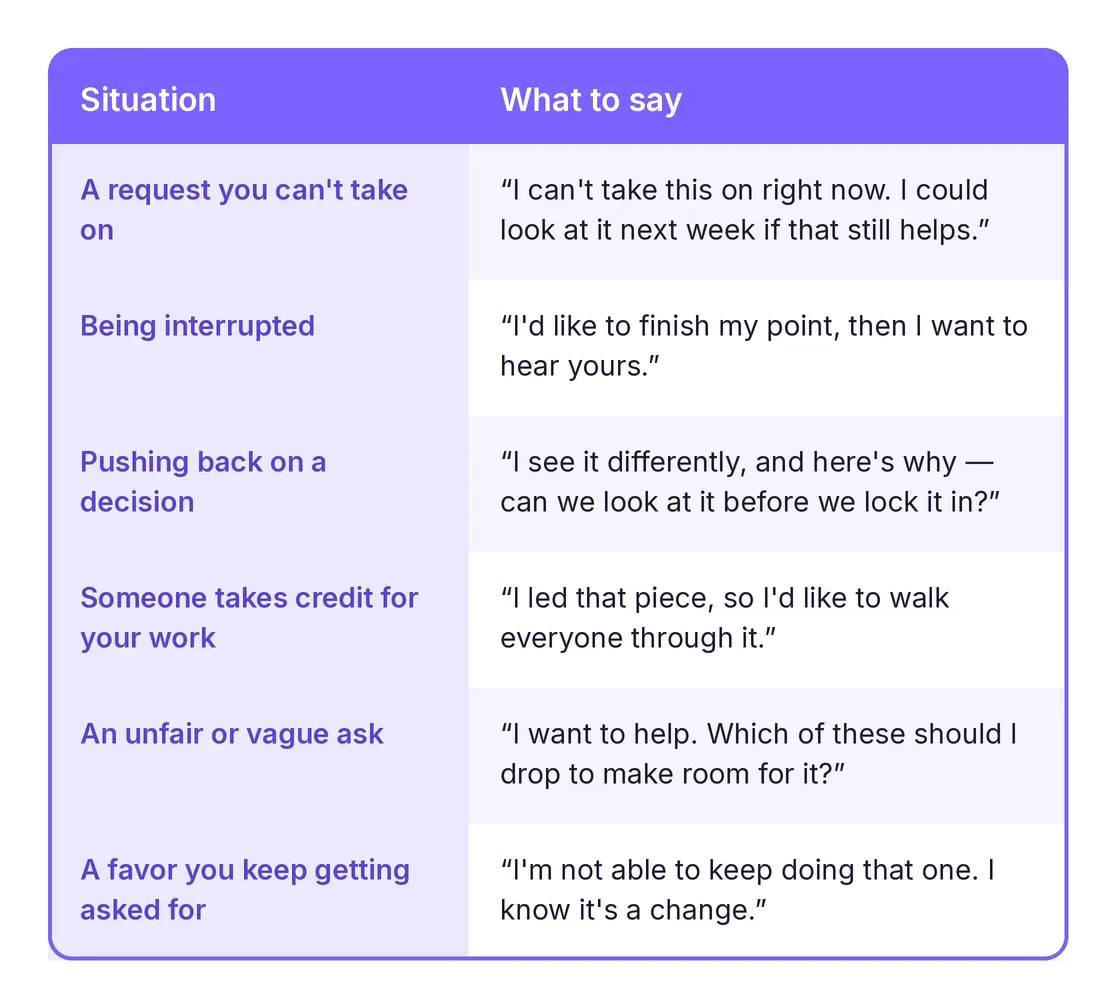
Two things make these work: none include a long apology, and none ask for permission to have the need in the first place.
Work is where most people feel the gap most, because the cost of staying quiet is a heavier workload and less credit. A few things make it easier to be assertive at work without reading as difficult.
Frame requests around the work rather than your feelings. "I can take this on if we move the other deadline — which would you rather have?" gives your manager a decision to make instead of a limit to argue with. Put agreements in writing once after a conversation, so the limit is a shared reference rather than something either of you has to remember. And apply it consistently, since a limit you drop whenever the week gets busy teaches people to wait for a busy week.
A couple of situations come up again and again. Meetings dominated by one person are their own skill: Jennifer Layman, a marketing and communications consultant and one of our experts, lays out the moves for handling a meeting dominator. Figuring out how to be assertive with rude coworkers is mostly keeping your response factual and unbothered — "I'm happy to go through this, and I'd like us to keep it civil" names the behavior without matching it. If your own habit is jumping in early, being more assertive can mean listening longer first, which is where learning to stop interrupting comes in.
If you want to rehearse this kind of phrasing before using it for real, RiseGuide's Communication Mastery journey is built for that — short lessons drawn from the work of communication experts, with tools like the Speech Analyzer and Small Talk Simulator to practice saying things out loud in a low-stakes setting.
Being more assertive has little to do with volume. It comes down to knowing what you want, saying it once in plain words, and staying steady when it is questioned, while still leaving room for the other person's side. Pushy is what happens when that last part drops out. Get clear, keep your tone level, stop over-explaining, and hold your ground calmly, and you can ask for what you need and keep the goodwill.
Usually because saying yes and staying quiet has been the path of least resistance for a long time, so a normal request now feels bigger and riskier to you than it is to the person hearing it. It is a trained habit, not a fixed trait, which is why small, repeated practice changes it.
Using "I" statements instead of blame, making one clear direct request, saying no without over-explaining, keeping an even tone and steady eye contact, and calmly holding your position when it is questioned.
State your own need without running over the other person's. Assertive keeps mutual respect in the room — you say the real thing and still let them respond. Aggressive presses the point through pressure, blame, or volume. Same request, and the delivery decides which one it is.
Be clear about the what and warm about the how: a level tone, a short reason if it helps, and no sarcasm or personal jabs. Firmness lives in repeating your point calmly rather than in sharpening it.