RiseGuide Team

To set boundaries without feeling guilty, decide what limit you actually need, say it plainly and early, and back it with action the first few times it gets tested. Expect the guilt to arrive anyway — it shows up because many of us learned that keeping other people comfortable is our job, not because the limit was unfair. Name the specific behavior and what you need instead, then stop explaining. Hold the line through the initial pushback, since that is what teaches people it is real. The guilt tends to fade within a few rounds, and most people react better than you expect them to.

⚠️ Disclaimer: The content provided in this article is for informational and educational purposes only and is not intended to be a substitute for professional psychological, psychiatric, or medical advice, diagnosis, or treatment. Always seek the advice of your physician or other qualified mental health provider with any questions you may have regarding a medical condition or mental health objective.
Almost half of American adults describe themselves as people-pleasers, and among those who do, 48% say it has made their life harder — according to a YouGov poll of 1,122 U.S. adults. Just over half say they struggle to say no at least somewhat often.
The difficult part of how to set boundaries is rarely finding the words. It is what happens after you say them: the replaying, the softer version you start drafting in your head, the urge to walk it back before anyone has even responded. Guilt is the reason most limits get stated once and then dropped.
A boundary is a limit on how you are willing to be treated and what you are willing to take on, plus what you do when that limit is ignored. The second half is the part people skip. A stated preference with nothing behind it is a request, and requests are easy to overlook.
It also helps to know which kind of limit you are dealing with, because "I need more space" is too vague to act on. In Set Boundaries, Find Peace, therapist and author Nedra Glover Tawwab sorts them into six types of boundaries.
Your body and your personal space - how much closeness or touch you are comfortable with, and who gets access to your home and your things.
How much of your inner life you share, and how much of other people's you absorb. This is the one that gets crossed when a friend uses you as their only outlet, or when someone dismisses what you have just told them.
How your hours get spent and who gets to claim them. Time is where most people notice the problem first, because the evidence piles up in a calendar. As Tawwab put it in a TED podcast conversation:
"Time is a place where we allow people to dictate what we're supposed to be doing."
Which topics you are willing to debate and how your ideas get treated. Ending a conversation that has turned into a lecture is an intellectual boundary.
Your money and possessions - what you lend, to whom, and on what terms.
Consent, and what you consider acceptable in the way sex is discussed, joked about, or initiated.
Boundaries vs control is worth separating early, because confusing the two is what makes people feel like the bad guy for asking. A boundary governs your own behavior: what you will do, what you will be part of, when you will leave. Control governs someone else's: what they must feel, say, or stop doing.
"I'm not discussing my relationship at dinner" is a boundary. "You need to stop being nosy" is an attempt at control. The first one you can enforce on your own; the second depends entirely on the other person cooperating. Therapist and author Terri Cole uses this distinction as a guilt test, writing on her site:
"As long as your heart is in the right place and you are not setting a boundary to be mean or to control someone else, your side of the street is clean."
Boundary issues rarely announce themselves. They show up as low-level symptoms you have stopped questioning:
Having no boundaries is usually not a decision anyone made. It is what happens when saying yes has been the path of least resistance for years, and the cost has been arriving in small installments the whole time.
The order here matters. You cannot communicate a limit you have not defined, and holding a limit only works once it has been stated out loud. Each step depends on the one before it.
Write down the behavior, the effect, and what you want instead. "My sister calls me at 11pm about her work problems, I lose sleep, and I want those calls to happen before nine." Vague limits get renegotiated, because there is nothing definite to point back to. If putting it into a single clean sentence is the sticking point, the two-sweep method is a useful way to get there.
Most limits get raised at the worst possible moment - after the fifth violation, in a tone that carries all four previous ones. Raise it while you are still neutral and it lands as information rather than an accusation. Melissa Urban, author of The Book of Boundaries, described what waiting produces:
"That feeling of, of being resentful except it's kind of not their fault because I haven't communicated what I needed."
Softening a limit until it disappears feels considerate and creates a second problem, because now the other person is going to cross a line they were never actually told about. Brené Brown makes the case for directness in Dare to Lead:
"Clear is kind. Unclear is unkind."
Establishing boundaries clearly does not mean being cold about it. Name the limit, give one reason if you want to, and stop there. The instinct to keep talking is usually the instinct to get permission.
Guilt after setting a boundary is not evidence that you did something wrong. It is what discomfort feels like when you break a pattern you were trained into. Tawwab has traced where it comes from:
"I think that the guilt is something we are taught as a way to get us to conform, right?"
Naming it as a familiar feeling rather than a signal is what stops it from reversing your decision. If the guilt arrives with commentary - that you are selfish, that you have damaged something - that is worth handling as an inner-critic problem rather than a factual assessment.
Almost every limit gets tested once. What you do on that occasion is what people actually learn from, which is why the stating alone so rarely works. Tawwab again:
"The behavior piece is sometimes the part that we struggle with the most because we think once we've said it, that the other person will take our boundary and now implement it."
If the 11pm calls continue, the boundary is not another conversation. It is not answering, and calling back the next morning.
Someone can be disappointed by your limit without your limit being wrong. Holding both of those at once is the part that takes practice, and it is where people usually cave. Urban puts the division of labor plainly:
"Your reaction to my boundary is not my business. And like that is yours to process and handle."
Two things inflate it, and both are worth knowing before you have the conversation.
The first is that you are almost certainly overestimating the fallout. In a 2024 study in the Journal of Personality and Social Psychology, Julian Givi and Colleen Kirk ran five experiments with over 2,000 participants and found that people who decline an invitation consistently expect the other person to be angrier, more disappointed, and less likely to invite them again than that person actually is. In their pilot, 77% of respondents admitted they had accepted an invitation they did not want purely out of worry about declining. The pattern held even among couples who had been together five years or more.
The second is that what you are calling guilt is often fear. Cole suggests checking which one you are dealing with:
"When you say you feel guilty for setting a boundary, I want you to dig deeper. Are you actually afraid? Is it fear or anxiety presenting as guilt?"
Fear of rejection responds to different treatment than guilt does. Guilt asks whether you did something wrong. Fear asks what it will cost you - and that question usually has a more manageable answer than it feels like it does.
Work boundaries are easier to hold when they are framed around the work rather than around your feelings, because that keeps the conversation on ground you share with your manager. "I can take this on if we move the other deadline" is a workable version of no. So is "I'm offline after seven, and I'll pick this up first thing."
Three things help:
Meetings are where work limits get tested most visibly, especially when one person takes up all the available room. Jennifer Layman, a marketing and communications consultant and one of our experts, lays out the specific moves for handling the person who dominates every meeting. Pushing back on a decision without turning it into a conflict is a related skill, and disagreeing respectfully is most of it.
Family limits carry the most guilt, for a straightforward reason: these are the relationships where the old pattern was formed, so a new limit registers as a bigger break than it would anywhere else. Long-standing roles - the one who always helps, the one who never makes a fuss - get defended by everyone who benefits from them, usually without any conscious intent.
A few things make it more manageable. Start with the lowest-stakes limit rather than the one you care most about, so the first round is survivable. Expect the limit to be tested more than once, and treat repetition as normal rather than as failure. And skip the negotiation about whether your limit is reasonable, since that conversation has no ending. Tawwab's Drama Free works through this territory in detail.
There is also a version of this that goes better than expected. As Tawwab has said about stating a limit at all:
"It takes a lot of courage to stand up and say, 'This is the way I want to be treated.'"
Knowing how to set healthy boundaries is mostly a matter of having language ready before you need it. Borrow and adapt:
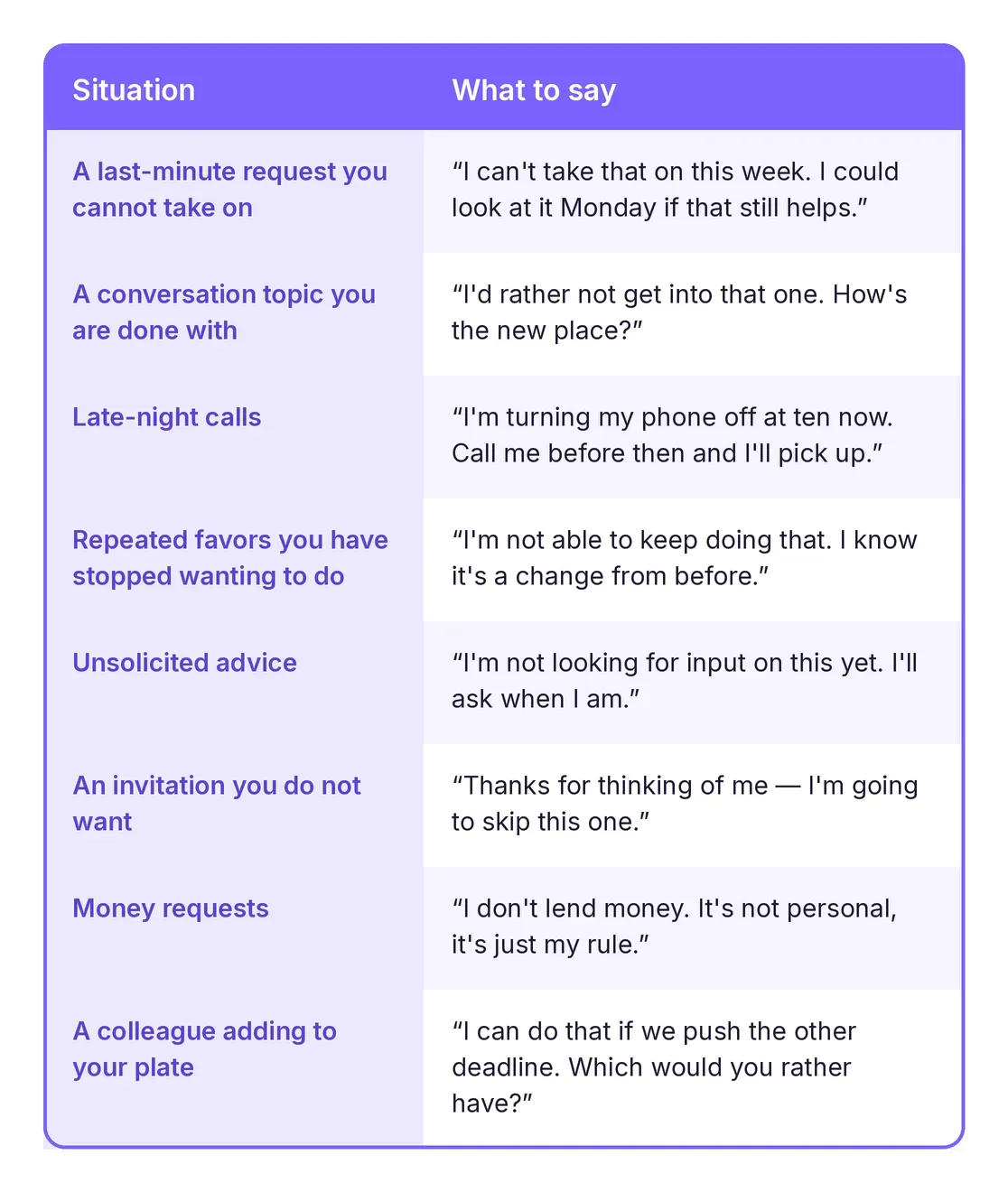
Two things make these work. None of them include a long justification, and none of them ask for approval. Clear boundaries tend to be short, and the brevity is what signals that the matter is settled. Over-explaining is one of the more common communication mistakes in exactly this kind of conversation.
If you want to go deeper than a single conversation:
How to set a boundary comes down to one specific sentence and then whatever you do the next time it gets tested. The guilt is not a sign you got it wrong, and it does not last as long as the resentment it replaces. Prentis Hemphill's line is the one worth keeping in mind on the days it feels selfish:
"Boundaries are the distance at which I can love you and me simultaneously."
Because guilt is what discomfort feels like when you break a pattern you were trained into, not because the limit was unfair. Tawwab describes guilt as something we are taught in order to get us to conform. It is also worth checking whether the feeling is actually fear of someone's reaction, which responds to different handling.
Six: physical, emotional, time, intellectual, material, and sexual. Naming which one is being crossed makes the limit far easier to state, because "I need more space" gives nobody anything to act on.
Frame the limit around capacity rather than preference — say what would have to give for you to say yes, and let your manager choose. Confirm it in writing once, and apply it consistently rather than dropping it in busy weeks.
Start with a lower-stakes limit than the one you care most about, expect it to be tested repeatedly, and skip the debate over whether it is reasonable. Family limits meet the most resistance because they change roles that have been in place for a long time.
Limits so rigid that nobody gets close, or so porous that anyone can override them. Both usually come from the same place, which is not having decided in advance what you are willing to take on.