RiseGuide Team

To read body language, you watch the whole set of signals a person gives off — their face, eyes, posture, hands and gestures, use of space, and tone of voice — and read them together instead of judging one gesture on its own. Start by noticing what's normal for that person, their baseline, then look for clusters of signals that point the same way and weigh them against the situation and the person's culture. Pay attention to what changes, because a shift from someone's usual behavior often says more than any fixed pose. And treat what you see as a clue about how someone might feel, not proof of what they're thinking. Even trained observers are only a little better than chance at spotting a lie from behavior alone.
Body language is everything you communicate without words: your facial expressions, the way you stand, what your hands do, how close you get to people, and the tone underneath your speech. It's one part of nonverbal communication, and most of us send and read it without thinking about it.
Learning how to read body language on purpose helps in ordinary moments. You notice that a friend has gone quiet, sense that a colleague disagrees before they say so, or pick up that the person across the table is ready to wrap up. Knowing how to read people's body language won't tell you exactly what someone is thinking, and anyone who promises that is overselling it. What it can do is give you better clues, so you respond to the person in front of you and not only to their words.
Reading body language is the everyday skill of noticing physical signals and making a sensible guess about what they might mean. Two ideas keep that skill honest.
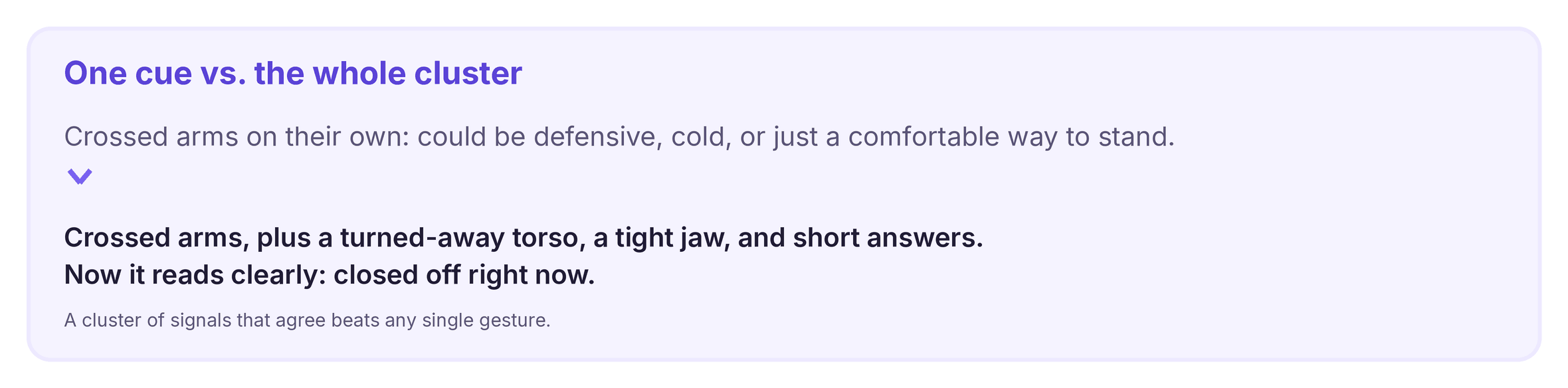
First, no single gesture has a fixed meaning. Crossed arms can mean someone feels defensive, or that the room is cold, or that it's simply a comfortable way to stand. A hand near the nose can be a nervous tell or an itch. A signal only becomes useful when you read it in context and next to other signals.
Second, body language is often oversold. You may have heard that 93% of communication is nonverbal. That number comes from Albert Mehrabian's 7-38-55 split — 7% words, 38% tone, 55% body language — which described how people judge feelings and attitudes when someone's words and tone don't match. It was never a rule about all communication, and Mehrabian has cautioned against stretching it that far. When you explain a plan or give directions, the words carry the meaning.
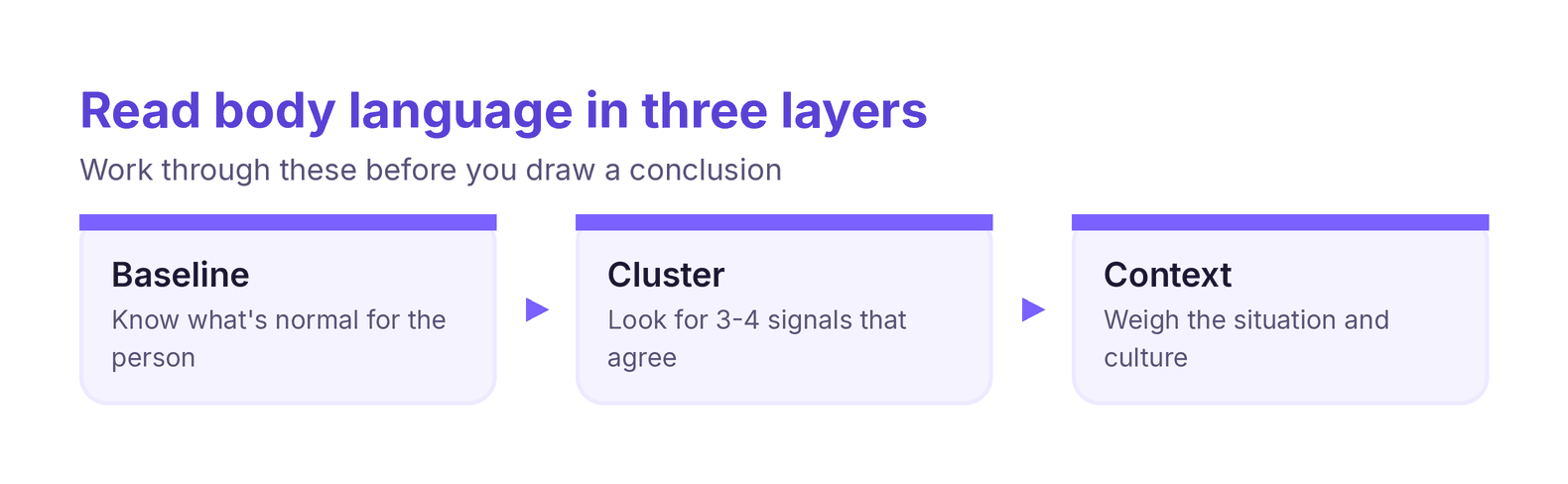
Before you read any single cue, notice how someone normally looks and acts when they're relaxed. That's their baseline: their usual amount of eye contact, how much they gesture, where they hold their hands, how fast they talk. People vary a lot. One person fidgets constantly; another sits still even when thrilled.
Once you know the baseline, meaningful signals are the ones that break from it. A friend who always talks with her hands going suddenly still is telling you something. A quiet coworker who leans in and starts gesturing is telling you something too. Reading body language is mostly reading change against a person's normal, which is also why you'll misread strangers more often than people you know well.
Body language shows up through several channels at once. You don't have to track all of them like a checklist. It helps to know what each one tends to carry, so a signal registers when it appears.
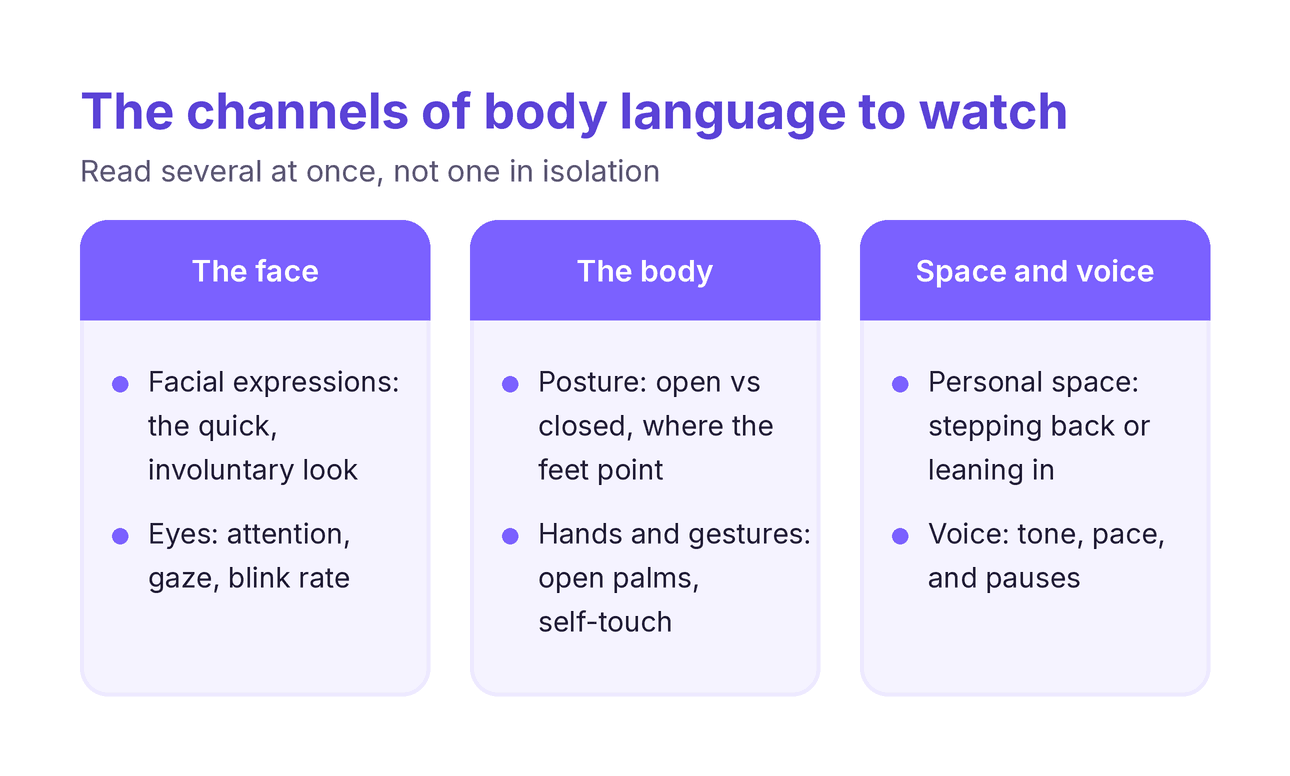
The face is the fastest channel. Psychologist Paul Ekman's research found seven universal emotions — anger, contempt, disgust, enjoyment, fear, sadness, and surprise — with facial expressions that people recognize across very different cultures. A real smile reaches the eyes and creases the corners; a polite one mostly moves the mouth. Expressions can also flash for a fraction of a second before someone covers them, so the quick, involuntary look often tells you more than the one a person holds.
Eye contact signals attention and comfort, but the "right" amount depends on the person and the setting. Steady, easy eye contact usually reads as interest. Someone who suddenly looks away, or who locks on far harder than usual, is showing a change worth noticing. Blink rate tends to climb when people feel stressed. Where someone points their eyes — toward you, toward the door, toward their phone — is a plain read on where their attention wants to go.
Posture carries confidence and engagement. An upright, open stance with the chest and shoulders relaxed tends to signal ease, while a hunched, closed posture can signal discomfort or low confidence. People also angle their torso and feet toward what interests them and away from what doesn't, so a person whose feet have turned toward the exit may be ready to leave even while still chatting. If you want to shape the signals your own stance sends, here's how to look more confident.
Hands are expressive and easy to watch. Open palms and visible hands generally read as honest and relaxed. Self-touching — rubbing the neck, playing with a ring, smoothing clothes — often shows up when people are soothing mild stress. Gestures that match what someone is saying suggest they mean it; gestures that lag behind or contradict the words are worth a second look. Remember the crossed arms point here: on its own it means little, so read the hands together with the face and posture.
How close people stand carries meaning too. Most people keep friends and family within arm's reach and hold acquaintances and strangers a bit further out. When someone steps back to reopen that gap, they may want more distance; when they lean in, they're usually comfortable. Comfortable distance varies by culture and situation, so treat it as a relative signal, not a fixed rule.
Tone, pace, volume, and pauses sit alongside body language and often confirm what the body shows. A voice that speeds up and rises can signal excitement or nerves; a flat, slow tone can signal boredom or low mood. A pause in an unexpected spot can mean someone is choosing words carefully. If the words say "I'm fine" while the voice drops and slows, trust the mismatch enough to check in.
If you'd rather build this up deliberately than pick it up piece by piece, RiseGuide's Communication Mastery journey includes a Body Language Vocab tool that walks through common cues and what they tend to signal, in short lessons you can finish in about fifteen minutes. It's a fit if reading people is the skill you most want to work on.
The single most useful habit is to stop reading cues one at a time. A cluster of three or four signals pointing the same way is far more reliable than any one gesture.
Take crossed arms again. By themselves they're ambiguous. But add a turned-away torso, a tight jaw, and short answers, and the cluster reads clearly as "closed off right now." Swap those for a relaxed face and a warm tone, and the same arms probably just mean the person is cold or settled. The other body language signs around a gesture are what give it meaning.
So when you notice one thing, look for two or three more before you draw any conclusion. If the signals agree, you can trust the read a bit more. If they conflict, that mixed picture is information too, usually that the person themselves feels two ways.
The same cue can mean opposite things in different settings. Little eye contact in a job interview might read as nerves; the same during a hard personal conversation might be respect or discomfort. Fast, big gestures at a party mean something different than at a funeral. Always ask what the situation would normally pull out of a person before you assign meaning.
Culture shapes the rules as well. Ekman's core expressions travel across cultures, but how much people show them, how much eye contact counts as polite, how close they stand, and what a given hand gesture means all vary by place and background. A gesture that's friendly in one country is rude in another. If you're reading someone from a different culture, hold your interpretations loosely and lean on the baseline and cluster habits even more.
Static poses tell you less than shifts. Someone can sit with folded arms for an hour and mean nothing by it. The moment their arms fold right after you mention a deadline, the timing is the signal.
Watch for the change and what triggered it: a smile that drops when a certain name comes up, a lean-in when the topic turns to something they care about, a step back when you move closer. Reading body language in real time is mostly catching these transitions and connecting them to what just happened.
Everything above comes together when you're actually talking with someone. The challenge is that you're listening and responding while also reading, so keep it light rather than turning the conversation into a study.
Stay mostly in active listening — focused on what the person is saying — and let the body language register in the background. Notice the broad state first: does this person look engaged or checked out? Signs of engagement usually cluster together, an open posture, a torso turned toward you, natural eye contact, gestures that track the conversation. Signs of pulling away cluster too: a body angled toward the door, shorter replies, more glances elsewhere, a phone that keeps coming out. When you catch a cluster like that, adjust — change the subject, ask a question, or wind things up.
New people are harder to read because you don't have their baseline yet, so give strangers more benefit of the doubt and watch for a few minutes before reading much into any one cue. If starting those conversations is the harder part for you, here's how to talk to strangers.
People most want body language to catch a lie, and this is exactly where it's weakest. There is no single gesture that reliably means someone is lying. Broken eye contact, fidgeting, and touching the face all get called body language signs of lying, yet honest, nervous people do all three, and practiced liars often do none of them.
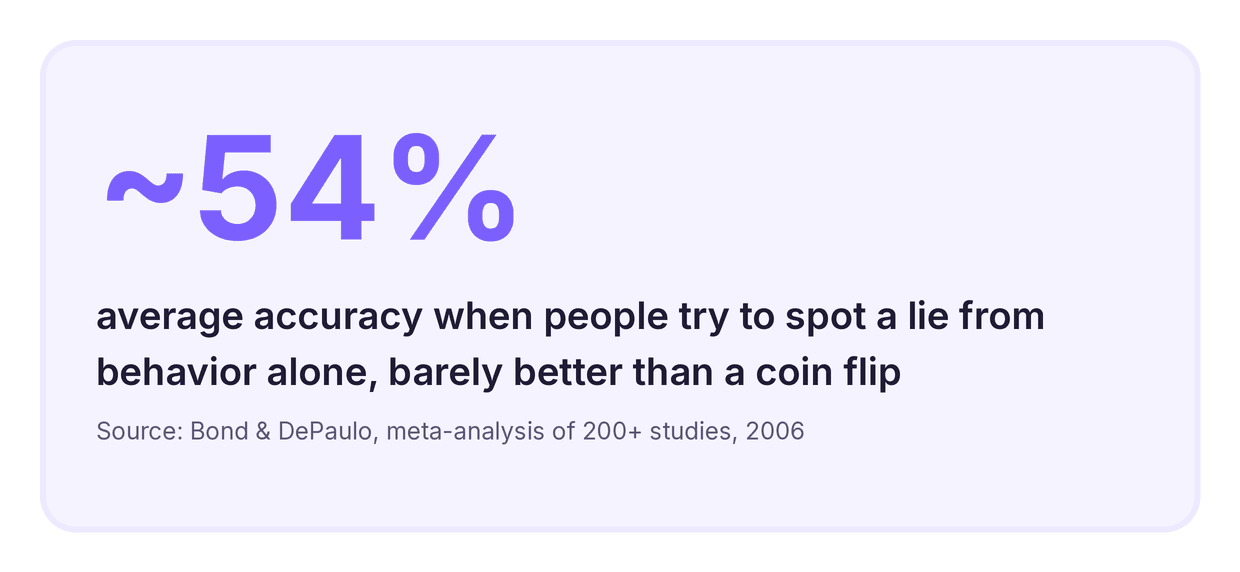
The research is sobering. A large review of studies found that people spot lies at an average accuracy of about 54%, barely better than a coin flip, and training tends to add little. So red flags in body language are clues to look into, not proof of anything on their own. A cluster of stress signals that appears right when a specific topic comes up, and breaks from the person's baseline, is worth noticing. It's a reason to ask another question, not a reason to conclude you've caught someone. Treat any "he crossed his arms, so he's hiding something" claim with real doubt.
Reading body language comes down to a few habits you can practice anywhere: learn a person's baseline, watch the channels without fixating on one, read signals in clusters, weigh the context and culture, and pay attention to what changes. Hold your reads as clues rather than certainties and you'll misread people less often. Like any communication skill, it gets easier the more real conversations you pay attention to.
They're the channels your body communicates through: facial expressions, eye behavior, gestures, posture and body movement, touch, use of personal space, and the voice qualities that sit alongside speech, such as tone and pace. Most everyday reads come from watching several of these at once.
Red flags are clusters of signals that break from a person's baseline and point the same way, such as a turned-away body, a tight face, and clipped answers appearing together right after a specific topic. A red flag is a reason to pay closer attention or ask a question, not proof of what someone is thinking, and no single cue counts as one on its own.
Start with the person's baseline, then read signals in clusters rather than one at a time, and weigh what you see against the situation and the person's culture. Focus on what changes from their normal behavior, and treat your interpretation as a likely read you can check, not a fixed conclusion.
No. Body language gives you clues about how a person might be feeling in the moment, not a transcript of their thoughts. Even skilled observers read it as probability, and studies show people are only slightly better than chance at judging something as specific as whether someone is lying.
The channels and the method are the same for everyone. Differences between two people come down to their individual baseline, the situation, and their culture far more than their gender, so reading someone as "a man" or "a woman" tends to lead you into stereotypes. Watch the actual person's baseline and clusters instead.