
RiseGuide Team
To be less shy, stop trying to turn yourself into an outgoing person and start working with the way you already are. Shyness usually means you take longer to warm up, so give yourself that time: arrive early, keep a few openers ready, and begin with low-stakes exchanges like thanking a cashier or asking a coworker one question. Move your attention off how you are coming across and onto the person in front of you. Practice in small, frequent doses instead of waiting to feel ready, since the discomfort eases with repetition rather than with more thinking. And check whether you are dealing with shyness or something closer to social anxiety, because that changes how you handle it.
Most of us have stood at the edge of a room, wanted to say something, and felt the moment pass while we talked ourselves out of it. Shyness is that gap between wanting to connect and finding it hard to start. It is common, it tends to run quietly under the surface, and it is far more workable than it feels in the moment.
It helps to name what shyness is and what it is not. It is not the same as being an introvert, who simply prefers less stimulation and recharges alone. It is closer to a hesitation around other people, a discomfort that shows up most when attention might land on you. Bernardo Carducci, who ran the Shyness Research Institute at Indiana University Southeast and spent decades studying it, concluded that shyness is a common trait rather than a defect. As he put it, "There is nothing wrong with being shy." Learning how to be less shy is really about removing the friction between you and other people while keeping the personality you already have.
If you have ever wondered why am I shy, the answer is usually a mix rather than a single cause. Part of it is temperament. Some people are wired to be more cautious in new situations, a pattern that often shows up early and stays into adulthood. Part of it is learned, shaped by early experiences, family, or a few moments that taught you to hold back. And part of it is the setting itself, since almost everyone feels shy in some contexts and not others.
Underneath most of it sits one mechanism Carducci described clearly: shy people are slow to warm up. They need a little extra time to settle into anything new, from a party to an ordinary conversation. That is not a defect in how you are built. It becomes a problem mainly when the world moves fast and you feel pushed to perform before you are ready. Seen this way, being shy is largely a matter of pacing, which is good news, because pacing is something you can plan around.
Before working on it, it is worth checking what you are actually dealing with, because how to overcome shyness and social anxiety are related but not identical problems. Shyness is a common personality trait. Social anxiety is a diagnosable condition where the fear of being judged is intense enough to disrupt daily life, sometimes to the point of avoiding situations entirely. Plenty of shy people never cross into social anxiety, and the everyday practices below are aimed at ordinary shyness.
The line between them is worth understanding, and we go deeper into the roots of the more serious version in our piece on where social anxiety comes from. If your discomfort feels closer to that end, with real avoidance or physical panic, the practices here can still help, but support from a professional is the more reliable route. For shyness itself, the rest of this guide is where to start.
The shift that matters most is where you put your effort. Carducci found that shy people often work hard at the wrong things: they talk themselves up in their heads, or they show up somewhere and wait for others to draw them out. What actually helps is practice in the real world, applied in small and specific ways. The techniques below are things you can start using this week, in any order.
Being less shy does not mean becoming the loudest person in the room. Carducci described a group he called the successfully shy: people who accept their nature and change how they act within it rather than fighting who they are. As he wrote,
"The successfully shy don't change who they are. They change the way they think and the actions they make."
Setting a realistic goal takes off a lot of the pressure. You are aiming to speak up when it counts and enjoy the people around you, not to audition for a personality you do not have.
Shyness feeds on self-focus. When you are tracking every word you say and imagining how you look, you have little attention left for the actual conversation. Carducci's central finding was that the fix lives outside your own head:
"To break free of the prison of shyness, you must stop dwelling on your own insecurities and become more aware of the people around you."
In practice this means getting curious about the other person, listening for what they care about, and asking a question because you want the answer. The relief is real, because attention can only be in one place at a time.
Since shyness is slowness to warm up, plan for it. Arrive early to a gathering so you settle in while the room is still quiet, rather than walking into a wall of noise. It is one of the most reliable moves before a networking event, where the room fills up fast. Ease in with easier exchanges before the harder ones. If you have a meeting or an event coming, spend a minute picturing how you want to open. None of this forces confidence on demand. It gives your natural pace the runway it needs.
One reason conversations stall is that shy people expect their first line to be perfect. It does not need to be. A simple, relevant opener does the job, and Carducci noted that people respond well to whoever is willing to start:
"People admire the person who is willing to take a risk and throw out a topic for conversation, but you have to make sure it has general appeal."
A few that travel almost anywhere:
If openers are the part you find hardest, we cover them in depth in our guide on how to make small talk without dreading it.
This is the technique most people skip. Carducci found that thinking happy thoughts on its own does little; the shy who improve are the ones who combine a better mindset with actual repetition. So treat ordinary moments as reps. Thank the barista and say one extra sentence. Ask a coworker how their week is going. Comment to the person next to you in line. Each small exchange is a chance to practice, and because shyness responds to repetition more than to analysis, the reps are what make overcoming shyness stick over time.
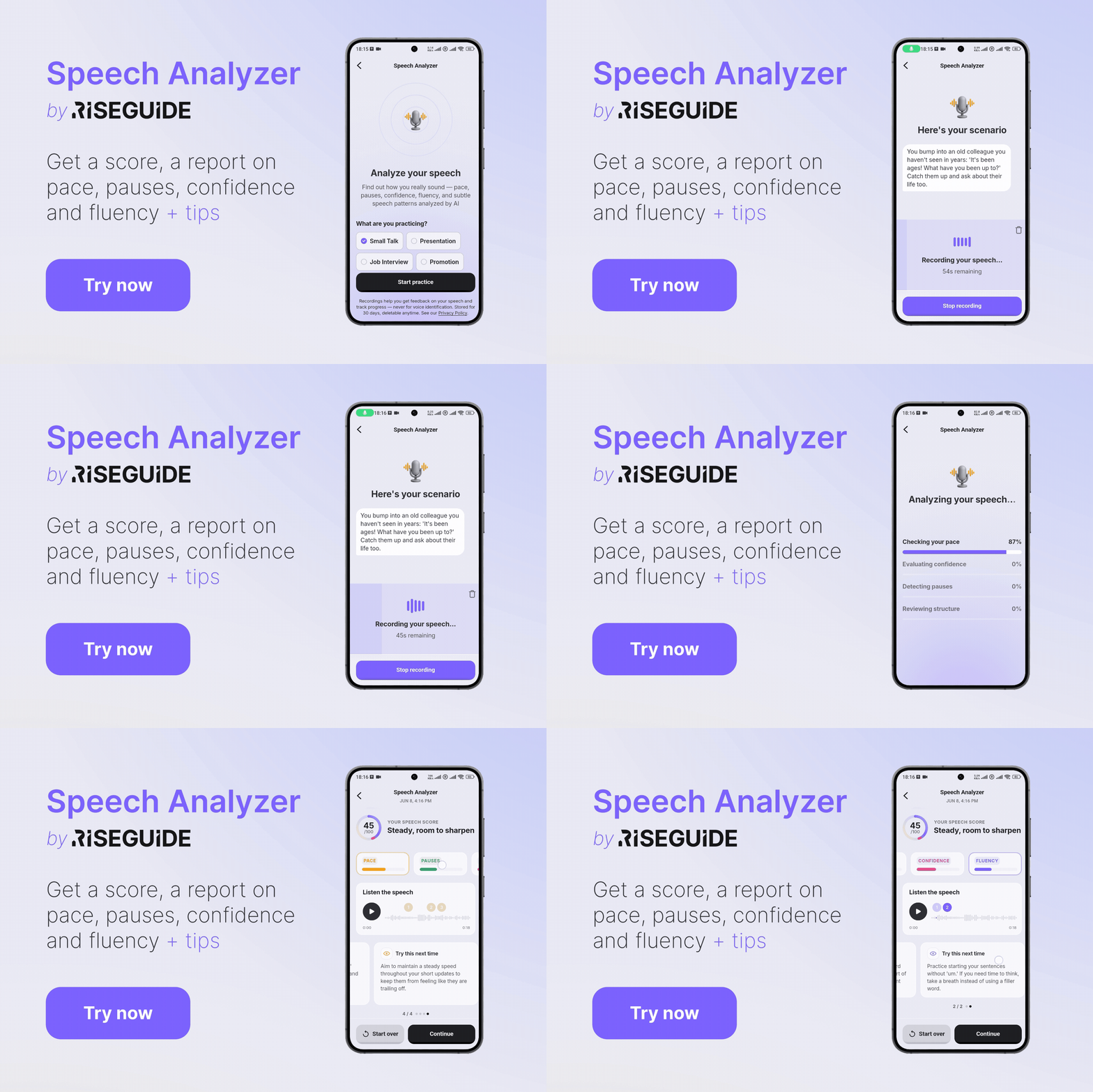
The hard part of practicing alone is that you rarely know how you came across, and you can freeze when you have to think of what to say on the spot. This is where a little structured rehearsal helps. RiseGuide, an expert-powered microlearning app, builds this into its Communication Mastery journey: the Small Talk Simulator hands you a scenario and lets you type a reply, then sends back feedback, while the Speech Analyzer lets you practice out loud and reports on your pace, pauses, and confidence. Rehearsing a conversation before it counts takes a lot of the guesswork out of the real one.
Try RiseGuide and run a scenario or two before your next social situation.
None of this depends on waking up as a different person. The next time you catch yourself hanging back, you need one real question that fits the moment and the willingness to ask it before you feel ready. Shyness loosens its grip a little each time you do this, and speaking up gradually becomes an ordinary part of your day rather than a hurdle.
Ready to practice with real feedback? RiseGuide's Communication Mastery journey lets you rehearse the conversations you find hardest, from small talk to speaking up at work, and see how you come across before it matters. Start with RiseGuide.
There is no single trick for how to stop being shy, but the reliable path is repetition plus a shift in focus. Practice low-stakes conversations often, aim your attention at the other person instead of yourself, and give yourself time to warm up in new settings. The discomfort fades with use.
When you feel it rising, the fastest move for how to not be shy right then is to get curious. Ask the person a real question and listen to the answer. It pulls your attention off yourself, which is where most of the discomfort comes from.
There is no fixed timeline for how to get over shyness, since it depends on how often you practice and the situations you face. Most people notice specific interactions feeling easier within a few weeks of regular, small reps, well before shyness stops being part of who they are.
Yes. Many strong communicators are naturally shy and have simply learned to work with it. If you want a starting toolkit, our roundup of the best apps to improve communication skills is a useful place to look.