RiseGuide Team

To start a conversation, open with something you both already share — the room, the moment, a small observation — then ask one real question and listen to the answer. The harder part is deciding how deep to go, so the starters below are grouped by depth: light openers, curious questions, and more personal ones, plus versions for friends and for texting. Match the question to the situation, then follow whatever the other person gives back. People are usually more willing to talk, and to go a little deeper, than we assume.
Most of us have stood next to someone we'd happily talk to and said nothing. The moment to speak arrives, the mind goes blank, and a few seconds later it has passed. It happens at parties, in waiting rooms, beside a colleague at the coffee machine, and in the message you type out and delete. Knowing how to start a conversation is one of the more useful social skills there is, and also one of the easiest to freeze on.
If you mainly want easy chit-chat, our guide on how to make small talk is a good companion.
Loneliness is more common than we tend to admit. A 2024 American Psychiatric Association poll found that 30% of U.S. adults had felt lonely at least once a week over the past year, and one in ten felt lonely every day. Many of those missed connections trace back to something small: standing next to someone with something to say and saying nothing.
The struggle also shows up plainly in how people talk about it online. On forums like Reddit, posts about trouble communicating and connecting are a constant, and the fear of starting a conversation comes up again and again. In one popular r/socialskills thread, someone put it precisely: "I'm a really good listener and I ask questions and I can add my own input. I feel like I really lack in starting conversations." They mentioned leaning on their job as a topic - "that's my crutch I always use" - and otherwise feeling like they had nothing to say. The replies were full of people who knew the feeling.
That captures why the start is the hard part. Holding a conversation is mostly a matter of responding to what the other person has already said, but starting one means coming up with the first line yourself, often before a silence settles. Those are different skills, which is why a good listener can still go blank at the opening. The pressure to sound interesting makes it harder still, and for some people it shades into social anxiety. In every version, though, the real problem is not a shortage of questions, so collecting more of them rarely helps.
What helps instead is keeping a few questions on hand, so you can choose from a short list rather than start from nothing. Which one fits depends on how well you know the person and how far the moment can go, so it is worth thinking less about the perfect line and more about the right depth.
When you start a conversation, the hardest decision is usually how personal to make it. The opening line matters less than its depth. Most people reach for the safest, shallowest question and stay there, assuming that anything more personal would be unwelcome. Research on how conversations actually unfold suggests that caution is usually misplaced. Nicholas Epley, a behavioral scientist at the University of Chicago's Booth School of Business, has studied people who held deeper than usual conversations with others, and found they had braced for an awkwardness that rarely arrived.
"Our participants' expectations about deeper conversations were not woefully misguided, but they were reliably miscalibrated in a way that could keep people from engaging a little more deeply with others in their daily lives." - Nicholas Epley, University of Chicago
The useful habit is to read how much depth a moment can take and then risk going slightly past what feels comfortable. How far you can go depends on the setting and on how well you know the person, so it makes sense to start with the lightest questions and work up from there.
The lightest questions are there to make the first exchange easy rather than meaningful. They show that you are friendly and give the other person a simple way to respond. Familiar openers like "How are you?" or "What do you do?" tend to invite equally automatic answers, which is why they rarely lead anywhere. Vanessa Van Edwards, who runs the research lab Science of People, has found that slightly unexpected questions tend to make you more memorable, because they ask the other person to think for a moment instead of reciting a stock reply. A small twist is usually all it takes.
These work at a party, in a class, or in a line, and they leave room for the other person to play along.
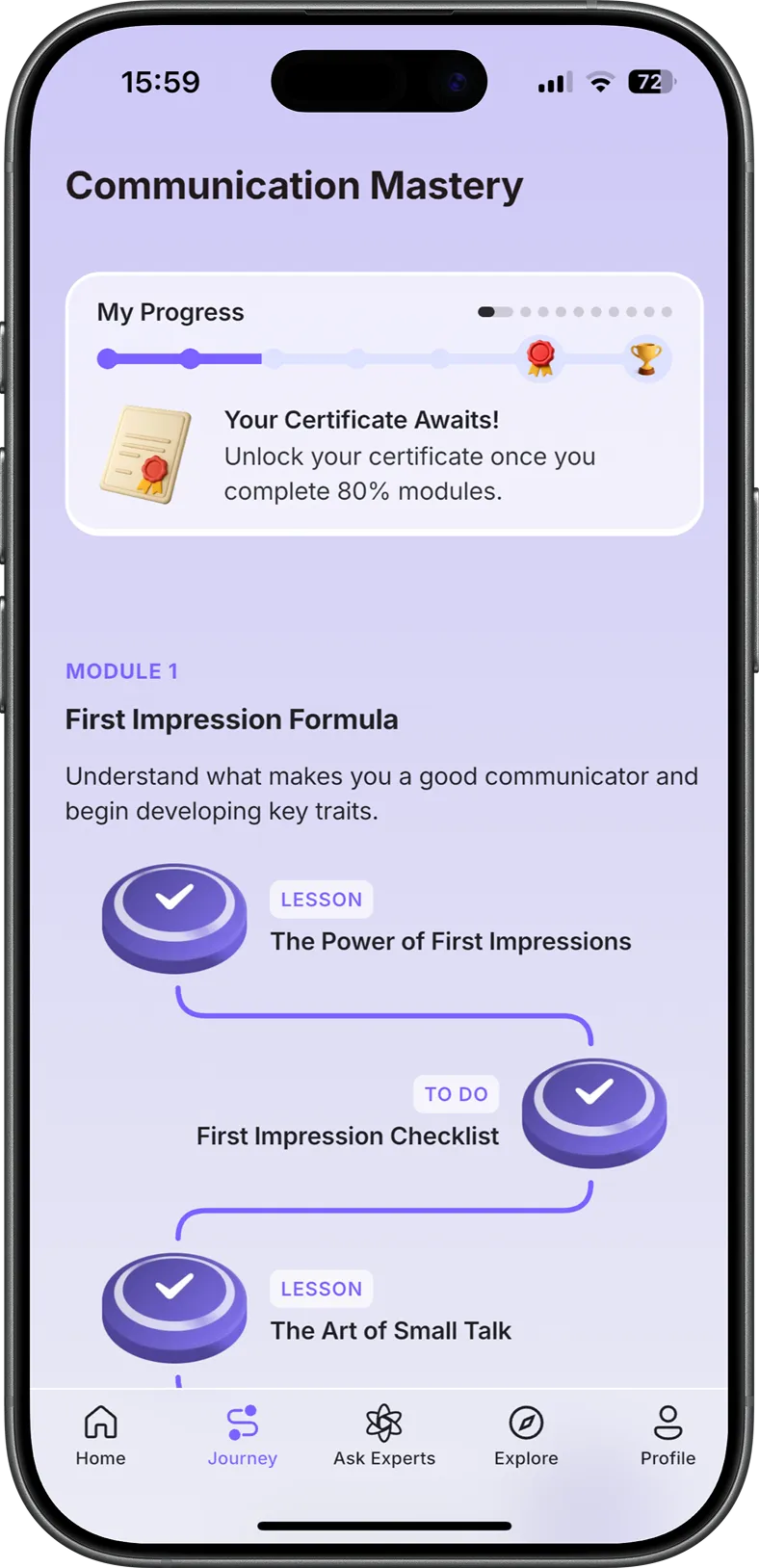
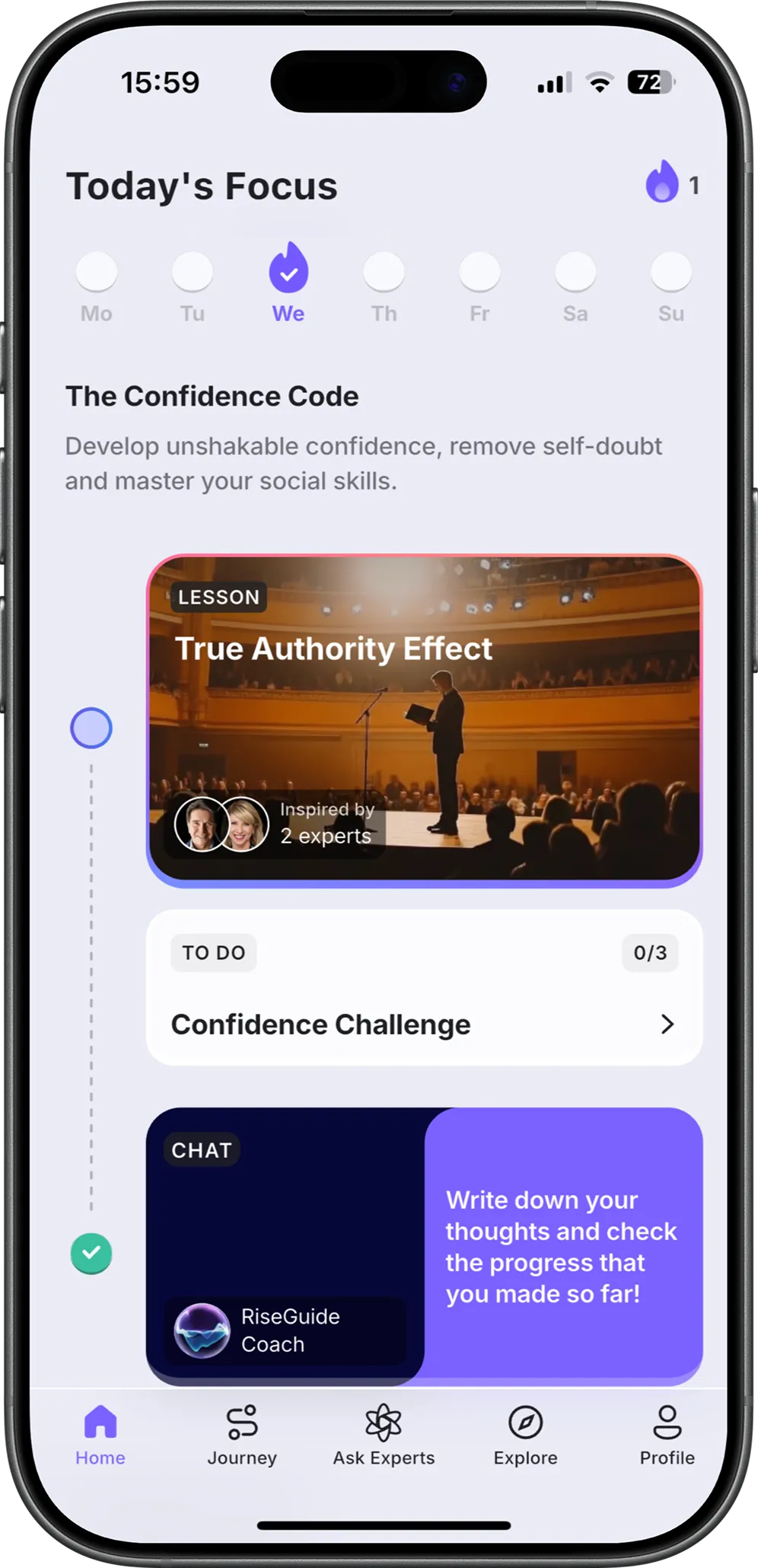
Knowing a good opener and using one under pressure are different skills. The Communication Mastery journey in RiseGuide lets you rehearse these moments Small Talk Simulator and Speech Analyzer, so the line is there when you need it. Start the journey
Once the first exchange feels easy, you can move to questions that invite the other person to talk about something they care about instead of stating a fact. These are the ones that open a real subject, and they tend to go better than people expect. As Epley's research suggests, reaching a little further is usually rewarded, so a slightly more curious question is worth the small risk.
When they answer, follow up on the part that interests you most, since a genuine follow-up usually carries a conversation further than jumping to a new topic.
The most personal questions are the ones that turn acquaintances into friends, and although they feel riskier, there is good evidence that they work. Psychologist Arthur Aron, at Stony Brook University, ran the well-known "36 Questions" study, in which pairs of strangers worked through a set of increasingly personal questions and came away feeling notably closer. His conclusion was that closeness can be built deliberately, through openness that grows in steps and runs in both directions. The important part is that it happens gradually: you earn the deeper questions by offering a little of yourself first.
Offer your own answer alongside each question, and let the depth build gradually rather than all at once.
With people you already know, there is no ice to break, so the difficulty is different. The easy trap is to stay on routine updates like "how was your weekend?", which tend to lead nowhere. The way around it is to be specific: ask about a particular thing rather than a general one, ideally something only the two of you share or something that has changed since you last spoke. A specific question shows you have been paying attention.
Text strips out tone and timing, so an opener that lands in person can read as flat on a screen. The best openers over text give the other person an easy and specific way to reply, such as a shared reference, a question only they can answer, or anything that avoids a simple yes or no.
It is worth remembering that spoken, real-time conversation usually feels warmer than typing, and the difference is easy to underestimate. Text works well for making first contact, but the connection tends to deepen once you actually talk.
Having the right question ready is only half of it. What keeps a conversation alive is listening to the answer closely enough to ask about it, instead of planning your next line while the other person is still speaking. Celeste Headlee, a journalist who has spent decades interviewing people, is blunt about how easily that breaks down:
"It takes effort and energy to actually pay attention to someone, but if you can't do that, you're not in a conversation. You're just two people shouting out barely related sentences in the same place." - Celeste Headlee
The goal was never to memorize a hundred questions. It is enough to choose one that suits the moment and to genuinely want to hear the answer. Start light when that is all the situation calls for, go deeper when it allows, and treat each conversation as practice for the next one.
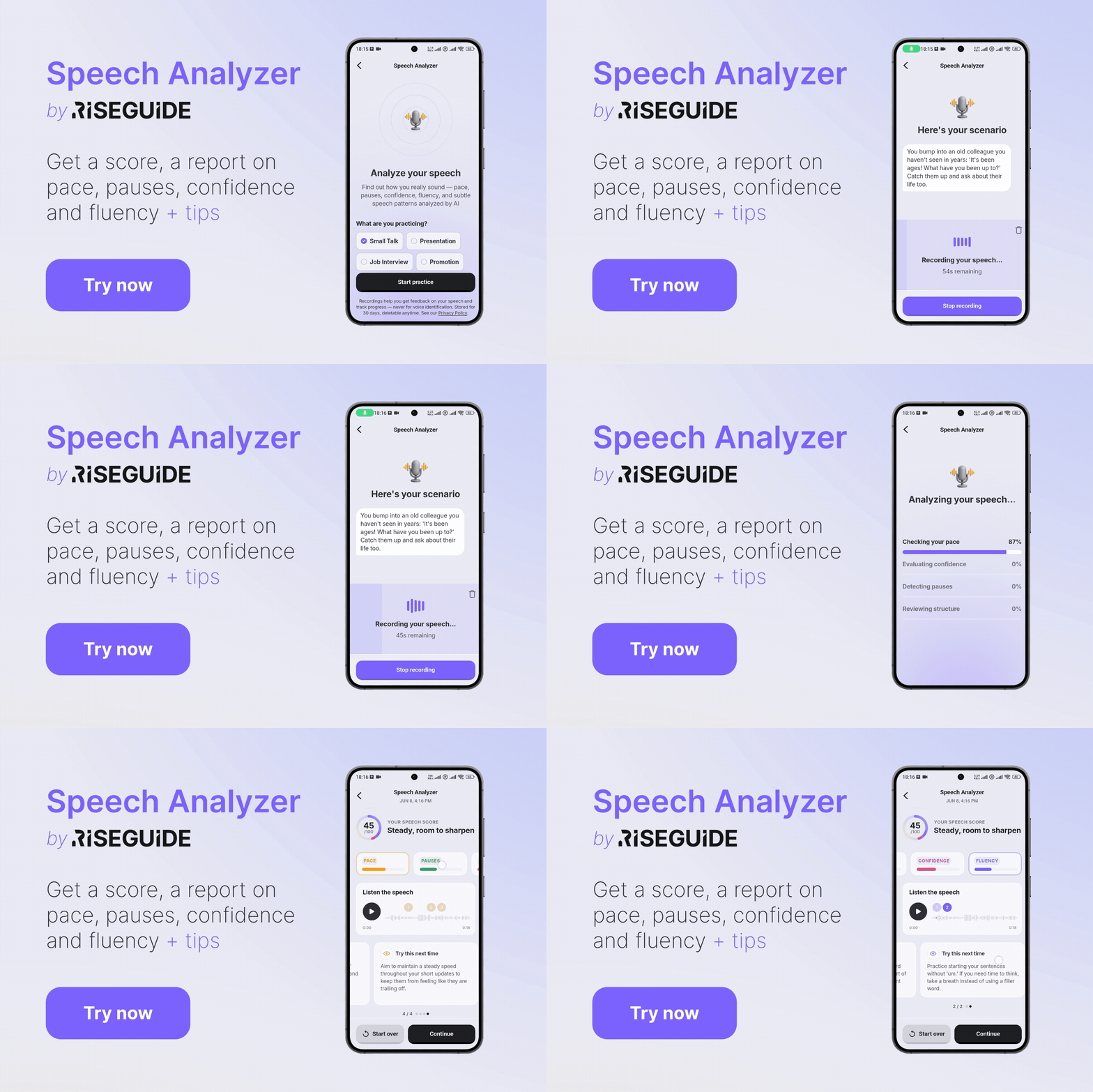
That kind of practice is hard to get from reading alone, because you rarely know how you come across until you try. RiseGuide, an expert-powered microlearning app, is built for that part. The Small Talk Simulator gives you a scenario and sends back analysis on how you answered, while the Speech Analyzer lets you record a response out loud and returns a report on your pace, clarity, and confidence. And when a specific question comes up, like how charismatic people talk, SEEK answers it from verified expert sources.
Open with something you both share in that moment, such as the place, the event, or a small observation, then ask one genuine question. Shared context lowers the pressure and gives you an easy reason to be talking. In casual settings, this is really just small talk: the same low-stakes opening, done with a bit of intention.
Go back to the last thing the other person said and ask one more question about it. A pause usually means a thread was dropped rather than that the conversation is over.
Give them something specific to reply to rather than a bare "hey", such as a shared link, a request for a recommendation, or a follow-up on something they mentioned.
Less often than people assume, provided you build up gradually and share something of your own. Research suggests that deeper questions tend to feel more connecting, and less awkward, than people expect.