RiseGuide Team
To change careers, you work through seven moves in order: get honest about why you want to leave, define what a better fit actually looks like for you, map the skills you can carry over, test a few directions with small real-world experiments before you commit, close the biggest skill gaps with focused learning, build relationships in the field you're aiming for, and then make the move with a resume and story that connect your past to your next role. A career change rarely happens in one leap. It works best as a series of small, low-risk steps that let you learn your way into the new path instead of betting everything on a guess.
Leaving a field you already know is uncomfortable, and most of the discomfort comes from a few specific places rather than one big one. This guide walks through a clear, tested path for how to change careers at any point in your working life, and what shifts when you make the move at 30, 40, or 50.
Leaving a field you already know is uncomfortable, and the discomfort usually comes from a few specific places rather than one big one. Naming them makes the move feel less like a cliff. The first is identity. When you've spent years as a teacher, an engineer, or a nurse, the job becomes part of how you describe yourself, so walking away can feel like losing a piece of who you are. The second is the sunk cost of everything you've already put in: the degree, the years, the seniority you'd be handing back at the start of something new. The third is practical. Most people can't stop earning while they retrain, so a switch has to fit around a current job, a mortgage, and the rest of real life. None of that means a change is a bad idea. Moving between fields is more common than it looks. The average worker born in the later baby-boom years held 12.9 jobs between the ages of 18 and 58, according to long-run tracking by the U.S. Bureau of Labor Statistics — a figure drawn from one long-term study, but a useful reminder that a single lifelong job is no longer the norm. Changing careers is a normal part of a working life, not a sign that something went wrong.
These seven steps run in order, because each one gives you the information you need for the next. You don't have to rush them. Some people move through the whole sequence in a few months; others take a year or more, especially when they're retraining alongside a full-time job. This is the core of how to change careers without gambling your stability on a hunch.
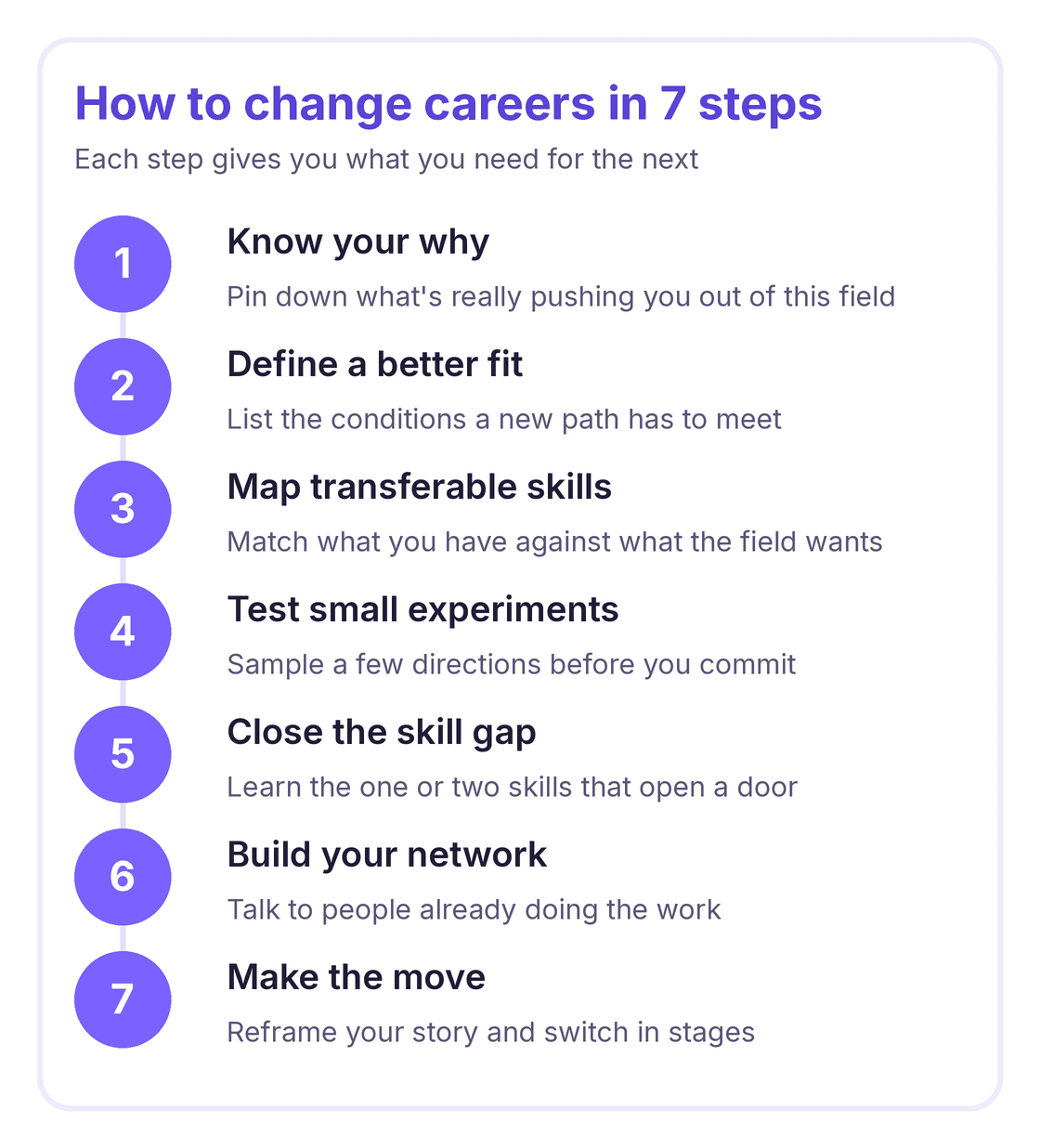
Before you look at new fields, get clear on what's pushing you out of this one. "I hate my job" is a start, but it's too broad to act on. Is it the actual work, the pay, the manager, the hours, the lack of growth, or the feeling that the field no longer fits who you are? The reason matters, because some of these are solved by changing roles or employers, not careers. Write down the parts of your current work you want to leave behind and the parts you'd happily keep. Being specific here saves you from switching fields only to land in a job with the same problem. If part of what you need is simply permission to put your own direction first, it helps to get comfortable choosing to focus on yourself without guilt.
Once you know what you're leaving, describe what you're moving toward. A good target isn't a single job title; it's a short list of conditions a new path has to meet. Think across three things: the tasks that give you energy (and the ones that drain it), the way you want to work (team or solo, hands-on or strategic, office or remote), and what you need the work to provide (income, flexibility, meaning, stability). This is reflective work, and it rewards structure. Sitting with a few focused prompts — what you lose track of time doing, what people ask your help with, what you want more and less of — turns a vague itch into criteria you can test options against. A set of reflection exercises can help you draw those answers out instead of staring at a blank page.
A career change is rarely a reset to zero. Most of what you've built transfers, you just have to translate it. Managing a classroom is stakeholder management and public speaking. Running a shift is operations and team leadership. Hitting sales targets is negotiation, resilience, and data. Make two columns. In the first, list your real skills, including the ones you take for granted. In the second, list what your target field asks for, pulled from a handful of actual job posts. The overlap is your bridge; the gaps are your to-do list for Step 5. Seeing both on one page also calms the "I'm starting over" fear, because you can see how much you're actually bringing with you.
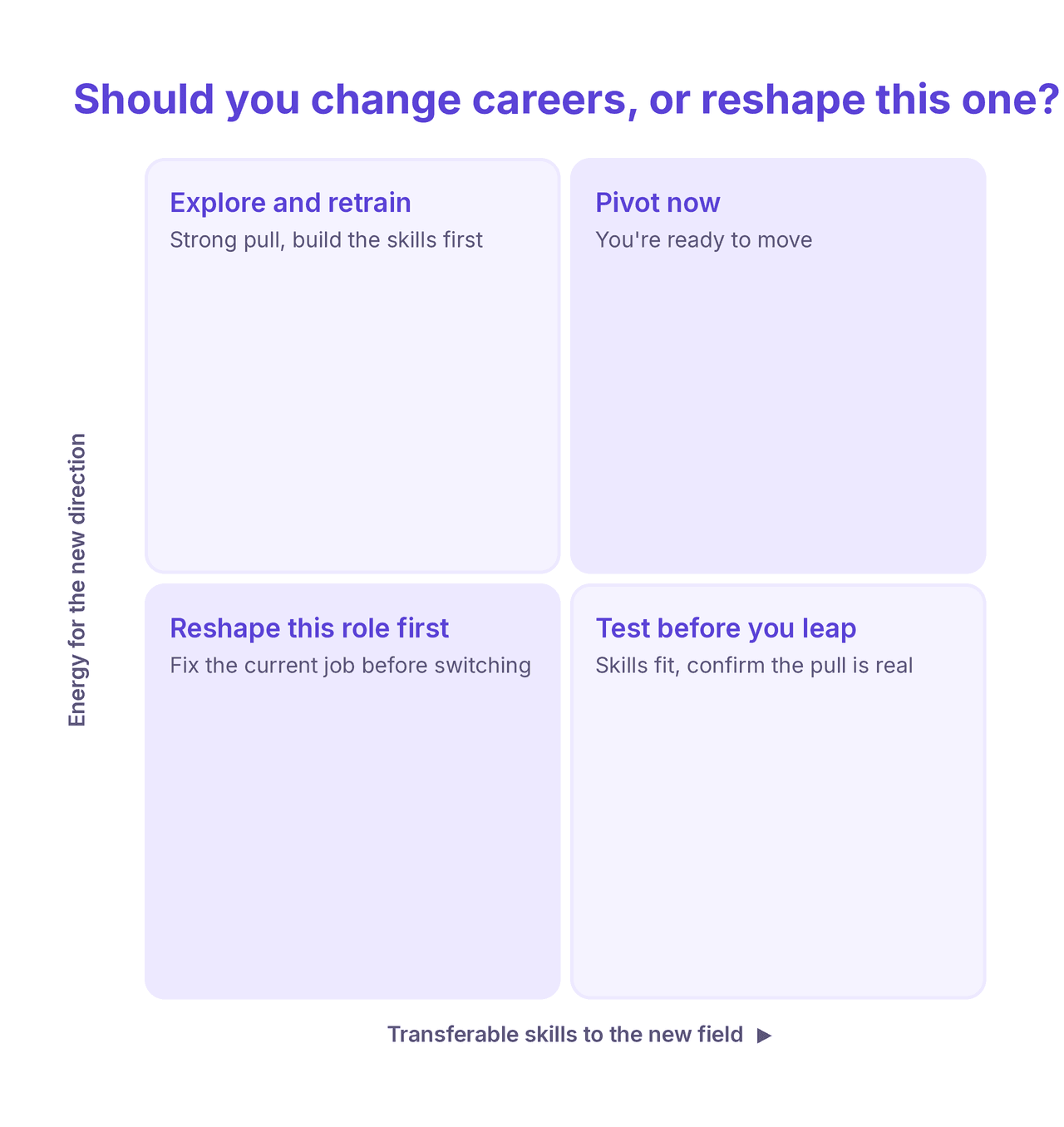
This is the step most people skip, and it's the one that protects you. Instead of trying to think your way to the perfect answer, try a few directions in small, low-cost ways and see which one holds up in real life. That might mean a short course, a weekend project, a volunteer shift, freelancing on the side, or a few conversations with people who do the work now. The reason to act before you're certain is well documented. Herminia Ibarra, a London Business School professor who studies career reinvention, has found that people change direction most successfully through action and experience rather than through analysis alone. You learn what a field is really like by sampling it, and you often discover the version of the work that fits you wasn't quite the one you imagined. Treat each experiment as information, keep the ones that energize you, and drop the ones that don't.
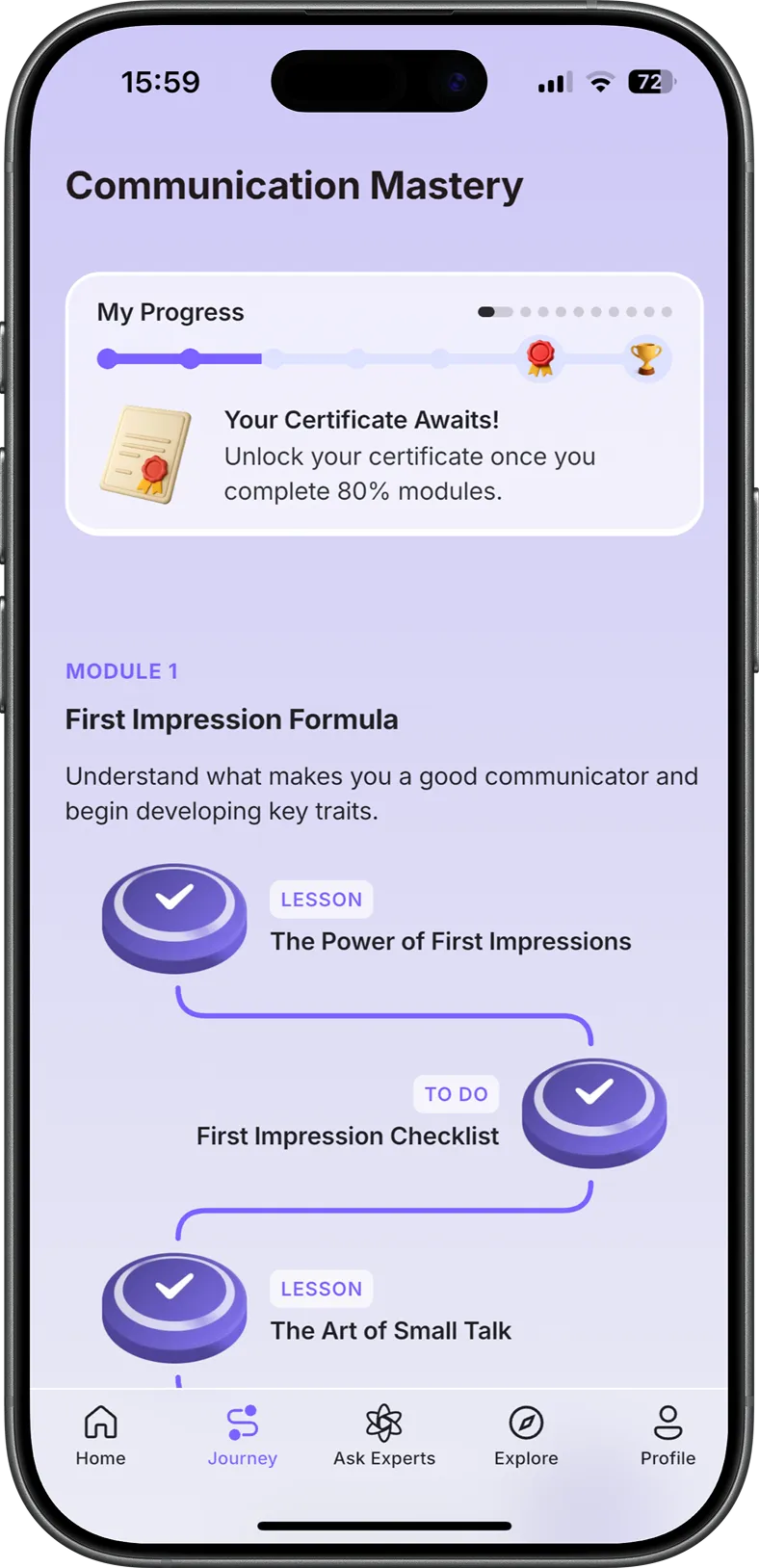
Now take the gaps from Step 3 and turn them into a short learning plan. Pick the one or two skills that stand between you and a real entry point into the field, and focus there first rather than trying to learn everything at once. Depending on the field, that could be a certificate, a technical skill, a portfolio of sample work, or a softer skill like selling your ideas or handling a room. Short, consistent learning beats occasional marathons here, especially when you're studying around a job. Micro-learning apps that give you a structured path in small daily pieces make this easier to sustain; a number of solid self-improvement apps are built exactly for that kind of steady, bite-size progress. If the field you're moving into runs on how well you communicate — client work, management, anything customer-facing — RiseGuide's Communication Mastery journey is one place to build that skill in short lessons drawn from expert insights, so you can practice it in the gaps of a busy week.
Most career change moves happen through people, not job boards. The people already doing the work can tell you what the day-to-day is really like, warn you about dead ends, and pass your name along when something opens. You don't need to be a natural extrovert for this; you need a few genuine conversations and a willingness to ask good questions. Start with people one step ahead of where you want to be and ask to learn, not to be hired. Keep it light and specific, and follow up when someone helps you. If reaching out cold feels awkward, these networking tips break it into moves that work even if you find it uncomfortable.
By now you have a direction you've tested, a skill or two you've built, and a few people who know what you're after. The last step is presenting your past as a bridge into the new field. Rewrite your resume and your short "why I'm making this move" story around the skills and results that matter to the new field, and lead with the overlap you mapped in Step 3. Then make it financially survivable. Many people move in stages: a side project becomes freelance income, a part-time role becomes full-time, or they save a cushion before handing in notice. Protect your stability while you cross over, and treat the first role in the new field as a doorway rather than the final destination.
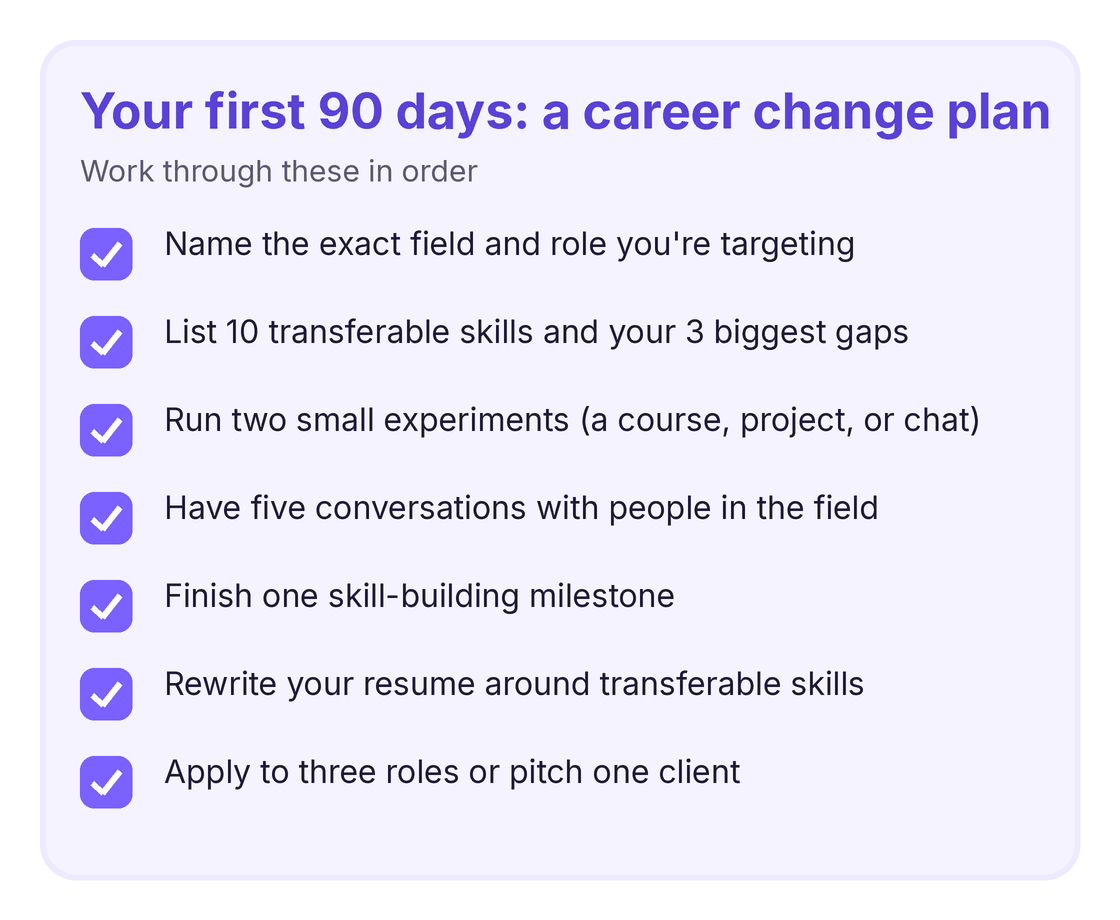
The steps above don't change with age, but the context around them does. What's realistic, what you're trading off, and what you're bringing all shift depending on where you are. Here's how the same move tends to look at different stages.
A career change at 30 is usually the most flexible. You have enough experience to know what you don't want and real skills to carry over, but fewer fixed commitments than you'll have later. This is a good time to take a bigger swing, retrain more deeply, or accept a short step back in title or pay to enter a field with more room to grow. Use that flexibility while you have it.
A career change at 40 often comes with more to protect — income, family, a reputation in your current field — and more to offer. A midlife career change works best when you lean on your transferable skills and look for fields where a decade of experience is an asset rather than something to hide. You rarely need to start at the very bottom; look for adjacent moves where your background gives you a head start, and retrain in a focused way rather than beginning a brand-new degree from scratch.
A career change at 50 is far more common than it used to be, and employers increasingly value the judgment and reliability that come with experience. The practical questions matter most here: how a switch affects your earnings in your highest-saving years, and how to frame deep experience as range rather than overqualification. Focus on roles that reward what you've accumulated — mentoring, specialist expertise, consulting, or a field next door to your own — and protect your finances as you transition.
Changing careers works best as a sequence of smaller, survivable steps: understand why you're leaving, define a better fit, map what transfers, test real options, close the key gaps, build relationships, and move in stages. Knowing how to switch careers this way takes the pressure off any one decision, because you're learning as you go and keeping your footing the whole time. Start with Step 1 this week, and let each step tell you what the next one should be.
No. People change fields successfully well into their 50s, and experience is often an advantage rather than a barrier. The approach shifts with age — you lean more on transferable skills and look for adjacent moves — but the door stays open.
You build a small amount of real experience before you apply, rather than waiting for someone to take a chance on you. A short course, a volunteer project, freelance work, or a portfolio of sample work all count, and they give you something concrete to point to when you make your case.
It varies widely, from a few months to a couple of years, depending on how far the new field is from your current one and whether you're retraining alongside a job. Breaking it into the steps above makes the timeline feel manageable instead of open-ended.
There's no single answer, because the best fit depends on your skills, interests, and what you need from work. Use Steps 2 and 3 to define your own criteria, then test a few fields against them rather than chasing whichever career happens to be trending.