RiseGuide Team

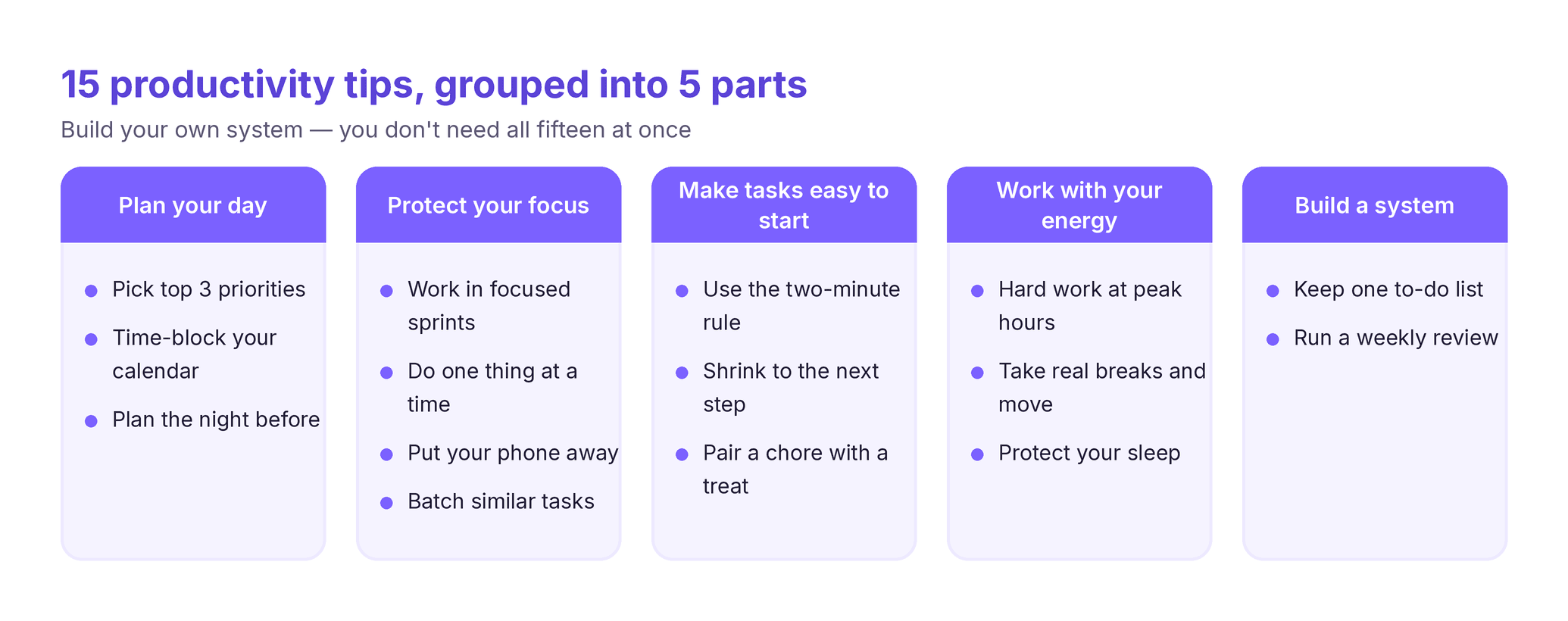
To be productive, plan your day, protect your focus, make tasks easy to start, work with your energy, and build a system you can repeat. The 15 tips: pick your top three priorities, time-block your calendar, plan tomorrow the night before, work in focused sprints, do one thing at a time, put your phone out of reach, batch similar tasks, use the two-minute rule to start, shrink a task to its next small step, pair a boring task with something you enjoy, do your hardest work at your peak hours, take real breaks and move, protect your sleep, keep one trusted to-do list, and run a short weekly review. Pick two or three to start with rather than all fifteen at once.
Most people don't struggle to work hard. They struggle to spend that effort on the right things without getting pulled away every few minutes. Being productive comes down to two moves: choosing what matters, and protecting the time to do it. If you've tried a pile of productivity hacks and other ways to be more productive and none of them stuck, the setup you're using is usually what needs to change, not your willpower. The productivity tips below are grouped into five parts: planning, focus, starting, energy, and systems, so you can put together your own approach instead of copying someone else's. You don't need all fifteen at once; a few small changes tend to do more than a complete overhaul.
A productive day is mostly decided before it begins. When you start the morning without a plan, the loudest email or the easiest task wins, and your real priorities get pushed to "later." A few minutes of planning saves you from spending the day reacting.
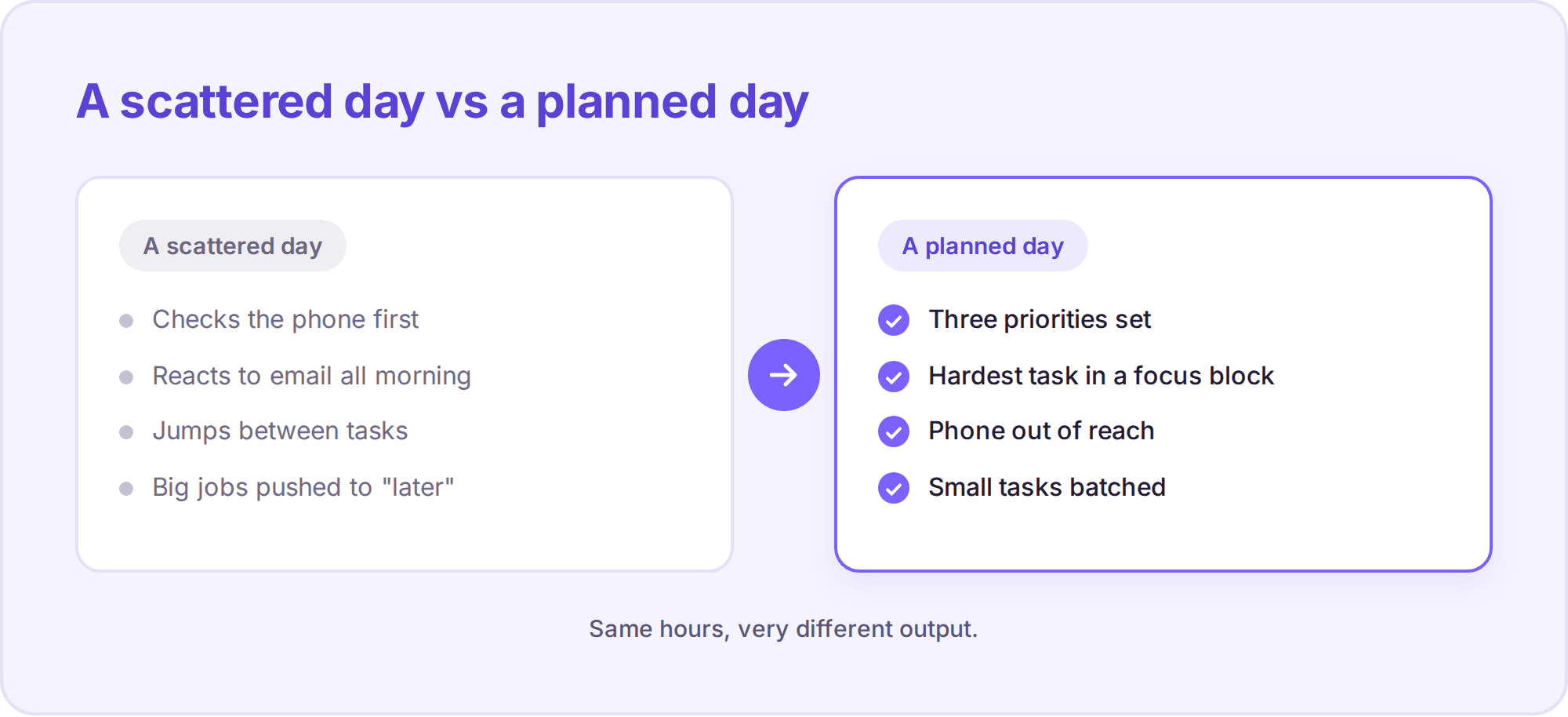
Before you open your inbox, decide the three outcomes that would make the day a win. Not fifteen tasks, three. A short list forces you to choose what actually matters, and it gives you something to protect when the day fills up. Everything else is optional until those three are done.
A to-do list captures what needs doing, but it won't tell you when each task will actually happen. Put your top priorities into specific blocks of time, the way you'd book a meeting, and treat those blocks as real appointments. Time-blocking also makes you honest about how much fits in a day, which is usually less than the list suggests.
Spend five minutes at the end of the day setting up the next one: the three priorities, the first task, and anything you need ready. You skip the morning decision-making, and your brain quietly sorts the problem overnight. Pairing this with a simple morning routine means you start the day already moving instead of deciding what to do.
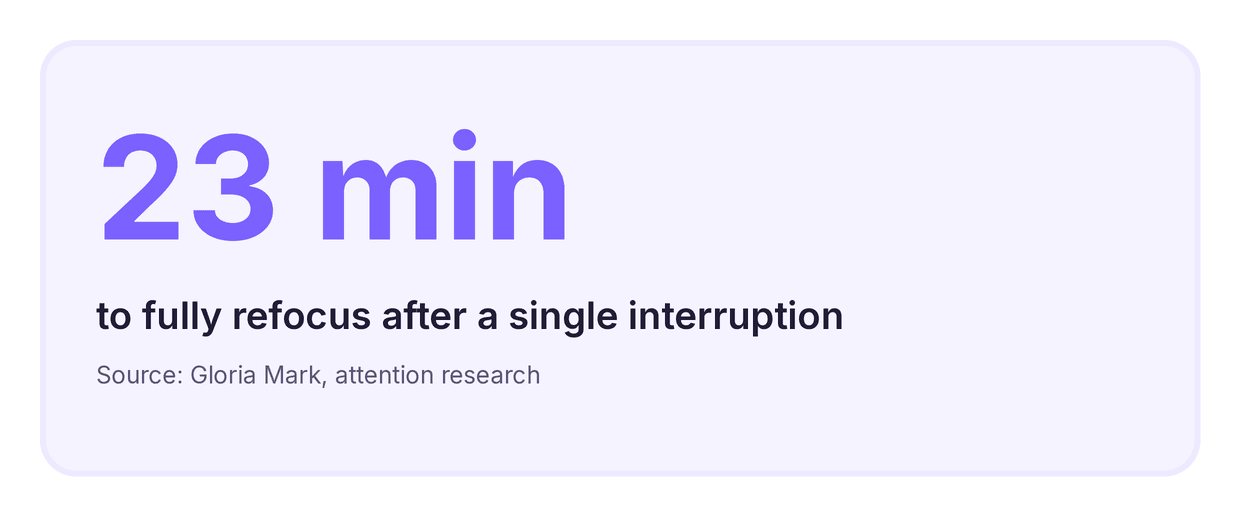
The single biggest lever for how to focus better is removing the things that break your attention in the first place. Focus is fragile: research from attention scientist Gloria Mark found it takes over 23 minutes to fully return to a task after an interruption. A few interruptions can eat an entire afternoon.
Set a timer and work on one task for a fixed stretch: 25 minutes in the Pomodoro method, created by Francesco Cirillo, or a longer 60 to 90 minutes if you're in a groove. Then take a short break. A deadline you can see makes it easier to start, and the break gives you a reason to push through the boring middle.
Multitasking feels productive, but it usually slows you down. Every time you switch between tasks, your brain pays a small tax to reload the new context, and the switches add up. Close the other tabs, pick one task, and let it have your full attention until the sprint ends. Cal Newport argues that constantly switching to social media and other feeds fragments your attention, and that, in his words, "this can permanently reduce your capacity for concentration to do exactly the type of deep effort" that valuable work depends on.
Your phone doesn't have to buzz to break your focus; just seeing it is enough to pull a piece of your attention. Put it in another room, in a drawer, or face-down and silenced during focus blocks. Making the distraction slightly harder to reach is usually more reliable than relying on willpower.
Group tasks of the same kind and do them together: answer emails in two set windows, make all your calls back to back, run errands in one trip. Batching keeps you from paying the switching tax over and over, and it clears small tasks out of the way so they stop pulling at your focus.
A lot of lost time isn't spent working or resting; it's spent avoiding a task that feels too big. The fix is usually a smaller first step rather than more discipline, which is one reason understanding why we procrastinate helps more than forcing yourself to power through. Writer Tim Urban gives that avoidance a face in his talk on procrastination: the "Instant Gratification Monkey," who "only cares about two things: easy and fun" and takes the wheel whenever a task looks hard. Shrinking the first step is how you take the wheel back.
If a task takes less than two minutes, do it now rather than writing it down. The rule comes from David Allen's Getting Things Done, and it keeps small tasks from piling into a heavy list. For bigger tasks, use a version of the same idea: commit to just two minutes of work, and let momentum carry you past the hard part of starting.
"Write the report" is a task you'll avoid. "Open the doc and write the first heading" is a task you can start. When something feels sticky, ask what the very next physical action is, and do only that. The rest usually feels lighter once you've begun.
Let yourself have a coffee, a good playlist, or a favorite podcast only while you do the task you keep dodging. Tying an unpleasant job to a small reward makes it easier to start and less miserable to finish, so the task stops living on tomorrow's list.
You don't have the same focus at 3 p.m. that you have at 10 a.m., and fighting that is a losing game. Productivity gets easier when you match the work to the energy you actually have.
Notice when your attention is sharpest. For most people it's the first few hours of the day, so guard that window for your most demanding task. Save email, admin, and routine work for the low-energy stretches. You get more from one focused hour at your peak than three tired ones.
Short breaks keep your focus from wearing down, but scrolling your phone doesn't count as a break, because it just tires a different part of your attention. Step away from the screen, stretch, walk, or look out a window. A few minutes of real rest, and some movement across the day, does more for your afternoon than pushing straight through, and it helps you stay motivated when energy dips.
None of these tips work well after a bad night's sleep. Tired brains focus worse, decide worse, and reach for distractions more. Treating a consistent bedtime as part of your productivity system, rather than the thing you sacrifice to get more done, pays off the next day.
Motivation comes and goes, so the goal is a setup that keeps you moving on the days you don't feel like it. A simple, repeatable system beats a burst of effort you can't sustain, which is the same reason it's easier to break bad habits by changing your setup than by relying on willpower alone.
Hold your tasks in one place you check daily, not scattered across sticky notes, your inbox, and your memory. When you trust the list to catch everything, your mind stops trying to hold it all and can focus on the task in front of you. Capture new tasks the moment they appear, so you're not relying on memory to hold them. This is the heart of David Allen's Getting Things Done method. As he puts it, "Your mind is for having ideas, not holding them," so a trusted list holds the tasks for you and frees up what he calls the space to think.
Once a week, look back and look ahead: what got done, what slipped, and what the next week's priorities are. A 15-minute review keeps small things from turning into fires and stops your system from drifting. It's the habit that increases productivity most over time, because it catches problems while they're still small.
The fifteen tips aren't a checklist to do all at once; they're parts you can combine into a day that suits your work and attention. A few ready-made shapes to start from:
Being productive comes down to a set of small, repeatable choices: decide what matters, protect the time for it, make starting easy, respect your energy, and keep a system you trust. The most reliable answer to how to be more productive is a system you can repeat, even on the days you don't feel like it. Pick two or three tips that fit the part you struggle with most, run them for a week, and add more once they feel normal.
The 3-3-3 rule, from writer Oliver Burkeman, splits your day into three parts: three hours on your most important project, three shorter urgent tasks, and three quick maintenance jobs that keep life running. It's a simple way to make room for deep work without ignoring the small stuff.
Start small and repeat. Pick one tip, like planning three priorities each morning, and do it every day until it's automatic, then add another. Productivity is a set of habits you build over weeks, so trying to change everything at once usually backfires.
Protect one block of focused time for your most important task before meetings and email fill the day, do one thing at a time, and batch small tasks into set windows. Most gains in how to increase productivity come from removing interruptions, not from working faster.
Give yourself a clear start and stop, a spot that's for work only, and set focus blocks the way you would in an office. The main challenge with how to be productive at home is that work and rest blur together, so visible boundaries matter more than they do at a desk.
Short timed sprints, tasks shrunk to their next small step, a visible timer, and removing distractions before you start tend to help most. Working with your attention in short bursts, instead of expecting hours of steady focus, makes how to be productive with ADHD far more realistic.