RiseGuide Team

To build a morning routine checklist, think of your morning the way you think of meals: a few stages everyone shares, filled differently depending on your life and goals. The five stages are waking up, getting light and water, moving your body, setting your mind and focus, and fueling up. Decide what each stage is for, pick one option that fits you for each, and keep the list short enough to run every day. Start from a ready-made routine type and adjust it, or assemble your own stage by stage.
There's no single best morning routine that works for everyone, which is why copying someone else's hour-by-hour schedule usually falls apart within a week. A better way to think about it: your morning has a few stages, the way a day has meals. Breakfast, lunch, and dinner exist for everyone, but what goes on the plate depends on your tastes, your schedule, and your goals. A morning routine checklist works the same way. This guide walks through the stages of a healthy morning routine, what each one is for, and how different people fill them, so you can build a version that fits your life.
Most good mornings move through the same five stages, even when they look completely different from the outside. Each stage has a job to do. Once you know the job, you can pick the option that fits you and skip the rest.
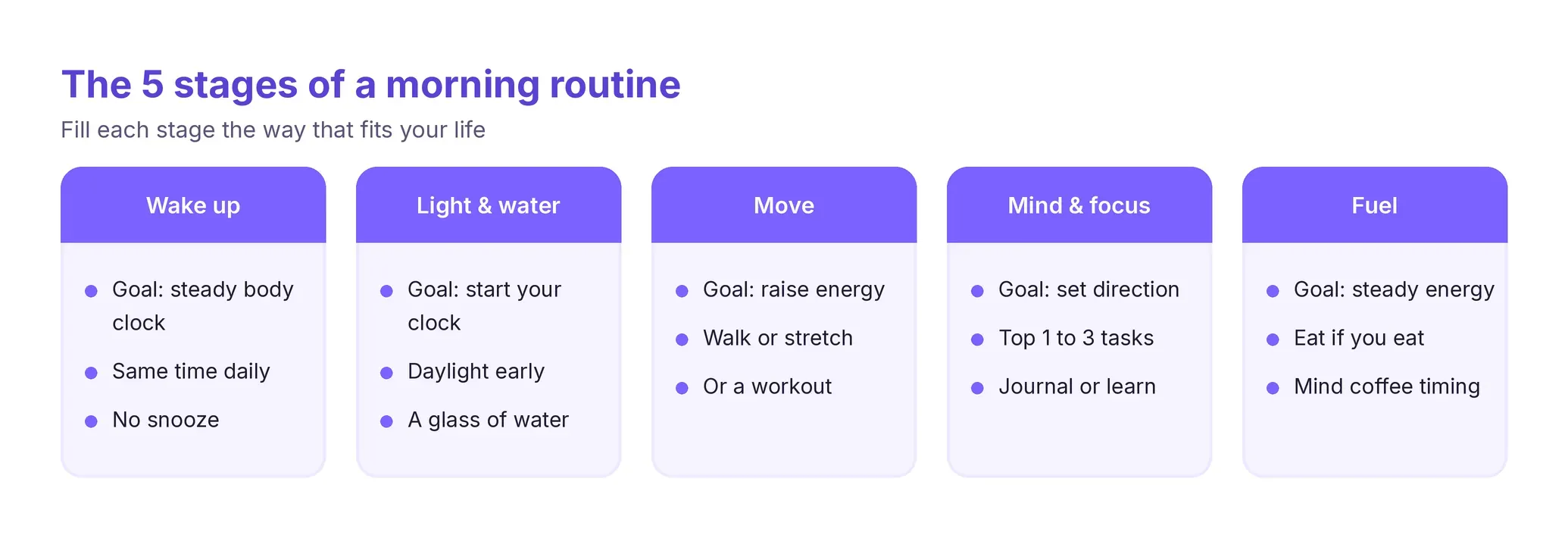
The five stages are waking up, getting light and water, moving your body, setting your mind and focus, and fueling up. You don't need all five every day, and how long you spend on each is up to you. What matters is knowing what each stage is for, so your choices are deliberate instead of random.
Here's each stage: the goal, a few options, and how some well-known people handle it. Treat the examples as ideas to borrow from, not schedules to copy exactly.
The goal is to get up near the same time each day so your body clock stays steady. Options run from a hard early start to a gentler one: a fixed alarm across the room, no snooze, or a wake-up light. Apple's CEO Tim Cook wakes at 3:45 a.m. and reads customer email before the gym, which suits a job built around it. A parent getting kids to school might wake at 6:30. The exact time matters less than keeping it consistent, including weekends.
The goal is to signal to your body that the day has started. Getting natural light soon after waking helps set your body clock, so you feel more awake now and wind down more easily at night, and a glass of water rehydrates you after a night's sleep. Neuroscientist Andrew Huberman recommends sunlight within 30 to 60 minutes of waking, plus about a liter of water in the morning. Options: step outside for a few minutes, drink water before your coffee, or sit by a bright window.
The goal is to raise your energy. This can be a five-minute stretch, a short walk, a full workout, or a quick body-weight set like the 5-5-5-30 (five push-ups, five sit-ups, five squats, and a 30-second plank). Pick the smallest version you'll still do on a bad day, then add more when you have time.
The goal is to decide what matters today before messages and to-dos take over. Options: write your top one to three tasks, journal for a few minutes, meditate, or spend a few minutes learning something. Benjamin Franklin opened his day by asking himself one question, "What good shall I do this day?", then planned his hours. If planning your day is the part you want to get better at, a few of these productivity books go deep on it.
The goal is steady energy without a mid-morning crash. Some people eat a real breakfast, others wait until later, and both are fine. One small change with good evidence behind it: Huberman delays caffeine by 90 to 120 minutes after waking to soften the afternoon dip. Options: eat within an hour, wait until you're hungry, or push your first coffee back.
If you'd rather start from a finished example, here are four routine types built from the stages above. Each fills the five stages differently, for a different kind of life and goal. The good morning routine for you is the one you'll actually repeat, so start with whichever is closest and adjust from there.
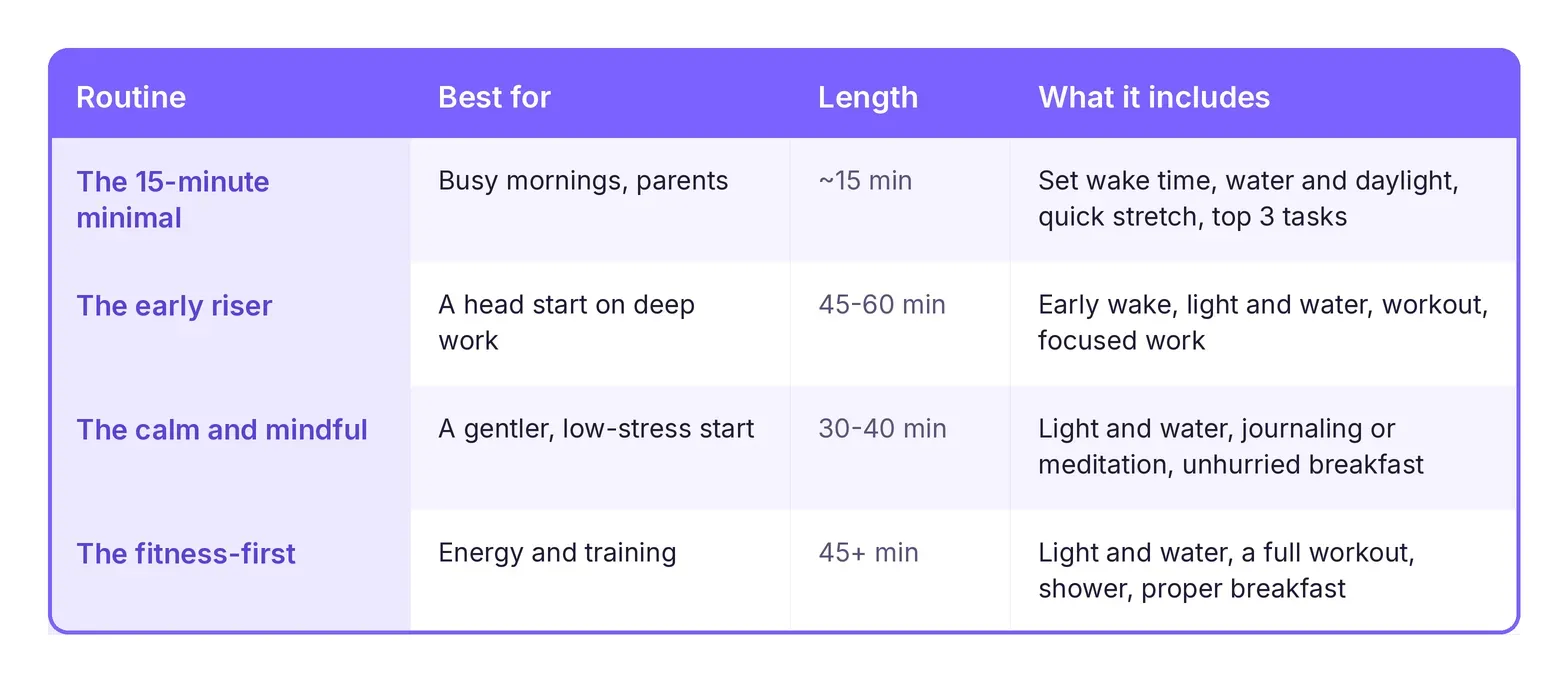
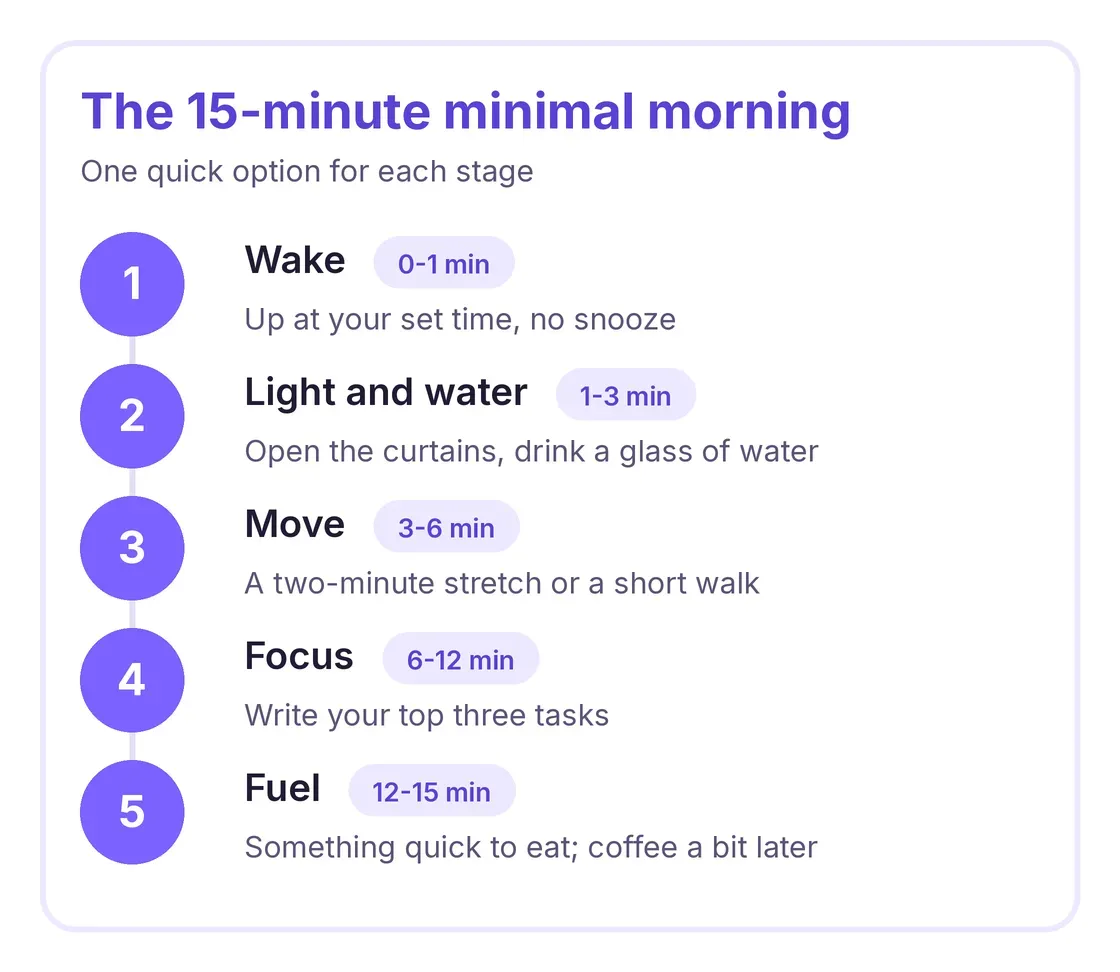
It's easy to fixate on the wake-up times in the morning routines of successful people, but the useful part is what they have in common. Across the examples above, three things repeat: a consistent wake time, some light and movement early, and a few minutes spent deciding what the day is for. You can get all three in fifteen minutes. The hour-long versions are optional.
Build it small and let it grow. Pick one option from each stage that you could manage on your worst morning, and write them down as a short morning routine list you can keep on your phone. Attach the first one to something you already do (start the coffee, then open the curtains) so the existing habit becomes the cue. Add or lengthen a stage only once the basics are automatic. Give it time, too: a new routine usually takes weeks to feel automatic, so judge yourself by how often you run it rather than how it feels on day three.
Choose your wake-up time and one option from one other stage (light is a good first pick) and run just those two tomorrow. Add an option from another stage each week until your morning has a shape you don't have to think about.
At a minimum, cover the five stages in some form: a consistent wake time, light and water, a little movement, a moment to set your focus, and something to fuel you. How much you do in each depends on your schedule and goals.
It comes from Robin Sharma's book The 5 AM Club: after waking, you spend 20 minutes moving, 20 minutes reflecting, and 20 minutes learning. It's one way to fill the move and mind stages, and you can shrink each block to five minutes if a full hour isn't realistic.
It's a quick body-weight set for the movement stage: 5 push-ups, 5 sit-ups, 5 squats, and a 30-second plank, often repeated a couple of times. It needs no equipment, and people adjust the numbers to their own fitness.
There's no single perfect morning routine for everyone. The best one covers the five stages in a way that fits your life and that you'll repeat. A short routine you keep is worth more than a long one you quit.