RiseGuide Team

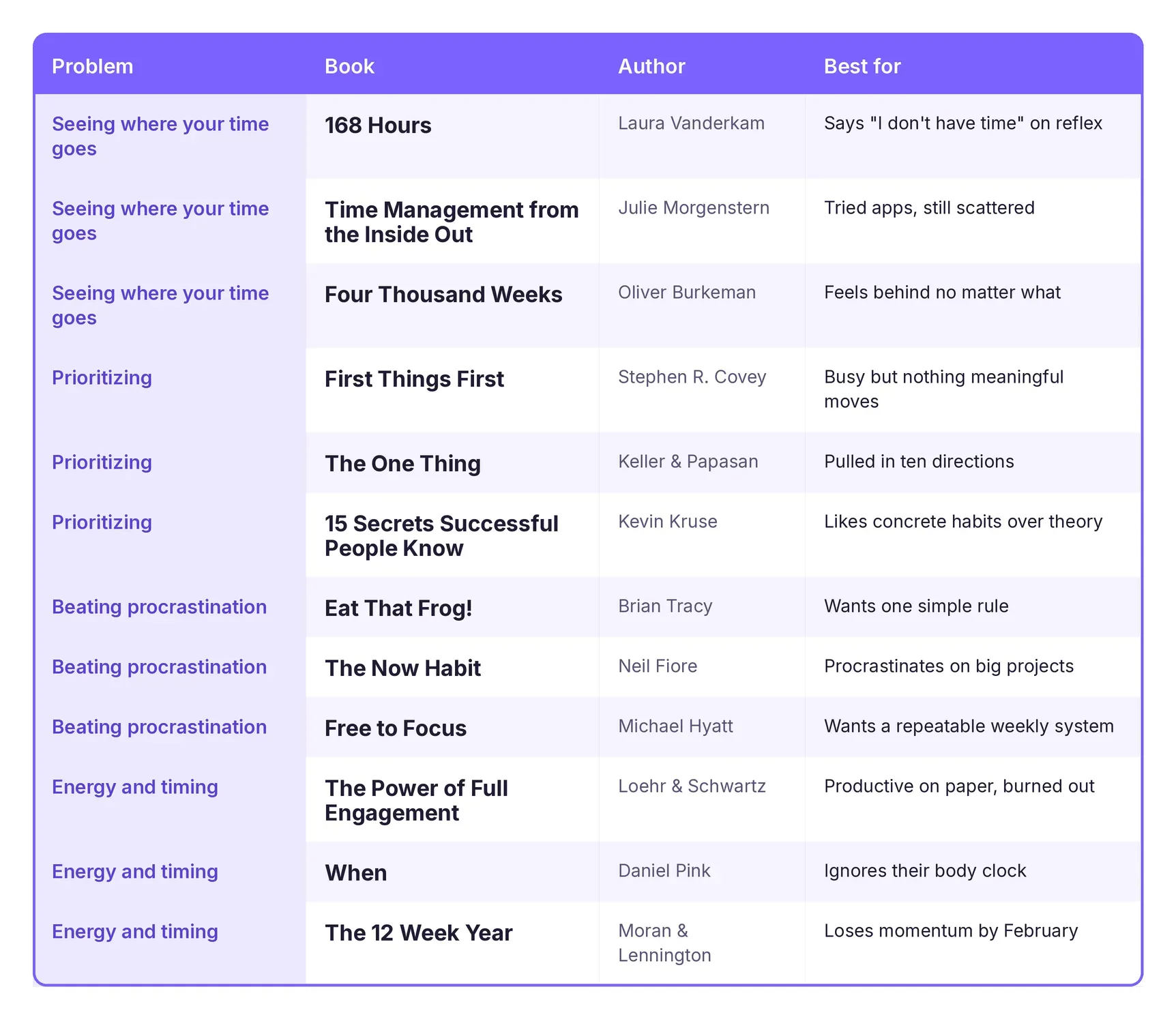
To pick a time management book, match it to the time problem you have. If you don't know where your hours go, start with 168 Hours by Laura Vanderkam or Four Thousand Weeks by Oliver Burkeman. If you can't decide what to work on, read First Things First or The One Thing. If you keep putting things off, Eat That Frog! and The Now Habit are the classics. And if you're busy but drained, The Power of Full Engagement and When focus on energy and timing rather than squeezing in more. The 12 best time management books below are grouped by those four problems, each with who it's for and one honest note on what it's like to read.
Here are the 12, grouped by the problem they solve:
There are hundreds of time management books, and most people bounce off them because they grab whatever's popular instead of the one that fixes their actual problem. Someone who over-schedules needs a different book than someone who procrastinates, and a busy parent needs something different again from a founder. So this list is grouped by the problem you're trying to solve, not ranked one to twelve. Find the group that sounds like you, then pick the title that fits. Where two books overlap, we've pointed it out so you don't read the same advice twice.
Before you pick, name your main friction in one sentence. "I'm always busy but nothing important gets done" points you toward prioritization. "I know what to do, I just don't start" points to the procrastination books. "I run out of steam by mid-afternoon" is an energy problem, not a scheduling one. Matching the book to your friction is what decides whether you finish it or give up partway.
It also helps to know what kind of reader you are. Some of these are systems you set up once, like Morgenstern's and Hyatt's; others are short mindset shifts you can act on the same day, like Tracy's and Vanderkam's. Neither is better, but knowing which you want saves you from buying a 300-page framework when you wanted a nudge.
It's hard to manage time you haven't looked at. These three help you find where your hours really go before you try to change anything, which is why they belong first.
Vanderkam's core idea is in the title: you have 168 hours a week, and once you log them, most people find far more usable time than they thought. The book walks you through tracking a week in half-hour blocks, then rebuilding it around what you care about. It's practical and a little tough-love, and the time-log exercise is the part you'll remember long after the anecdotes fade.
Best for: anyone who says "I don't have time" on reflex.
Worth knowing: it's more mindset and tracking than a step-by-step system, so pair it with a scheduling book if you want a framework.
If logging by hand feels tedious, time tracking tools do the same half-hour accounting automatically and hand you the weekly picture Vanderkam asks you to build.
Morgenstern, a professional organizer, treats your schedule like a closet: you declutter it, then build a system that fits your real life instead of a generic template. She starts with why your current setup fails before handing you a new one, so the fix is diagnosis first, tools second.
Best for: people who've tried productivity apps and still feel scattered.
Worth knowing: it reads like working with a calm consultant, and the "inside out" approach means the system is yours rather than borrowed, so expect some setup work.
If the average life is about four thousand weeks, Burkeman argues, then the goal was never to do everything, and most time-management advice keeps selling that impossible dream. Instead he makes the case for choosing what your finite time is for and letting the rest go. It also appears in our roundup of the best productivity books, where the focus is on output rather than the time angle here.
Best for: anyone who feels behind no matter how much they get done.
Worth knowing: it leans philosophical rather than tactical, so pair it with a system book if you want concrete steps.
Plenty of people stay busy without moving the things that matter to them. These three are about deciding, so the hours you do have go where they count.
Covey's classic argues for putting important-but-not-urgent work first, before the week fills with fires. Its famous four-quadrant grid sorts tasks by urgency and importance and shows why most people live in the wrong box.
Best for: anyone who ends every day busy but feels like nothing meaningful moved.
Worth knowing: the writing is denser and more values-driven than a modern productivity book, so give it some patience.
The whole book hangs on one question: what's the one thing you can do such that by doing it everything else becomes easier or unnecessary? Ask it of your year, your week, and your day, and a bloated to-do list collapses into a clear next move.
Best for: people who feel pulled in ten directions at once.
Worth knowing: it's repetitive by design, so you can get most of the value from the first half and the focusing question alone.
Kruse interviewed hundreds of high performers and boiled their habits down to fifteen ideas, starting with a mindset shift: you get 1,440 minutes a day, and treating them as scarce changes how you spend them. Each chapter is short and ends with something to try.
Best for: readers who like concrete habits over theory.
Worth knowing: it's a fast, list-style read, so it works as a menu you dip into rather than a system you adopt whole.
For a lot of people, planning goes fine, and the trouble is starting, then guarding the time once they've started. These three tackle procrastination head-on.
Tracy's book takes its name from a line often attributed to Mark Twain: if you eat a live frog first thing, nothing worse will happen all day. The frog is your biggest, most important task, and the advice is to do it first, before easier work crowds it out. It also turns up in our list of the best productivity books for the same reason.
Best for: chronic putter-offers who need one simple rule rather than a system.
Worth knowing: it's short and blunt, and the core idea is one sentence, so the book's value is in making you apply it.
Fiore, a psychologist, reframes procrastination as a coping response to pressure rather than laziness, then offers the "unschedule": you plan your free time and play first, which makes it easier to start work without guilt. If motivation is where your goals usually stall, Whitnie Wiley, one of our experts, writes about moving from planning into action when the plan feels safer than the doing.
Best for: people who procrastinate on big, anxiety-heavy projects.
Worth knowing: it digs into the psychology underneath putting things off, with less on calendars, so it pairs well with a scheduling book.
Hyatt's book is a full weekly system built around three steps: stop, cut, and act. You decide what matters, eliminate or delegate what doesn't, and then structure your week with tools like the "Ideal Week" and a weekly preview.
Best for: people who want a repeatable process, not just inspiration.
Worth knowing: it's the most system-heavy book in this group, so it can feel like a lot if you only wanted a quick fix.
You can have a perfect schedule and still get nothing done if you're exhausted or working against your own rhythms. These three treat energy and timing as the real levers.
The argument here is that energy, more than the hours you manage, is the key lever for high performance. Loehr and Schwartz, who trained elite athletes, show how physical, emotional, and mental energy get depleted and restored, and why building in renewal beats grinding straight through.
Best for: anyone who feels productive on paper but burned out in practice.
Worth knowing: the sports-science framing is motivating, though some examples now read as dated, so take the principles over the specifics.
This book is about timing: when you do something can matter as much as what you do. Drawing on research about daily rhythms, Pink shows how most people move through a peak, a trough, and a recovery each day, and how to schedule demanding work for your peak and routine work for the trough.
Best for: people who already manage their tasks but ignore their body clock.
Worth knowing: it's an easy, evidence-based read, and the practical takeaway is simple enough to try tomorrow.
Moran and Lennington's method fixes a common time trap: an annual goal feels so far off that you coast for months, then scramble. By treating twelve weeks as your whole "year," you create urgency and a tight execution cycle.
Best for: people who set big goals and lose momentum by February.
Worth knowing: it leans toward work and business examples, but the twelve-week structure adapts cleanly to personal goals.
The honest limit of any of these top time management books is that reading one can feel like progress even when nothing changes. The value only shows up when a method becomes a habit, which takes repetition after you close the book. Pick one book, take the single change that fits your friction, and run it for a couple of weeks before adding anything else. Trying to combine three systems at once usually backfires.
This is where a daily practice helps more than another book. RiseGuide's micro-learning journeys on discipline, focus, and mindset are built from the insights of experts and break the ideas into short daily lessons, so the shift you read about turns into something you do a little of each day. If you'd rather compare a few options, our roundup of the best self-improvement apps is a good starting point, and our motivation books list pairs well if follow-through is your real sticking point.
A common shortlist of the best books on time management is Four Thousand Weeks by Oliver Burkeman, Eat That Frog! by Brian Tracy, The One Thing by Gary Keller, 168 Hours by Laura Vanderkam, and First Things First by Stephen Covey. The best one for you depends on whether your problem is planning, prioritizing, procrastinating, or energy.
The 3-3-3 method, popularized by author Oliver Burkeman, structures a workday into three parts: spend three hours on your most important project, complete three shorter urgent tasks, and do three small maintenance tasks. It's a simple way to protect deep work while still handling the day's smaller demands.
If you're not sure, start with 168 Hours or Four Thousand Weeks. Both help you see where your time goes and what it's for, which makes every other technique more useful once you know what you're managing.
They're worth it if you apply one idea rather than collecting many. A single method you practice for a few weeks will do more than five books about time management you read and forget, so treat these as a menu, pick one, and act on it.