RiseGuide Team

The seven core time management skills are prioritizing, planning and scheduling, setting clear goals, protecting your focus, managing your energy, delegating and saying no, and beating procrastination. Prioritizing decides what to work on, planning decides when, and goals give the whole thing a direction. The rest protect that time from distractions, tiredness, extra requests, and delay. Pick a method or two to practice with, like the urgent-important grid, time blocking, or the Pomodoro technique, and start with the single skill that would help you most this week.
Good time management is a set of skills you can learn, and like any skill, it gets easier with practice. When you build a few of the right habits, your hours go to what matters and you feel less rushed by the end of the day. This guide covers the seven core time management skills, the methods and time management tips you can use to practice each one, and how to build them into habits. Time researcher Laura Vanderkam makes a useful point: we find time for what counts by treating it as a priority and planning our days around it, rather than trying to shave minutes off everything else.
Time management skills are the habits and methods you use to decide what to work on, plan when to do it, and protect that time from everything competing for it. They help you choose better, so your hours go to what matters instead of whatever feels most urgent in the moment. The importance of time management is straightforward: when you handle it well, you get more of the right things done, feel less rushed, and have more room left for rest and the people you care about.
Most of what works comes down to seven skills. You do not need all of them at once, so start with the one where you feel the most friction and add the rest over time.
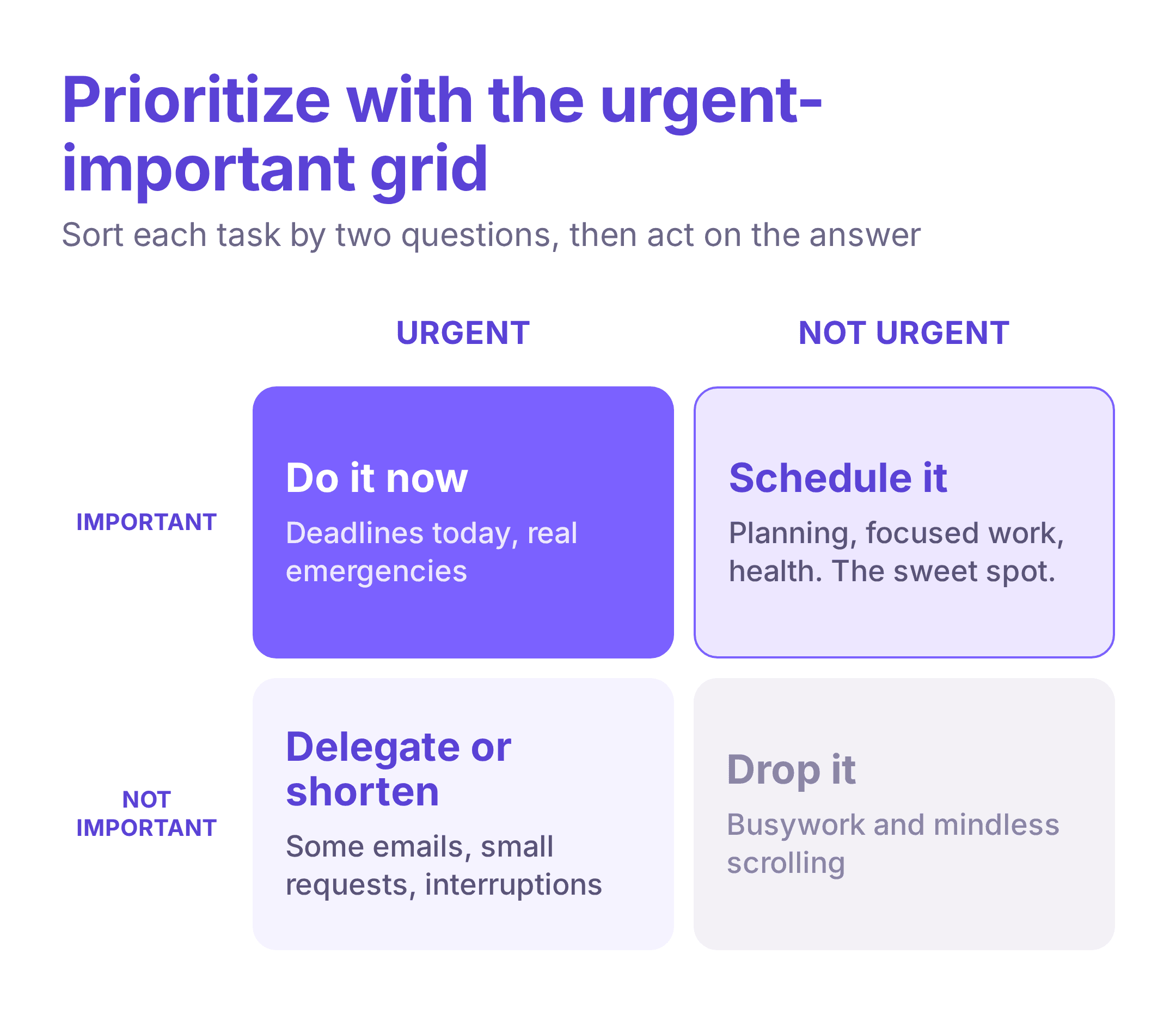
The first skill is deciding what deserves your time. A simple tool is the urgent-important grid: sort each task by whether it is urgent and whether it is important, then act on the answer. Do the urgent and important tasks now, schedule the important but not urgent ones (these are the tasks that move you forward), delegate or shorten the urgent but unimportant, and drop the rest. Laura Vanderkam's point applies here: block time for what matters before the busywork fills it in.
A plan turns your intentions into time on the calendar. Each morning, list your tasks, pick the two or three that matter most, and block time for those first. Time blocking, which means giving each task its own slot rather than working from an open-ended list, keeps your day from being taken over by whatever comes up. Cal Newport, who studies focused work, recommends planning every block of your day in advance so no time goes unassigned.
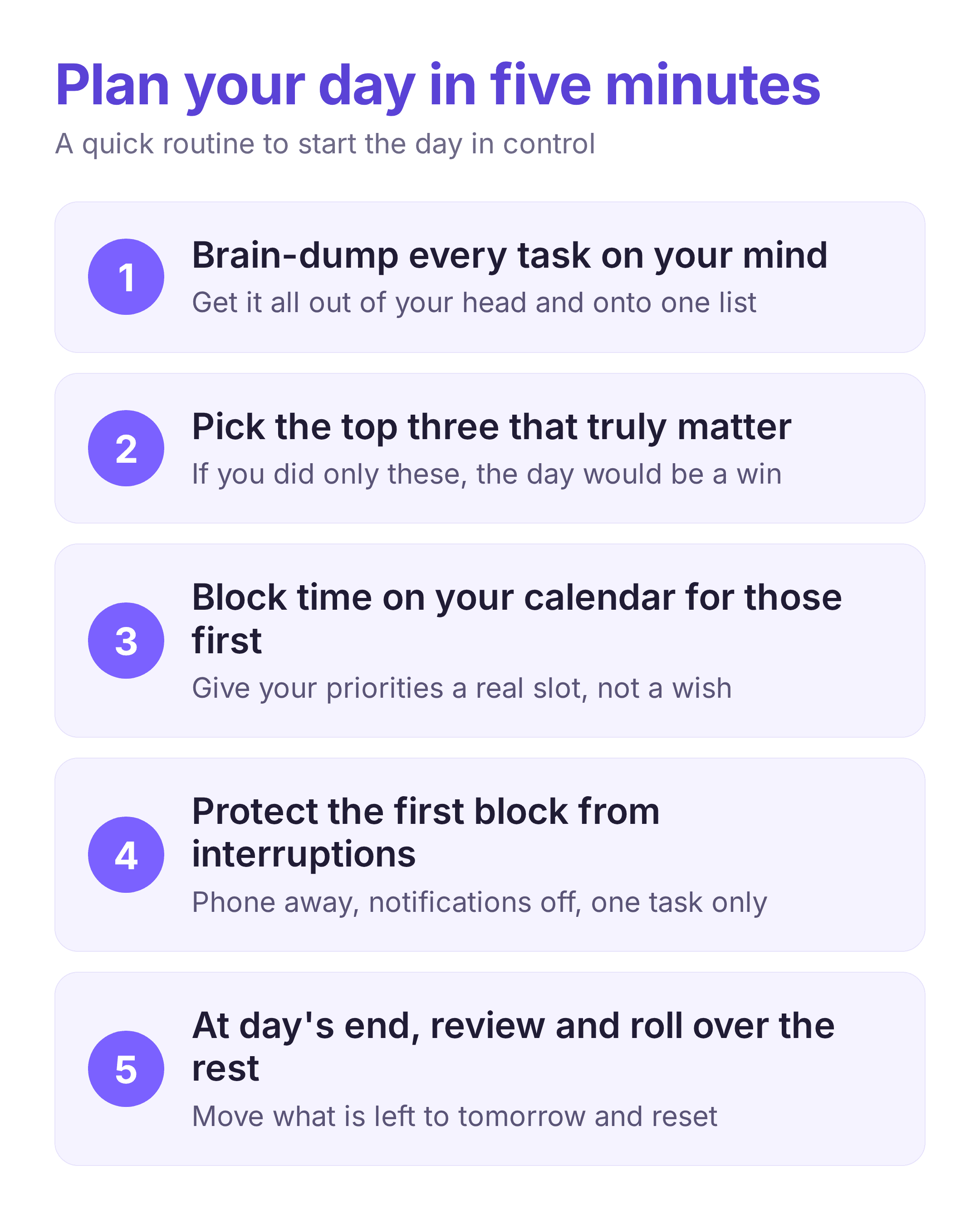
A steady start helps too, and our morning routine checklist shows how to set your day up before the noise begins.
Prioritizing and planning work best when they point at something. A clear goal, for the week, the quarter, or a project, tells you which tasks are worth your time in the first place. Write down what you are working toward, then check that your daily to-do list adds up to it. Without a goal, it is easy to stay busy with tasks that feel productive but do not take you anywhere.
A plan only works if you can stay with the task in front of you. Do one thing at a time, deal with distractions in batches instead of reacting to each one, and put your phone out of reach during focused work. This matters more than it sounds: after an interruption, it takes the average person about 25 minutes to fully return to what they were doing, so a few protected blocks are worth more than a whole day of scattered attention.
You can schedule your time perfectly and still get little done if you are exhausted. Notice when you focus best, often the first hours of the day, and put your hardest work there. Take real breaks, protect your sleep, and eat and move enough to keep your mind steady. You will get more done in one focused hour than in three tired ones.
You cannot do everything, and trying to is its own time sink. Hand off what someone else can do, decline the meeting that could be an email, and drop the low-value tasks that only feel productive. Saying yes to one thing usually means saying no to another, so choose on purpose and keep room for the work that counts.
When a task feels too big, you put it off, and the delay costs more time than the task would. Shrink the first step until it is almost too easy to skip: open the document, write one sentence, do two minutes. Once you start, momentum usually carries you, and turning these moves into good habits makes them automatic over time.
You do not need to invent a system. These proven time management techniques each solve a common problem, so pick one or two that fit how you work. The Pomodoro technique breaks work into 25-minute sprints with short breaks. Time blocking assigns every task a slot. The 80/20 rule is a reminder that a small share of your tasks drives most of the results. The two-minute rule says that if something takes under two minutes, you should do it now. And "eat the frog" means doing your hardest task first, while your energy is fresh.
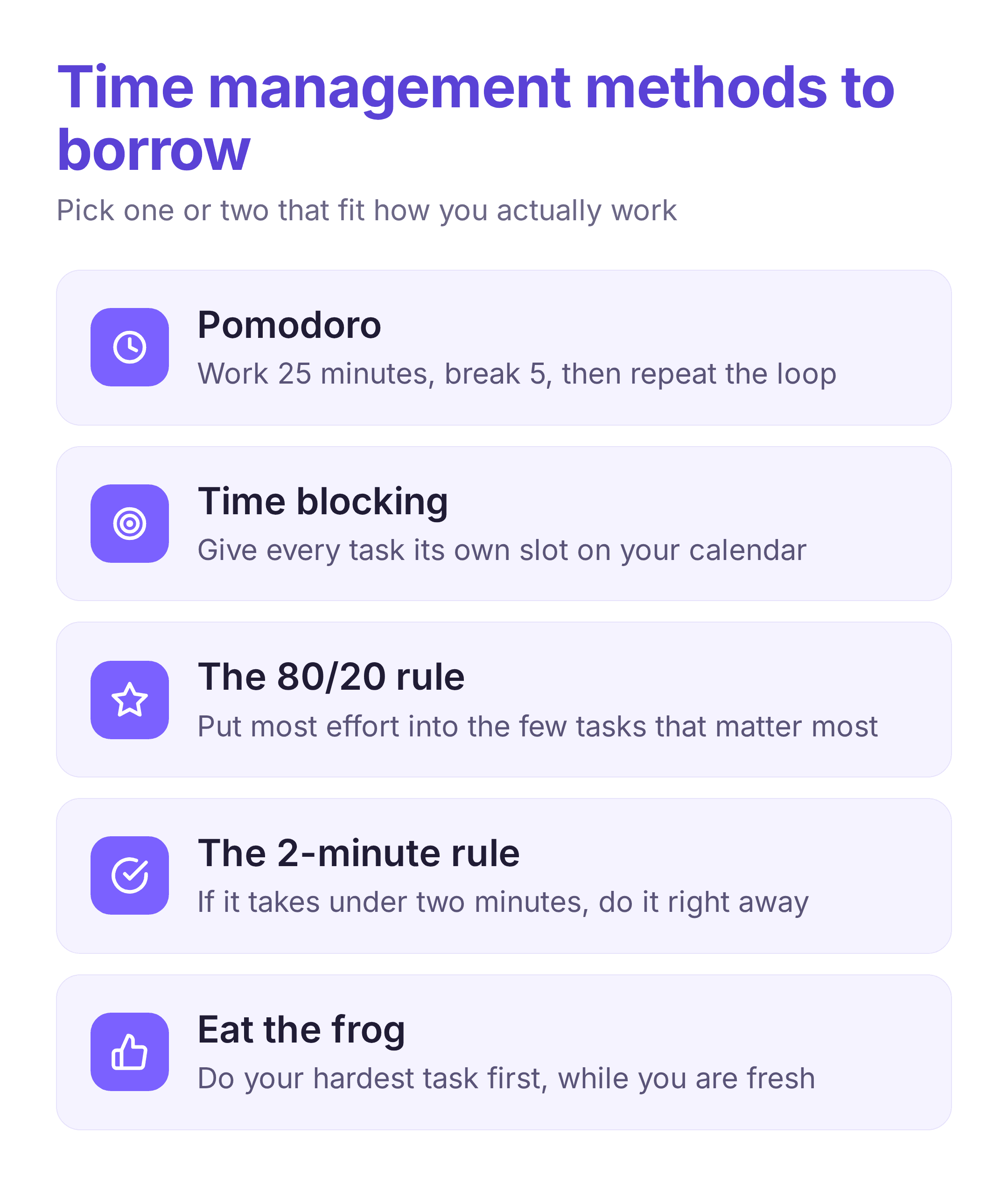
If you would rather let an app run these methods for you, a planner or timer tool can help, and our roundup of the best time management apps covers options for different working styles.
Aim for a few skills you use without thinking, not a system you have to maintain. Start with one, usually prioritizing or planning, and practice it for a week before adding another. Attaching a new skill to something you already do daily helps it hold. RiseGuide takes this micro-learning approach across skills like focus and discipline, turning spare minutes into short, interactive lessons built on expert insights, so you build the habit in a few minutes at a time rather than overhauling your whole routine at once. Its SEEK tool can also give you a quick, cited answer from vetted expert sources when one nagging question is eating your afternoon.
You do not need to master all seven skills at once. Pick the one that would help you most this week, use a method to support it, and add the next when the first feels natural. Time management improves the way any skill does, a bit at a time.
A common shortlist is prioritizing, planning, focusing, managing your energy, and saying no. Prioritizing decides what to work on, planning decides when, focusing protects the work, energy management keeps you sharp, and saying no keeps low-value tasks from crowding out the rest.
The seven in this guide are prioritizing, planning and scheduling, setting clear goals, protecting your focus, managing your energy, delegating and saying no, and beating procrastination. Together they cover deciding what to do, when to do it, how to protect that time, and what to hand off or drop.
The five P's are described a few different ways. One common version is Prioritize, Plan, Prepare, Perform, and Pause, which walks through deciding what matters, mapping it out, getting ready, doing the work, then resting and reviewing. Another common phrasing is the reminder that proper planning prevents poor performance.
For most people it is prioritizing. If you spend your time on the wrong things, no amount of planning or speed will make up for it, so learning to tell the important from the merely urgent gives you the biggest return.
Make the first step tiny: open the file, write one line, set a two-minute timer. Procrastination usually comes from a task feeling too big or unclear, so shrinking the start and removing distractions gets you moving, and momentum does the rest.