RiseGuide Team
To build good habits, make each one small enough to do without relying on motivation, attach it to something you already do every day, and arrange your surroundings so the good action is the easy one. Pick a single habit at a time, repeat it at the same cue until it runs on its own (about 66 days on average), and give yourself a small reward right after so your brain wants to come back to it. When you miss a day, do the habit again the next day instead of starting over. Small, anchored, rewarded, and forgiving is the combination that turns a good intention into a habit you keep.
Most of us do not struggle with good habits because we do not know what to do. We know we should read more, move more, or get to bed earlier. The hard part is turning that intention into something we do without arguing with ourselves every single time. A habit is a behavior your brain has made close to automatic, so it costs less effort and less willpower each time you repeat it. Learning how to build good habits at that level, how they form and where they usually fall apart, is what lets you set them up on purpose instead of hoping they take hold.
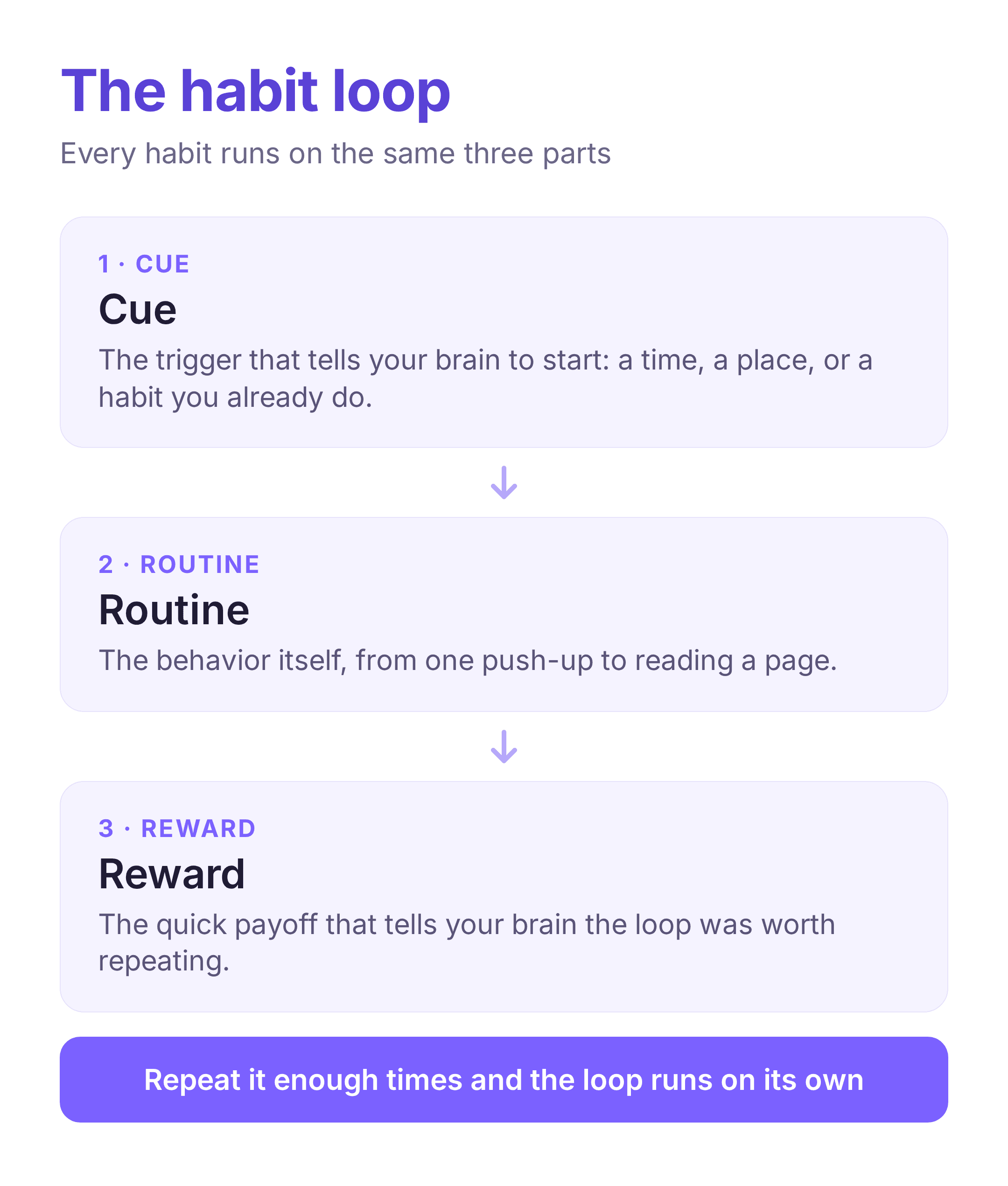
Every habit runs on a short loop, and knowing the parts makes a habit much easier to design. Charles Duhigg, the journalist who popularized the idea in The Power of Habit, describes three pieces: a cue that tells your brain to start, a routine (the behavior itself), and a reward that tells your brain the loop was worth remembering. Repeat it enough times and the loop starts to run on its own. You notice the cue and the routine follows before you have really decided to do it.
Charles Duhigg walks through the loop with real examples in his TEDx talk.
The useful part is that the cue and the reward are the levers you can actually pull. If you want a new routine to take hold, give it a clear cue you cannot miss and a reward you can feel right away. That is also why habits take a while to settle in. In a study run by Dr. Pippa Lally at University College London, it took an average of 66 days for a new behavior to feel automatic, and the range across people ran from 18 to 254 days. The "21 days to a habit" idea you have probably heard is a myth. Plan for a couple of months of repetition, not three weeks.
Knowing how to build a habit comes down to designing the loop above on purpose. The order below matters: you choose the habit before you shrink it, and you anchor it before you worry about rewards. Work through one habit at a time rather than redesigning your whole day at once.
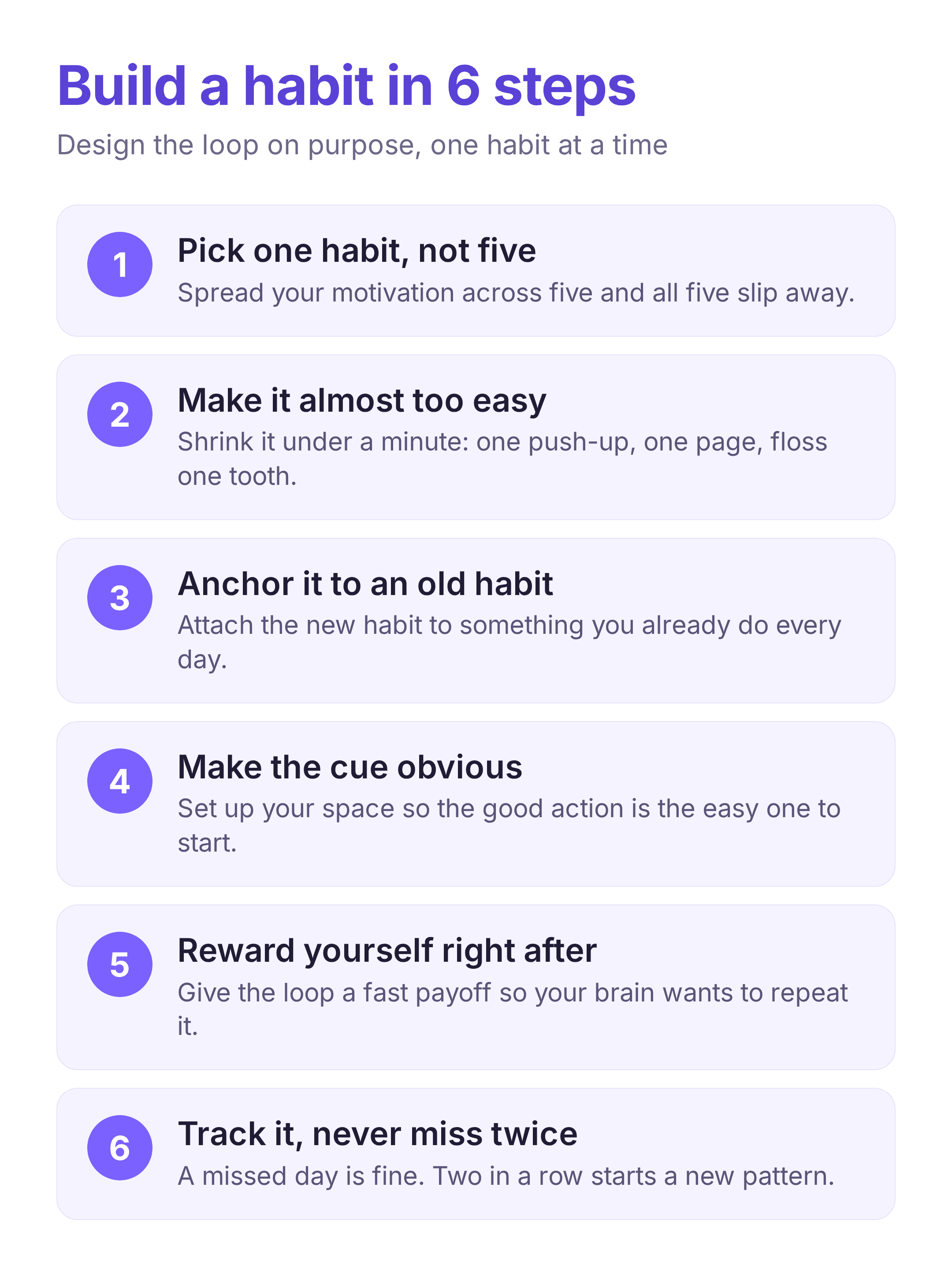
Motivation is a limited budget, and spreading it across five new habits is how all five slip away. Choose the single habit that would make the biggest difference and start only with that. It helps to tie it to the kind of person you want to become: "I am someone who moves every day" holds up better than "I want to lose weight." If you are building toward something bigger, a personal development plan can help you decide which habit to start with.
The most common reason a habit fails is that the first version is too big. Behavior scientist BJ Fogg found that shrinking a habit until it takes less than a minute, one push-up, flossing one tooth, reading one page, removes the need for motivation almost entirely. You can always do more once you have started, but the tiny version is the part you promise yourself.
BJ Fogg explains why starting tiny works in his TEDx talk.
A new habit needs a reliable cue, and the most reliable cues are the things you already do every day without thinking. Attaching the new habit to an existing one is the fastest way to give it a trigger, and it is worth its own section below.
Your surroundings decide a lot of your behavior, so set them up in your favor. Put the book on your pillow, leave the running shoes by the door, keep the guitar on a stand instead of in its case. Do the opposite for habits you want less of: the harder something is to start, the less often you will do it. James Clear calls this making the good habit obvious and easy.
James Clear covers environment and small improvements in this talk.
Your brain repeats what feels good, so give the loop a reward it can register immediately. That can be as small as ticking a box, a short stretch you enjoy, or simply telling yourself "good job." The reward does not have to be big; it has to be fast, because a payoff next month cannot reinforce a habit today.
A simple mark on a calendar or an app turns an abstract goal into a visible streak, and the streak itself becomes a small reward. The rule that protects the streak is this: missing once is an accident, missing twice is the start of a new pattern. If you skip a day, make the next day non-negotiable.
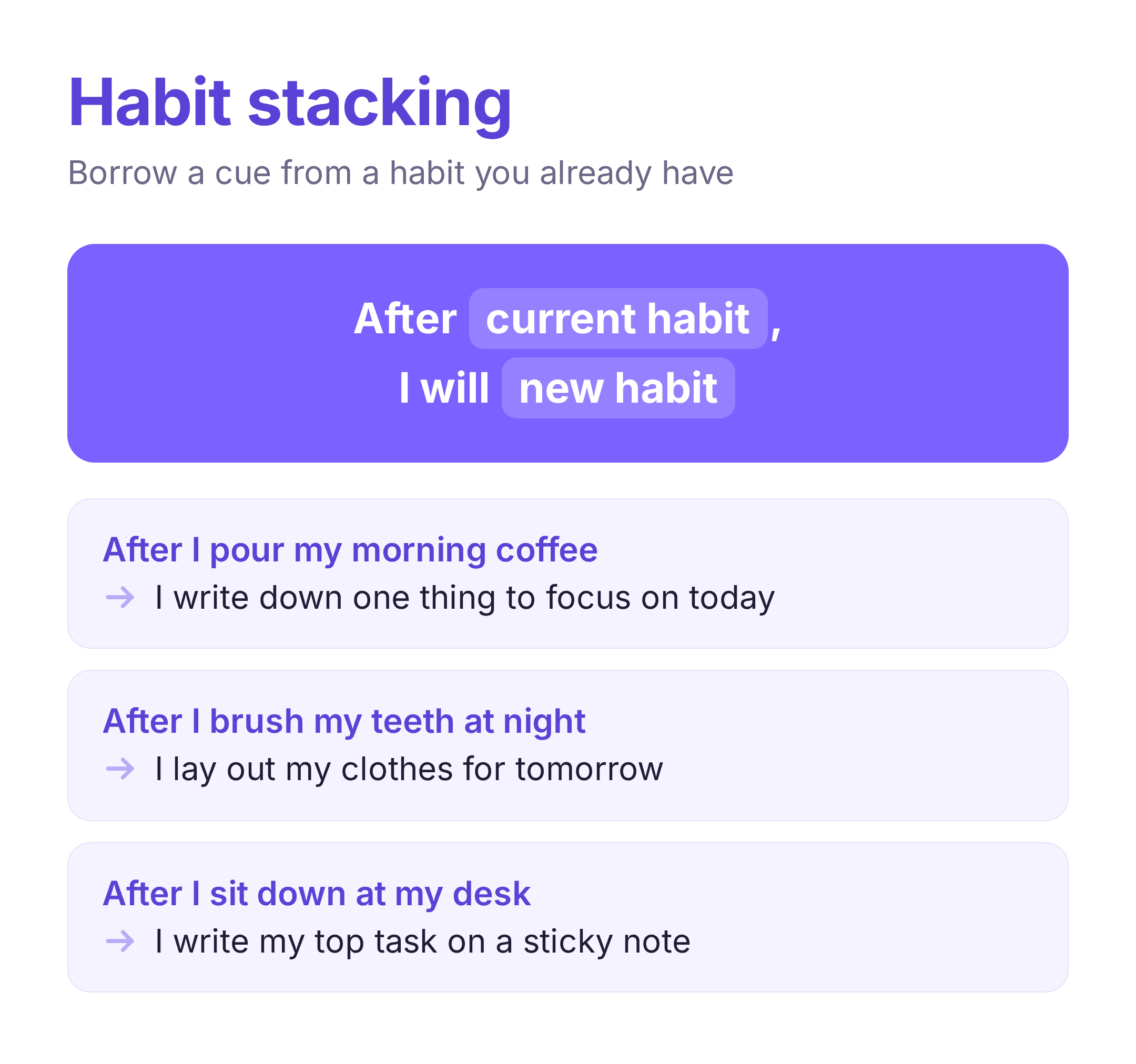
Habit stacking is the most reliable way to give a new habit a cue, so it deserves a closer look. The idea, popularized by James Clear, is to use a habit you already do every day as the trigger for the new one. Instead of hoping you will remember, you borrow a cue that is already locked into your routine.
The formula is a single sentence: "After [current habit], I will [new habit]." For example: after I pour my morning coffee, I will write down one thing I want to focus on. After I brush my teeth at night, I will lay out my clothes for tomorrow. After I sit down at my desk, I will write my top task on a sticky note. Because the first habit already happens on autopilot, it drags the new one along with it.
A few things make a stack hold. Match the size of the new habit to the anchor, so a two-minute habit follows a daily one, not a weekly one. Be specific about the exact moment ("after I close my laptop," not "in the evening"). And stack onto something that happens whether you feel like it or not, which is why anchoring to a morning routine works so well: mornings tend to happen the same way every day.
Motivation is useful on day one and mostly gone by day ten, so a habit that depends on feeling inspired will not last. Learning how to build habits that stick is really about building a system you can follow on your worst day, not just your best one. As James Clear puts it, "You do not rise to the level of your goals. You fall to the level of your systems."
A few things carry a habit through the flat middle stretch. Keep the habit small enough that the low-energy version still counts, so on a hard day you still show off two minutes instead of skipping entirely. Judge yourself by whether you showed up, not by how well it went. And when you slip, treat it as one missed rep rather than proof that you have failed, because the guilt spiral does more damage than the missed day. This is how to create good habits that survive a bad week: you make the bar low enough to clear and you forgive the misses fast.
If the part you keep running into is your own follow-through, working on self-discipline directly gives you more to work with than willpower alone.
If you know you want to change something but not what, it helps to see a few good habits to build laid out by area. Pick one, shrink it, and anchor it using the steps above rather than trying to adopt the whole list. These are small on purpose, which is also how to build healthy habits that survive past January.
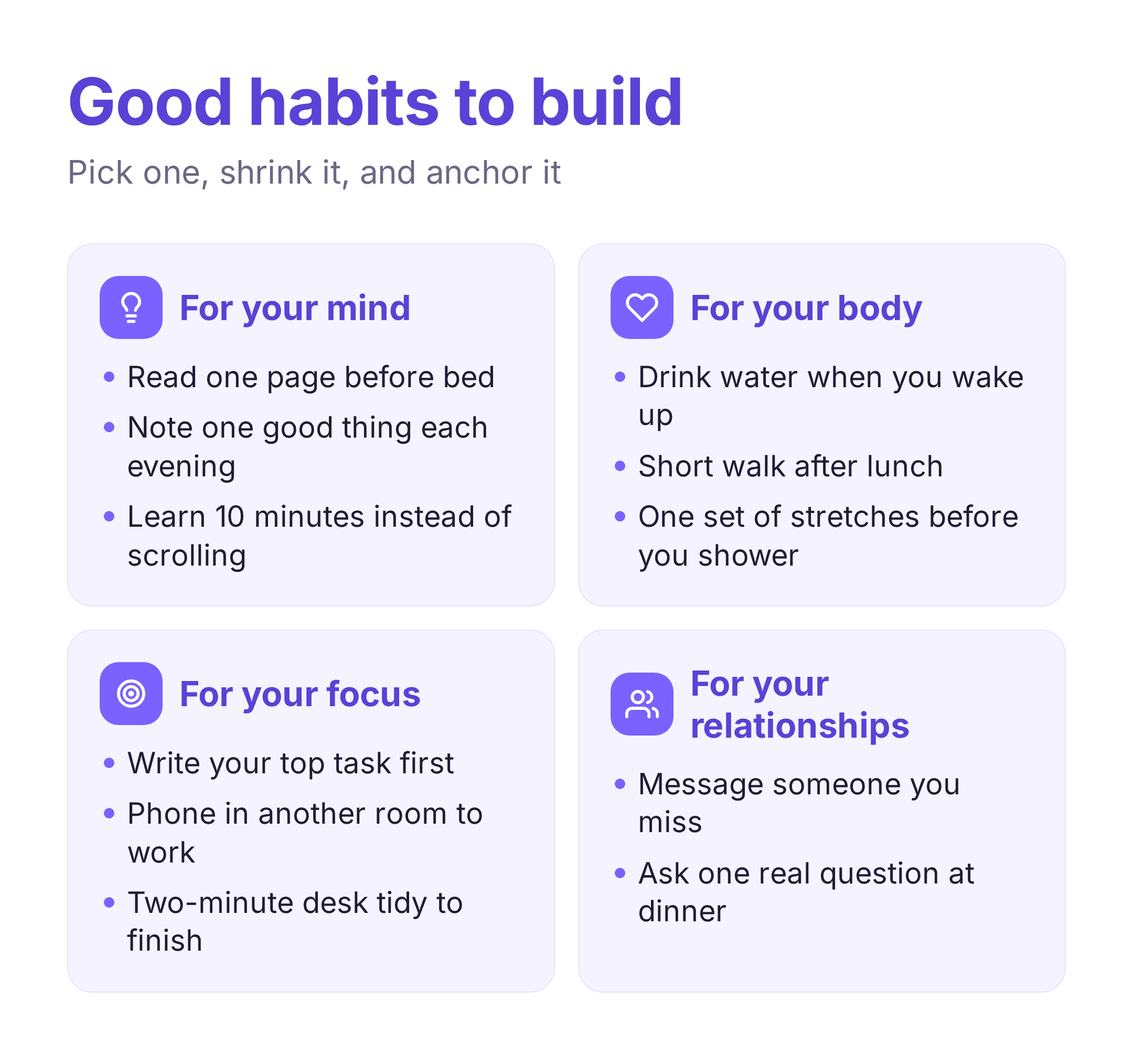
For your mind: read one page before bed, write down one thing that went well each evening, or spend ten minutes learning something instead of scrolling.
For your body: drink a glass of water when you wake up, take a short walk after lunch, or do one set of stretches before you shower.
For your focus: write your single most important task before you open email, put your phone in another room while you work, or do a two-minute tidy of your desk at the end of the day.
For your relationships: send one message to someone you have not spoken to in a while, or ask one real question at dinner instead of talking about your own day.
None of these will change your life on their own. The point is to get one loop running reliably, feel what it is like to keep a promise to yourself, and then build the next one on top of it.
Good habits are mostly a matter of design. When a habit is small, tied to something you already do, easy to start, and rewarded right away, you need far less willpower to keep it, and willpower was never going to carry it for two months anyway. Start with one habit this week, make it almost embarrassingly small, and give it a clear cue. Once it runs on its own, you will have both the habit and a method you can use for the next one.
On average about 66 days, based on Dr. Pippa Lally's research, though it ranged from 18 to 254 days across people. Simpler habits settle in faster than harder ones. Plan for a couple of months of steady repetition rather than the "21 days" you may have heard.
One. Motivation and attention are limited, and starting several new habits at the same time usually means none of them sticks. Get one running on autopilot, then add the next.
Habit stacking means attaching a new habit to one you already do, using the formula "after [current habit], I will [new habit]." The established habit acts as the cue, so you do not have to remember the new one on your own.
Treat a miss as a single event and restart the next day. The rule that keeps a habit alive is to never miss twice in a row, so one skipped day is fine as long as the following day is not.