RiseGuide Team

To build self discipline, stop trying to force it with willpower and build a system around the behavior instead. Start so small the first step feels almost too easy, design your environment so the right choice takes less effort, and repeat the behavior at the same time and place until it turns into a habit. Attach it to a reason and an identity you care about, make an if-then plan for the moment you usually quit, track it so progress stays visible, and treat a missed day as normal rather than a reason to stop. Discipline is built through repetition and setup over weeks, not summoned in a single burst, so give it time and keep the streak going even on the days you only do the smallest version.
Most people treat self discipline as something you either have or you don't, a kind of inner strength that focused people were born with. That picture is wrong, and it's also why so many attempts to get disciplined fall apart by the second week. Self discipline comes mostly from the systems you set up around a behavior, and those systems are things anyone can build. Gritting your teeth barely comes into it. This guide covers what self discipline actually is, why it gets hard when you lean on willpower alone, and how to build self discipline in a way that holds up on ordinary, low-energy days, so you can learn how to be disciplined without depending on a burst of motivation.
Self discipline is the ability to do what you decided to do, even when you don't feel like doing it in the moment. It means choosing the action that serves your longer-term goal over the easier or more immediately pleasant option, going for the run, opening the textbook, moving money into savings, and doing it on a repeatable basis rather than once.
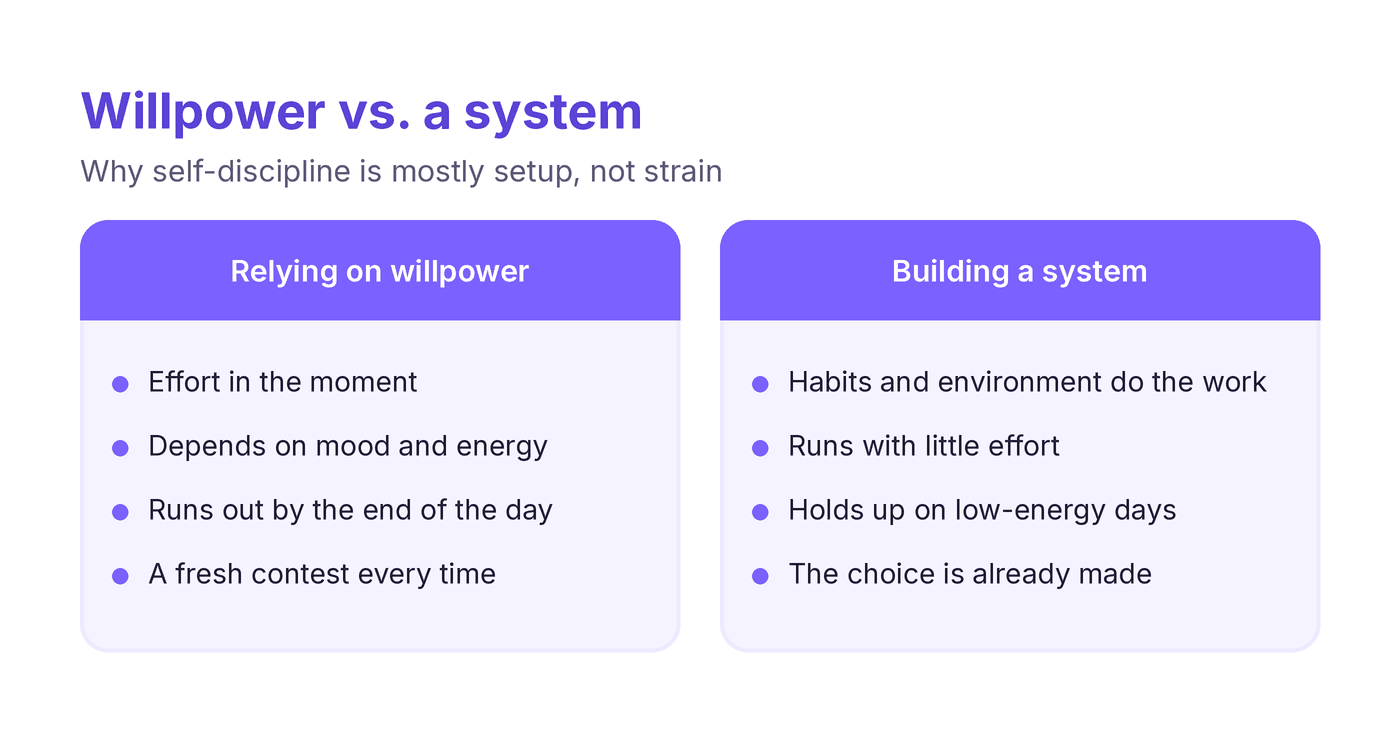
A few words get used as if they mean the same thing, and separating them helps. Willpower is the in-the-moment effort of resisting a temptation or pushing through resistance; it's real, but it's a limited and unreliable fuel. Motivation is the feeling of wanting to act, which rises and falls with your mood and energy. Self control is close to willpower, the act of holding back an impulse. Self discipline is the steadier picture around all of that: the habits and choices that mean you don't have to summon willpower or wait for motivation every single time.
People with strong self discipline tend to do better across many areas of life. In one well-known study, Angela Duckworth and Martin Seligman found that self-discipline predicted students' grades more strongly than IQ did. The encouraging part is that, unlike IQ, it's something you can deliberately build.
If getting disciplined were only a matter of trying harder, most of us would have managed it by now. When it stays hard, the reason usually comes down to two things, and neither is a character flaw.
Willpower runs down over a long day, and motivation comes and goes on its own. When your whole plan depends on feeling ready and mustering effort at the exact moment of temptation, you've built it on the least reliable part of the system. This is also why the people who look the most disciplined often aren't the ones straining the hardest. In a 2015 study, psychologists Brian Galla and Angela Duckworth found that people with strong self-control tend to succeed because they've built good habits that make the right action almost automatic, not because they're better at resisting temptation in the moment.
A goal like "be more disciplined" or "get in shape" gives you nothing concrete to start, so nothing starts. And when the easy, tempting option is always within reach, the phone on the desk, the snacks on the counter, you're forced into a willpower contest every time you sit down. Demetra Moore, one of our experts, makes the case for building mental fitness so you can keep going without waiting to feel motivated, which is a steadier foundation than willpower on its own.
The techniques below don't depend on feeling motivated, because each one either lowers the effort a behavior takes or makes it more automatic. You don't need all of them at once. Pick the two or three that fit what you're working on and the point where you usually stall. This is how to develop self discipline gradually, one supported behavior at a time, rather than trying to overhaul everything in a week. It's also the most reliable way to build discipline that holds, because you're changing the setup around a behavior instead of leaning on effort.
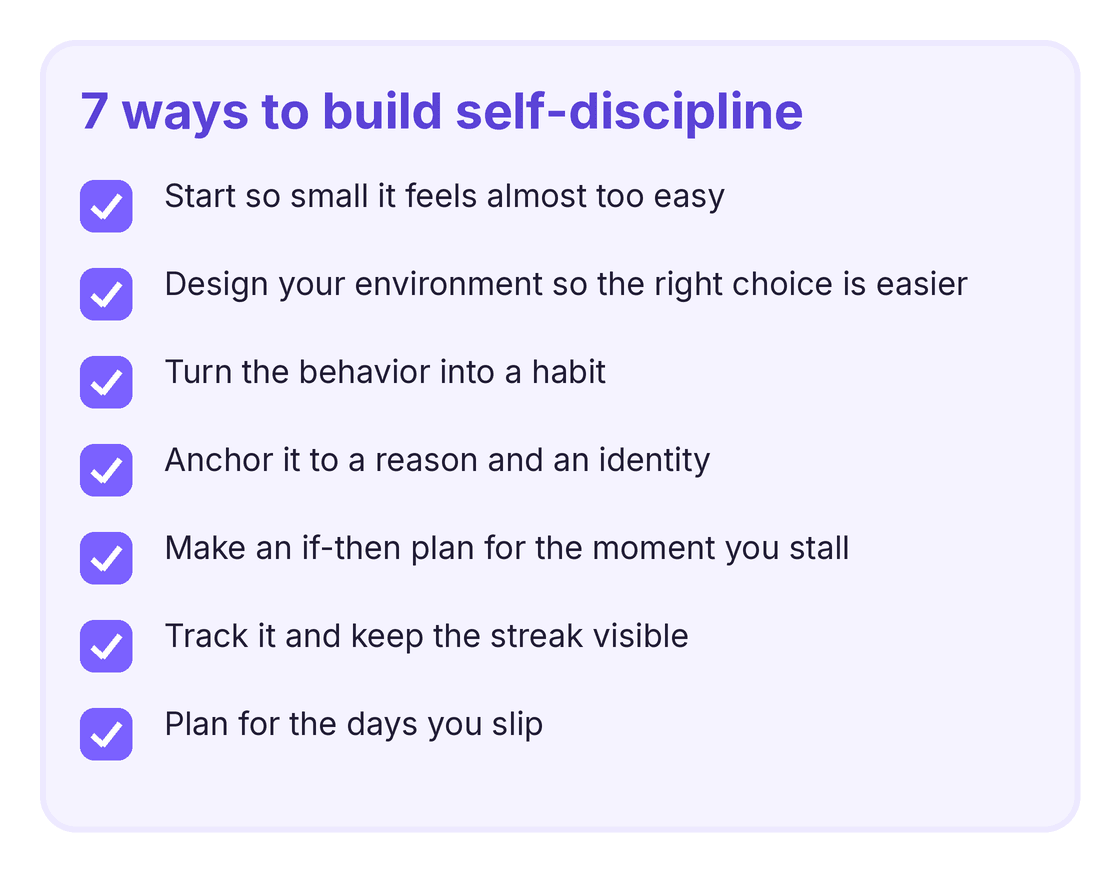
The most common mistake is starting too big. An hour at the gym or two hours of study is easy to skip on a tired day. Shrink the first step until it's almost impossible to say no to: put on your running shoes, read one page, write one sentence. The small version gets you moving, and momentum usually carries you past it. Even on the days it doesn't, you've kept the behavior alive, which matters more than any single big session.
Most of what looks like discipline is really a well-arranged environment. Reduce the friction in front of the behavior you want and add friction in front of the one you don't. Lay your gym clothes out the night before, keep the book on your pillow, put your phone in another room while you work, move the snacks out of sight. Deciding these things in advance, when you're calm, means you're not negotiating with yourself in the moment your willpower is lowest.
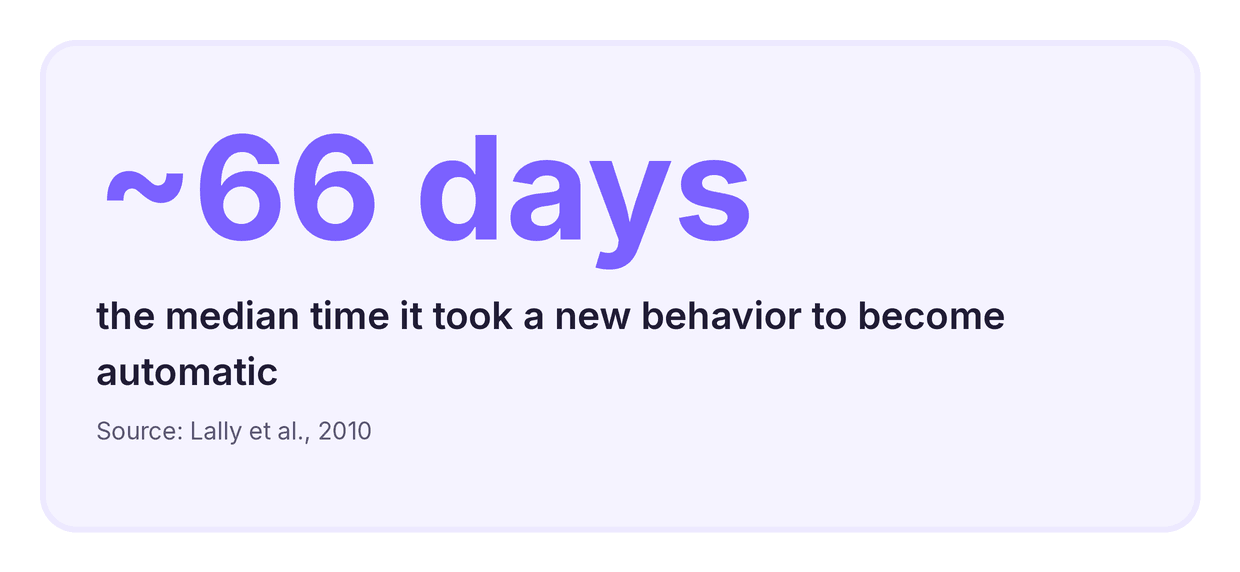
The real goal is to stop deciding. A behavior you repeat at the same time and in the same place eventually runs with far less effort, because it stops being a choice and becomes what you just do. This takes longer than the popular "21 days" line suggests. In a 2010 study, researcher Phillippa Lally found it took a median of about 66 days for a new behavior to feel automatic, and the time varied widely from one person and habit to the next. So the useful expectation is weeks to months of steady repetition, not a few days, and this stretch is where learning how to stay disciplined actually lives, in the weeks after the first motivation fades.
A behavior sticks better when it's connected to something you actually care about and to the kind of person you're trying to become. "I'm someone who trains" carries you further than "I should exercise." Spend a minute naming why the goal matters to you, then let the behavior become part of how you see yourself. John Lentini, a leadership coach and one of our experts, describes discipline as one of the dials of self-leadership you can deliberately turn up, rather than a fixed trait you're stuck with.
Decide in advance what you'll do at the exact point you usually give in. Name the trigger and the response: "If it's 7 a.m., then I put on my running clothes," or "If I finish lunch, then I study for 20 minutes." These plans do the deciding for you, so you're not relying on willpower when it's weakest. Whitnie Wiley, an executive coach and one of our experts, writes about moving from planning into action when planning itself becomes the way you avoid starting.
If building the habit is the part you keep losing, some outside structure can help carry it. RiseGuide is an expert-powered self-improvement app with short daily lessons of around 15 minutes, built from the insights of experts, on discipline, mindset, and other skills. The lessons run on the same small-and-repeatable logic as these techniques, so the practice fits into the gaps in a normal day.
Progress you can see is easier to keep. Mark an X on a calendar for every day you do the behavior, or use a habit app, and let the growing chain become its own small reason not to break it. Tracking also keeps you honest about how you're really doing, which is more useful than a vague sense that you've "been good lately."
You will miss days. The people who stay disciplined aren't the ones who never slip; they're the ones who don't let one miss turn into five. Treat a missed day as information rather than failure, and do the smallest version the next day to keep the chain going. Being hard on yourself after a slip tends to make the next attempt harder, so getting back to the behavior quickly matters more than getting the reasons right. If you want to go deeper on the systems behind all of this, several of the best productivity books are built around exactly this idea.
Building self discipline comes down to setting up a behavior so it no longer depends on willpower: start small, shape your environment, repeat it into a habit, tie it to a reason you care about, plan for the moment you'll stall, track it, and keep going after a slip. None of it happens in a single burst. Give it a few weeks of steady repetition and the thing that once took force starts to feel like routine, which is the point where you've improved self discipline for good rather than pushed through for a while.
There's no single official list, but most versions come down to five things: a clear, specific goal; self-awareness about where and why you slip; an environment and set of habits that make the right action easier; a reason that matters to you; and consistency, ideally with some accountability. In short, they're the parts of a system that lets you act without relying on willpower.
Usually a mix of vague goals, depending on willpower and motivation, an environment full of easy temptations, and being tired or under-slept so your effort runs out faster. It's rarely a fixed personality trait, which is why changing the goal and the setup tends to help more than trying to want it more.
Self discipline is what lets you follow through on goals after the initial motivation fades, and research links it to better outcomes in school, health, and money. Because it drives whether your intentions turn into action, it often shapes results more than talent or a one-time burst of effort.
Everyday self discipline examples include going to bed on time when you'd rather stay up, saving a set amount each month before spending, studying or working before you check your phone, and doing a short workout on a day you don't feel like it. Each is a small choice for the longer-term payoff over the easier option.
There's no fixed number, but expect weeks to months rather than days. A new behavior took a median of about 66 days to feel automatic in Lally's research, and it varies a lot by person and habit, so consistency over that stretch matters more than intensity in any single week.
Willpower is the effort you spend resisting a temptation in the moment, and it's limited. Self discipline is the wider system of habits, environment, and planning that means you rarely need to spend that effort in the first place. Willpower helps you win one standoff; self discipline keeps you from having the standoff at all.