RiseGuide Team

To tell intrinsic from extrinsic motivation, you ask one question about why you are doing something: is the activity itself the reward, or are you doing it to get something else? Intrinsic motivation is when the activity is its own reward, like reading because the subject interests you. Extrinsic motivation is when you act to earn a reward or avoid a consequence, like studying to pass a test or working to get paid. Most of what you do falls somewhere between the two, and both have a use. Intrinsic drive tends to last longer and feel better, while outside rewards are good at getting you started on hard or dull tasks. The approach that works best is to use a reward to get moving on things you would rather skip, then find a genuine reason to care so the habit keeps going once the reward stops.
Think about two people training for the same race. One runs because the medal and the finish-line photo matter to them. The other runs because the quiet hour on the road is the best part of their day. They are doing the same thing for completely different reasons, and those reasons shape how long each of them keeps at it. That difference sits at the heart of intrinsic vs extrinsic motivation, one of the most studied ideas in the psychology of why people do what they do. Knowing which kind is driving you makes it easier to choose habits that stick and to spot the ones that fall apart the moment the reward disappears.
The simplest way to separate the two is to ask what you are after when you act. With one kind of motivation, the activity itself is the point. With the other, the activity is a way to get something else. Psychologists have a name for the framework behind this split: self-determination theory, developed by Edward Deci and Richard Ryan, which describes intrinsic motivation as doing something for its inherent satisfaction and extrinsic motivation as doing it to reach a separable outcome.
The internal kind runs on interest, curiosity, and enjoyment. You read a novel because the story pulls you in, or you cook a new dish because the process is fun. The external kind runs on outside rewards and pressures. You file a report to keep your job, or you sort the recycling to avoid a fine. Both are real motivation, and both get things done. What changes is where the energy comes from and how it holds up over time.
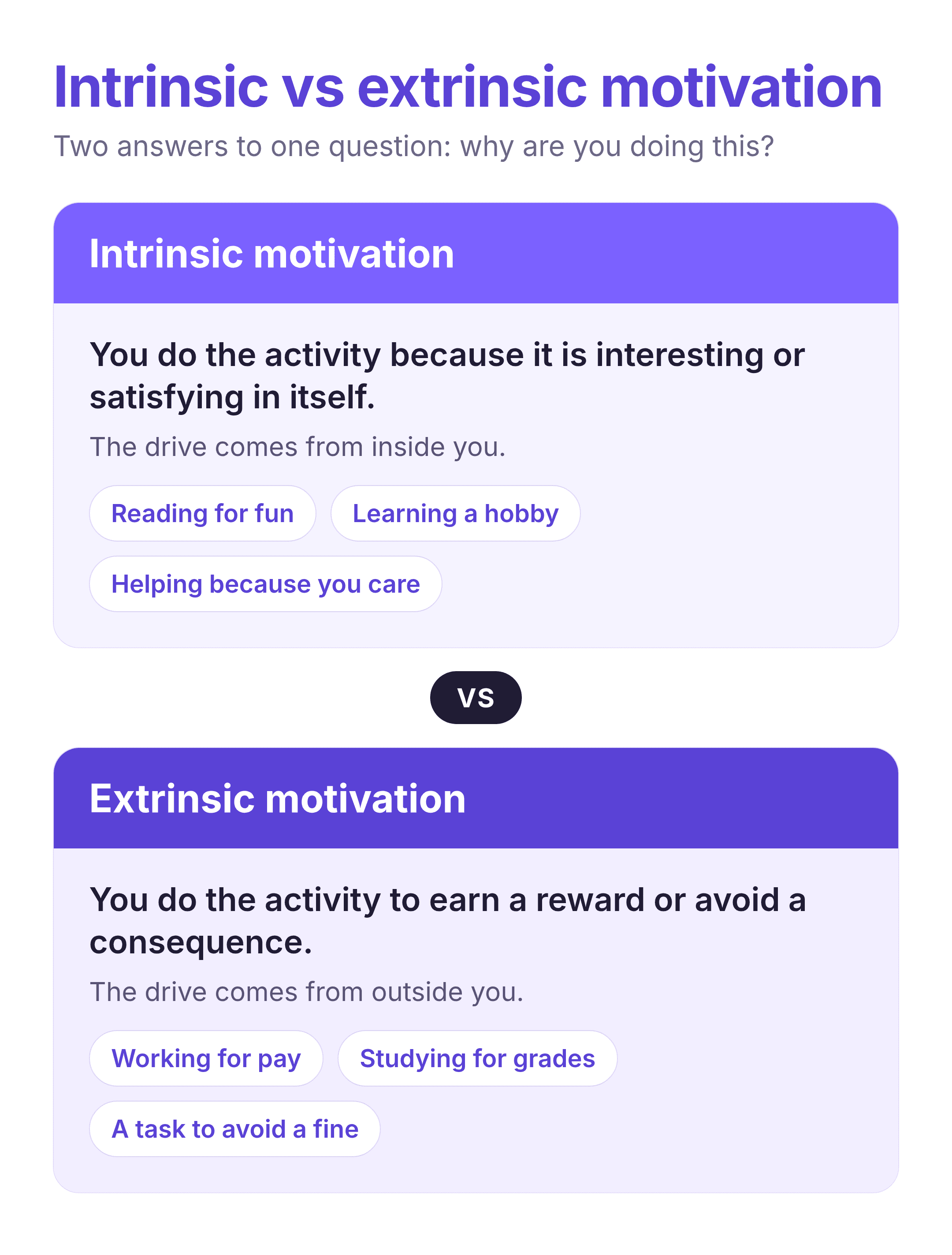
Intrinsic motivation is the drive to do something because you find it interesting or satisfying on its own, with no reward attached. A child who spends an afternoon drawing because it is fun is intrinsically motivated. So is an adult who learns guitar for the pleasure of playing, not to perform. This inside drive tends to produce better focus, more creativity, and habits that last, because the activity keeps paying you back every time you do it.
There is a catch though. Adding a reward to something you already enjoy can weaken the interest that was there to begin with. In a 1973 study, researchers watched preschoolers who loved to draw. The children who were promised a certificate for drawing later spent less time drawing on their own than the children who drew for nothing. The reward had taught them to treat a favorite activity as work. Psychologists call this the overjustification effect, and it is a good reason to be careful about paying yourself for things you already like doing.
So where does lasting internal drive come from? Author Daniel Pink, drawing on decades of this research, points to three things: autonomy (having a say in what you do), mastery (getting better at something that matters to you), and purpose (feeling your effort connects to something larger). In his book Drive, Pink puts the contrast plainly:
"Control leads to compliance; autonomy leads to engagement." — Daniel Pink, Drive
Pink lays out the science of motivation in his TED talk:
Extrinsic motivation is the drive to do something in order to get an outside result: a paycheck, a grade, praise, a prize, or the chance to avoid a penalty. It is the reason most people show up to work on a slow day and the reason students study for a subject they find dull. This kind of drive gets a bad reputation, but it is useful. It is very good at getting you moving on tasks that are hard, boring, or new, where interest alone would never be enough.
The trouble starts when an outside reward becomes the only reason you act. Once the paycheck, the deadline, or the applause goes away, the drive usually goes with it, and the behavior stops. The two kinds work together more often than they compete, and an outside reward can either back up your interest or wear it down, depending on how it is used. The practical lesson is to treat outside rewards as a way in, not a way to keep going.
The clearest way to see the difference is to look at the same activity done for two different reasons. Here are some everyday examples across the areas where the two show up most.
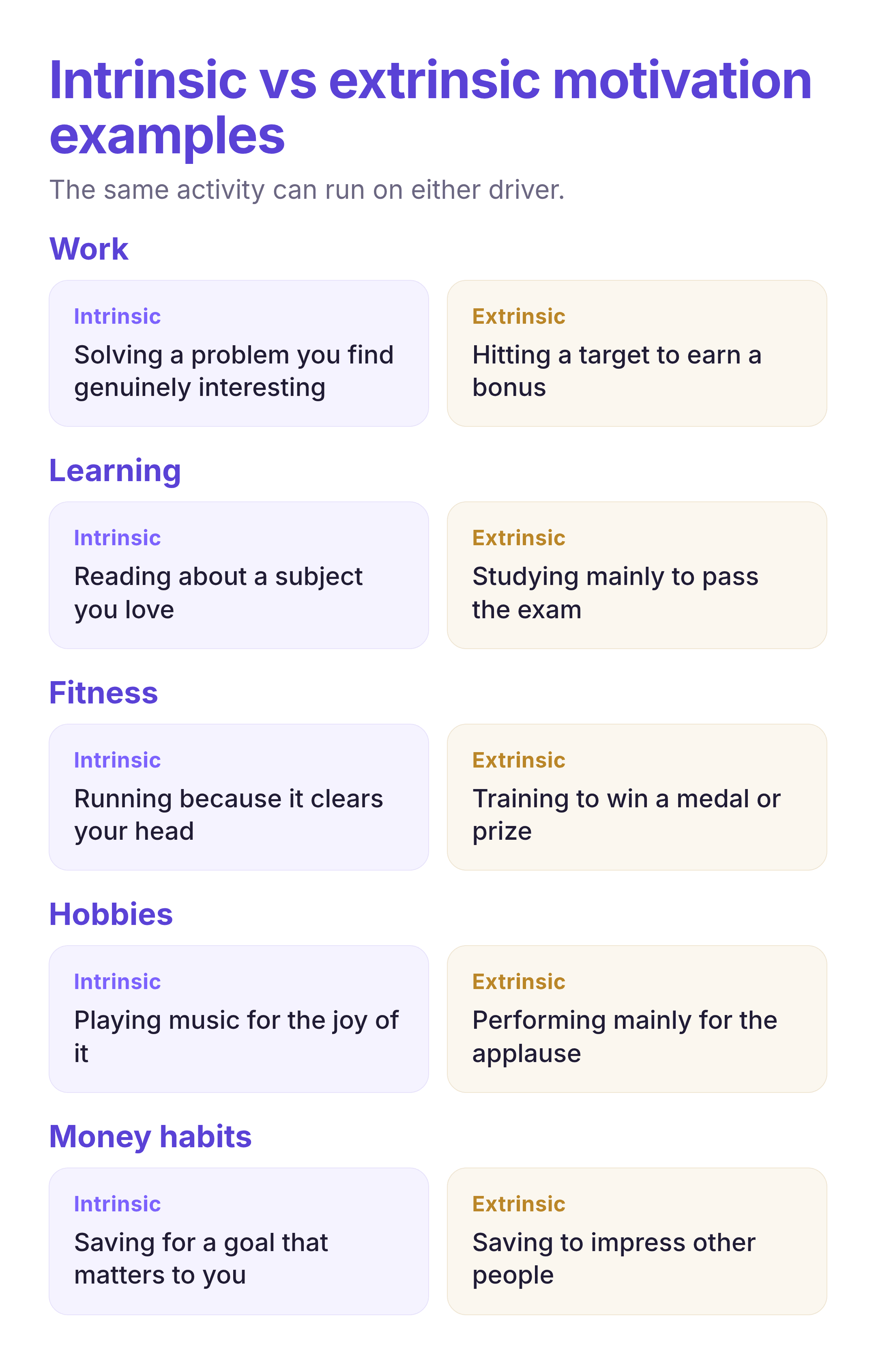
At work, the internal version looks like digging into a problem because it fascinates you, while the external version is pushing through the same problem to hit a target and earn a bonus. In learning, it is the difference between reading about a subject you love and studying only to pass the exam. In fitness, one person runs because it clears their head, and another trains to win a medal. Hobbies split the same way: playing music for the joy of it, or performing mainly for the applause. Even money habits follow the pattern, with some people saving toward a goal that truly matters to them and others saving mostly to impress the people around them.
Splitting motivation into two boxes is useful, but the reality is more of a spectrum. Self-determination theory describes several types of motivation that sit between pure outside pressure and pure inside interest, and seeing them helps you tell where a habit really stands.
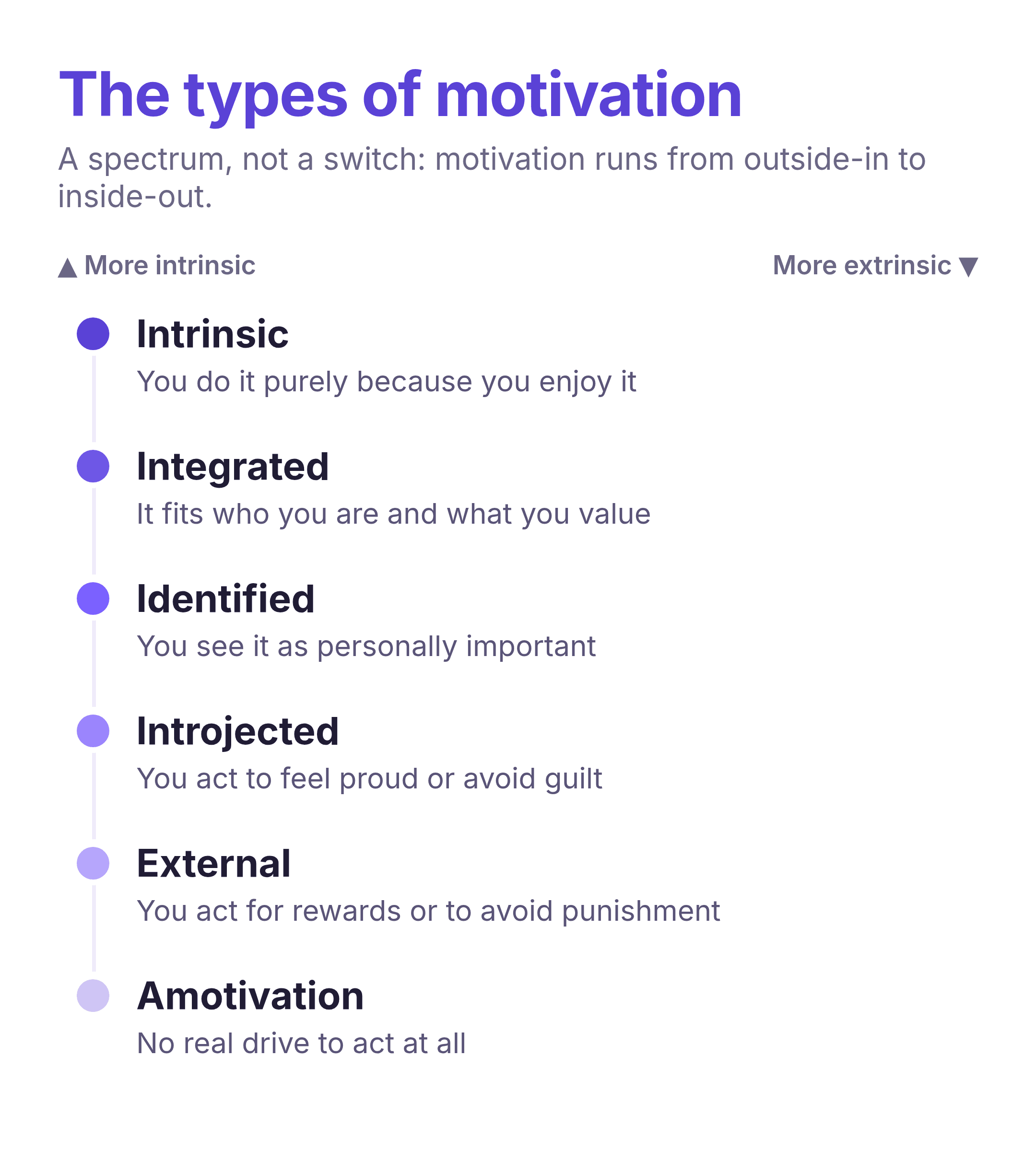
At one end is amotivation, where there is no real drive to act at all. Next comes external motivation, acting purely for rewards or to avoid punishment. Introjected motivation is a step inward: you act to feel proud or to avoid guilt, so the pressure now comes from your own self-image. Identified motivation is when you accept that something is personally important, like exercising because you value your health, even if you do not love the activity itself. Integrated motivation goes further, where the behavior fits who you are and what you stand for. At the far end is intrinsic interest, doing something purely because you enjoy it. The useful move is to nudge your reasons up this scale, from outside pressure toward personal meaning, because motivation that feels like your own is the kind that survives a bad week.
Using both kinds of motivation on purpose works better than trying to run on willpower alone. The idea is to use each one for what it does well. Start hard or boring tasks with a small extrinsic push, a reward or a deadline, then look for a reason to care that is your own, so the habit holds once the reward fades.
A few practical moves help. Connect the task to something you value, so a chore borrows meaning from a goal that matters. Give yourself some say in how you do it, since autonomy feeds internal drive. And expect your interest to dip, because it will, and that is where a little structure carries you through. Jennifer Layman, a marketing and communications consultant and one of our experts, writes about staying motivated when the results you are working toward are slow to show up. Demetra Moore, a leadership and communication coach and one of our experts, makes the case for building mental fitness so you lean on motivation less in the first place. And when the hard part is getting started, Whitnie Wiley, an executive coach and one of our experts, has a useful guide to moving from planning into action.
If the skill you are trying to build is how you communicate, RiseGuide's Communication Mastery journey turns that goal into short, practical lessons built from expert insights, which is one way to give a new habit enough structure to survive the early weeks when interest alone runs thin.
Intrinsic and extrinsic motivation are both tools, and the people who stay motivated longest tend to use both on purpose. Reach for an outside reward when you need to get moving, and build a real reason to care when you need to keep going. Pay attention to which one is driving a habit, and you can usually tell in advance whether it will last or fade the moment the payoff disappears.
Reading a book because the story interests you, learning a language for the fun of it, or helping a friend because you care are all examples of it. In each case the activity itself is the reward, with nothing extra attached.
Many activities involve both at once. A nurse may care deeply about patients and also work for a salary. A student might enjoy a science class while studying hard for the grade. The inside and outside drivers often run side by side.
The most common cause is turning something you enjoy into a means to an end. Heavy rewards, tight control, constant deadlines, and outside pressure can all wear down that inner interest, which is what researchers call the overjustification effect. Too much focus on the payoff can crowd out the interest that was there to start with.
Neither is better in every case. Inner motivation usually lasts longer and feels more rewarding, so it is the stronger choice for habits you want to keep. Outside rewards are better for getting started on tasks you would otherwise avoid. Using them together tends to work best.