RiseGuide Team

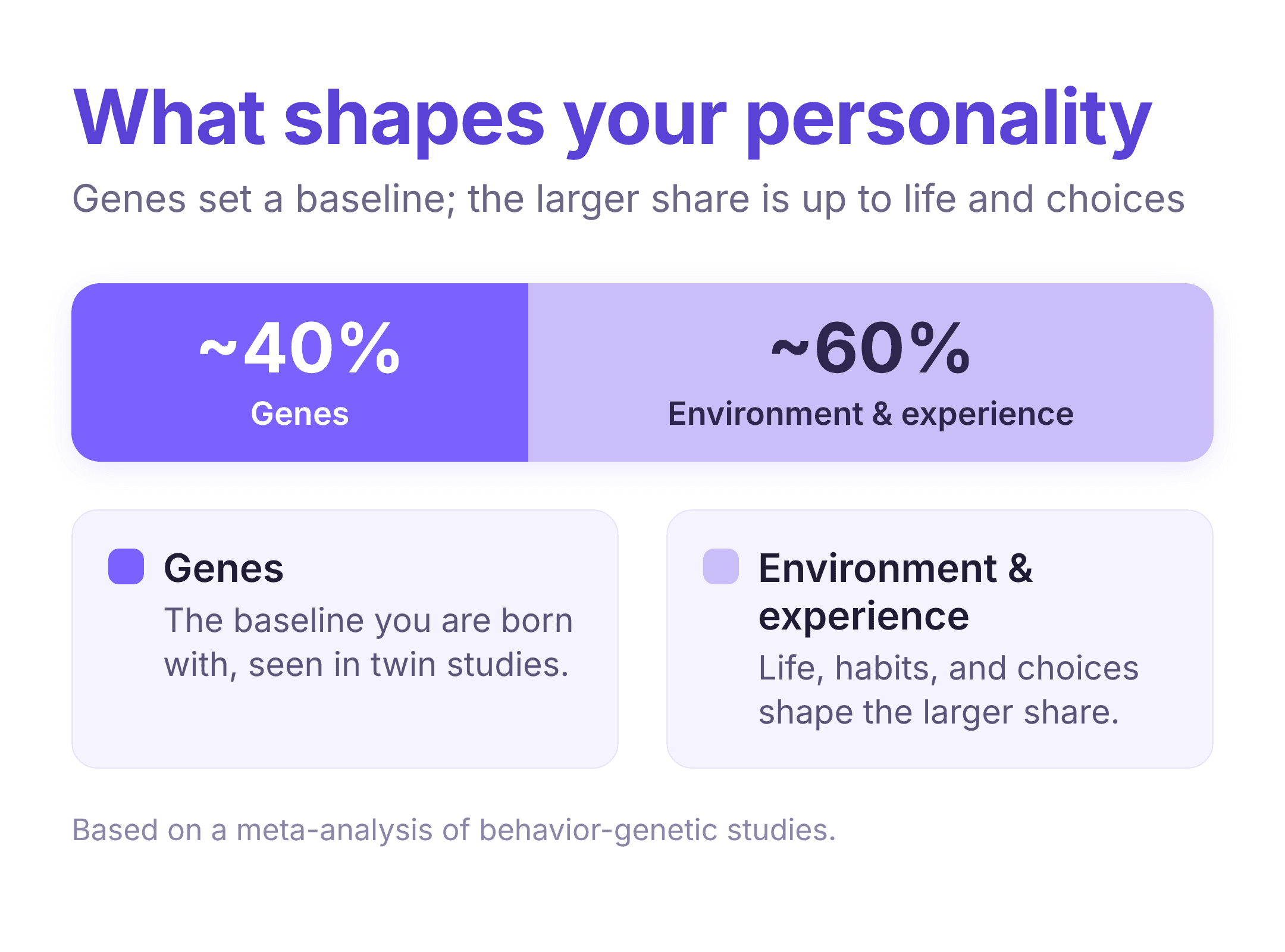
The big five personality traits are openness, conscientiousness, extraversion, agreeableness, and neuroticism, grouped under the nickname OCEAN. Each one is a scale you fall somewhere along rather than a box you fit into, so your personality is a blend of five scores rather than a single type. Openness covers curiosity and imagination; conscientiousness covers organization and self-discipline; extraversion covers how much energy you draw from being around other people; agreeableness covers warmth and cooperation; and neuroticism covers how strongly you feel stress and difficult emotions. Your scores stay fairly steady from year to year but still drift over a lifetime, about 40% of the differences between people trace back to genes, and a free big five personality test scores you on all five so you can see where you land.
Many online personality quizzes sort you into a type, such as a color, an animal, or a four-letter code. The big five works differently, and it is the model psychologists rely on most. These five dimensions have held up across many languages, age groups, and countries, which is one reason they appear in psychological research far more often than pop-culture quizzes do. Where you fall on them describes how you think and act more precisely than a single label can.
The big five personality traits are five broad dimensions that together describe the main ways people differ from one another: openness to experience, conscientiousness, extraversion, agreeableness, and neuroticism. The first letter of each spells OCEAN, which is why they are also called the OCEAN personality traits. You are not one trait or another. You have a level of all five at once, usually somewhere in the middle, and the combination is what shapes your personality.
The model grew out of a straightforward idea: the ways people differ matter enough that languages develop words for them. When researchers collected the thousands of personality-describing words in the dictionary and examined which ones clustered together, the same five groupings kept appearing. Work by psychologists Paul Costa and Robert McCrae turned those groupings into the big five factors of personality measured today, and the approach became known as the big five personality theory. The same five dimensions have since appeared in studies across 50 cultures, which is one reason psychologists treat the big five as a reliable model of personality.
If you want the wider picture of how different systems sort people, from Myers-Briggs to the Enneagram to DISC, our team's guide to personality types lays them out. This post stays on the five OCEAN dimensions.
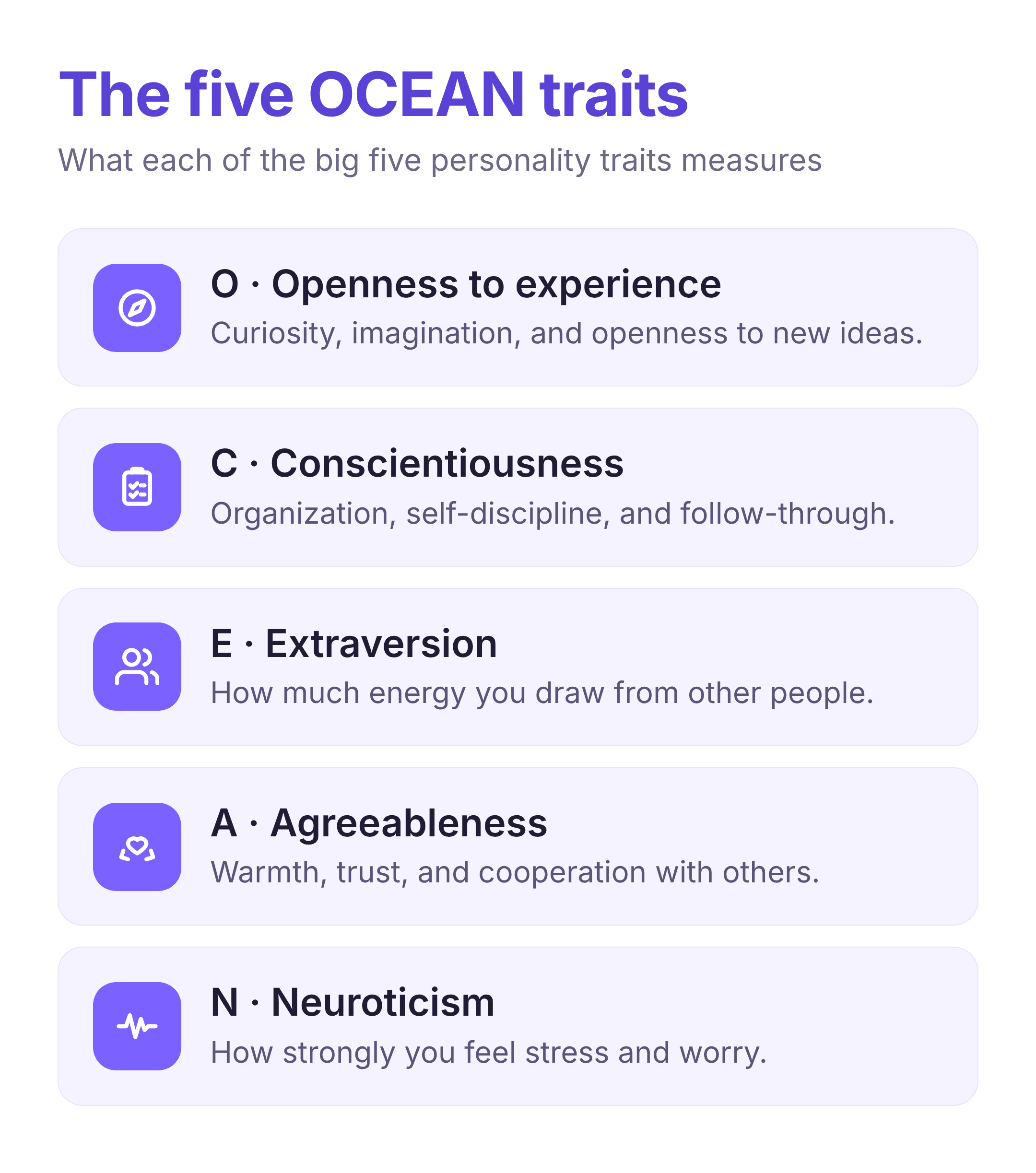
Openness to experience is about how drawn you are to new ideas, experiences, and ways of seeing things. People high in openness tend to be curious, imaginative, and comfortable with the abstract or unfamiliar, and they often like art, travel, and changing their routine. People lower in openness tend to prefer the familiar and the practical, value tradition and routine, and feel more at home with concrete facts than with theory. Neither end is better. High openness helps with creative work and adapting to change, while lower openness often comes with focus, consistency, and a steady preference for what already works.
Openness is often clearest in how you respond to an idea that challenges what you already believe. A more open person tends to consider it, while a less open person tends to set it aside. That curiosity also supports skills like questioning your own assumptions, which our team's guide to self-reflection walks through.
Conscientiousness is the trait of organization, self-discipline, and follow-through. People high in conscientiousness plan ahead, keep their commitments, and finish what they start. People lower on it tend to be more spontaneous and flexible, and can find strict routines and deadlines harder to keep. Of all five traits, this is the one most tied to everyday outcomes: conscientious people, on average, do better at school and work and even tend to live longer, partly because the same habits that keep a calendar tidy also keep up exercise, checkups, and sleep.
Usefully, conscientiousness is shaped by habit as much as by temperament. The daily systems that raise it, such as small routines, clear cues, and finishing one task before starting another, can be learned, and our team's Atomic Habits summary collects the most useful of them.
Extraversion is about how much you draw energy from the outside world, especially from other people. People high in extraversion tend to be sociable, talkative, and assertive, and they usually feel charged up after time with others. People lower in extraversion, often called introverts, tend to find a lot of social contact draining and recharge in quieter settings, which is not the same as shyness or weak social skills.
Personality psychologist Brian Little describes what drives the trait in his TED talk: extraverts seek a level of stimulation that introverts already have enough of.
"One of the things that characterizes extroverts is they need stimulation."
That single difference affects many everyday preferences, from how loud a room you enjoy to how you prefer to work. Our post on introvert vs extrovert goes deeper into the differences and where most people fall, which is usually somewhere in between.
Agreeableness covers warmth, trust, and how much you cooperate with and care for the people around you. People high in agreeableness are compassionate, forgiving, and quick to assume the best of others, and they tend to smooth over conflict and put the group first. People lower in agreeableness are more skeptical and competitive, and more willing to push back and disagree openly. High agreeableness builds trust and keeps relationships warm, while lower agreeableness can help in difficult negotiations and honest feedback, where directness matters more than being liked.
Because agreeableness shapes how you read and respond to other people, it is closely linked to skills like reading a room and handling tension when you disagree.
Neuroticism measures how strongly and how often you feel stress, worry, and other difficult emotions. People high in neuroticism feel setbacks strongly and take longer to settle after something goes wrong. People low in neuroticism, the end often called emotional stability, stay calmer under pressure and recover more quickly. It is worth avoiding judgment here: a person higher in neuroticism often notices problems and risks early, which is valuable, and steadiness has its own advantages.
This is the trait people most often want to change, and it can change. Steadier responses to stress can be developed with practice, and much of that work overlaps with our team's guide to building confidence, since confidence and lower neuroticism tend to go together.
Here is what the high and low end of each trait tends to look like in everyday life. Most people sit somewhere between the two ends on every row.
| Trait | Higher end | Lower end |
|---|---|---|
| Openness | Curious, imaginative, drawn to novelty | Practical, routine-loving, grounded in the familiar |
| Conscientiousness | Organized, disciplined, finishes what they start | Spontaneous, flexible, less tied to plans |
| Extraversion | Outgoing, energized by people | Reserved, recharges in quiet |
| Agreeableness | Warm, trusting, cooperative | Skeptical, competitive, blunt |
| Neuroticism | Feels stress strongly, slow to settle | Calm under pressure, bounces back fast |
OCEAN and the big five are the same thing, so if you have taken an OCEAN personality test, you have taken the big five. The main difference from tests like Myers-Briggs or the Enneagram is the form of the result. Those tests sort you into a type, while the big five places you along five scales. This matters because personalities vary by degree rather than falling into fixed categories, and a scale can describe someone who is fairly organized but not extremely so, which a yes-or-no type cannot. It is also why the big five is the model most used in psychology research, while type tests remain more popular for quick self-description.
Your traits are stable but not fixed. Twin studies show how much is inherited: a large meta-analysis of behavior-genetic studies estimated that genes account for about 40% of the differences between people on these traits, which leaves the majority to environment, experience, and choice. The traits also shift on their own over a lifetime. A meta-analysis of long-term studies found that most people become more conscientious and more emotionally stable through their twenties and thirties, usually moving in the direction of maturity.
You can also influence them deliberately. Brian Little's term for this is a free trait: you can act out of character, sometimes for long stretches, for something you care about, such as an introvert who becomes more outgoing for a cause, or a relaxed person who becomes highly organized for an important goal. The trait is still your baseline, but it does not fully determine how you behave. Building habits and self-knowledge around a trait, which our team's guide to self-awareness covers, is how most lasting change happens.
A good big five personality test is short and gives you a score from low to high on each of the five dimensions, usually as a percentage or a 0-to-100 figure. It does not label you a type. You answer a set of statements about how you usually think and act, such as "I keep my things tidy" or "I enjoy meeting new people," and your pattern of answers places you on each scale. A good test takes about ten minutes, and you can take one for free. The test here is a short self-assessment for personal insight. It is not an official or validated psychological test, and it does not diagnose anything.
When your results come back, try not to read them as a verdict. A few things make them more useful:
Knowing your profile is only the starting point; what matters is acting on it. RiseGuide's short daily lessons, built from expert insights, help you build on what your profile shows, starting with Communication Mastery if getting your point across is where you struggle most.
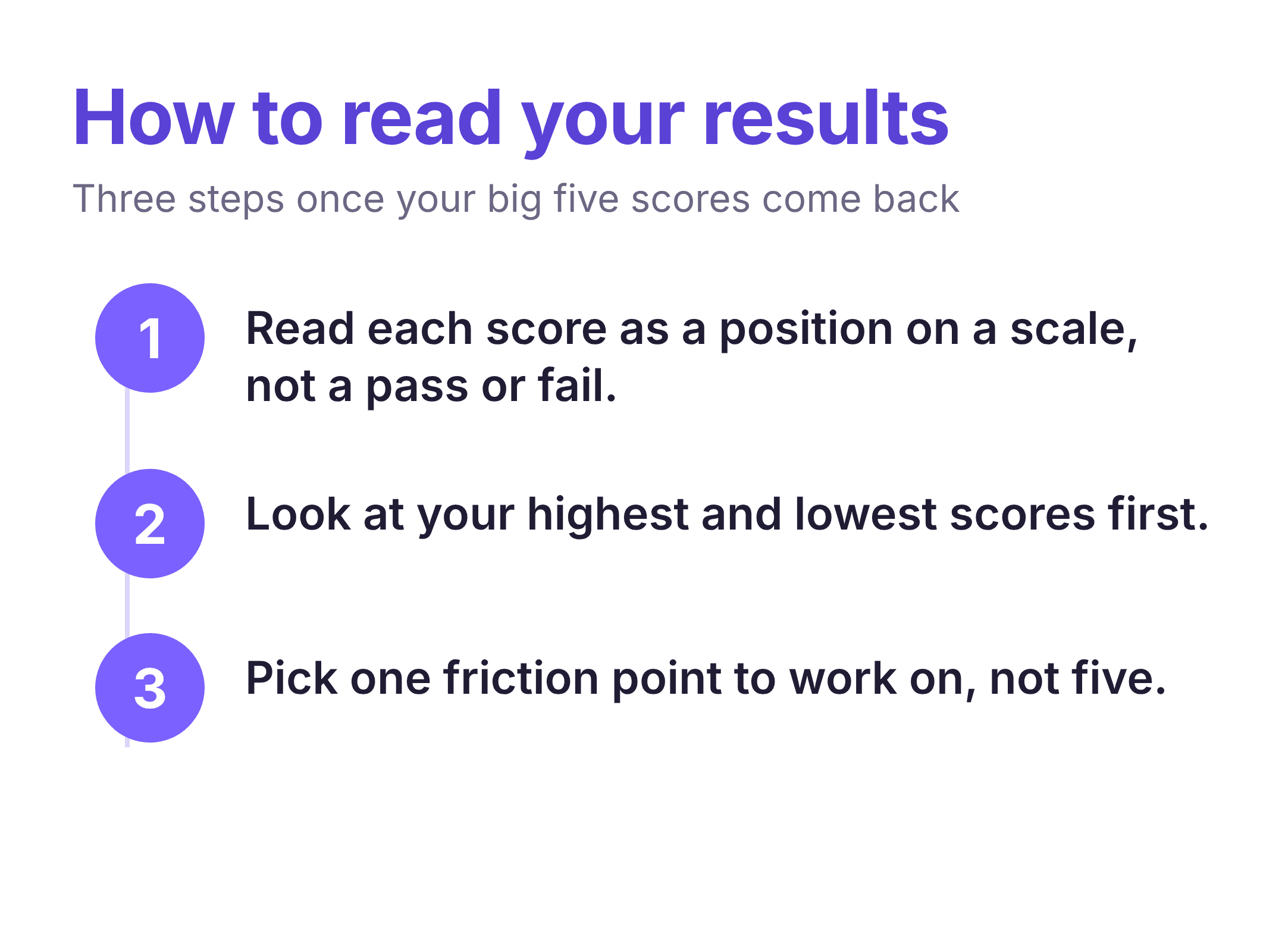
Your big five scores describe how you tend to think, feel, and act, measured on five scales rather than reduced to a single type. They are stable enough to be meaningful and flexible enough to work with. Treat them as a starting point: notice where you score high or low, consider where that helps you and where it creates difficulty, and choose one area worth some effort.
Yes. OCEAN is an acronym for the five traits, openness, conscientiousness, extraversion, agreeableness, and neuroticism, so OCEAN and the big five are two names for the same model, also called the five-factor model.
For everyday outcomes like health, school, and work, conscientiousness tends to predict the most, which is why it receives so much research attention. For relationships, agreeableness and the stable end of neuroticism matter more. Overall, which trait matters most depends on what you are trying to do.
The big five is the model used in most personality research, because it measures traits on a scale rather than sorting people into fixed types. Myers-Briggs remains popular for quick self-description, though its type categories describe personality less closely than a set of scales does.
They can shift. Genetics explains roughly 40% of the differences between people, and the rest is open to environment and experience. Most people also become somewhat more conscientious and emotionally stable with age, and you can push a trait further with deliberate habits.
Five: openness, conscientiousness, extraversion, agreeableness, and neuroticism. Some models add a sixth, honesty-humility, in the HEXACO model, but the five-factor version is the most widely used.