RiseGuide Team
To practice self-reflection, set aside a little regular time to look back on your experience and learn from it, then turn what you notice into small changes. Start with a few clear questions (what went well, what drained me, what I'd do differently, whether my choices matched my values), use a simple technique like journaling or the "what, not why" approach, and keep each session short and regular rather than rare and heavy. A short list of questions and a simple worksheet are all you need to start.
You can go weeks on autopilot, moving from one task to the next without ever asking how any of it is actually going. Self-reflection is the deliberate pause that breaks that pattern: a set time to look at your own experience, notice what it's telling you, and decide what to do differently. People have treated it as central to a good life for a long time, and it's still one of the simplest ways to learn about yourself. This guide covers what self-reflection is, why it's worth doing, the questions to ask yourself, a few techniques that make it stick, and a worksheet you can use straight away.
Self-reflection is the practice of looking back on your own thoughts, feelings, and actions to understand them and learn from them. That is the plain self-reflection definition. The self-reflection meaning is right there in the word: turning your attention back on yourself on purpose, instead of only ever looking outward.
It helps to separate it from two near neighbors. Self-reflection is the active practice; self-awareness is what that practice builds over time, the clearer picture of yourself that reflection produces. And reflection is not the same as rumination. Reflection looks back to learn and then moves forward; rumination replays the same bad moment on a loop without reaching anything new. The difference is direction: useful reflection ends with an insight or a small decision, while rumination just keeps circling.
"The unexamined life is not worth living." - Socrates
The case for self-reflection is practical. When you review your own experience instead of rushing past it, you spot patterns you'd otherwise repeat, you understand your reactions well enough to handle them better next time, and you make choices that line up with what you actually care about. It's how a hard week becomes something you learn from rather than just survive.
There are real benefits of self-reflection beyond self-knowledge. It tends to lower the sense of being driven by events, because naming what you feel takes some of the heat out of it. It sharpens your judgment, since questioning your own assumptions is the same move our team's guide to critical thinking is built on. And it helps you catch what's wearing you down before it builds up, which is part of how you manage stress, as our post on the topic lays out, rather than only reacting to it.
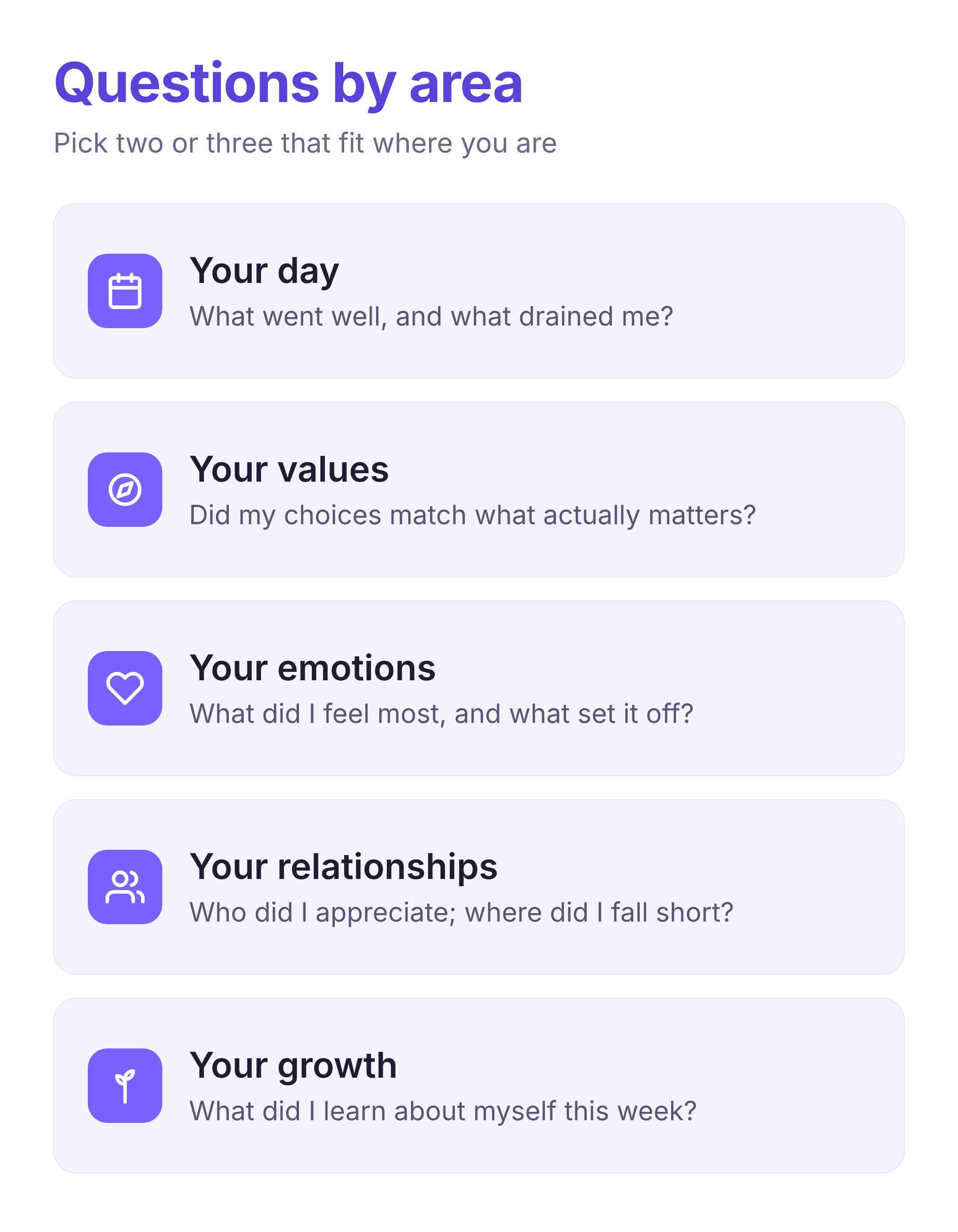
The quickest way to start is with a few good questions. You don't need all of them at once; pick two or three that fit where you are and answer them honestly. Here are self-reflection questions grouped by what they help you look at.
Your day or week. What went well, and what drained me? What took more energy than it should have? If I could redo one moment, what would I change?
Your values and direction. Did my choices this week match what actually matters to me? What am I spending time on that I'd rather stop? If nothing changed for a year, would I be okay with that?
Your emotions. What did I feel most strongly this week, and what set it off? Where did I react more than the situation called for? What was that reaction really about?
Your relationships. Who did I appreciate, and did I tell them? Where did I fall short with someone, and what would repair it?
Your growth. What did I learn this week? What's one small thing I now know about myself that I didn't before?
A quick self-reflection example: ask "what drained me this week?", notice that back-to-back meetings with no breaks left you short with your family in the evening, and decide to block fifteen minutes between calls. That's the whole loop in miniature, a question leading to a pattern leading to a small change.
Questions give you the material; these self-reflection techniques give you a way to do it regularly so it becomes a habit rather than a one-off.
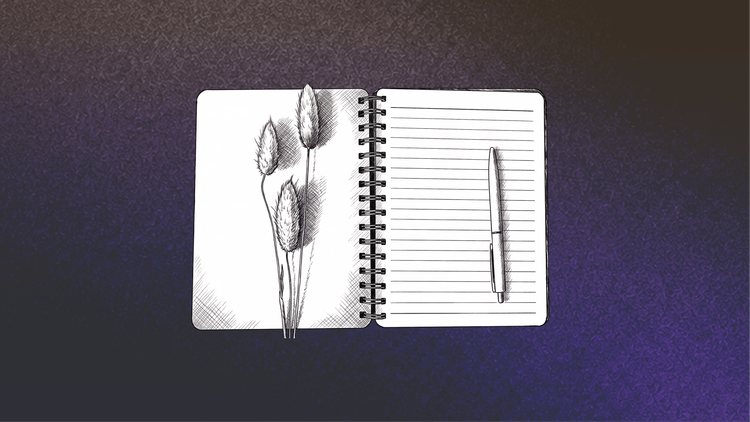
Keep a reflection journal. Writing slows your thinking down and makes vague feelings concrete. You don't need anything elaborate; a few lines a day is enough. If a blank page is intimidating, start with set self-reflection journal prompts like the questions above, or a simple end-of-day line: one thing that went well, one thing to do differently.
Ask "what," not "why." When you turn a reaction over, "what" questions tend to lead somewhere useful ("what was I feeling, and what triggered it?"), while "why" questions often spiral into a tidy story that isn't true ("why am I like this?"). Aim your reflection at what happened and what you'll do, not at diagnosing your whole character.
Keep a decision journal. For bigger choices, jot down what you decided, what you expected to happen, and why, then revisit it later. Comparing your prediction with the result is one of the most honest ways to learn, and it's a habit that helps you make better decisions over time.
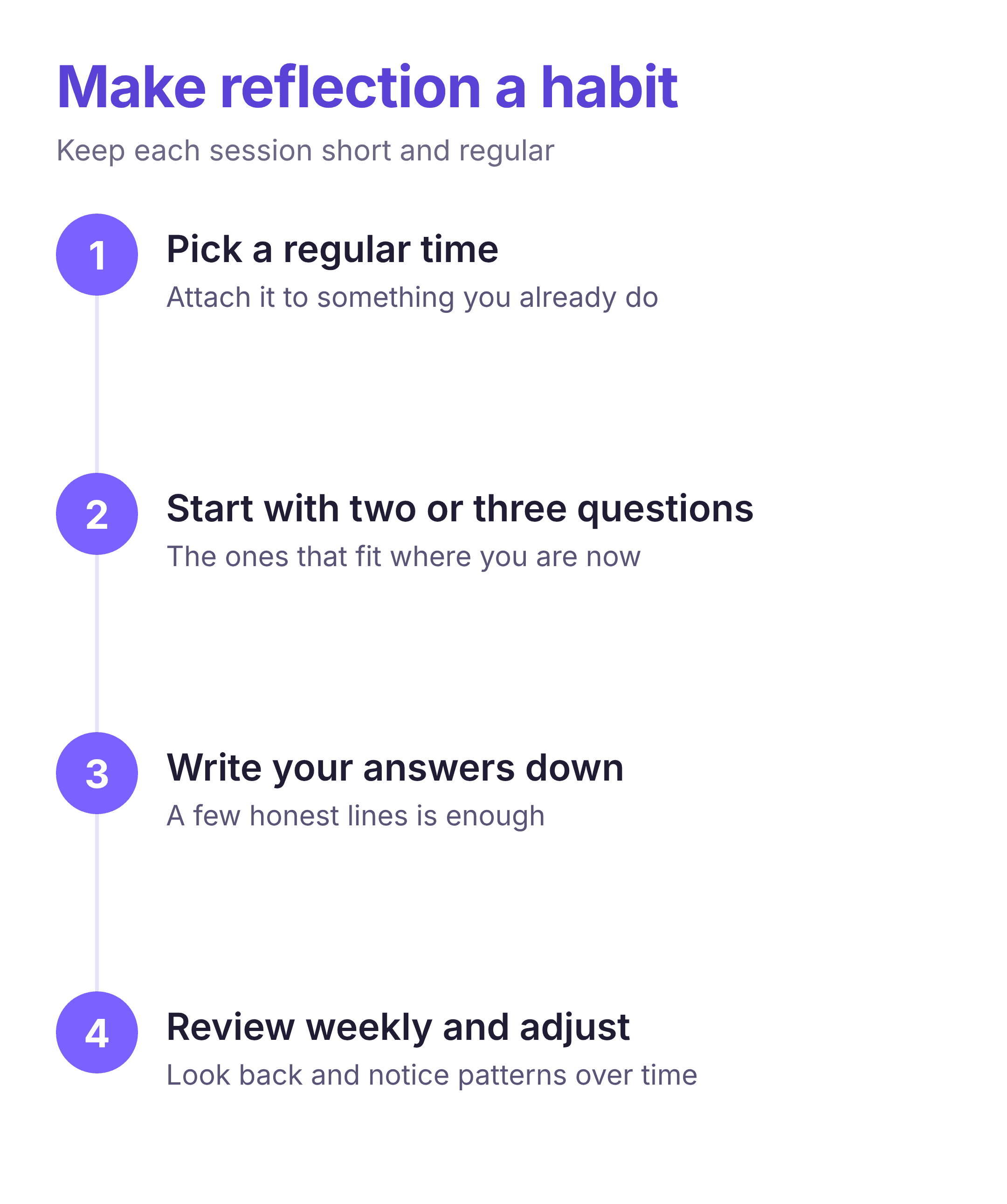
Give it a regular slot. Reflection that has no time set aside rarely happens. Attach it to something you already do, like the end of the day or a quiet first few minutes in the morning, so it rides along with an existing morning routine, like the one in our checklist, instead of needing its own willpower.
Talk it out. Reflecting out loud with someone you trust works too, because explaining your thinking to another person forces you to make it clear. If you'd rather have a bit of structure, RiseGuide's short personal-growth lessons build small reflection habits into a few minutes a day.
Use this worksheet as a weekly check-in. Set aside ten minutes, answer the prompts honestly in your own words, and end with one small change for the week ahead. Keep your answers somewhere you'll see them, so you can look back and notice patterns over time.
| Area | Prompt to answer | Your reflection |
|---|---|---|
| The week in review | What went well, and what drained me? | |
| Emotions | What did I feel most strongly, and what set it off? | |
| Values | Did my choices match what actually matters to me? | |
| Relationships | Who did I appreciate, and where did I fall short with someone? | |
| Growth | What did I learn, and what would I do differently? | |
| One small change | What is one thing I'll do differently next week? |
Self-reflection isn't complicated, and it doesn't take long. A few honest questions, a regular slot, and somewhere to write it down are enough to turn everyday experience into something you actually learn from. Start small this week with two or three questions and the worksheet above, keep it short so you'll come back to it, and let the picture of yourself get a little clearer each time.
Self-reflection means deliberately looking back on your own thoughts, feelings, and actions to understand them and learn from them. In plain terms, it's turning your attention inward on purpose, usually by asking yourself questions, so your everyday experience becomes something you grow from instead of just moving past.
A few that work for almost anyone: What went well this week, and what drained me? Did my choices match what actually matters to me? What did I feel most strongly, and what set it off? Where did I fall short with someone? What did I learn about myself? Pick two or three rather than trying to answer all of them at once.
A simple self-reflection example is asking "what drained me this week?", noticing that packed days with no breaks left you irritable at home, and deciding to protect fifteen minutes between tasks. What makes it reflection is the small change that follows from the thought.
Short and regular beats long and rare. A few minutes at the end of each day, plus a slightly longer weekly review with the worksheet above, is plenty for most people. The point is to make it a habit you keep, so keep each session small enough that you'll actually come back to it.