RiseGuide Team
To make sense of personality types, start with the two kinds of system people mean by the phrase. Sorting systems like the Myers-Briggs 16 personality types, DISC, and the Enneagram place you in a named category. Trait systems like the Big Five score you along a few sliding scales instead. The Big Five has the most research behind it, while the 16-type tests are the most popular. To find yours, take a free personality test from a reputable source, read the full description of your result, and treat it as a starting point for self-knowledge rather than a fixed label.
Most people meet personality types through a quiz a friend sends over, a label in a dating bio, or a workshop at work. The appeal is simple: a short description that seems to capture how you think, decide, and get along with other people. There are several systems, though, and they do not all measure the same thing or agree on how many types exist. This guide walks through the main ones in plain terms, what each is good for, and how to find the result that fits you.
A personality type is a way of grouping people by patterns in how they think, feel, and behave. Most systems build on the same raw material. It helps to know what personality traits are: the stable tendencies that show up across situations, like how outgoing, organized, or anxious someone usually is.
The systems differ in how they handle those traits. Some turn them into categories and put you in a box with a name, like "INFJ" or "the Reformer." Others keep them as scales and tell you where you land on each one, high, low, or somewhere in between. Knowing which kind of result you are reading is the first step to using it well.
So how many personality types are there? There is no single answer, because each system draws its own lines. Myers-Briggs describes 16, the Enneagram has 9, DISC works with 4 main styles, and trait models like the Big Five do not really count "types" at all.
There are more frameworks than anyone needs, but a handful come up again and again. Here are the five you are most likely to run into, what each measures, and where each one helps.
The most famous system is the Myers-Briggs Type Indicator, which sorts people into 16 personality types written as four letters, such as INTJ or ESFP. It grew out of the ideas of psychiatrist Carl Jung and was turned into a questionnaire by Katharine Cook Briggs and her daughter Isabel Briggs Myers. Each letter marks a preference on one of four pairs: where you get your energy (introversion or extroversion), how you take in information, how you make decisions, and how you organize your days.
The energy pair is the one most people already know. If you want to go deeper on just that dimension, our post on introverts and extroverts covers it on its own. The 16-type labels are easy to share and fun to compare, which is a big part of why they spread. They work best as a vocabulary for talking about differences, not a precise readout.
If the 16 types are the most popular system, the Big Five is the one researchers trust most. Instead of a box, it scores you on five personality traits that each run on a scale, summed up by the acronym OCEAN: openness, conscientiousness, extroversion, agreeableness, and neuroticism. You are not an "O" or an "N"; you sit somewhere along each line. Psychologists describe it as the most researched and widely accepted map of personality across cultures.
Personality psychologist Brian Little walks through these five traits and why they matter in his TED talk, which is a clear place to start if you want to understand the model in about ten minutes.
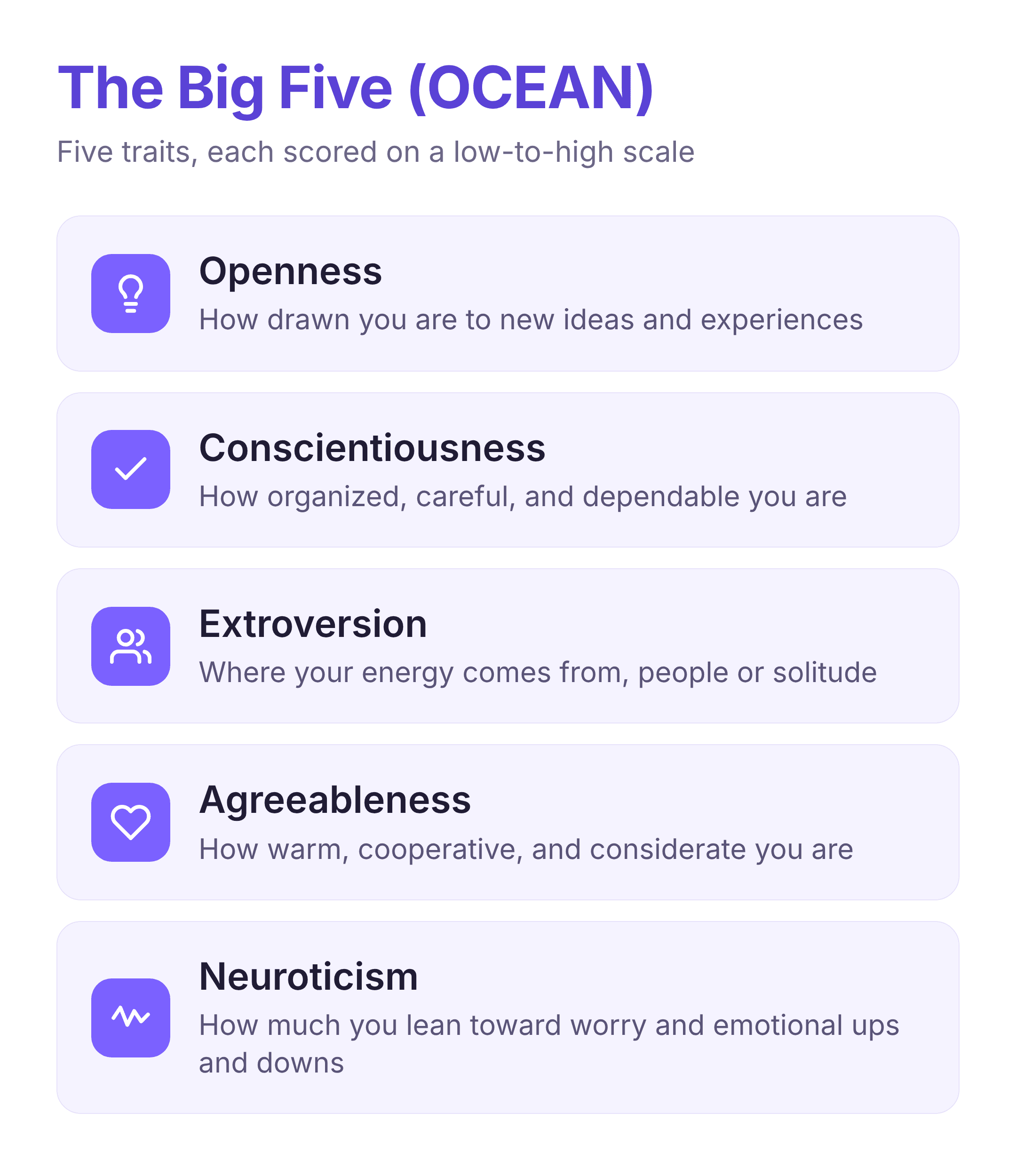
Because it uses scales rather than types, the Big Five tends to be more stable and more useful for predicting things like how someone handles stress or works on a team. It is less catchy than a four-letter label, which is probably why it never spread the same way socially.
Long before modern tests, people sorted temperament into four personality types, and that habit survives in the Type A, B, C, and D model. Type A is driven and competitive, Type B is relaxed and easygoing, Type C is careful and detail-focused, and Type D (for "distressed") leans toward worry and keeping feelings in. The A and B split came out of heart-health research in the mid-20th century, and the C and D additions came later.
It is a broad-strokes way to describe people, which is both its weakness and its appeal: four buckets are easy to remember. It works as casual shorthand, not a serious assessment.
DISC is a workplace favorite that groups behavior into four DISC personality types: Dominance, Influence, Steadiness, and Conscientiousness. The idea is that people lean toward one or two of these styles, which shapes how they communicate, handle conflict, and approach tasks. A "D" pushes for results and speed, an "I" focuses on people and enthusiasm, an "S" values steadiness and support, and a "C" cares about accuracy and getting things right.
Because it looks at observable behavior rather than inner identity, DISC is common in team training and hiring. It is practical for figuring out how to work with someone, and less suited to deep self-insight.
The Enneagram describes nine Enneagram personality types, each built around a core motivation, fear, and pattern, numbered one through nine with names like the Reformer, the Helper, and the Achiever. It also maps how the types connect, so your type can lean toward another one under stress or growth.
People tend to find the Enneagram meaningful because it digs into why you do things, not just what you do. It has less scientific backing than the trait models, so it is best used for reflection and conversation rather than as a hard measurement.
| System | What it measures | Types | Best for |
|---|---|---|---|
| Myers-Briggs | Preferences across four pairs | 16 | Shared language, self-reflection |
| Big Five (OCEAN) | Five trait scales | No fixed types | Research, predicting behavior |
| DISC | Behavior styles at work | 4 styles | Teamwork and communication |
| Enneagram | Core motivations and fears | 9 | Deeper self-reflection |
| Type A, B, C, D | Broad temperament | 4 | Quick, casual shorthand |
Finding your type is straightforward, and you do not need to pay for it. The fastest route is a reputable free personality test: for the Big Five, look for a research-based Big Five or IPIP test; for the 16 types, the widely used version at 16personalities is free to take. Read the full description of your result, not just the label, and notice which parts ring true and which do not.
A quick way to get a rough read before any formal personality types test is to think through four things about yourself:
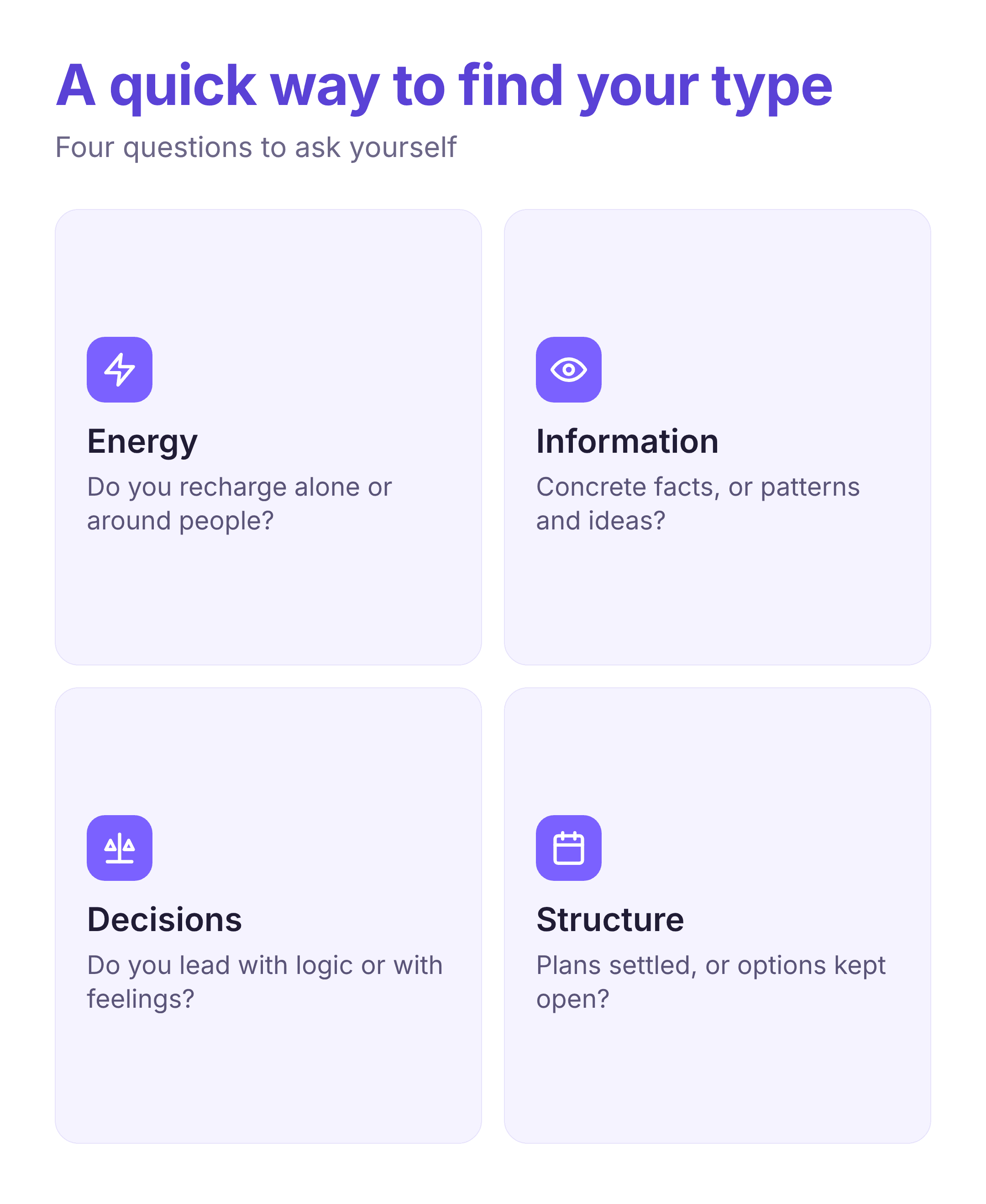
Your answers point toward the kind of profile that will fit. If you want to keep going, our post on the emotional intelligence test looks at a related side of how you handle yourself and other people. The real point of any of these is self-knowledge you can act on. Once you know your tendencies, you can pick one skill to work on, communication, focus, or confidence, and build it on purpose. That is the idea behind RiseGuide's short, expert-based lessons: if communication is the area you want to grow, for example, the Communication Mastery journey turns self-awareness into daily practice.
It depends on the system. The trait-based models hold up best, and the Big Five is reliable enough that researchers use it to study real-world outcomes. The sorting systems are shakier. The Myers-Briggs has relatively low test-retest reliability, meaning a fair number of people get a different type when they take it again a few weeks later. That does not make it useless, but it is a reason to hold your four letters loosely.
It also helps to know that personality is partly inherited and partly shaped by life. Twin studies have estimated that around half of the variation in personality traits is heritable, with newer gene-based studies landing lower. Either way, type is not destiny. Traits shift gradually with age and effort, which is why a result is a starting point rather than a life sentence. Whitnie Wiley, an executive coach and one of our experts, writes about how self-awareness is the ground that real change grows from. And if your result makes you want to grow instead of just get sorted, our post on building a growth mindset is a good next read.
Personality types give you a useful lens on yourself, as long as you hold the result loosely. The 16-type labels and the Enneagram are good for language and reflection, the Big Five is the one to reach for when you want something grounded in research, and DISC and the Type A-D model are handy shorthand for how people work. Take a test or two, keep what fits, and use the result as a prompt to understand yourself and grow from there.
There is no single number, because each system counts differently. Myers-Briggs describes 16 personality types, the Enneagram has 9, and DISC uses 4 main styles. Trait models like the Big Five do not use fixed types at all; they score you on five scales instead.
The best-known "four types" model is Type A, B, C, and D: driven (A), easygoing (B), detail-focused (C), and distressed or reserved (D). DISC also uses four styles, so "four personality types" can mean either model depending on who is asking.
For a research-based result, a Big Five or IPIP test is the most reliable free option. For the popular 16-type format, 16personalities is free and easy to read. Taking one of each gives you both a scientific profile and a shareable label.
Your core tendencies are fairly stable, but they do shift slowly over time and with deliberate effort. That is why a personality type is best treated as a snapshot of where you are now, one that keeps shifting over time.