RiseGuide Team

An emotional intelligence test measures how well you notice, understand, and manage emotions, both your own and other people's. Most fall into two types: ability tests like the MSCEIT, which score your answers against a best response, and self-report questionnaires like the EQ-i 2.0, where you rate yourself. A typical test takes 10 to 20 minutes and gives you an overall score plus a breakdown across areas like self-awareness, self-regulation, empathy, and social skills. Free versions are a fine place to start, but treat any result as a snapshot of where you are now, not a fixed limit, because emotional intelligence can be built with practice.
Curiosity about your own emotional intelligence usually starts with a moment: a conversation that went sideways, feedback that stung, or a friend who always seems to know the right thing to say. A test like this is one way to put a number on something that otherwise feels hard to pin down. The score won't capture everything about you, but a good one can show where your emotional habits help you and where they get in your way.
An emotional intelligence test is an assessment that estimates how well you recognize and work with emotions. The result is often called your emotional quotient, or EQ, a nod to IQ. Where an IQ test looks at reasoning, this one looks at the skills behind noticing a feeling, understanding what is driving it, and choosing how to respond. In other words, it tries to measure your emotional intelligence, the set of abilities behind how you read yourself and the people around you. No single test captures all of that perfectly, which is why there are several well-known ones, each built on a slightly different idea of what emotional intelligence is.
Most tests are built around a short list of skills. The best-known list comes from psychologist Daniel Goleman, who described five parts: self-awareness, self-regulation, motivation, empathy, and social skills.
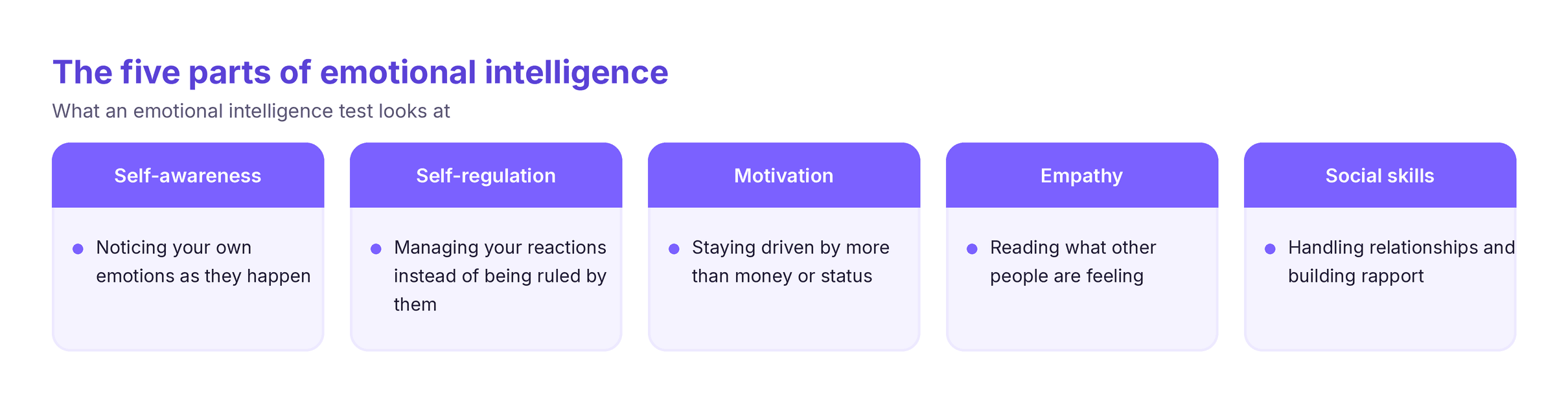
Self-awareness is where it begins: noticing your own emotions as they happen instead of after the fact. Whitnie Wiley, an executive coach and one of our experts, treats self-awareness as the base the rest is built on. Self-regulation is what you do with those feelings once you notice them, so you respond on purpose rather than react. Juliann Wiese, a master certified coach and one of our experts, writes about staying steady when things feel uncertain. Motivation, in this model, is being driven by more than money or status. Empathy is reading what other people feel, often from tone, expression, and body language. Social skills tie it together: handling relationships, resolving friction, and building rapport.
Goleman argued that these skills matter as much as raw intellect:
"Emotional intelligence is the sine qua non of leadership." — Daniel Goleman
There are two main ways to measure emotional intelligence, and they answer slightly different questions. One checks how well you can actually solve emotional problems; the other asks how you rate your own emotional skills.
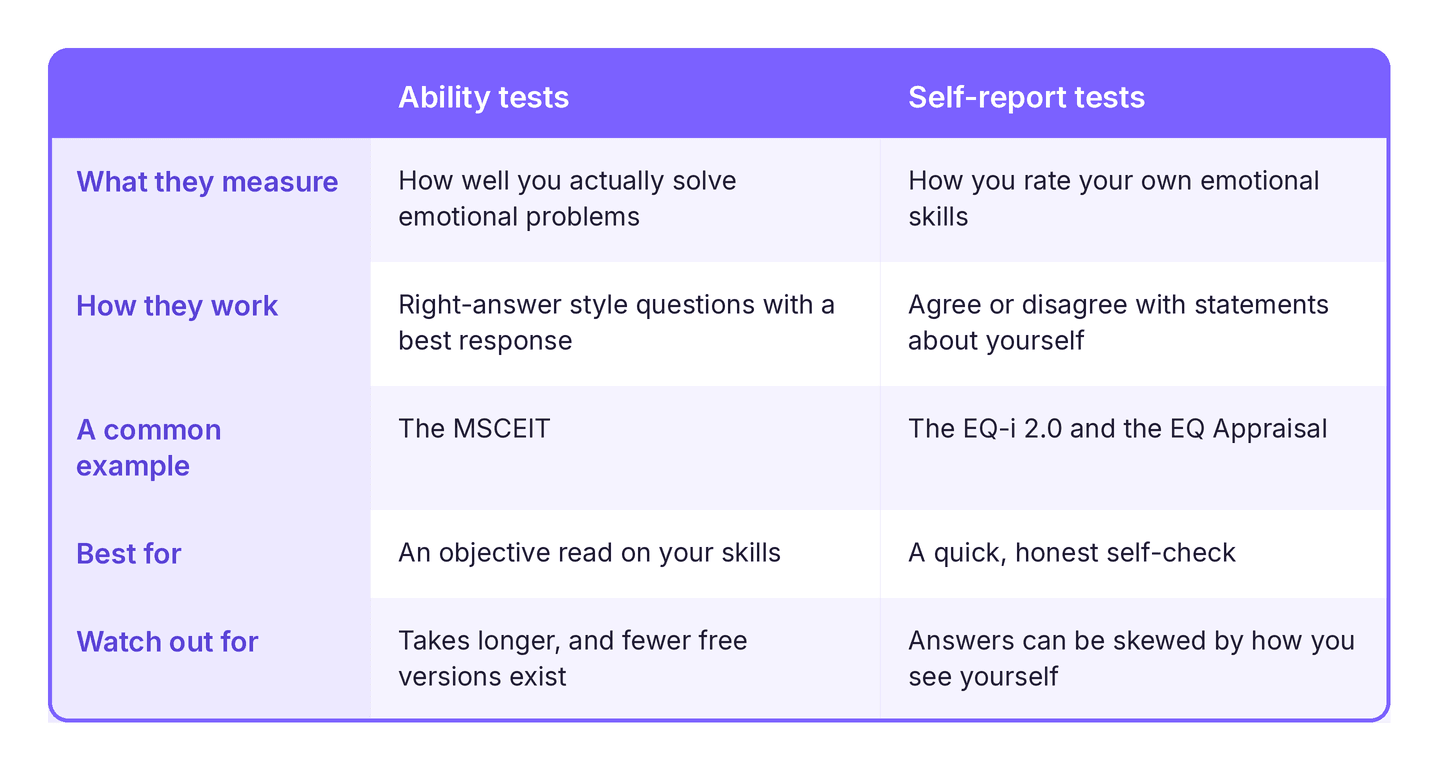
Ability tests treat emotional intelligence as a skill you can be better or worse at, so their questions have stronger and weaker answers. The best-known is the MSCEIT, the Mayer-Salovey-Caruso emotional intelligence test, which asks you to solve emotion-related problems, such as identifying the feeling in a face or picking the most effective way to handle a situation. Because your answers are compared to a scoring standard, ability tests give a more objective read, but they take longer and fewer free versions exist.
Self-report tests ask you to rate how much a series of statements sounds like you. The EQ-i 2.0 and the EQ Appraisal that comes with the book Emotional Intelligence 2.0 are common examples. They are quick and easy to take, which is why most free options use this format. The trade-off is that the results reflect how you see yourself, so a blind spot can raise or lower your own rating.
Whatever the format, a good test uses short, everyday scenarios rather than trick questions. On an ability test, you might read a situation and choose the response that best fits, or look at a photo and name the emotion. On a self-report test, you rate how strongly you agree with a statement like "I can stay calm when I'm criticized." That is what emotional intelligence test questions and answers tend to look like: short, realistic scenarios that ask for judgment and honest reflection rather than facts you can memorize. If you are wondering how to test emotional intelligence in a way that means something, the format matters more than any single question, because a reliable test looks at patterns across many answers rather than one.
Most tests give you an overall score plus a breakdown by area, so you can see where you are strong and where there is room to grow. Read the number as a snapshot of today, not a permanent label. You can't really pass or fail, and a lower score in one area is information, not a verdict. The most useful thing a result gives you is direction: a specific skill, like handling criticism or reading a room, that you can practice.
You don't need to pay to get a useful read. A free emotional intelligence test is a reasonable starting point, and several well-regarded ones are open to anyone. Psychology Today, the Greater Good Science Center at UC Berkeley, and the Institute for Health and Human Potential each offer a free emotional intelligence quiz or EQ test online. A free EQ test is usually shorter and self-report style, so treat the number as a rough guide rather than a clinical measure. If you want a more rigorous result, an ability test like the MSCEIT is typically administered through a trained practitioner.
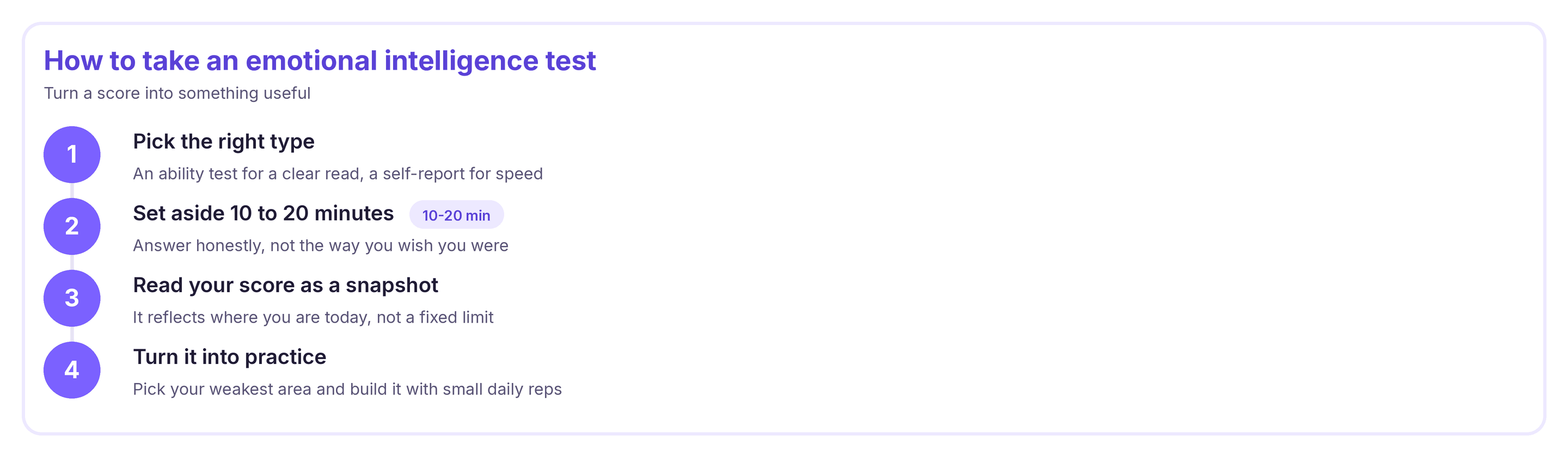
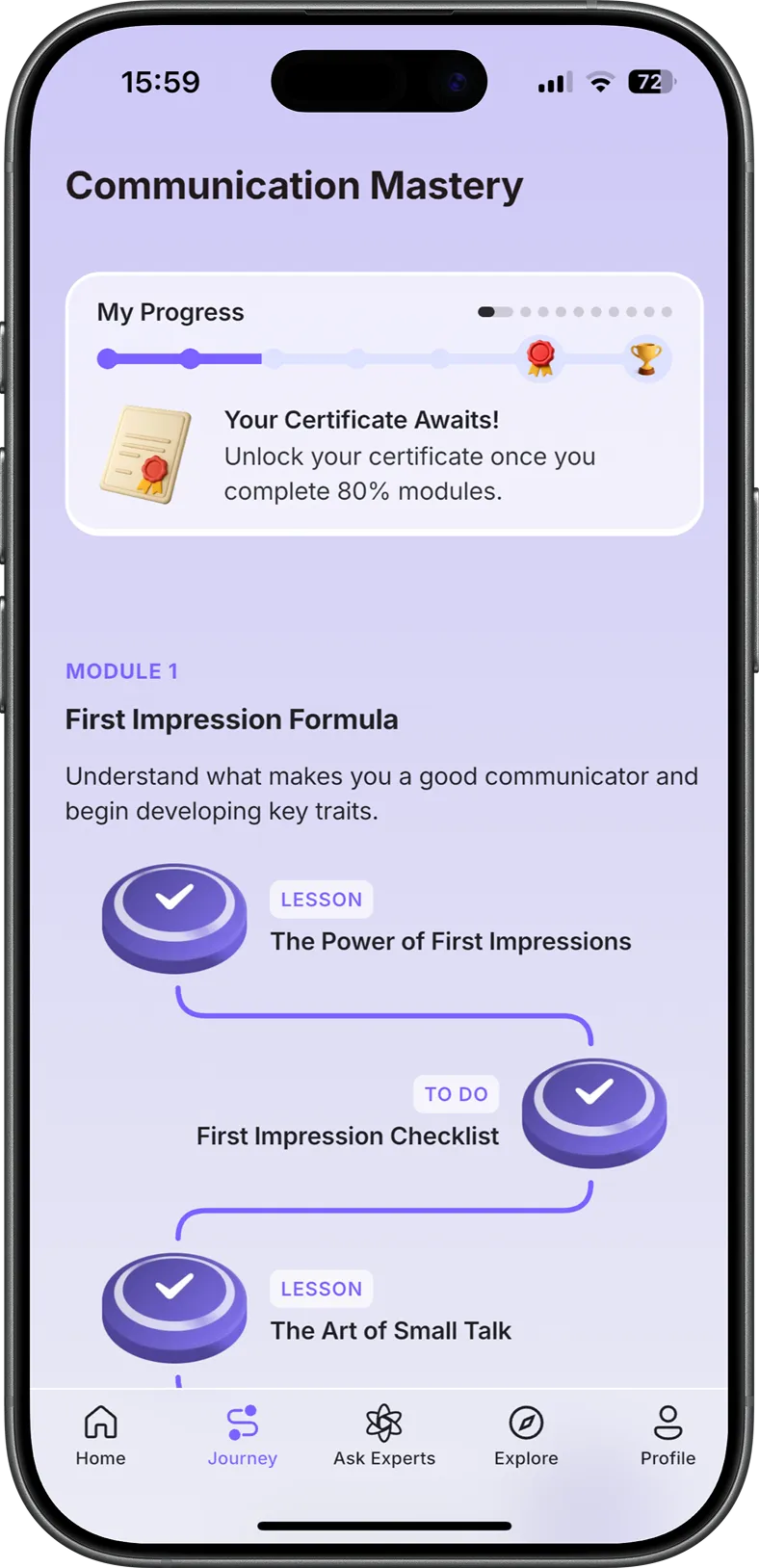
Yes. Unlike IQ, which stays fairly stable through adulthood, emotional intelligence can be developed with attention and practice. A test is most useful when you treat the result as a starting line: pick the area you scored lowest in and work on it in small, regular ways, like naming your emotion before you respond, or asking one genuine question in a tense conversation. If communication is the area you want to grow, RiseGuide's Communication Mastery journey breaks it into short lessons built from expert insights that you can practice a few minutes at a time.
An emotional intelligence test can't sum you up in a single number, but it can point you toward the emotional habits worth paying attention to. Pick a reputable test, answer honestly, and use the result to decide where to put your attention next.
Yes. Psychology Today, the Greater Good Science Center at UC Berkeley, and the Institute for Health and Human Potential all offer a free EQ test you can take online in a few minutes. These are self-report tests, so treat the score as a useful guide rather than a formal assessment.
Ability-based tests, especially the MSCEIT, are generally considered the most rigorous because they score your answers against a standard instead of relying on self-rating. Self-report tests like the EQ-i 2.0 are quicker and still useful, but the result depends on how accurately you see yourself.
Emotional quotient, or EQ, is a way of describing your emotional intelligence as a score, much like IQ describes reasoning ability. A higher EQ suggests you tend to notice and manage emotions well; it is not a fixed trait.
Common signs include struggling to name what you feel, being caught off guard by your own reactions, finding feedback hard to take, and often misreading how others are responding. These are habits, not a life sentence, and they tend to improve with practice.
No. There is no pass or fail. A test gives you a snapshot of your current emotional skills and shows which areas you might want to strengthen.