RiseGuide Team

Empathy is sharing what another person feels; compassion adds warmth and a wish to help, and it moves you toward doing something about their situation. The difference between empathy and compassion matters because empathy on its own can pull you down into someone else's distress, while compassion tends to keep you steady enough to be useful.

⚠️ Disclaimer: The content provided in this article is for informational and educational purposes only and is not intended to be a substitute for professional psychological, psychiatric, or medical advice, diagnosis, or treatment. Always seek the advice of your physician or other qualified mental health provider with any questions you may have regarding a medical condition or mental health objective.
Empathy and compassion get treated as the same thing in everyday conversation, and most of the time nobody notices the swap. They describe two different responses to another person's pain, though, and the difference between them shows up in how you feel afterward and in whether the other person got any real help. Psychologists and neuroscientists have spent the last decade or so separating the two, partly because the distinction affects who burns out from caring and who keeps going.
This is a walk through what each word actually means, where sympathy sits alongside them, what the research has found, and how to shift from one response to the other when you need to.
Empathy is the ability to share in what someone else is feeling. Researchers Tania Singer and Olga Klimecki define it as "the capacity to share the feelings of others" - you pick up on another person's emotional state and, to some degree, feel it yourself. That single word covers a few distinct things, which is part of why conversations about it get muddled.
Affective empathy is the felt, automatic side: you see a friend's face fall and something in you drops too. The University of California, Berkeley's Greater Good Science Center describes empathy as including this capacity to physically sense what another person is going through. It's fast and largely involuntary, and it's the part most people mean when they say they're empathetic.
Cognitive empathy is understanding what someone feels without necessarily feeling it yourself. It's the perspective-taking side, working out what a situation is like from the inside of another person's head. This one leans heavily on attention, the same attentive stance that separates active from passive listening - you can't read someone accurately if you're only half-present.
Empathic concern is closer to caring: feeling for a person rather than only feeling as they do. Stanford psychologist Jamil Zaki draws the line clearly.
"Empathic concern - feeling for someone - is distinct from emotional empathy - feeling as someone else does."
That distinction is the hinge this whole topic turns on, because empathic concern is where empathy starts leaning toward compassion.
Compassion keeps the warmth and care of empathic concern and adds one more thing: a pull toward action. Singer and Klimecki define it as "feelings of warmth, concern and care for the other, as well as a strong motivation to improve the other's wellbeing." You feel for the person, and you want to do something that helps.
That motivational step is the heart of the empathy vs compassion question. Paul Gilbert, the psychologist who founded compassion-focused therapy, frames empathy as a skill you either have or lack, separate from whether you're moved to help at all.
"Empathy is a competency and not a motive. Some people can be empathic but with little caring motivation while others have caring motivation but may struggle with empathy skills."
In other words, the two can come apart. Someone can read a room perfectly and use that skill coldly, and someone else can care deeply while fumbling to understand exactly what another person needs. Compassion is the combination of understanding and the will to act on it.
Sympathy is the third word people reach for, and it sits a step further back. When you feel sympathy, you recognize that someone is suffering and you feel sorry about it, but you're observing their pain from the outside rather than sharing it. The difference between empathy and sympathy is mostly one of distance: sympathy acknowledges, empathy joins in.
That extra distance can be a strength or a limitation depending on the moment. Sympathy keeps you separate, which protects you but can read as cool or detached to the person who wanted to feel understood. The difference between sympathy and empathy matters most when someone needs to feel that you're with them rather than watching them, and that's usually where empathy and, past it, compassion do more.
Here's how the three responses compare across the things that actually change your experience of them.
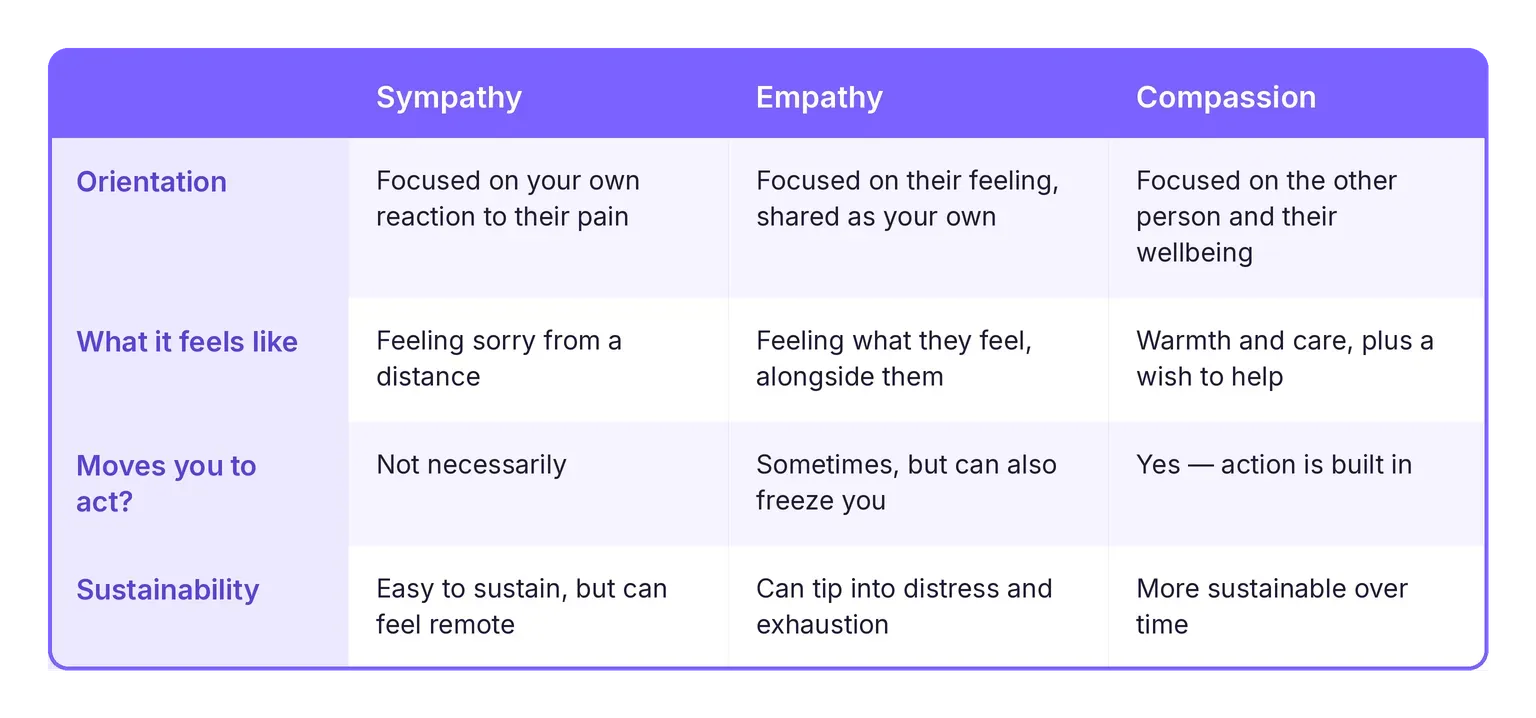
The gap between these responses isn't only a matter of definitions. Researchers have found that empathy and compassion track with different feelings and, in some studies, different patterns of brain activity after training.
In a 2013 training study, Olga Klimecki, Tania Singer and colleagues had participants practice empathy or compassion and then measured how they felt and responded. After empathy practice, people reported more negative feeling and showed increased activity in networks associated with pain. After a matched course of compassion practice, they reported more positive feeling and showed activity in areas linked to reward and affiliation. It was a small, early study, so it's best read as a signal rather than a settled fact, but the direction is telling: sharing pain and caring about pain don't leave you in the same state.
That difference shows up in who burns out. A 2026 review of 29 studies of nurses found that personal distress, the self-focused reaction of being overwhelmed by someone else's suffering, went along with higher burnout. Empathic concern showed no clear link to burnout in either direction, and perspective-taking looked mildly protective. The caring itself doesn't seem to be what wears people down; the distress does.
There's also reason to think the more sustainable response can be built. A 2025 meta-analysis pooling 37 studies and more than 16,000 people found that compassion was positively associated with well-being, and that compassion-training programs produced a moderate benefit - though the authors are careful to note that inconsistent control groups make it hard to call the relationship strictly causal.
Not everyone thinks empathy belongs at the center of moral life. The psychologist Paul Bloom has argued that emotional empathy is biased and narrow, steering us toward the one person we happen to feel for while others fall out of view, and that compassion guided by reason is the better compass. You don't have to go all the way with him to take the point: the version of empathy that simply absorbs another person's feelings has real limits.
In close relationships, the practical value of the distinction is that compassion lets you stay useful. When a partner or friend is falling apart, matching their panic feeling-for-feeling rarely helps either of you. Holding warmth while keeping your own footing lets you actually respond. The same holds in conflict: caring about the other person's position while still holding your own is what makes it possible to disagree respectfully instead of either caving or hardening.
At work, the difference shows up most in anyone whose job involves other people's difficulties, from managers to nurses to teachers. The burnout research points to a workable balance: staying warm and caring is sustainable, while dissolving into every hard story a colleague or client brings you is not. Compassion, in that sense, is what lets people keep caring for years without being hollowed out by it.
When you notice empathy tipping into distress, you can steer toward compassion instead. These aren't rigid stages, more a set of moves you can reach for depending on the moment.
If moving from empathy to compassion is something you'd rather practice than only read about, it helps to have a place to work on it in small doses. RiseGuide's communication journey is built from the insights of experts and breaks skills like this into short lessons you can practice on your phone, so a warmer, steadier response gradually becomes the one you reach for by default. Try RiseGuide now.
To a degree, yes. As Paul Gilbert points out, caring motivation and empathy skills can come apart, so someone can be genuinely motivated to help while still struggling to read exactly what another person feels. Compassion leans on the wish to improve someone's wellbeing, and that can be present even when fine-grained empathy is weak.
Yes, and most of the time they work together. Empathy is often the doorway: you feel what someone is going through, and that feeling turns into care and a wish to help, which is compassion. The healthiest version is empathy that leads into compassion rather than stalling in shared distress.
Compassion is usually described in three parts: noticing that someone is suffering, being emotionally moved by it, and feeling motivated to help relieve it. That last part, the motivation to act, is what most clearly separates compassion from simply feeling alongside someone.
Sitting with a grieving friend without trying to fix anything; checking in on a coworker who's clearly overwhelmed and offering to take something off their plate; giving a stranger the benefit of the doubt on a bad day; forgiving someone who's genuinely sorry; and speaking to yourself kindly after a mistake instead of piling on. Each pairs care with some small action.
They do different jobs, so it's less a ranking than a sequence. Empathy is the connection that helps you understand someone; compassion is the warmth and motivation that turns that understanding into help. Compassion tends to be more sustainable and more useful to the person in front of you, but it often grows out of empathy rather than replacing it.