RiseGuide Team

To develop a growth mindset, treat your abilities as things you can improve with effort and practice instead of fixed traits you're born with. Notice your fixed-mindset self-talk and name it, add the word "yet" when you hit a limit, treat mistakes as useful information, focus on the process and not only the result, ask for feedback and act on it, and take on challenges slightly beyond what you can already do. A growth mindset is the belief that your skills can grow; a fixed mindset assumes they're set. Practice these techniques on real tasks — a work project, a new skill, a hard conversation — and repeat them until the reframe becomes your default.
The idea of a growth mindset comes from Stanford psychologist Carol Dweck, who spent decades studying why some people keep going after setbacks while others give up. Her answer was that a lot depends on what you believe about your own abilities: whether you see them as fixed at birth or as something you can grow. That belief shapes how you handle a hard class, a stalled project, or feedback you didn't want to hear. Learning how to develop a growth mindset comes down to changing a few specific habits of thought, and this guide covers what a growth mindset is and the techniques that build one.
A growth mindset is the belief that your abilities — your intelligence, skills, and talent — can improve through effort, better strategies, and practice. It doesn't claim anyone can become anything. It says most people can get better at most things with the right kind of work. Carol Dweck, who coined the term, describes it this way:
"In a growth mindset, people believe that their most basic abilities can be developed through dedication and hard work—brains and talent are just the starting point. This view creates a love of learning and a resilience that is essential for great accomplishment." — Carol Dweck, Mindset: The New Psychology of Success
The opposite is a fixed mindset: the belief that your abilities are set and there's little you can do to change them. Most people hold a mix of both, and which one shows up depends on the situation. You might have a growth mindset about cooking and a fixed one about math.
This isn't only a pep talk. When researchers taught a group of seventh-graders that intelligence works like a muscle that gets stronger with use, those students' motivation went up and the intervention reversed the decline in their math grades, while a comparison group kept sliding. What you believe about your abilities changes how hard you try and how you respond when things get difficult.
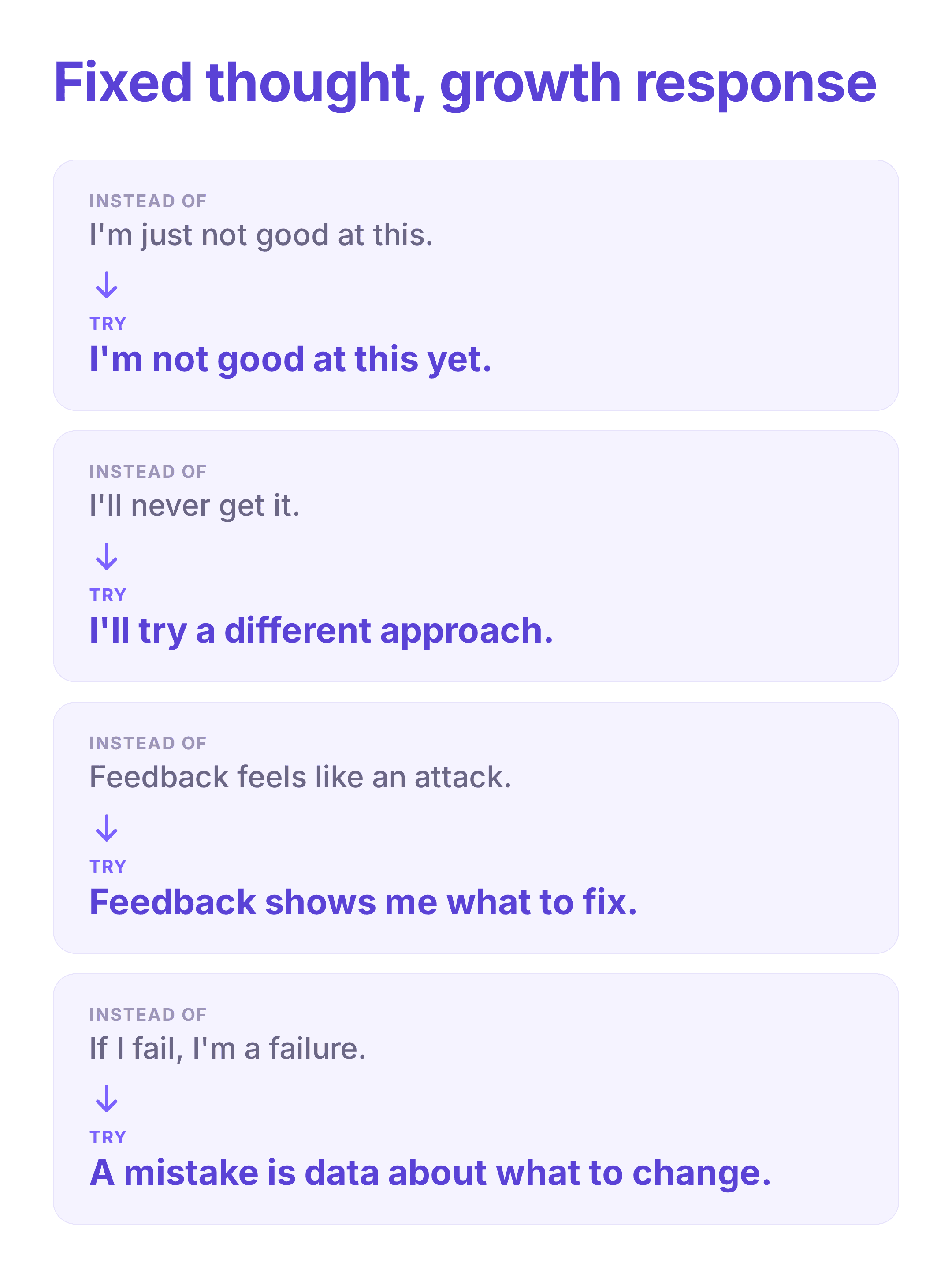
Learning how to build a growth mindset comes down to a handful of repeatable techniques you practice on real tasks. Order doesn't matter much, so start with whichever fits the situation in front of you. The point is to run them often enough that the growth-minded response becomes the one you reach for first.
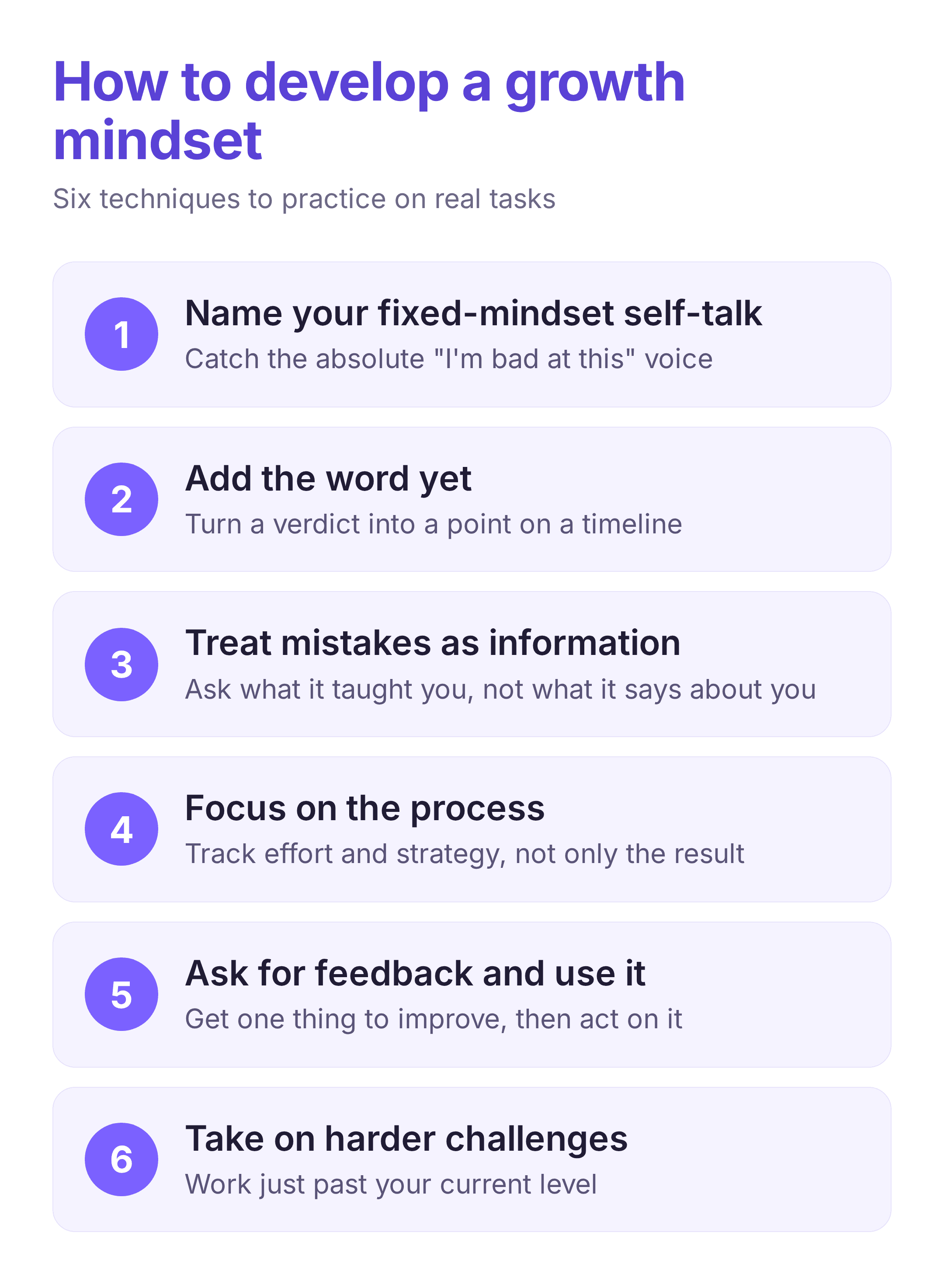
The first move is to catch the fixed-mindset voice when it shows up. It tends to sound absolute: "I'm bad at this," "I'll embarrass myself," "there's no point." Give that voice a name — some people call it their inner critic or their fixed-mindset persona. Naming it puts a small gap between the thought and your reaction, and in that gap you get to choose a different response instead of believing the thought on sight.
One of the simplest changes is to add "yet" to the end of a fixed-mindset sentence. "I don't understand this" becomes "I don't understand this yet." "I can't run five miles" becomes "I can't run five miles yet." The word turns a permanent verdict into a point on a timeline, which is a more accurate picture of how learning works. Dweck built a lot of her public work around this small shift.
Growth-minded people tend to look straight at what went wrong instead of away from it. In one experiment, people with a growth mindset showed a bigger brain response to their own mistakes and did better on the next try. A mistake is data about what to change, so the useful question after one is "what did that teach me?" rather than "what does this say about me?"
Demetra Moore, a leadership and communication coach and one of our experts, makes a related case for building mental fitness so you keep going after a setback instead of stalling. The reaction to a mistake is where a growth mindset either holds or slips.
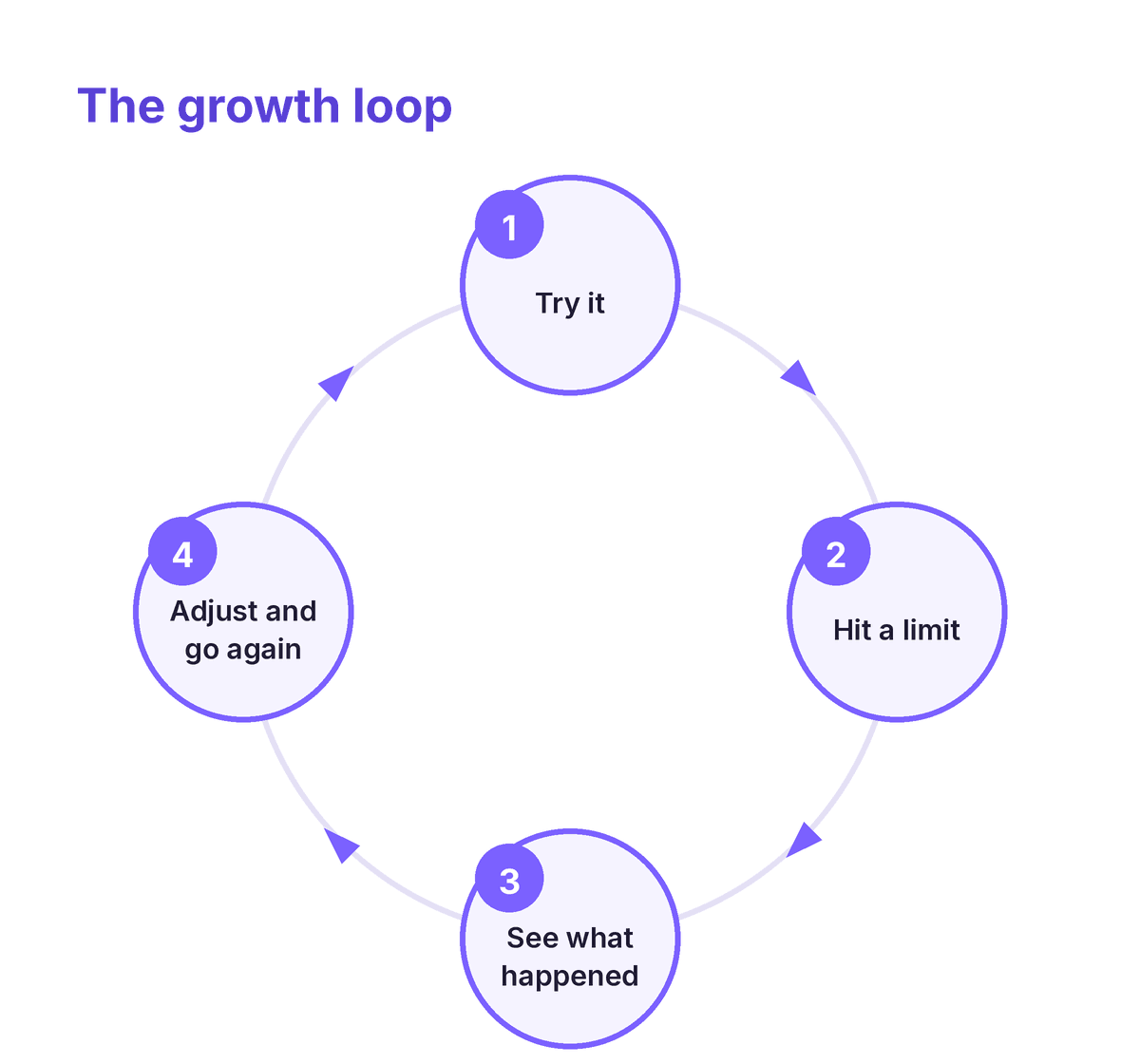
When the result is all that counts, every setback feels like a verdict. Shifting attention to the process — the hours you put in, the strategy you tried, the feedback you used — keeps you improving even when the outcome is slow to arrive. Eduardo Briceño describes two modes to move between: a learning zone, where you work on things you haven't mastered yet, and a performance zone, where you do what you're already good at. Time spent in the learning zone is where improvement happens.
Jennifer Layman, a marketing and communications consultant and one of our experts, points out that progress is often slow to show, so it helps to track the effort and small wins you can see now rather than waiting on the final result to feel like you're getting somewhere.
A fixed mindset treats feedback as a grade on who you are, so it avoids it. A growth mindset treats feedback as free information about what to work on next. Ask specific questions — "what's the one thing I could do better here?" — and then do something with the answer. Feedback you collect but never act on doesn't build anything.
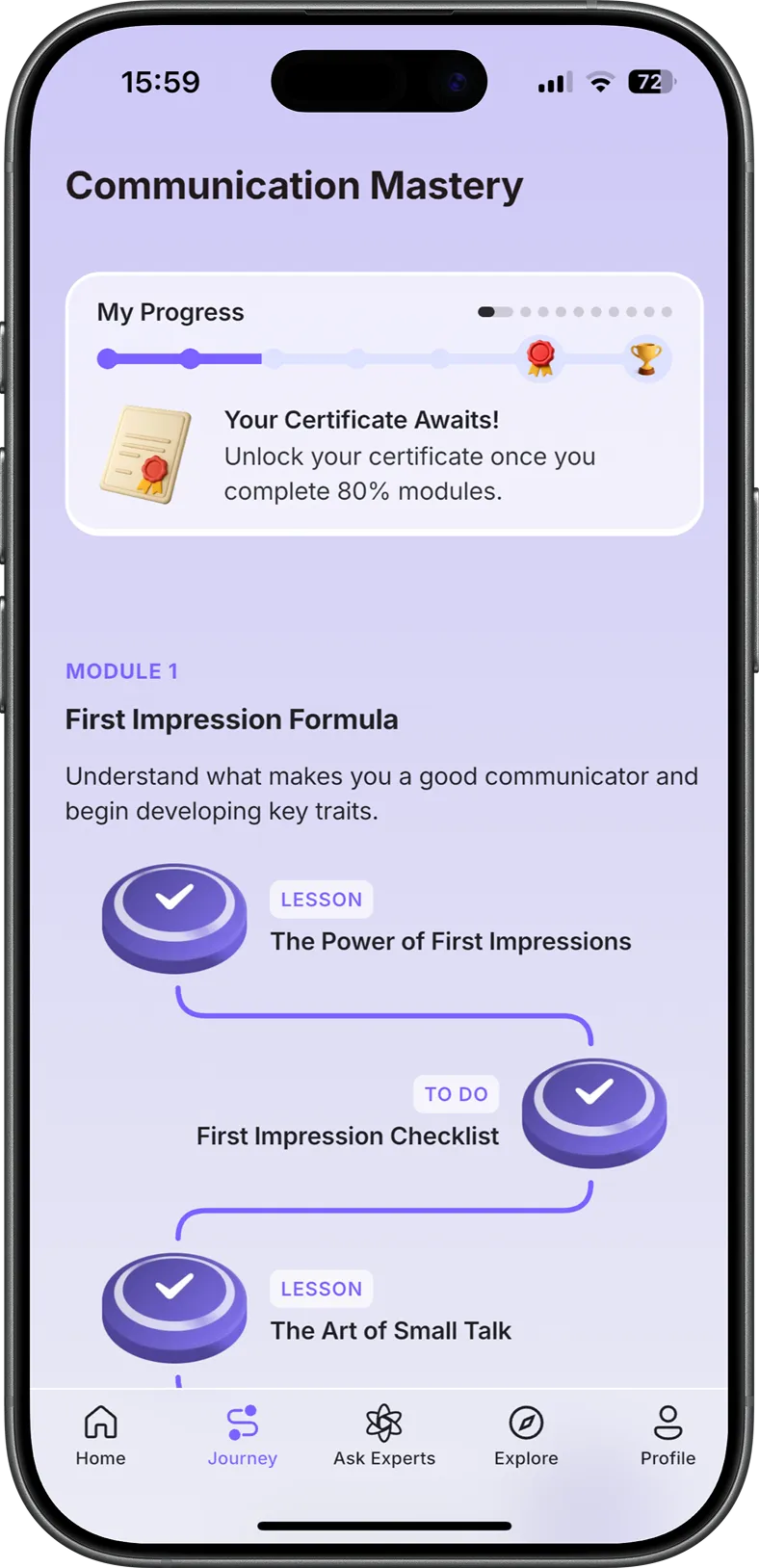
Skill grows at the edge of what you can already do. Pick tasks that are a little harder than your current level: the next difficulty in a language app, a presentation to a slightly bigger group, a problem you're not sure you can solve. If you want a structured way to practice, RiseGuide breaks skills like communication into short lessons built from expert insights, so you can work on something slightly harder each day. Its flagship Communication Mastery journey is a good place to start if talking to people is the area you most want to grow.
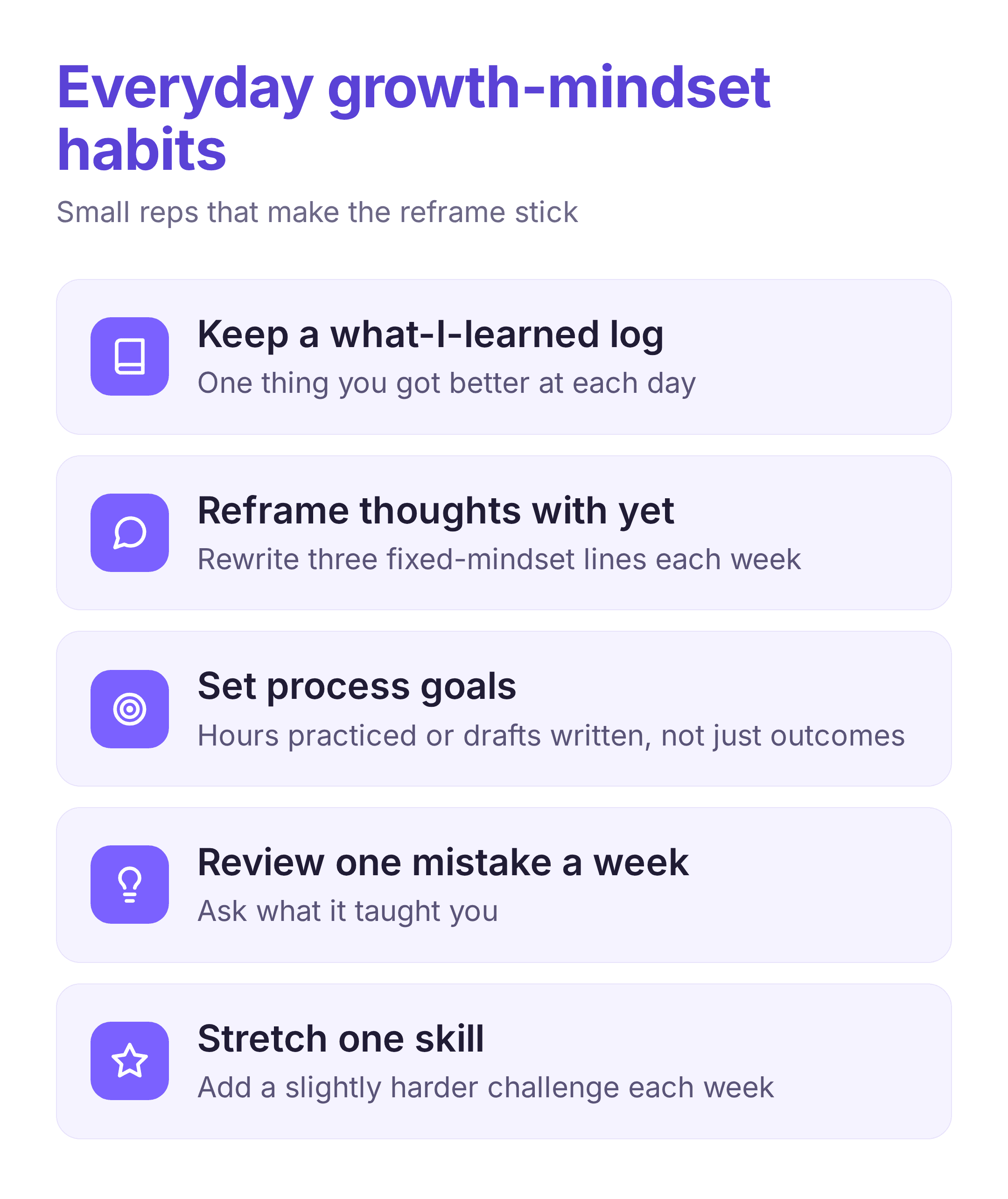
Beliefs change through repetition, so a few small growth mindset activities do more than one big decision to "think differently." Each of these gives the growth-minded response a rep, and reps are what make it stick.
Keep a short "what I learned" log at the end of the day — one thing you got better at or figured out. Once a week, write down three fixed-mindset thoughts you caught and rewrite each with "yet." Set process goals you control, like hours practiced or drafts written, alongside any outcome goals. Do a quick weekly review of one mistake and what it taught you. And pick one skill to stretch, adding a slightly harder challenge each week so you stay just past your comfort zone.
A growth mindset isn't a magic switch, and Dweck herself later cautioned that the idea often gets misused. Two mistakes are common. The first is claiming the label without changing any behavior — saying you believe in growth while still avoiding hard things. The second is praising effort on its own, even when someone is stuck and actually needs a new strategy rather than more of the same.
Effort counts, but only when it's paired with learning and a willingness to try a different approach. It also helps to be honest that everyone has fixed-mindset triggers — a certain kind of criticism, a rival, a subject that always felt out of reach. Noticing your own triggers is part of the work, not a sign you're doing it wrong.
Developing a growth mindset is ongoing, not a box you check once. Pick one technique from this guide — adding "yet" is an easy start — and use it on something real this week. Over a few weeks of catching the fixed-mindset voice and choosing a different response, the growth-minded reaction becomes more automatic and starts to feel like your normal way of handling a hard thing.
Practice a few specific habits on real tasks: name your fixed-mindset self-talk, add "yet" to statements about what you can't do, treat mistakes as information, and ask for feedback you then act on. Improvement comes from repeating these on actual challenges, not from reading about them once.
Notice and name your fixed-mindset self-talk, reframe limits with the word "yet," treat mistakes as useful data, focus on the process instead of only the result, and take on challenges slightly beyond your current level.
The same way at any age. Knowing how to build a growth mindset as an adult mostly means catching your automatic reactions to difficulty and choosing a more useful one, then repeating that until it sticks. Adults have an advantage: you can see your own patterns clearly and pick specific situations to practice in.
There's no fixed timeline, and it's never fully finished. Most people notice their self-talk changing within a few weeks of consistent practice, but a growth mindset stays a work in progress, showing up more in some areas than others.