RiseGuide Team

To build self-awareness, first understand what it is and look at yourself from two directions. Self-awareness is the ability to see yourself clearly: your feelings, values, strengths, and the effect you have on other people. Researchers split it into internal self-awareness (how well you know your own inner world) and external self-awareness (how accurately you understand the way others see you), and the two don't always go together. You build it by asking people you trust for honest feedback, reflecting on what you feel and do rather than endlessly asking why, noticing your reactions as they happen, and comparing what you meant to do with how it actually landed.
Most of us assume we know ourselves well, and most of us are only partly right. You can be certain you came across as calm in a meeting while everyone else saw you as tense, or sure you're an easy person to work with while your team might disagree. Self-awareness is what lets you see yourself more accurately, and it shapes your decisions, your relationships, and how well you lead. This guide explains what self-awareness is, the two types that make it up, why it matters, how to spot when it's missing, and practical ways to build it.
Self-awareness is the ability to see yourself clearly and accurately: to notice your own emotions, values, strengths, weaknesses, and the effect your behavior has on the people around you. That is the short self-awareness definition. In plain terms, the meaning of self-awareness is being able to step back and observe yourself almost as another person would, instead of running purely on autopilot.
It helps to separate self-awareness from a couple of things it's often confused with. It is not the same as self-consciousness, which is anxious attention to how you look to others. And it is more than introspection: simply thinking about yourself a lot does not guarantee you see yourself accurately, because you can reflect your way into a story that feels true but isn't. Real self-awareness is about accuracy, not the amount of time you spend in your own head.
One of the most useful ideas about self-awareness comes from organizational psychologist Tasha Eurich, whose research found two distinct types that are worth understanding separately.
Internal self-awareness is how clearly you see your own inner world: your values, feelings, what you want, your strengths and blind spots, and how all of that fits the life you're trying to build. Someone with strong internal self-awareness can name what they're feeling and why a situation bothers them, rather than just feeling off.
External self-awareness is how accurately you understand the way other people experience you. It's knowing that your dry humor reads as sarcasm to new colleagues, or that your quietness in groups comes across as aloof even when you feel friendly.
The important part is that the two don't come as a package. You can have a rich understanding of your own feelings and still have no idea how you land on others, or read a room perfectly while avoiding your own. Building self-awareness means working on both, because each one corrects the blind spots of the other.
Self-awareness sounds abstract, but its effects are concrete. When you can see yourself clearly, you make decisions that fit who you actually are instead of who you think you should be, you handle feedback without falling apart, and you notice your part in a recurring conflict instead of blaming the other side every time. These are practical self-awareness examples: choosing a job that suits your real strengths, catching your temper before it runs a conversation, or realizing a habit of yours keeps creating the same problem.
It also sits underneath other skills people work hard on. Clearer thinking depends on watching your own reasoning, the same skill we cover in our post on critical thinking. Coming across the way you intend depends on knowing how you actually come across, which is part of what makes someone charismatic, as our team's guide explains. And managing your energy starts with noticing your own warning signals, like the early signs of burnout our team's guide helps you catch before they take hold.
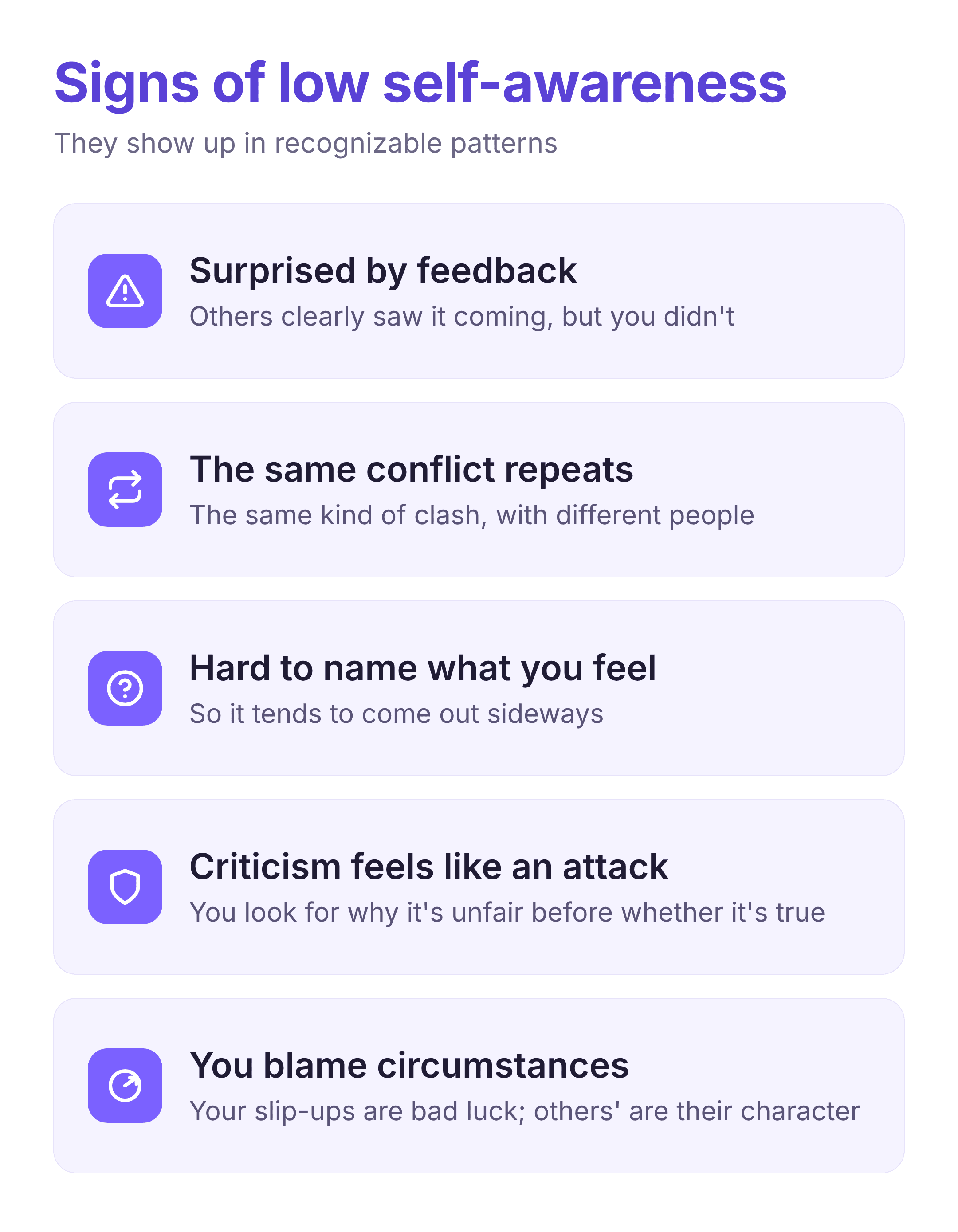
A lack of self-awareness is hard to spot in yourself, almost by definition, but it shows up in recognizable patterns. You tend to be surprised by feedback that others clearly saw coming. The same kind of conflict keeps happening with different people. You find it hard to name what you're feeling, so it comes out sideways. Criticism feels like an attack rather than information, and you reach for a reason it's unfair before you consider whether it's true. You explain your own slip-ups by circumstance but other people's by their character.
None of these means something is wrong with you. They are simply signs that one of the two types of self-awareness has a gap in it, and gaps can be closed with practice.
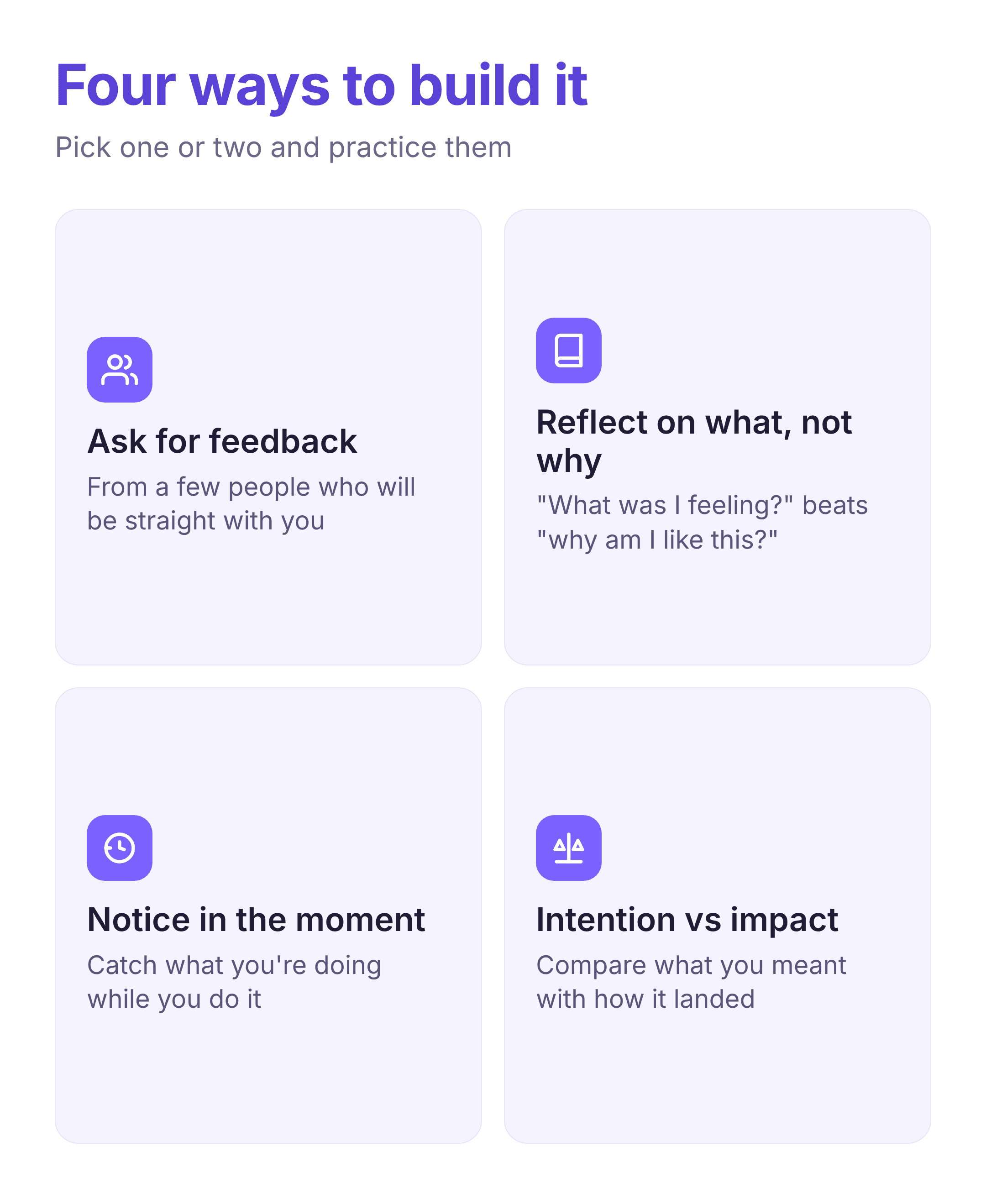
You can improve self-awareness at any age, because it's a skill rather than a fixed trait. These are a few reliable ways to improve self-awareness; pick one or two and practice them rather than trying everything at once.
Ask people you trust for honest feedback. External self-awareness is hard to build alone, because you can't see yourself from the outside. Pick a few people who will be straight with you and ask something specific, like "when do I come across as impatient?" rather than "what do you think of me?" The specific question is easier to answer honestly and more useful to hear.
Reflect on what, not why. Setting aside time to think about yourself only helps if you do it well. When you turn a reaction over, ask "what" questions instead of "why" ones: "what was I feeling, and what set it off?" tends to lead somewhere useful, while "why am I like this?" often spirals into a tidy story that isn't true. Working through the right questions in a structured way is its own practice, and a dedicated self-reflection routine is the natural next step once you've got the basics here.
Notice yourself in the moment. A lot of self-awareness is catching what you're doing while you do it, rather than reconstructing it afterward. Pausing to name what you're feeling during a tense exchange, before you react, is a small habit that pays off quickly and gets easier with repetition.
Watch the gap between intention and impact. After an interaction, compare what you meant to do with how it seems to have landed. When the two don't match, that difference shows you where your external self-awareness can improve.
If you'd like structure around this, RiseGuide's short lessons on personal growth, built on expert insights, are one way to build the habit a few minutes a day, and a quick self-awareness test can be a useful starting point to see which of the two types you want to work on first.
Self-awareness is the groundwork under most personal growth: see yourself clearly, in your own eyes and in others', and almost everything else gets easier to work on. Thinking about yourself more is not what builds it. You build it by checking your view of yourself against reality, through honest feedback, better questions, and attention in the moment. Start with one habit and one relationship where you'd like to understand yourself better, and let your picture of yourself get a little more accurate from there.
Having self-awareness means you can see yourself clearly and accurately: you can name what you're feeling and why, you know your own strengths and blind spots, and you have a realistic sense of how you come across to other people. What matters is whether your view of yourself matches reality; thinking about yourself constantly doesn't guarantee it.
Internal self-awareness is how well you understand your own values, feelings, and strengths. External self-awareness is how accurately you understand the way others see you. They are independent, so a lot of building self-awareness is noticing which one you're weaker on and working on that side.
Start by getting outside information, since a lack of self-awareness hides from the inside. Ask a few people you trust for specific, honest feedback, pay attention to patterns that keep repeating in your life, and reflect on your reactions by asking what you felt rather than why. Small, regular practice closes the gap over time.
There are self-awareness tests and quizzes that can give you a rough starting point, and they're most useful for showing which type, internal or external, you might want to focus on. Treat the result as a prompt for reflection rather than a fixed score, since real self-awareness shows up in how you act, not in a number.