RiseGuide Team

People skills are the abilities you use to work well with other people — the part of your skill set that only shows up in someone else's company. The 15 that matter most at work are active listening, empathy, clear verbal communication, written communication, giving feedback, receiving feedback, conflict resolution, persuasion and influence, collaboration, negotiation, relationship building, reading nonverbal cues, cultural and cross-functional awareness, mentoring and coaching, and trust and reliability.
The skills employers reward are shifting. As software and AI take on more of the technical and repeatable work, the abilities that are hardest to hand off are the ones you use with other people. The World Economic Forum's Future of Jobs Report 2025 ranks leadership and social influence third among the core skills companies call essential, and places empathy and active listening in the top ten, right alongside analytical thinking. That is the backdrop for this list: fifteen concrete abilities, each one something you do with another person, each with an example of what it looks like at work.
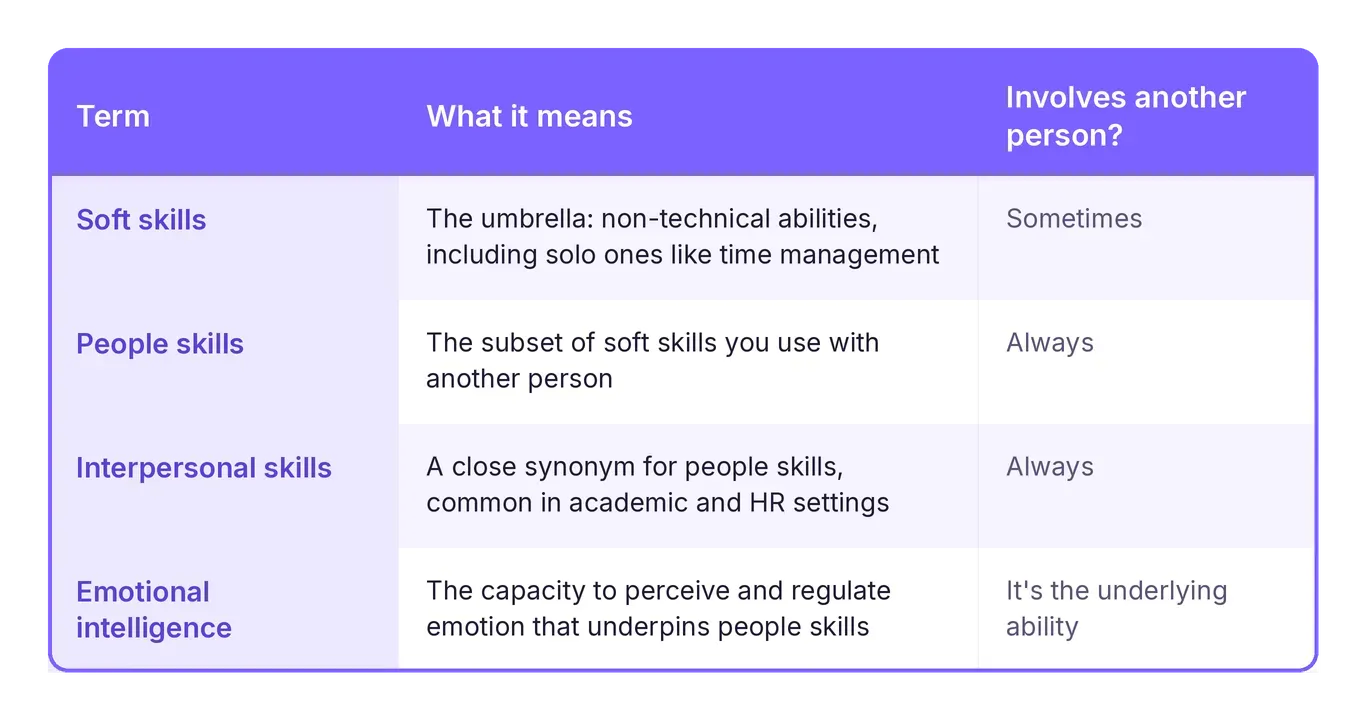
These four terms get mixed together everywhere, and the mix is where most confusion starts. The short people skills definition: they are the subset of your abilities that involve another human being. Sorting out how they relate to the neighboring terms is worth doing once, clearly.
Soft skills are the broad umbrella. The category includes plenty of things you can do alone - time management, resilience, staying organized under pressure - so not every soft skill is a people skill. If you want the full breakdown of the umbrella and where the hard-skill line sits, RiseGuide covers soft skills vs hard skills separately. Interpersonal skills is effectively a synonym for people skills in a more academic register; you will see it on competency frameworks and job descriptions. Emotional intelligence is the underlying capacity that powers the rest: the ability to read and manage emotion, yours and other people's. It is the engine rather than the driving, which is why someone can score well on an emotional-intelligence measure and still handle a hard conversation badly.
Robert Bolton's 1979 book People Skills grouped the field into four clusters that still hold up: listening, assertion, conflict resolution, and collaborative problem-solving. The list below fits inside that shape.
Each entry pairs a short definition with a real example, so the people skills examples stay concrete. They're numbered for reference, not for order - you don't build them in sequence, and the one worth your attention depends on your own work. The single rule holding the list together is that every item is something you do with another person.
Giving someone your full attention and showing you followed before you respond. In practice, that means paraphrasing what a colleague said back to them before you add your own view, so they know it landed. People share more, and more honestly, when they can tell they've actually been heard.
Reading how another person feels and letting it shape your response. In practice, it's noticing a teammate is stretched thin and adjusting what you ask of them instead of piling on. The Future of Jobs Report 2025 puts empathy and active listening among the core skills employers rate as essential, which is unusual company for a trait once dismissed as soft.
Saying what you mean so the other person can act on it, without jargon or padding. In practice, you open a status update with the decision you need, then give the context, rather than the other way around. Ambiguity is expensive; it turns into rework and follow-up meetings.
The same clarity in messages, docs, and email, where tone is easy to misread and no one can ask a quick follow-up. In practice, it's a message that states the ask, the deadline, and the reason in three lines instead of thirty. Most coordination at work now happens in writing, so this one carries more weight than it used to.
Telling someone what to change in a way they can actually hear and use. Specific and timely beats general and delayed every time: "In the client call you answered before Maya finished - she had the pricing data. Next time, let her land it." Feedback like that improves the work without bruising the relationship.
Taking input without getting defensive, and acting on the part that's useful. In practice, it's asking one clarifying question instead of explaining why the person giving it is wrong. People quietly stop coaching anyone who argues with every note.
Working through a disagreement so that both the relationship and the work survive it. In practice, you name the shared goal first, then lay out the two different ways you each want to reach it. Friction that never gets addressed doesn't disappear; it just slows the team down where no one can see it.
Moving people toward a decision through reasons they care about, not through authority you may not have. In practice, you frame a proposal around the other team's targets rather than your own. Most work depends on people who don't report to you, which makes this one quietly essential.
Doing your piece of shared work while keeping the whole in view. In practice, it's flagging a blocker early instead of missing a handoff in silence. Teams only outperform individuals when the seams between people hold.
Reaching an agreement both sides can live with, and want to honor. In practice, you ask what the other side actually needs before you start trading on price or scope. A deal that leaves the relationship intact is the one that sets up the next deal.
Building trust over time so that working together is easier when it counts. In practice, it's a two-minute check-in with a cross-team contact well before you need a favor from them. RiseGuide's guide to networking tips goes deeper on the long game here, and if the opening move is what stalls you, how to make small talk covers getting past the first thirty seconds.
Picking up on tone, expression, and body language, and adjusting in the moment. In practice, you notice a client's answers getting clipped on a call and slow down to check in rather than plow ahead. Reading the room is part of the empathy-and-listening cluster that the Future of Jobs Report 2025 ranks so highly.
Adjusting how you work across cultures, functions, and communication styles. In practice, it's checking whether someone's "yes" means agreement or politeness before you build a plan on it. Teams now stretch across time zones and disciplines, so the default assumptions rarely travel.
Helping someone else grow by asking questions and giving room, instead of handing over the answer. In practice, you ask "what have you tried?" before you solve it for them. The World Economic Forum files teaching and mentoring under the "working with others" skills employers want, and RiseGuide's explainer on leadership coaching unpacks how the coaching version works in practice.
Doing what you said you'd do, so people can count on you without checking. In practice, it's flagging a slip the day you notice it, not the day it's due. Every other skill on this list rests on being someone others can rely on.
The reflex is to assume technology makes human skills less important. The data points the other way. The Future of Jobs Report 2025 finds that 39% of workers' core skills will change by 2030, and 63% of employers name skill gaps as the biggest barrier to transforming their business. The skills growing fastest are technical, but the ones most widely required across roles are increasingly human.
As Till Leopold, the WEF's Head of Work, Wages and Job Creation, put it when the report launched:
"Trends such as generative AI and rapid technological shifts are upending industries and labour markets, creating both unprecedented opportunities and profound risks."
The workplace picture backs this up. Microsoft's 2026 Work Trend Index, a survey of 20,000 knowledge workers across ten countries, found that 86% treat AI output as a starting point rather than a final answer and stay responsible for the thinking, 50% say quality control of that output matters more and more, and 46% name critical thinking as a rising human skill. The judgment, the persuasion, and the relationships around the work are the parts that don't get automated. Microsoft's own read on the people who use AI most heavily is blunt:
"Frontier Professionals refuse to outsource their thinking-they know long-term success means continuing to build human skills and not letting them atrophy."
You can't improve people skills the way you learn a formula, because they only show up in the presence of another person. What works is picking one skill tied to real friction in your week, practicing it in low-stakes reps, and getting honest feedback on how it landed. A word on the pick: don't default to communication because it sounds foundational. If your one-on-ones already go well but negotiations rattle you, negotiation is your skill. Start where the friction actually is.
Then shrink the practice. Pick a single behavior - paraphrasing before responding, asking one clarifying question when you get a critical note - and use it deliberately for a week until it stops feeling like effort. This is where structured people skills training helps more than another article: RiseGuide breaks the abilities on this list into short lessons built from expert insights, so a few minutes a day turns into real reps over a month. RiseGuide's own breakdown of how to improve soft skills lays out the same method across the wider skill set.
The uncomfortable part is the feedback. You're a poor judge of your own people skills, because the whole point of them is how they land on someone else. Ask one person you trust what you actually come across like in a meeting, and take the answer without defending yourself. That single loop, repeated, moves you faster than any amount of reading.
Active listening, empathy, clear verbal and written communication, giving and receiving feedback, conflict resolution, persuasion, collaboration, negotiation, relationship building, reading nonverbal cues, cross-cultural awareness, mentoring, and reliability. Anything you do that involves another person, and that makes working with you easier, counts.
The people skills meaning is straightforward: the abilities you use to interact well with others. They're the relational slice of soft skills, distinct from solo abilities like time management, and they're what let you communicate, collaborate, and handle friction with the people around you.
Not quite. Soft skills is the broader category and includes abilities you can use alone, such as staying organized or managing your time. People skills are the subset that only work with another person involved. Every people skill is a soft skill; not every soft skill is a people skill.
Interpersonal skills is the closest synonym, and the one you'll most often see on job descriptions and competency frameworks. "Social skills" and "soft skills" get used loosely for the same idea, though soft skills is technically the wider category.
Rather than listing "good with people," show people skills on a resume through specific results: a conflict you resolved, a cross-functional project you coordinated, a team you mentored. Employers value the evidence over the label — NACE's Job Outlook 2026 reports that teamwork, problem-solving, and communication top the attributes recruiters look for.