RiseGuide Team

Leadership coaching is a confidential, one-on-one partnership in which a trained coach helps a leader set goals, reflect on how they actually operate, and close the gap between the two. It develops leaders less by handing over advice and more by building self-awareness, accountability, and better habits of thinking, usually across a handful of sessions rather than a long program. Controlled studies find a moderate positive effect on things like goal attainment, though the effect shrinks once you account for publication bias and rely on other people's ratings rather than the leader's own. It tends to help most when a leader has a specific goal, is genuinely open to changing, and is matched with a coach whose experience fits that goal. To judge whether it's worth it for you, look at the fit and your own readiness, not the coach's price or credentials alone.

Coaching has become a standard line in how organizations grow their leaders. The 2025 ICF Global Coaching Study counted 122,974 coach practitioners worldwide and roughly $5.34 billion in annual revenue, and 54% of those coaches say they specialize in leadership and executive work. More than half of their clients are sponsored by an employer. For something this widespread, though, what happens inside it — and whether it does what people hope — stays surprisingly vague. This piece walks through what the practice is, the things it gets confused with, what the evidence shows, and how to tell if it would help you.
At its core, leadership coaching is a structured working relationship between a leader and a coach whose job is to help that leader think more clearly and act more deliberately. The coach doesn't run the leader's team or hand down answers. They ask questions, reflect patterns back, hold the leader to commitments they set themselves, and help them work through real situations as those situations unfold. The International Coaching Federation defines coaching as:
"partnering with clients in a thought-provoking and creative process that inspires them to maximize their personal and professional potential."
The main word there is partnering. A coach operates from the premise that the leader is capable and resourceful, and that the useful answers usually come from drawing those out rather than importing them. The ICF frames the skill set as a set of core competencies - establishing a clear agreement, building trust, listening actively, and evoking awareness - which is a helpful checklist for what a good coach is actually doing in the room.
Self-awareness is the raw material most of this depends on. A leader who can see their own defaults - how they react under pressure, where they avoid conflict, what they assume about others - has something to work with; one who can't tends to spin. Whitnie Wiley, an executive coach and one of our experts, makes the case for that starting point in self-awareness as the foundation of leadership.
Several distinct things share this vocabulary, and they're worth separating before going further. Executive leadership coaching usually refers to the same practice aimed specifically at senior leaders, often with a sharper focus on organizational stakes. Mentoring, consulting, and therapy each do something genuinely different. And confusingly, the coaching leadership style is not coaching at all - it's a way of managing your own team.
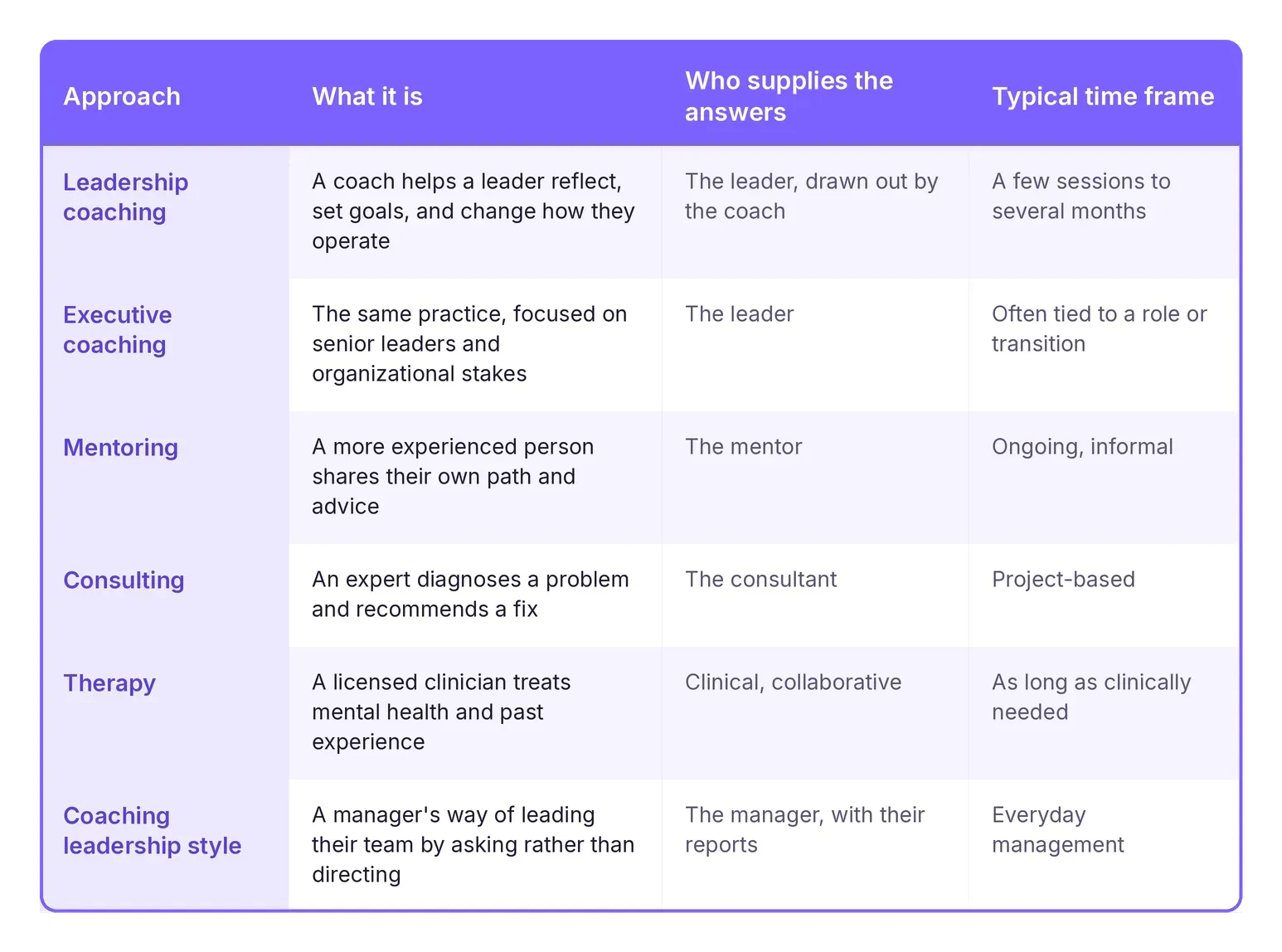
That last row is where a lot of search traffic gets muddled. A coaching leadership style means a manager who develops their people through questions and feedback instead of top-down instruction - a 2025 systematic review links it to better team engagement and performance. It draws on coaching skills, but it's something you do as a boss, not something you receive from an outside coach.
The mechanics are less mysterious than the marketing around them suggests. A typical engagement moves from setting up the relationship, to working through goals with a loose framework, to a defined stretch of sessions. Here's what each part involves.
Good coaching starts with an explicit agreement: what the leader wants to work on, how success will be judged, and what stays confidential. The relationship rests on trust and candor, because a leader who's managing their image with their coach isn't getting much. Clare Norman, a Master Certified Coach, draws a sharp line about the coach's role here:
"Your job as a coach is not to create value. Your job is to be a catalyst for the creation of value."
Many coaches lean on a simple structure to keep sessions productive. The best known is GROW - Goal, Reality, Options, Will - which walks a conversation from what the leader wants, through an honest look at the current situation, to options and a concrete commitment. Graham Alexander is credited with originating it, and John Whitmore popularized it. Whitmore himself was wary of treating it as a technique divorced from the mindset behind it, warning that "any dictator can use GROW" - the structure is only as good as the trust and intent underneath it.
Engagements are shorter than most people assume. Across controlled studies, coaching runs anywhere from 1 to 16 sessions, with an average of about 7. Notably, the results don't seem to depend much on how long the overall assignment lasts, which suggests that more sessions are not automatically better.
This is where honesty matters most, because the space is full of impressive-sounding numbers that don't survive scrutiny. The most rigorous synthesis to date, a 2023 meta-analysis restricted to randomized controlled trials (36 trials, 2,528 participants), found an overall effect of g = .59, with goal attainment higher at g = .82. Effect sizes are measured here as Hedges' g, where roughly 0.5 counts as a moderate effect.
Two caveats pull those figures down, and both point the same way. When the authors corrected for publication bias - the tendency for studies showing weak results to never get published - the overall effect dropped to g = .32. And the numbers depend heavily on who's doing the rating: self-reported effects came in at g = .62, while effects rated by outside observers were only g = .29. A separate 2023 meta-analysis found the same pattern from the other direction: an overall g = 0.44, but subordinate-rated change was just g = 0.24 - the people being led saw the smallest difference of anyone.
The practical read is straightforward. Coaching produces a real, moderate benefit, strongest on the goals a leader sets for themselves and weakest in the eyes of the people around them. That gap is also the honest answer to the eye-catching return-on-investment claims that circulate: figures collected by asking coached leaders to estimate their own results will always look far larger than what observers actually notice. If the team a leader manages is who you most want to see change, the effect exists but is modest - worth going in with the right expectations. Demetra Moore, a leadership and communication coach and one of our experts, gets specific about the behaviors teams respond to in soft skills that actually keep your team engaged.
Coaching pays off in some situations far more than others. It tends to be worth considering when:
If your challenge is really a knowledge gap or a strategic problem, a mentor or consultant may serve you better. Coaching works on how you lead, not on supplying answers you're missing.
The variable that matters most is not the one people shop on. A 2025 study of 184 coaching pairs found that the only kind of fit predicting goal attainment was needs-supplies fit - whether the coach's expertise matched what the leader actually needed (β = .22). Being similar to your coach didn't help and slightly lowered satisfaction. And the warm working alliance most people equate with good coaching predicted how satisfied clients felt, but not whether they hit their goals. Rapport feels like progress; it isn't the same thing.
A few other patterns are worth holding onto. Longer engagements don't reliably beat shorter ones, so more sessions aren't a safeguard. And there's a difference between being coachable and your organization being ready to support the change - a leader can do the work and still stall if nothing around them shifts. John Lentini, a leadership coach and one of our experts, breaks down the internal side of that readiness - discipline, mindset, and resilience - in the dials of self-leadership.
Given all that, choosing well comes down to fit and judgment more than to titles. A credential from a body like the ICF signals that a leadership coach has trained against a defined standard, which is a reasonable filter - but it's a floor, not a guarantee. Industry leaders are openly skeptical of leaning on it too hard; as Korn Ferry's Dennis Baltzley put it, certification can be "a diluted proxy for relevant experience and skill" in an unregulated market. A few things to weigh when picking an executive coach:
Leadership coaching is a focused partnership for changing how you lead, and the evidence says it works — moderately, most on the goals you set yourself, and best when the coach genuinely fits the problem you're bringing. Its reputation is inflated by numbers that don't hold up, but the honest version is still a real case: for a leader with a specific goal and the openness to act on it, a good coach is one of the more reliable ways to grow. Judge it on fit and your own readiness, go in with grounded expectations, and keep doing the work between sessions.
A leadership coach helps a leader think through their goals and challenges by asking questions, reflecting patterns back, and holding them accountable to the commitments they set. They don't run the team or hand over answers — the work is drawing out the leader's own thinking and helping them act on it more deliberately.
They're largely the same practice. Executive coaching usually refers to leadership coaching aimed specifically at senior leaders, often with a sharper focus on organizational stakes and higher-pressure decisions. The skills and methods overlap heavily.
The best controlled research shows a moderate positive effect, strongest on the goals a leader sets for themselves. The effect shrinks once you account for publication bias and rely on outside observers rather than self-reports, and the people a leader manages tend to notice the smallest change — so it helps, but the dramatic ROI numbers often quoted don't hold up.
Most engagements are short — studies show a range of 1 to 16 sessions, averaging about 7. Results don't reliably improve with longer assignments, so a longer engagement isn't automatically a better one.
No. Therapy is delivered by a licensed clinician and treats mental health and past experience. Mentoring is an experienced person sharing their own advice and path. Coaching is future-focused and non-directive: the coach helps you find your own answers rather than supplying theirs.