RiseGuide Team

Here are the 14 tools we cover, and the part of a better self each one helps with:
You don't need all fourteen. Becoming your better self happens one part at a time, so pick the area you feel most, choose the one tool that fits it, and start there.
Growing into a better version of yourself sounds like a single big project, but it's really a handful of smaller ones: getting better with people, learning new things, understanding yourself, looking after your mind and body, and handling everyday life with a bit more calm. Each of those is a direction you can move in, and each has a tool that makes the moving easier.
The list below isn't a ranking or a face-off. It's a set of online tools for personal growth that people genuinely use to become who they want to be, grouped by the part of life each one helps with. For every tool you'll find what it actually does, how to put it to work, and the kinds of problems and goals it fits, so you can tell quickly whether it's for you.
Think about which version of yourself you're reaching for. Someone who speaks up with confidence? Someone who reads more, worries less, or finally keeps a promise to themselves? That answer points you to a section of this list. The best tools for personal growth aren't the most popular ones; they're the ones aimed at the change you actually care about.
One tool, used often, will do more for you than ten you download and forget. Growth comes from small things repeated, so the value of any of these lives in whether you open it tomorrow. If you'd rather grow through everyday practices than apps, our roundup of self-improvement apps is a good companion.
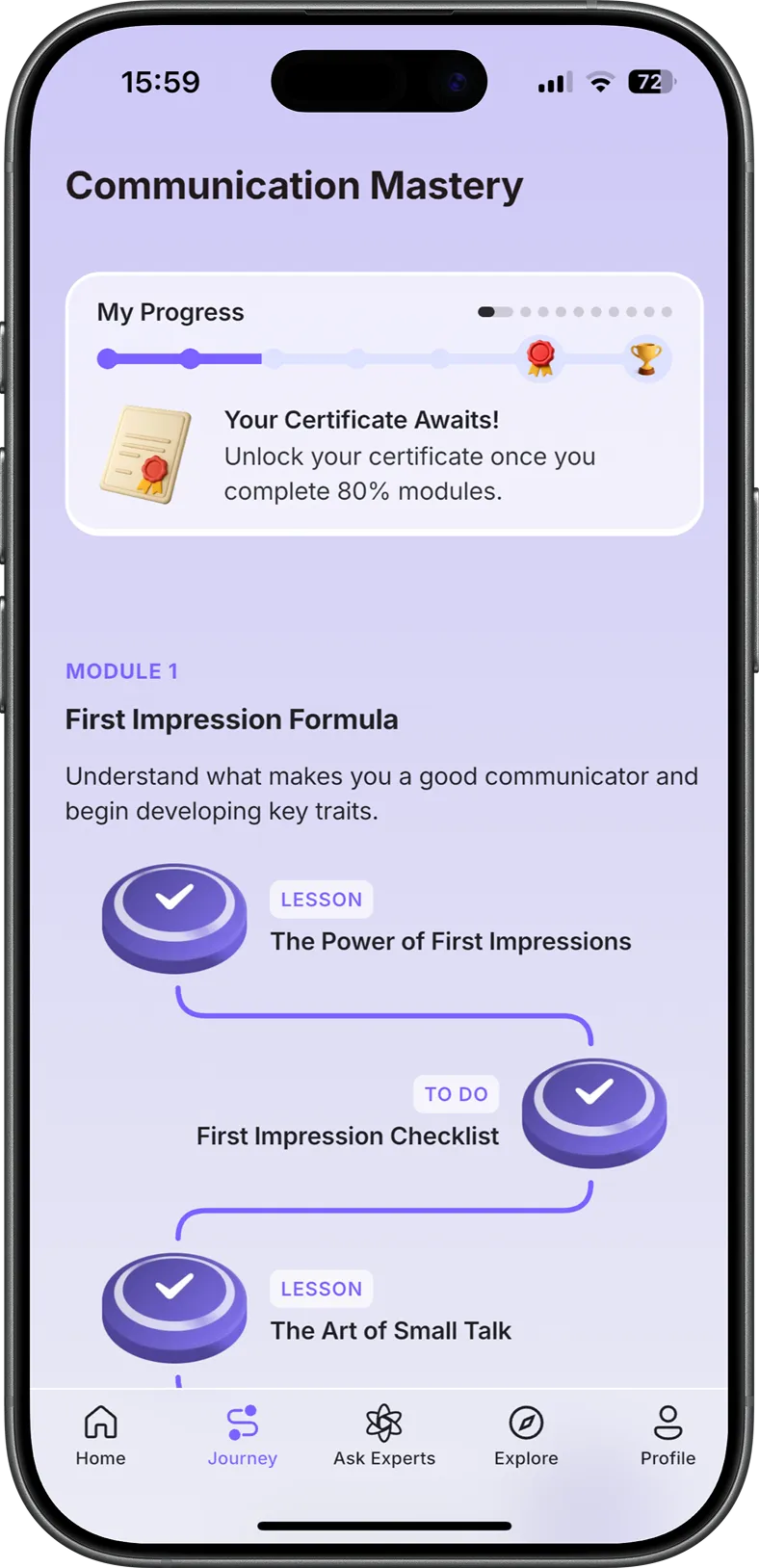
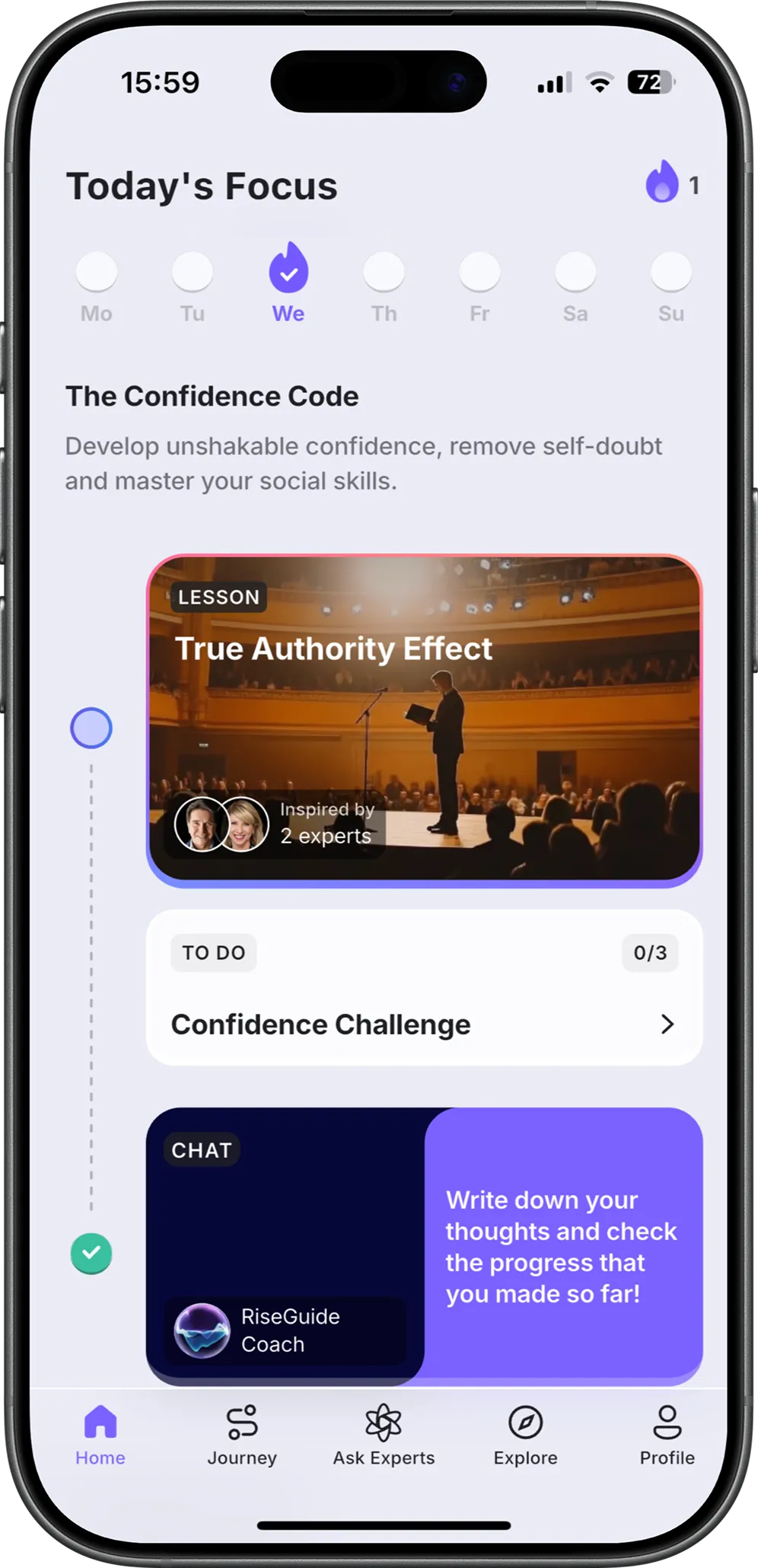
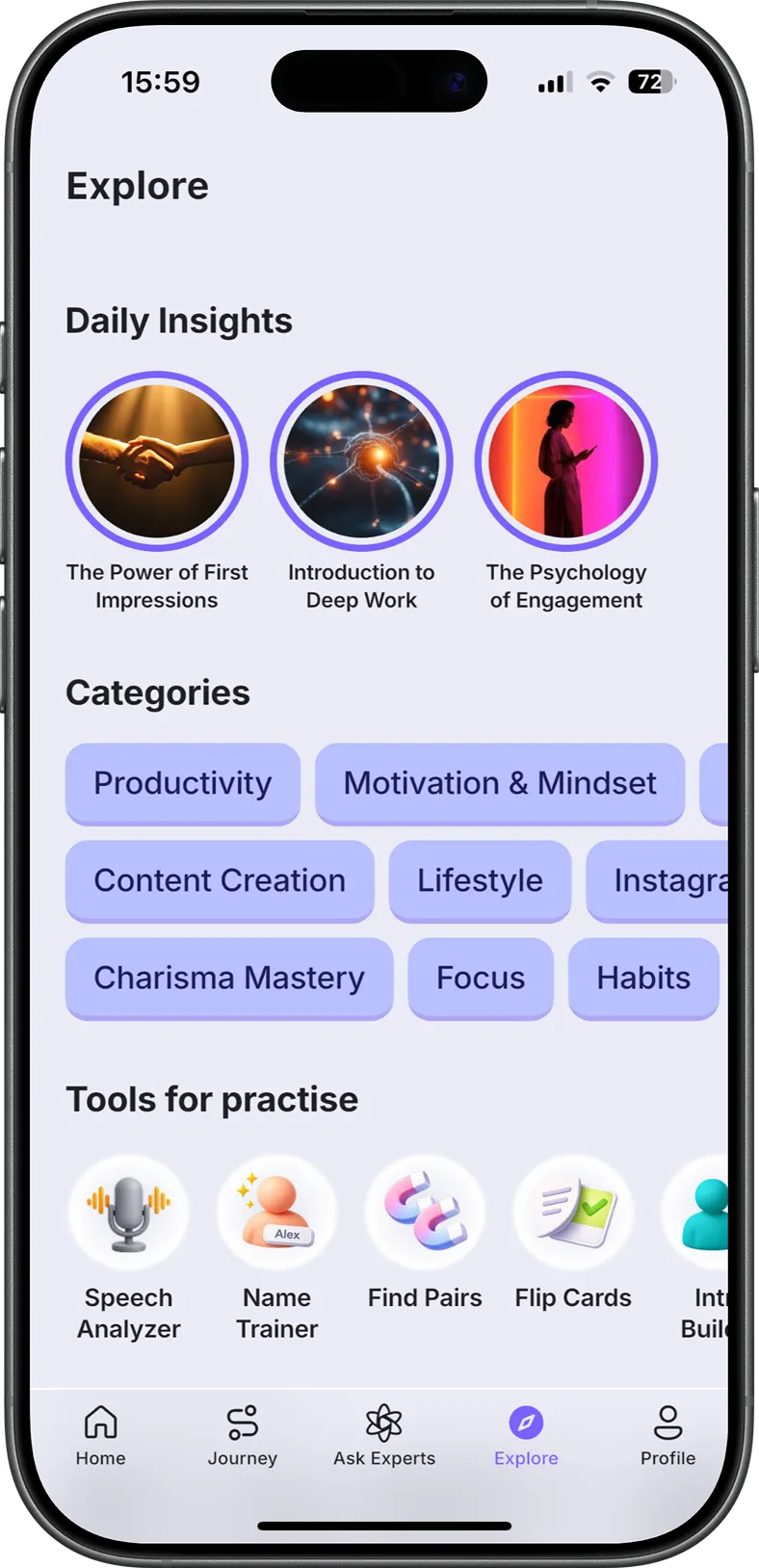
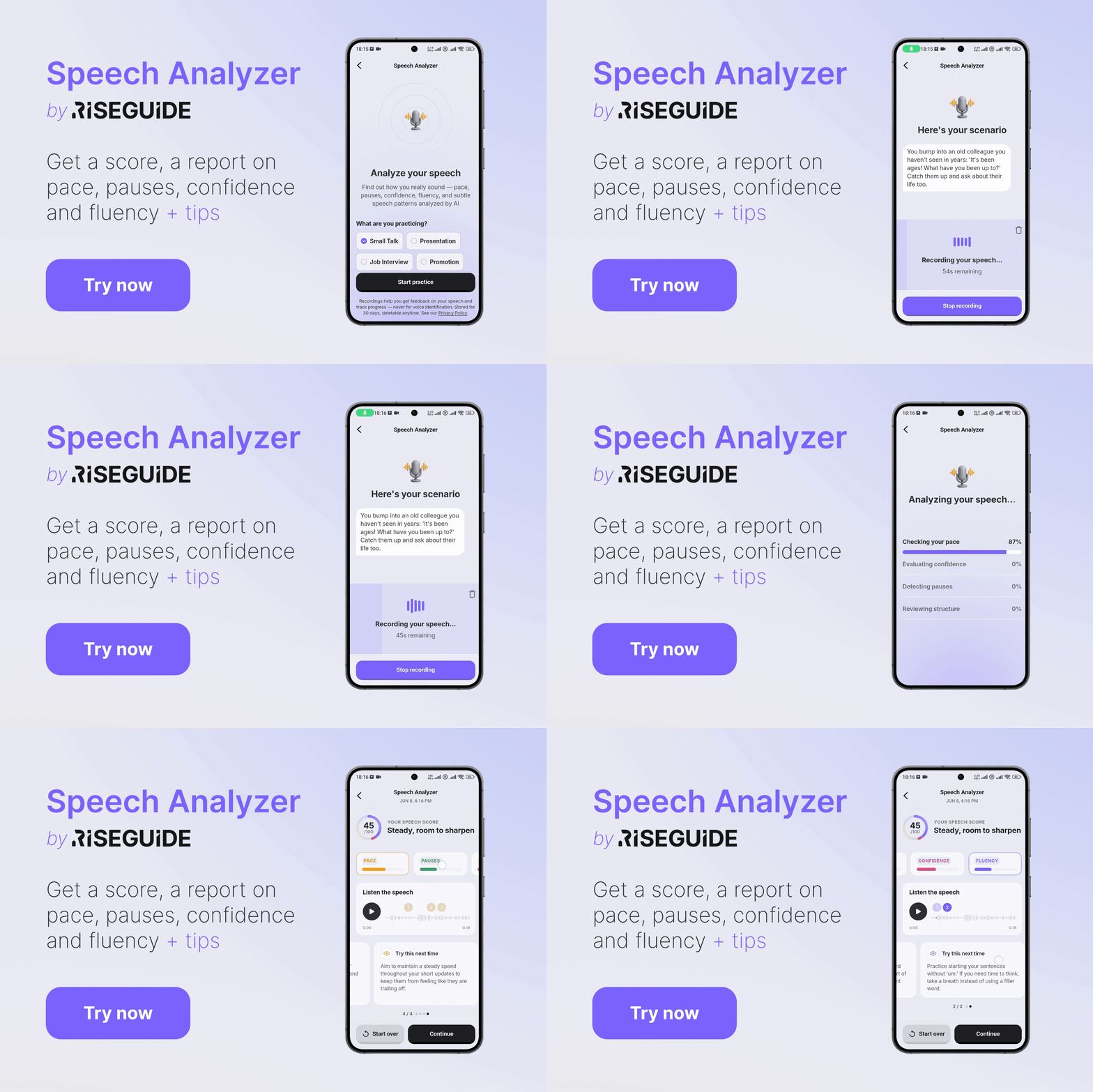
RiseGuide is built around communication, the skill that shapes almost every relationship, interview, and meeting you'll ever be in. Its lessons come from expert insights and are organized into journeys, which are step-by-step paths through one skill at a time, covering speaking, voice, body language, storytelling, and first impressions, with a short lesson each day. Alongside the lessons sit practice tools: a Speech Analyzer that records a minute of you talking and scores your pace, pauses, and confidence, a small talk game to rehearse real situations, and SEEK, which answers a question from a curated library of expert sources.
Use it when there's a specific moment you want to handle better, like a presentation, a job interview, a wedding toast, or a hard conversation you keep putting off. It's built for the common gap where you know what good communication looks like but freeze or ramble when it's your turn, so you can practice in private before it counts for real.
The goals it fits are the everyday ones: speaking up in meetings without your voice shaking, making a stronger first impression, keeping small talk going, and sounding like yourself under pressure. Practiced a few minutes a day over a few weeks, that's how a nervous speaker slowly becomes a confident one.
Coursera brings full courses from universities and companies like Google and IBM onto your phone, from single classes to multi-course specializations and even degrees. Each one pairs video lessons with quizzes, assignments, and deadlines, so it feels like a real course rather than a loose playlist, and many end in a certificate you can add to a résumé or LinkedIn.
Reach for it when your growth goal is concrete and career-shaped: learning data analysis for a promotion, picking up marketing or coding to change fields, or building a credential that makes you more employable. It solves the problem of drifting through scattered free videos without ever finishing anything, by giving you a structured path with an endpoint.
It suits people who want proof of progress, not just the feeling of it. If a full course platform is more commitment than you want right now, our roundup of Masterclass alternatives covers lighter ways to learn from experts.
Blinkist condenses thousands of nonfiction and self-help books into roughly fifteen-minute reads or listens that capture each book's main ideas. You can go through one over a coffee, listen on a commute, or use it to decide whether a book is worth buying in full before you commit.
Use it to get the core framework of a book fast, to keep learning when a full read feels like too much, or to sample widely across topics like psychology, business, and health. It's aimed squarely at the problem most readers know well: a to-read pile that never shrinks and good intentions that never turn into finished books.
The goal it serves is simple, which is to take in more useful ideas and actually put one to work, rather than none. For learning in small pockets like this more broadly, our post on microlearning apps covers the wider category.
Duolingo teaches dozens of languages through short, game-like lessons that mix reading, listening, and speaking, and it leans on streaks, reminders, and friendly competition to keep you coming back day after day. Sessions are small enough to fit into a bus ride or a coffee queue.
Use it to prepare for a trip, to reconnect with a heritage language, or simply to build a five-minute daily habit that adds up over months. It's built for the exact place most language learners give up, which is the daily consistency, and the game design is there to carry you past it.
Set it toward a real goal, like ordering food and asking directions on your next trip, or holding a simple conversation with relatives, and the small daily reps slowly turn a foreign language into one you can actually use.
Habitica turns your habits and to-dos into a role-playing game. You create a character that gains experience and rewards when you follow through on your habits and loses health when you skip them, and you can join parties and challenges with other people for shared accountability.
Use it to track daily habits like drinking water, moving your body, or reading, to keep on top of recurring tasks, and to make the whole thing feel less like grinding through a checklist. It targets the point where most good intentions die, which is not starting a habit but keeping it going once the novelty fades.
If your goal is consistency, a streak that finally holds, or simply doing the small things you keep meaning to do, the game layer gives your brain a reason to show up that plain discipline sometimes can't.
Fabulous helps you build morning and evening routines through guided, science-based journeys rather than a blank tracker. It introduces one small habit at a time, like drinking water when you wake or winding down before bed, and adds the next only once the first has taken hold, with reminders and gentle coaching along the way.
Use it when your days feel chaotic and you want structure you don't have to design yourself, whether that's a calmer morning, a better wind-down for sleep, or more focused work blocks. It solves the overwhelm that sinks a lot of routine-building, where people try to change ten things at once and keep none of them.
The goal is a routine that eventually runs on its own, so the good parts of your day happen by default instead of by daily willpower. It suits people who'd rather be led through the change than build it from scratch.
Forest is a focus timer with a twist: when you want to concentrate, you plant a virtual tree that grows while you stay off your phone, and withers if you leave to scroll. Stay focused across many sessions and you grow a whole forest, a small visual record of the attention you've protected.
Use it for deep-work sprints, study sessions, phone-free meals, or any stretch where you want your attention in one place. It goes straight at the modern problem of a fractured focus and the reflex to check your phone every few minutes, giving you a small, immediate reason not to.
Point it at a goal like an hour of undistracted work a day, or evenings without the phone, and it helps you slowly rebuild the ability to sit with one thing, which quietly underpins every other kind of growth on this list.
Notion is a flexible workspace that you can shape into almost anything: a goal tracker, a habit log, a reading list, a project planner, or a full life dashboard that holds all of it in one place. It combines notes, tasks, and simple databases, and there's a large library of ready-made templates so you don't have to start from a blank page.
Use it to gather your goals and plans out of scattered notes and half-remembered intentions and into one organized system you actually check. It solves the quiet drag of feeling disorganized, where good ideas and commitments slip through the cracks because they live nowhere in particular.
If your goal is to be more intentional, to see your priorities clearly and track progress toward them, Notion is the tool that ties the rest of your growth together. Its flexibility takes a little setup, so it rewards people who enjoy building their own system.
Day One is a private digital journal with writing prompts, photos, reminders, and an "on this day" view that resurfaces past entries. It's designed to make daily writing an easy habit rather than a chore you keep meaning to start.
Use it for a few lines of gratitude each night, to process a hard day, to track your mood over time, or to capture small wins you'd otherwise forget. It answers a problem that's easy to miss, which is that you can't work on what you never pause to notice, and reflection is how patterns in your mood, energy, and reactions become visible.
Aim it at self-awareness, whether that's understanding what drains or lifts you, or simply seeing how far you've come, and the habit of putting your days into words does the quiet work over time.
Headspace teaches meditation and mindfulness through short guided sessions, with structured courses on stress, focus, and sleep, plus quick "SOS" exercises for moments when anxiety spikes. The instructions are plain and beginner-friendly, so you're not left guessing what to do.
Use it for a ten-minute morning reset, a wind-down before bed, or a few breaths before a stressful meeting or difficult call. It targets the racing mind, the low-grade stress, and the poor sleep that so many people carry, giving you a simple way to notice your thoughts without being swept away by them.
If your goal is to stay steadier when things get tense, to react less and recover faster, a regular practice here builds that calm gradually, and a calmer mind makes every other part of growth easier.
Finch pairs self-care with a virtual pet that grows as you look after yourself. You check in on your mood, set small daily goals, and work through short reflections and breathing exercises, and the bird thrives alongside your own small acts of care.
Use it on the days when growth tips into harsh self-criticism, or when looking after yourself keeps sliding to the bottom of the list. It's built for gentle, low-pressure self-care, the kind that meets you where you are rather than demanding a total overhaul, which makes it especially kind on low-energy days.
The goal it supports is a warmer relationship with yourself: checking in honestly, treating a rough day with patience, and building the habit of small, steady care instead of waiting until you're running on empty.
Strava tracks runs, rides, walks, and dozens of other activities using your phone's GPS, records your progress over time, and adds a social feed where friends and clubs can see and cheer on what you do. Challenges and segments give you extra things to aim at.
Use it to train toward something specific like a first 5k, to log everyday walks so they feel like they count, or to stay accountable to friends who'll notice if you go quiet. It tackles the two things that usually derail exercise, which are losing motivation and losing track of whether you're actually improving.
Point it at a goal, whether that's moving most days or building toward a race, and the mix of visible progress and gentle social pressure is what turns the occasional workout into a habit that sticks.
YNAB, short for You Need A Budget, is built around a single method: give every dollar a job. Instead of tracking spending after the fact, you assign the money you have to specific purposes, set savings goals, and watch reports that show where it's actually going, backed by workshops that teach the approach.
Use it to get out of debt, build a savings cushion, stop the paycheck-to-paycheck cycle, or plan calmly for big expenses like a trip or a move. It goes at the money stress that quietly drains energy from everything else, replacing the vague anxiety of not knowing where your money went with a clear plan you made on purpose.
The goal is less about the app and more about who you become around money: someone who feels in control rather than caught off guard. The method takes a little learning up front and some regular upkeep, and it pays that back in calm.
BetterHelp is an online therapy service that matches you with a licensed therapist you can meet by video, phone, or messaging, on a schedule that fits your week. Instead of a waiting room and a commute, you get a steady, private space to talk things through with someone trained to help you make sense of them.
Use it when you keep circling the same worry, want to understand a pattern in your relationships or your confidence, or feel stuck in a rut you can't think your way out of alone. It's for the ongoing work of growing, not only hard seasons: a place to unpack what holds you back with a real person who reflects things back and helps you see them more clearly.
The goal it supports is self-understanding and the quiet strength of not carrying everything by yourself. If things ever feel more urgent than everyday stress, reaching out to a local professional or a crisis line is the right first step, but for the steady work of understanding yourself, regular sessions are one of the most direct tools on this list.
Becoming a better version of yourself isn't a single leap, it's a direction you keep choosing in small ways. So don't try to adopt all fourteen of these at once. Notice the part of your life that's asking for attention right now, whether that's how you speak, how you rest, how you move, or how you spend, and pick the one tool that meets it.
Give it a couple of honest weeks before you add anything else. The tool matters less than the fact that you keep showing up, and if communication is the part you most want to grow, RiseGuide is a good place to begin.