RiseGuide Team
The fastest way to find a good Masterclass alternative is to first pin down what Masterclass isn't giving you — a lower price, shorter lessons, more hands-on practice, a wider subject range, real credentials, or something that fits into your phone and your day. Once you know that, the right category becomes obvious. If you want short, interactive lessons you can act on right away, microlearning apps like RiseGuide, Mindvalley, and Imprint fit best. If you want that same polished, expert-taught experience, BBC Maestro, CreativeLive, and Domestika come closest. And if you want a broad library or a single course on almost any subject, Coursera, Udemy, and Skillshare cover the most ground.
Masterclass built its name on cinematic, celebrity-taught video courses — Gordon Ramsay on cooking, Margaret Atwood on writing, Chris Voss on negotiation. The production is beautiful, the instructors are famous, and for many people that's exactly the appeal. Access runs on an annual subscription across a few tiers.
That model works well for some learners and less well for others, which is why searches for alternatives to masterclass are so common. The platform leans toward inspiration and big-picture thinking rather than step-by-step practice, the lessons are long, and the subscription is a year-long commitment. None of that makes it a bad product. It just means it's built for a particular way of learning, and if that isn't yours, there are strong masterclass competitors built around different priorities.
Before comparing platforms, it helps to name what's actually pushing you to look. The best masterclass alternative for you depends entirely on that reason, and most people are searching for one of a handful of things.
Some people are looking at the price and want the same idea for less, or a way to pay for just one course instead of a full year. Others are fine with the cost but struggle with the format - hour-long, lean-back videos are hard to finish when your time comes in ten-minute pockets. A large group wants more interaction and practice: Masterclass is something you watch, and they'd rather learn something they can immediately apply and repeat. Some simply want shorter lessons that fit a commute or a coffee break. Others need a wider or more specific subject range - coding, a language, a niche creative craft - that a curated celebrity roster doesn't cover. And some are after recognized credentials, a certificate that means something to an employer, which Masterclass doesn't set out to provide.
There's also a practical split in how these platforms charge, and it's worth understanding before you pick. Some run on a subscription: you pay monthly or yearly and get unlimited access to everything while you're subscribed. Others work course by course: you buy a single course, often keep it for life, and pay nothing ongoing. Neither is better on its own - a subscription rewards people who learn constantly, while buying per course suits people who want one specific skill and no recurring bill.
Once you know which of these matters most to you, the alternatives below sort themselves into three groups. Start with the one that matches your reason for leaving.
If your issue with Masterclass is the length, the passiveness, or the lack of something to do, this is your category. These apps are built for short, mobile, interactive learning - the kind you can fit into daily gaps and actually apply, usually focused on mindset, communication, and self-improvement rather than a broad course catalog.
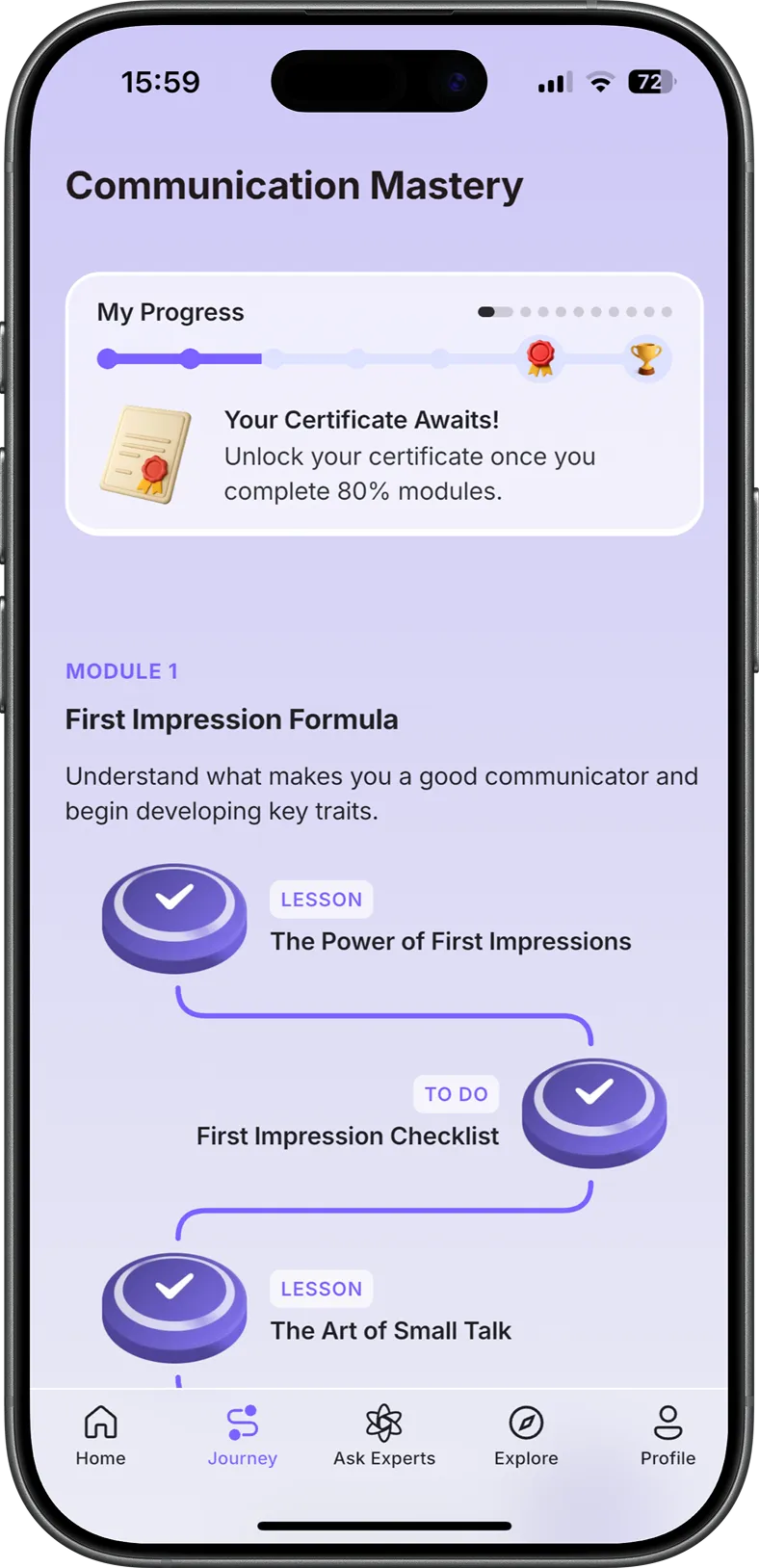
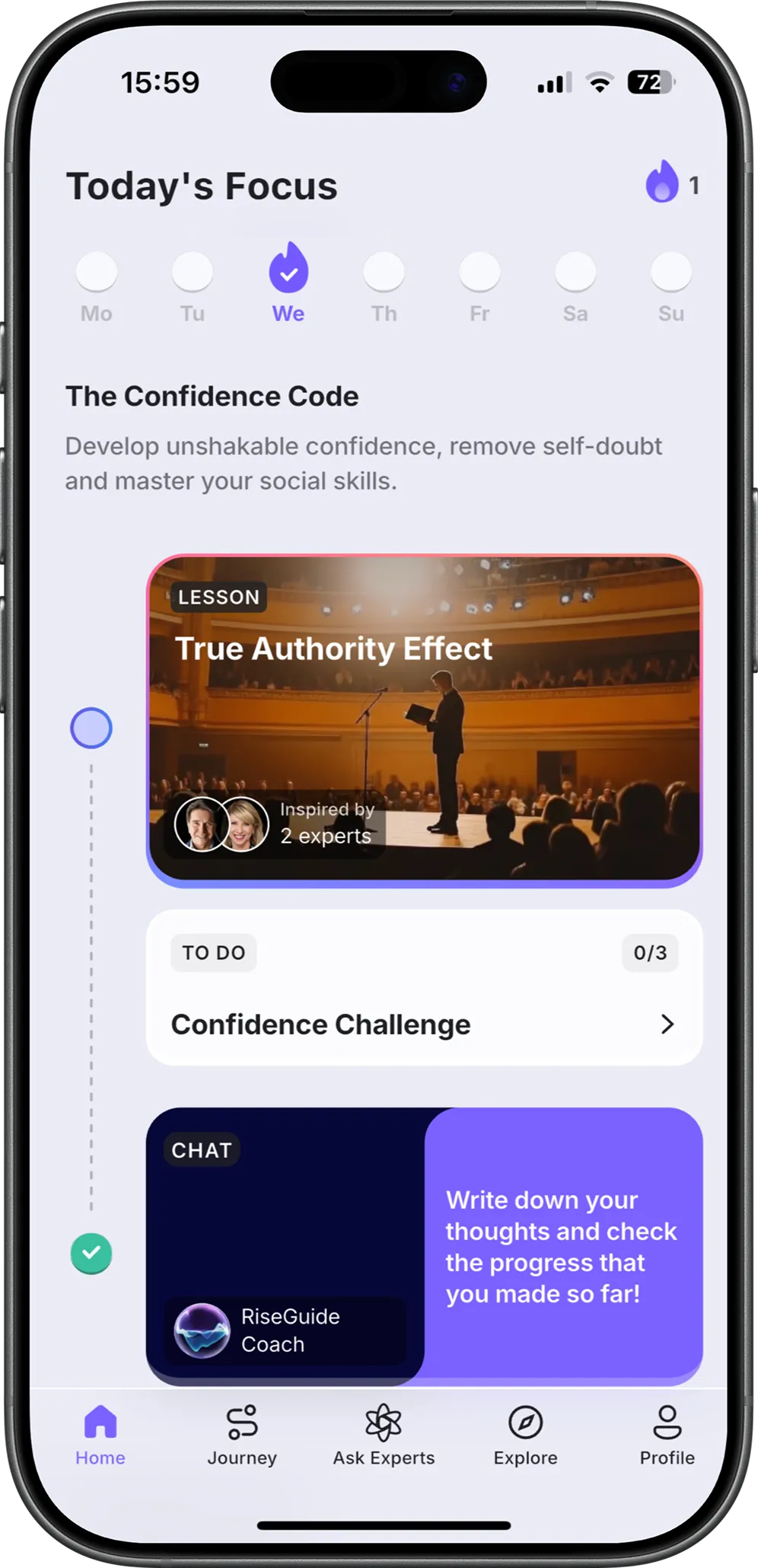
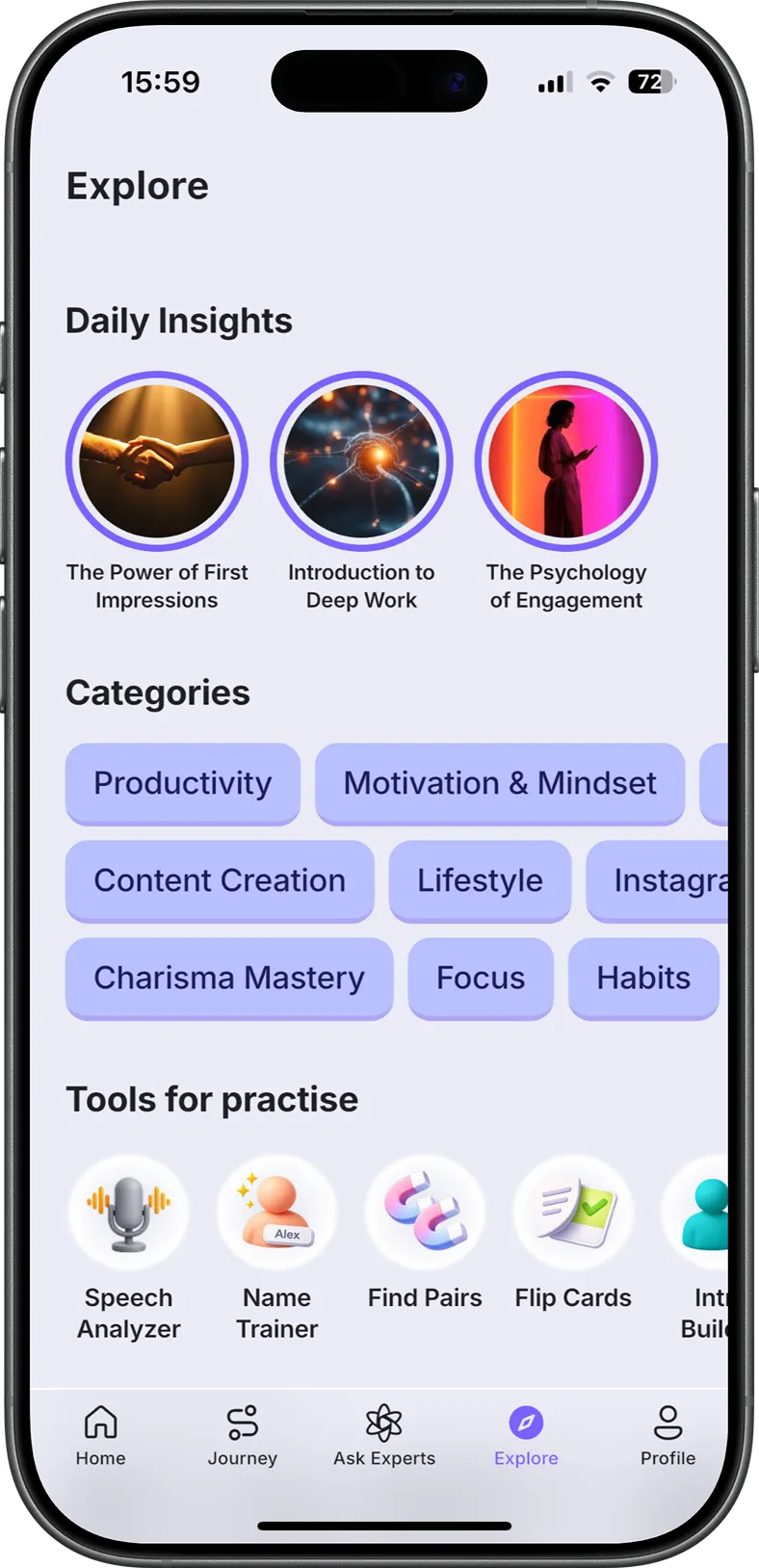
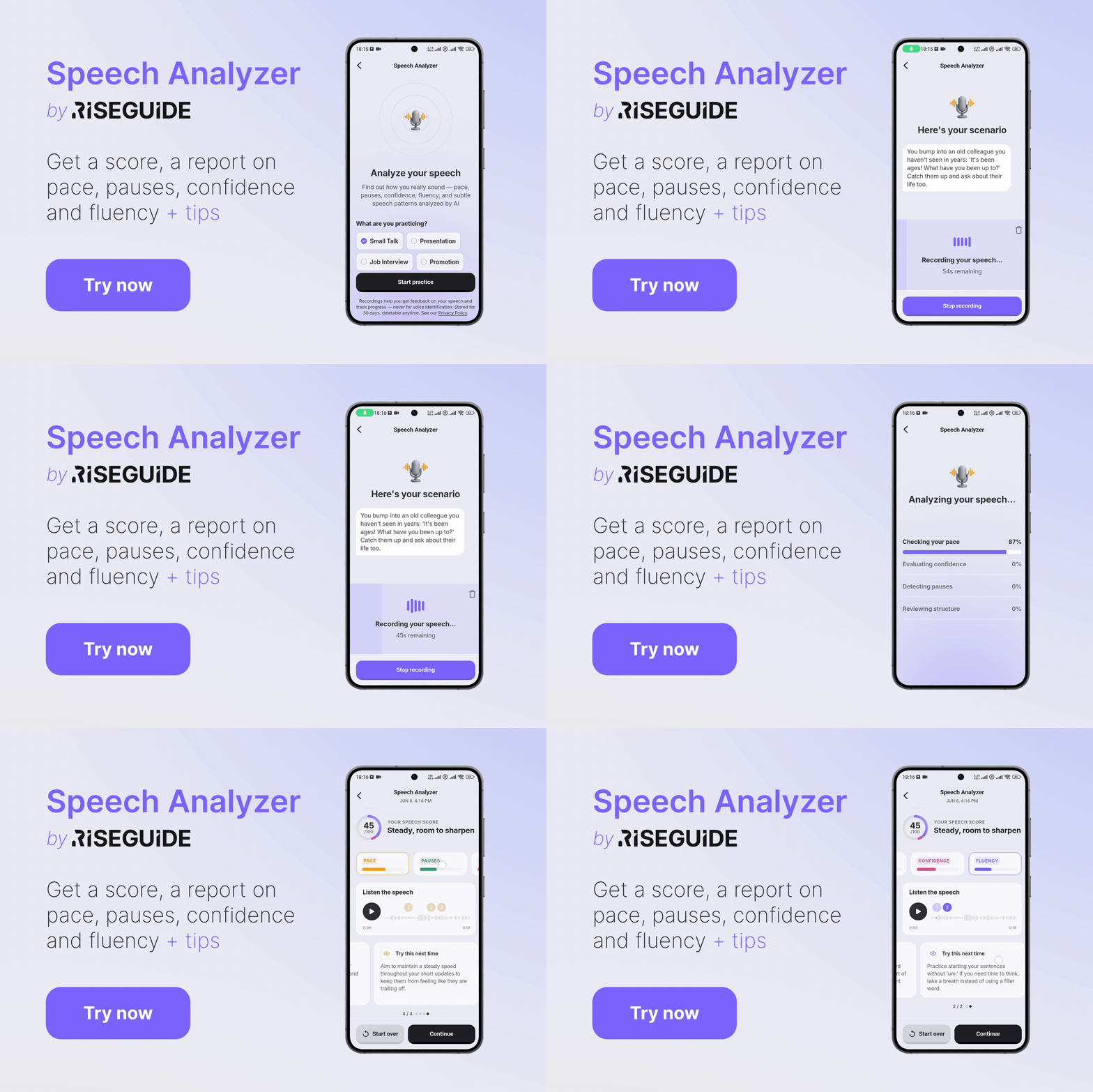
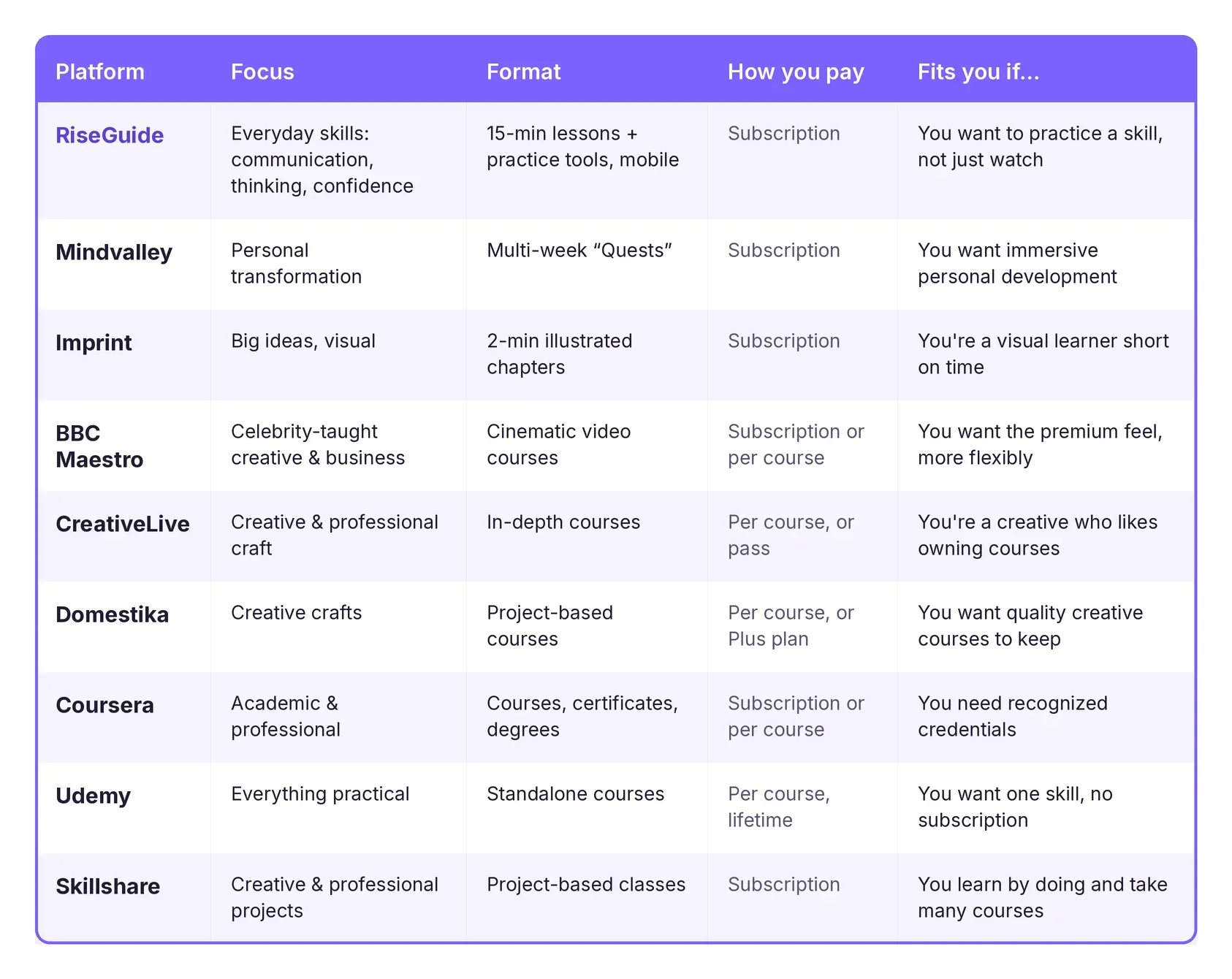
RiseGuide is a microlearning app with short, interactive lessons based on insights from top experts and thinkers. The lessons cover the everyday skills people most want to build, like communication, clearer thinking, confidence, and productivity. What sets it apart is that it's built for practice, not just consumption. Where most platforms hand you theory and leave the "now what?" up to you, RiseGuide pairs the ideas in each lesson with tools to actually rehearse the skill - for example, a Speech Analyzer that gives feedback on how you speak, a Small Talk Simulator to practice conversations, a Name Trainer for remembering people's names, and others. There's also SEEK, a search tool that answers your questions from a closed library of verified expert sources and cites the originals, so you're not sifting through generic advice. It's a subscription-based service.
That focus on doing rather than watching is the core difference. Lessons run about 15 minutes and give you the insight and a bit of theory, then a way to turn it into a repeatable skill - which is what makes RiseGuide fit people who found Masterclass inspiring but hard to translate into daily habits. If your main goal is a formal certificate or a deep technical curriculum, you'll likely prefer one of the broad course platforms further down this list. For a closer look at how it compares to similar tools, our roundup of the best microlearning apps goes deeper.
Mindvalley focuses on personal transformation - mindset, health, relationships, and productivity - taught through "Quests," which are multi-week programs of short daily sessions led by well-known coaches like Jim Kwik and Vishen Lakhiani. It pairs that structure with meditations and an active global community, so the experience is as much about ongoing motivation as individual lessons. Access is a subscription that unlocks the full library.
Mindvalley fits people who want a guided, immersive personal-development experience over several weeks. If you're mainly after quick, practical skills or a lighter commitment, a simpler app or a pay-per-course platform will suit you better.
Imprint teaches big ideas visually. It turns concepts from psychology, business, and science into animated illustrations, short text, and quick knowledge checks, with two-minute chapters you can finish while you wait in line. It runs on a subscription that opens up the whole library.
Imprint fits visual learners who want to absorb ideas in very small, attractive pieces. If you learn best by doing rather than reading, or you want to build a specific skill through repeated practice, an interactive app or a hands-on course platform is the stronger match.
If you liked the Masterclass experience - high production, taught by genuine experts - but want a different roster or the option to buy a single course, these come closest. They center on rich, well-made courses, often in creative fields.
BBC Maestro is the closest thing to Masterclass in spirit: polished, cinematic courses taught by notable figures across writing, cooking, music, business, and film. Its key difference is flexibility in how you pay - you can take an all-access annual pass, or buy a single course outright and keep it.
BBC Maestro fits people who want the premium, big-name experience but prefer the option to pay for one course rather than commit to a full subscription. If you want a huge library spanning every subject, a broader platform will give you more range.
CreativeLive specializes in creative and professional skills - photography, design, music production, and entrepreneurship - taught by working professionals. Courses are bought individually, with a subscription pass available if you'd rather have ongoing access to the catalog.
CreativeLive fits creative professionals who want in-depth, craft-focused courses and like owning them one at a time. If you're looking for personal-development or academic subjects, you'll find a better fit elsewhere on this list.
Domestika is a creative course platform known for beautifully produced classes in illustration, design, crafts, and photography, with a large international community. Courses are typically bought individually, and a Plus subscription adds monthly course credits and library discounts on top.
Domestika fits hobbyists and creatives who want high-quality, project-based courses to keep. If your goals are professional credentials or non-creative subjects, a broader platform will serve you better.
If your reason for leaving is subject range or credentials - you want to learn almost anything, or earn a certificate that carries weight - these platforms are built for that. Between them they cover academic, technical, creative, and professional skills, and they show the two pricing models clearly.
Coursera partners with universities and companies to offer courses, professional certificates, and even full degrees. Its standout feature is accreditation: many of its certificates are recognized by employers. It runs mostly on a subscription, with individual courses and longer degree programs also available.
Coursera fits people who want credentials that count professionally or academically. If you just want to explore a topic casually or learn a creative craft, its formal, university-style structure may be more than you need.
Udemy is a vast open marketplace with courses on nearly every practical topic, from spreadsheets to guitar. You buy courses one at a time and keep them for life, with no subscription. Because anyone can teach, quality varies, so ratings and previews help you choose well.
Udemy fits people who want a specific, practical skill without any recurring cost. If you want a curated, consistently premium experience, a subscription platform with vetted instructors will feel more polished.
Skillshare is a subscription platform built around project-based creative and professional classes, where you learn by making something rather than only watching. A single membership unlocks the whole library.
Skillshare fits people who want to learn creative skills by doing and expect to take many courses over time. If you'd rather pay once for a single course, or you need accredited certificates, another option here is the better match.
Across all of these platforms, the difference that tends to matter most over time is the one between watching and doing. A well-made course can teach you a great deal, and the ideas are more likely to stay with you once you get to put them into practice rather than only hear them explained.
There's no single winner among these options. The microlearning apps, the premium course platforms, and the broad libraries each do something different well, so the one that earns your time is simply the one whose format and pace fit how you like to learn.
The companies like masterclass that come closest in style are BBC Maestro and CreativeLive, since both offer polished, expert-taught courses. For a different but popular approach, personal-growth apps such as RiseGuide and Mindvalley deliver expert insight in a shorter, more interactive format.
Masterclass is worth it if you value cinematic, celebrity-taught courses and will watch enough to justify the annual subscription. If you found yourself wanting shorter lessons, more practice, or a certificate, one of the masterclass alternatives above will likely fit you better — which is exactly why identifying your reason first matters.