RiseGuide Team
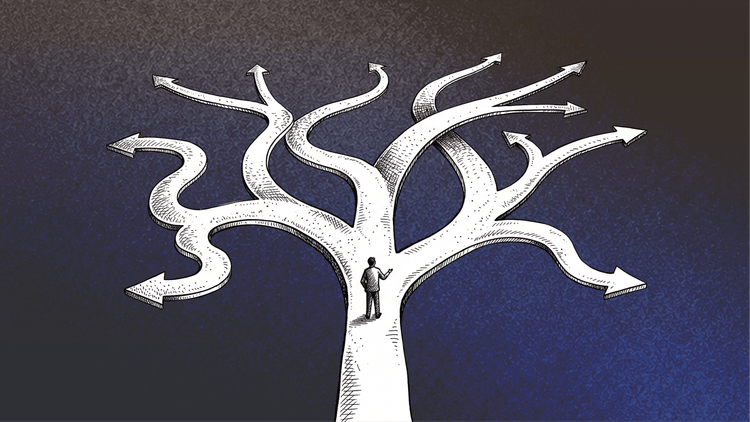
To boost divergent thinking, hold off on judging ideas while you generate them, aim for a high number of options before you narrow down, use prompts like naming every possible use for an everyday object, combine ideas that do not usually go together, and change the constraints of the problem to force fresh angles. Divergent thinking is the ability to come up with many different ideas or answers to an open question. It is the creative, idea-generating side of thinking, and it works best paired with convergent thinking, which picks the best option. Anyone can strengthen it with practice.
When you brainstorm ten ways to spend a free weekend, or think of five different ways to word a message, you are using divergent thinking. It is the part of your mind that opens a question up and generates possibilities, rather than closing in on a single right answer. Here is what divergent thinking is, how it differs from its partner convergent thinking, and simple ways to get better at it.
Any mention of ADHD, autism, or other conditions in this article is for general and educational information only. It is not medical or mental health advice, and nothing here is a diagnosis. If these patterns affect your daily life, consider speaking with a qualified professional.
Divergent thinking is the ability to generate many possible ideas, solutions, or answers to a question that has no single correct response. Ask yourself how many uses you can think of for a brick, and the flow of different answers is divergent thinking at work.
The divergent thinking psychology definition comes from the study of creativity. Psychologist J.P. Guilford, who built one of the first tests for it in 1967, described this kind of thinking as branching outward to explore many directions at once. So if you have ever wondered what is divergent thinking in plain terms, it is simply your mind producing lots of options instead of settling on the first one. People who score high in openness, one of the big five personality traits, often find it comes easily, though anyone can build the skill.
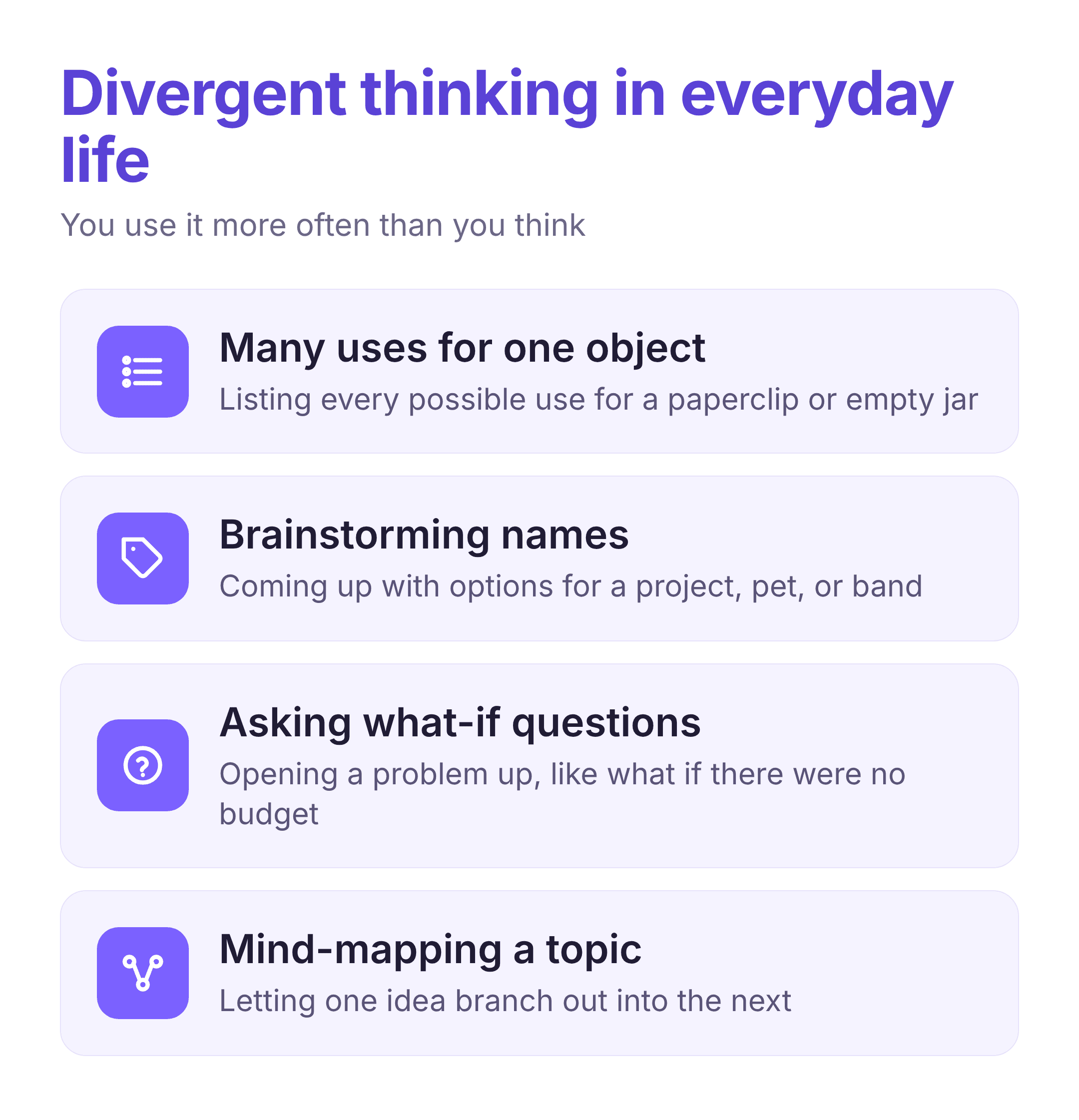
A few everyday divergent thinking examples show how often you already use it:
What these have in common is quantity and range. You are not looking for the answer, you are producing many of them and staying open to unusual ones.
Divergent thinking has a partner called convergent thinking, and good thinking uses both. Convergent thinking is the opposite move: taking many options and narrowing them down to the single best answer. Where divergent thinking opens a question up, convergent thinking closes it down.
| Divergent thinking | Convergent thinking | |
|---|---|---|
| Goal | Generate many possible ideas | Narrow down to the best answer |
| Direction | Opens options up | Closes options down |
| Best for | Brainstorming, creativity, exploring | Decisions, testing, problem-solving |
| Mindset | Playful, holding off on judgment | Focused, evaluating each option |
Most real thinking moves between the two. You open a problem up with divergent thinking to get a wide set of ideas, then switch to convergent thinking to choose and refine. The common mistake is doing both at once, judging each idea the moment it appears, which shuts down the flow before you have enough to work with. Noticing which mode you are in, a skill called metacognition, helps you keep them separate.
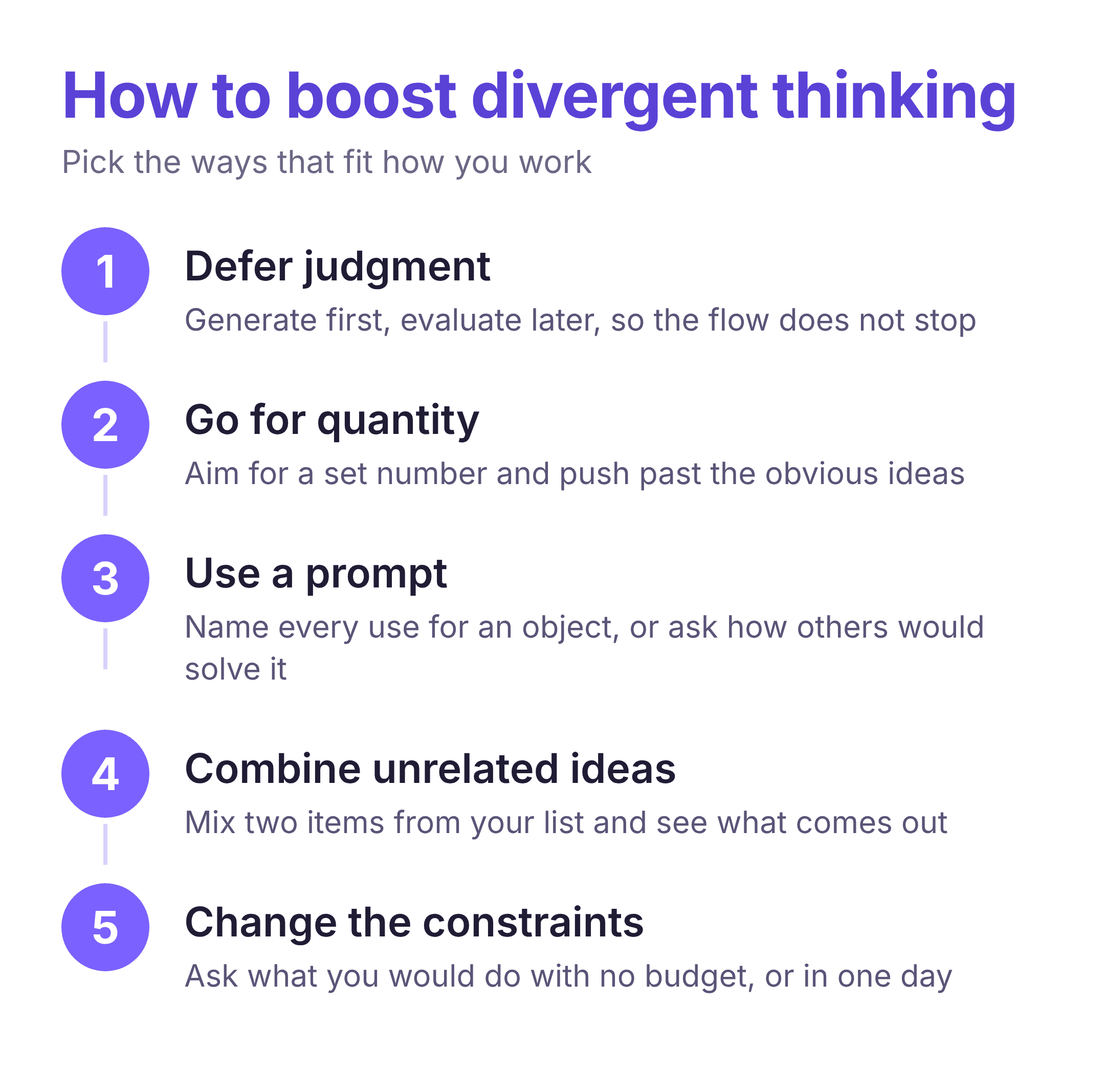
Divergent thinking is a skill, and like any skill it grows with practice. These are ways to build it, not strict steps, so pick the ones that fit how you work.
Defer judgment while you generate. Give yourself a stretch of time where no idea is too silly to write down. Judging and generating at the same time is what kills most brainstorms, so keep them apart.
Go for quantity first. Set a target number, like twenty ideas, and push past the obvious ones. The early answers are usually the predictable ones, and the interesting options tend to show up later.
Use a prompt to loosen up. Pick an everyday object and name every possible use for it, or ask how a child, an artist, and an engineer would each solve your problem. Prompts like these pull you out of your default track.
Combine ideas that do not usually go together. Creativity often comes from joining two unrelated things, so take two items from your list and ask what a mix of them would look like.
Change the constraints. Ask what you would do with no budget, then with almost none, then in a single day. Shifting the limits forces new angles and breaks you out of a fixed view. Working through structured exercises like these regularly is what builds the habit, and short daily sessions in an apps like RiseGuide can give you a steady way to practice thinking skills.
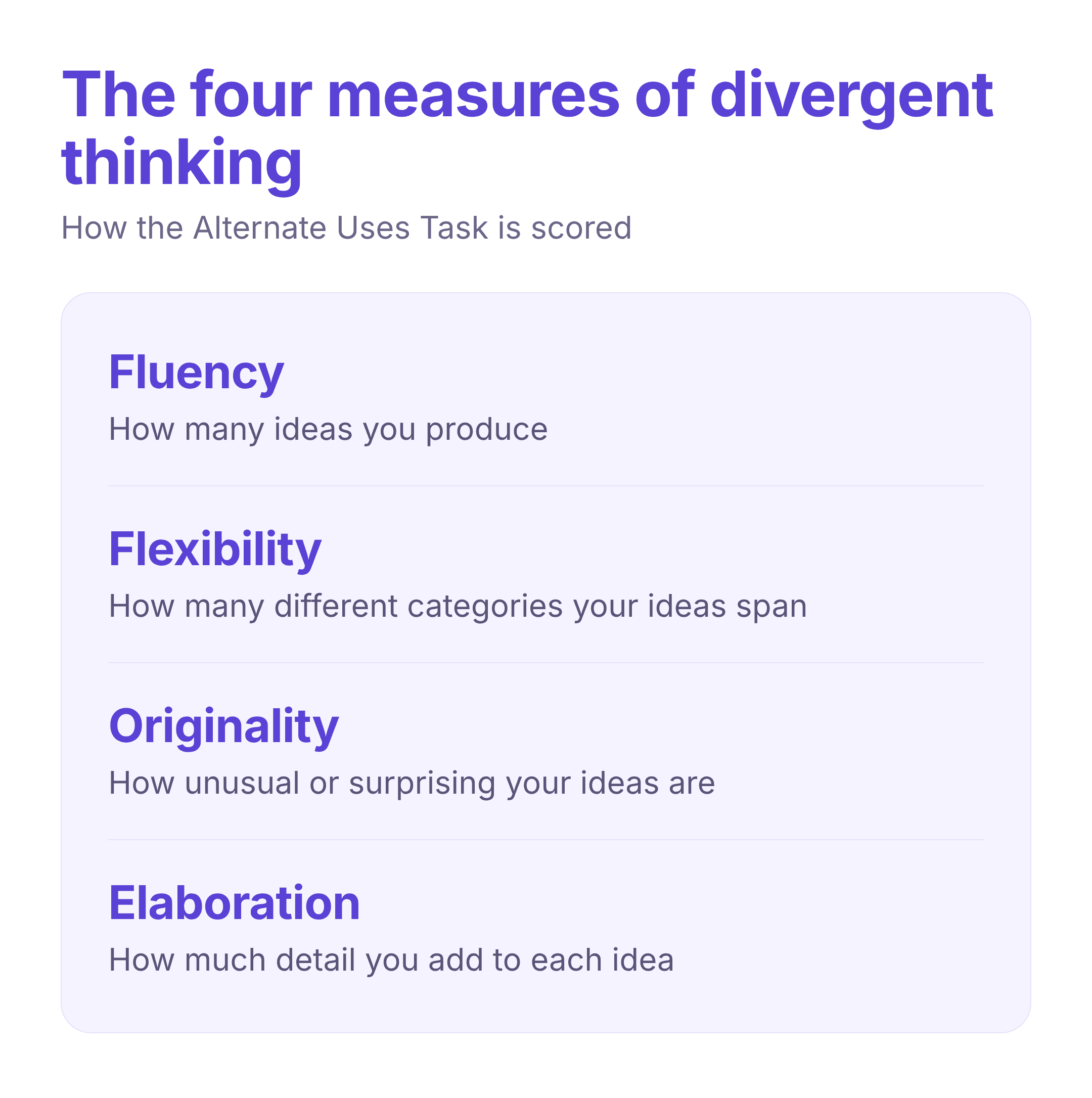
The best-known divergent thinking test is the Alternate Uses Task, created by Guilford in 1967. You take one everyday object, such as a plank of wood, and list as many different uses for it as you can within a time limit. It is a simple way to see your idea flow in action, and you can try it on yourself in two minutes.
Responses are usually scored on four measures: fluency, how many ideas you produce; flexibility, how many different categories they span; originality, how unusual they are; and elaboration, how much detail you add. Together they give a fuller picture than a single score, and they also show what to aim for when you practice: more ideas, more variety, more surprise, and more depth.
Divergent thinking is the open, idea-generating side of how you think, and it pairs with convergent thinking to turn a wide set of options into a good choice. You can build it by separating generating from judging, aiming for quantity, and using prompts that pull you off your usual track. The more you practice opening a question up before you narrow it down, the easier fresh ideas become.
Listing many uses for an object, brainstorming names, finding several ways to solve one problem, asking what-if questions, and mind-mapping a topic are all divergent thinking. The common thread is producing many options instead of one.
Divergent thinking is a way of thinking, not a diagnosis. Some people with ADHD feel their minds naturally jump between ideas, which can help with idea generation, but divergent thinking is a skill anyone can build with practice, with or without ADHD.
No. Neurodivergent describes brains that work differently from what is typical, such as ADHD or autism. Divergent thinking is a specific thinking skill. The words look alike, but they mean different things.
Divergent thinking generates many possible ideas and opens a question up. Convergent thinking narrows those ideas down to the single best answer. Strong thinking uses both, one after the other rather than at the same time.