RiseGuide Team

To use metacognition, you step back and watch how your own mind is working, then adjust it. It has two parts: knowing how you think and learn (your strengths, what a task needs, which strategies work) and steering that thinking as you go. In practice it runs as a loop: plan before you start, monitor whether your approach is working while you do it, and evaluate the result so you do better next time. You build it with simple habits like asking "do I actually understand this, or does it just feel familiar?", predicting your performance and checking the prediction, and testing yourself instead of rereading. It's one of the most reliable ways to learn faster, because it fixes the thing most people get wrong: assuming they understand something when they don't.
You think all day without ever watching how you think. You reach conclusions, trust a gut feeling, decide you've "got it" and move on, mostly on autopilot. Metacognition is the skill of stepping outside that process and looking at it: noticing how you reached a conclusion, whether your current approach is actually working, and whether a different one would work better. It's often described as "thinking about your thinking," and while that sounds abstract, it turns into very concrete habits, especially when you're trying to learn something. This guide explains what metacognition is, what it looks like in everyday life, and how to build it so it actually changes how you study and solve problems.
Metacognition is awareness and control of your own thinking. The psychologist John Flavell, who introduced the term in the 1970s, described it as "knowledge concerning one's own cognitive processes" and the ability to monitor and regulate them. In plainer words: it's the part of your mind that watches the rest of your mind at work.
It helps to split it into two layers. The first is thinking itself: reading a page, solving a problem, recalling a fact. The second, sitting above that, is metacognitive awareness: noticing "I read that whole page and don't remember any of it," or "I'm guessing here, I don't actually know this." That second layer is where metacognition lives. Everyone has some of it, but most people rarely use it on purpose, which is why they study for hours and still feel unprepared, or feel sure about a decision that later looks obviously wrong.
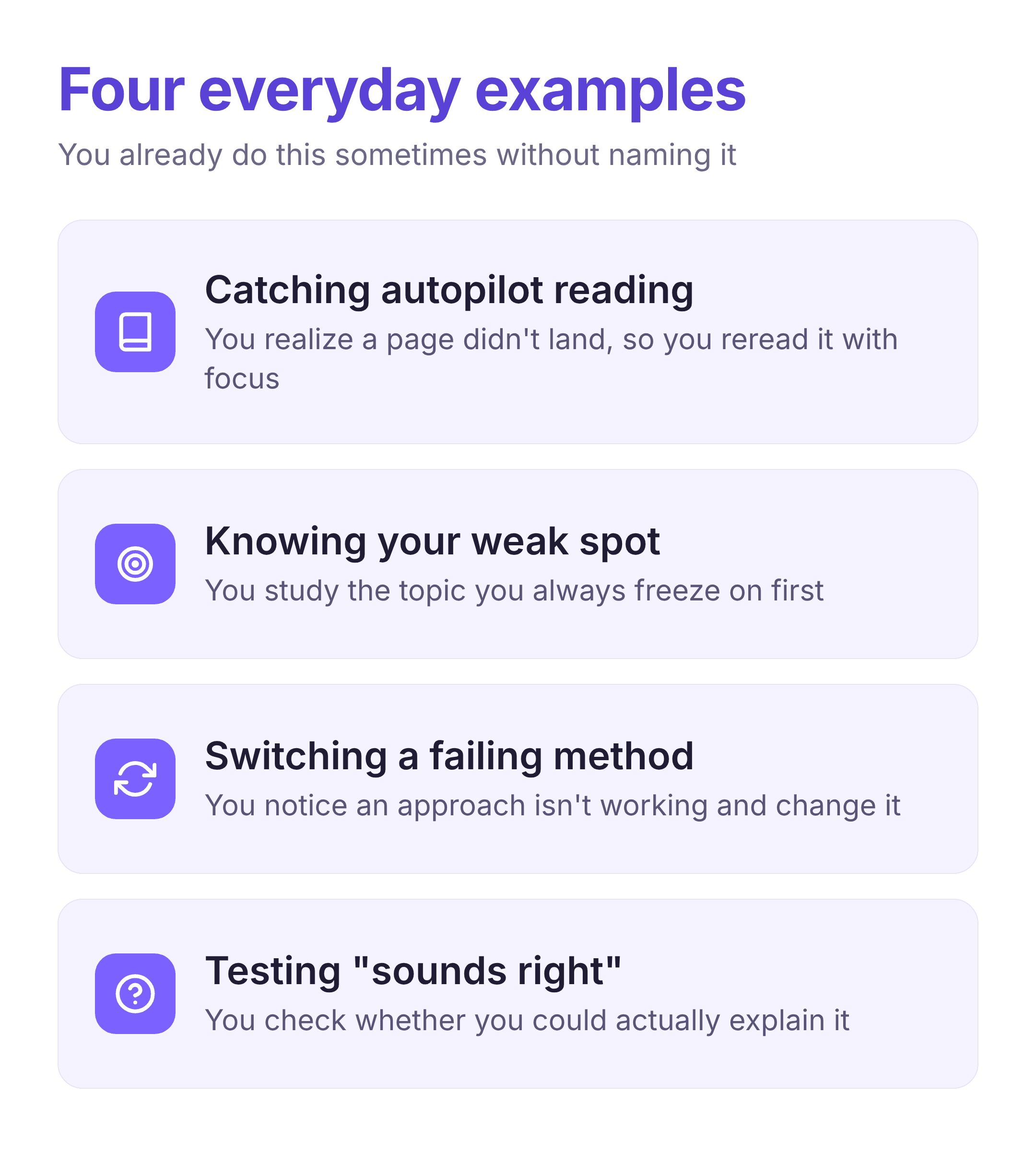
The clearest way to understand metacognition is through everyday examples, because you already do it sometimes without naming it.
Notice that none of these are about being smart in the moment. They're about checking your own thinking rather than trusting it blindly.
Researchers usually break metacognition into two pieces, and both are worth building.
The first is metacognitive knowledge: what you know about yourself as a thinker and learner. That includes knowing your own tendencies (you lose focus after 40 minutes), knowing what a task really demands (this chapter needs active recall, not just reading), and knowing which strategies work for which jobs (flashcards for vocabulary, worked examples for math). The more accurate this self-knowledge is, the better your choices.
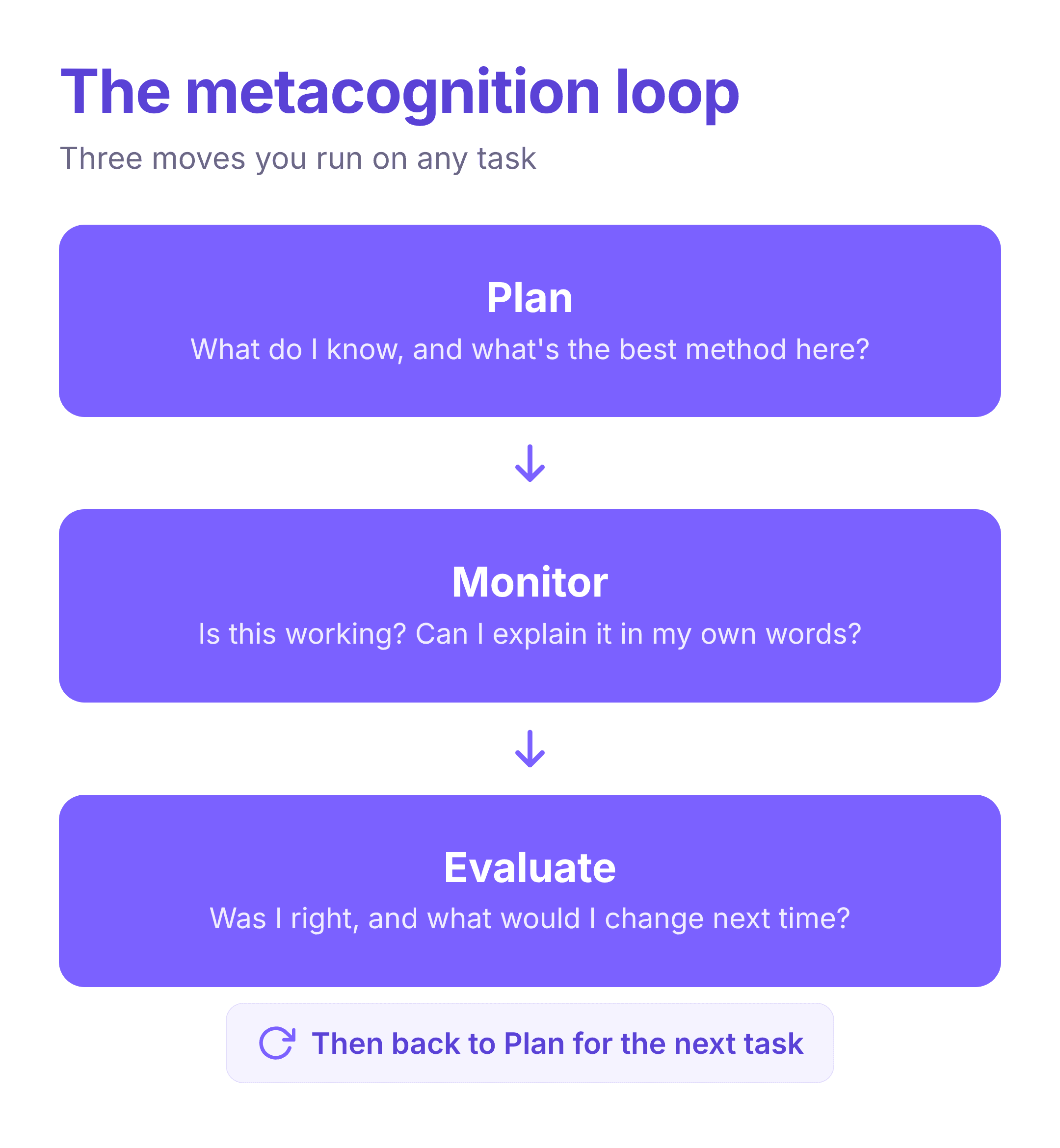
The second is metacognitive regulation, the active skills you use while working. These metacognitive skills run as a loop with three moves: plan, monitor, and evaluate. You plan by deciding how you'll approach a task before diving in. You monitor by checking, mid-task, whether it's working. You evaluate afterward by asking what went well and what you'd change. Knowledge tells you what you're like; regulation is what you do about it in real time.
Metacognitive strategies are the concrete habits that turn this from an idea into a skill. They map onto the plan-monitor-evaluate loop, and you can use them on anything from studying for an exam to learning an instrument.
Before you start (plan). Ask what you already know about the topic and what you're actually trying to achieve. Predict how hard it will be and roughly how long it should take. Choose a method on purpose instead of defaulting to rereading. Even one question, "what's the best way to learn this particular thing?", pulls you out of autopilot.
While you work (monitor). Pause and ask, "do I understand this, or does it just feel familiar?" Familiarity is the trap: rereading and highlighting make material feel known without making it known, which is why our team's guide to studying effectively pushes self-testing instead. Try to explain the idea in your own words, out loud or on paper. If you can't, that's useful information, not a failure.
After you finish (evaluate). Check your prediction against what happened. Did you understand as much as you expected? Where did you go wrong, and was it the content or your approach? This is where a lot of learning actually happens, because it tells you what to change next time. Pairing this with our posts on spaced repetition and steady study habits is what turns a one-off insight into a routine.
A simple version of the whole loop: predict, do, check. Predict how you'll perform, do the work, then check whether your prediction was right. Over time your predictions get more accurate, which is really what "knowing yourself as a learner" means.
Metacognition matters most when you're learning, which is why it shows up so often in education. Students who plan, monitor, and evaluate their own learning outperform students who just put in hours, because they catch misunderstandings early and spend their time on what they haven't learned yet. The UK's Education Endowment Foundation, reviewing hundreds of studies, found that teaching metacognition and self-regulation is one of the most cost-effective ways to help students learn, worth roughly seven months of extra progress across a year for very low cost.
The practical takeaway for metacognition in education is that it's trainable. You're not born with a fixed amount of it. The habits above (predicting, self-testing, explaining in your own words, reviewing what went wrong) are the training. Do them often enough and the self-watching starts to happen on its own.
Metacognition is awareness turned on your own thinking: the ability to watch it, question it, and adjust it instead of trusting it by default. It's two things working together, knowing how you think and steering it as you go, and it runs on a simple loop of plan, monitor, and evaluate. The reason it's worth building is practical, not philosophical. The moment you can tell the difference between understanding something and only recognizing it, you stop wasting effort and start learning for real.
Realizing partway through reading that you haven't absorbed anything and going back to reread with focus is a simple example of metacognition. So is knowing which exam topic you always freeze on and studying it first, or asking whether you could actually explain an idea rather than assuming you understand it.
Not exactly. Strong metacognition tends to go with good thinking, but it's a skill you can build rather than a fixed trait, and it isn't the same as a high IQ. Plenty of capable people have weak metacognitive awareness and overestimate how much they understand, while people who deliberately check their own thinking often learn faster than raw ability alone would predict.
They overlap but aren't identical. Self-awareness is broad: understanding your emotions, values, and how you come across. Metacognition is narrower and focused on your thinking and learning specifically, how you reason, remember, and understand.
Build the plan-monitor-evaluate habits. Before a task, decide your approach and predict how it'll go. During it, check whether you actually understand or just feel like you do. Afterward, compare what happened to your prediction and adjust. Self-testing instead of rereading is the single fastest way to sharpen it.