RiseGuide Team
To use spaced repetition, you review what you want to remember at growing gaps of time instead of studying it all at once. You learn something, recall it after a day or two, then again after about a week, then a few weeks later, coming back each time just as you are about to forget it. Each review takes less effort than the last and pushes the material further into long-term memory, which is why spacing your study out works better than cramming for anything you need to keep. The simplest way to do it is with flashcards: write one question per card, try to recall the answer before you check, and see the cards you find hard more often than the ones you know well. Apps like Anki run this for you, so you only review each card on the day it is due.
You study something properly, feel like you know it, and a week later most of it is gone. The problem is usually timing. You can study hard and still lose most of what you learned if you never come back to it at the right moments. Memory fades on a fairly predictable schedule, and spaced repetition is the learning method built around that schedule. It comes from more than a hundred years of research on how we forget, and it works for exam material, a new language, medical terms, or anything else you need to hold onto. Here is what it is, why it works, and how to put it to use.
Spaced repetition is a study method where you review information at growing intervals over days and weeks, rather than all at once. You look at the material, revisit it after a short gap, then a longer one, then a longer one still. Each review comes just before you would have forgotten the material, so you are always pulling it back from the edge of memory rather than reading something you still know by heart.
The idea sits underneath a lot of study advice, so if you have ever wondered what is spaced repetition when a course or an app mentions it, that is the whole of it: the same review, spread out and timed to catch you right before you forget. It pairs naturally with active recall, which means testing yourself from memory instead of rereading, and the two together are the core of most evidence-based spaced repetition learning. Our post on how to learn anything faster shows how to combine them into a full routine.
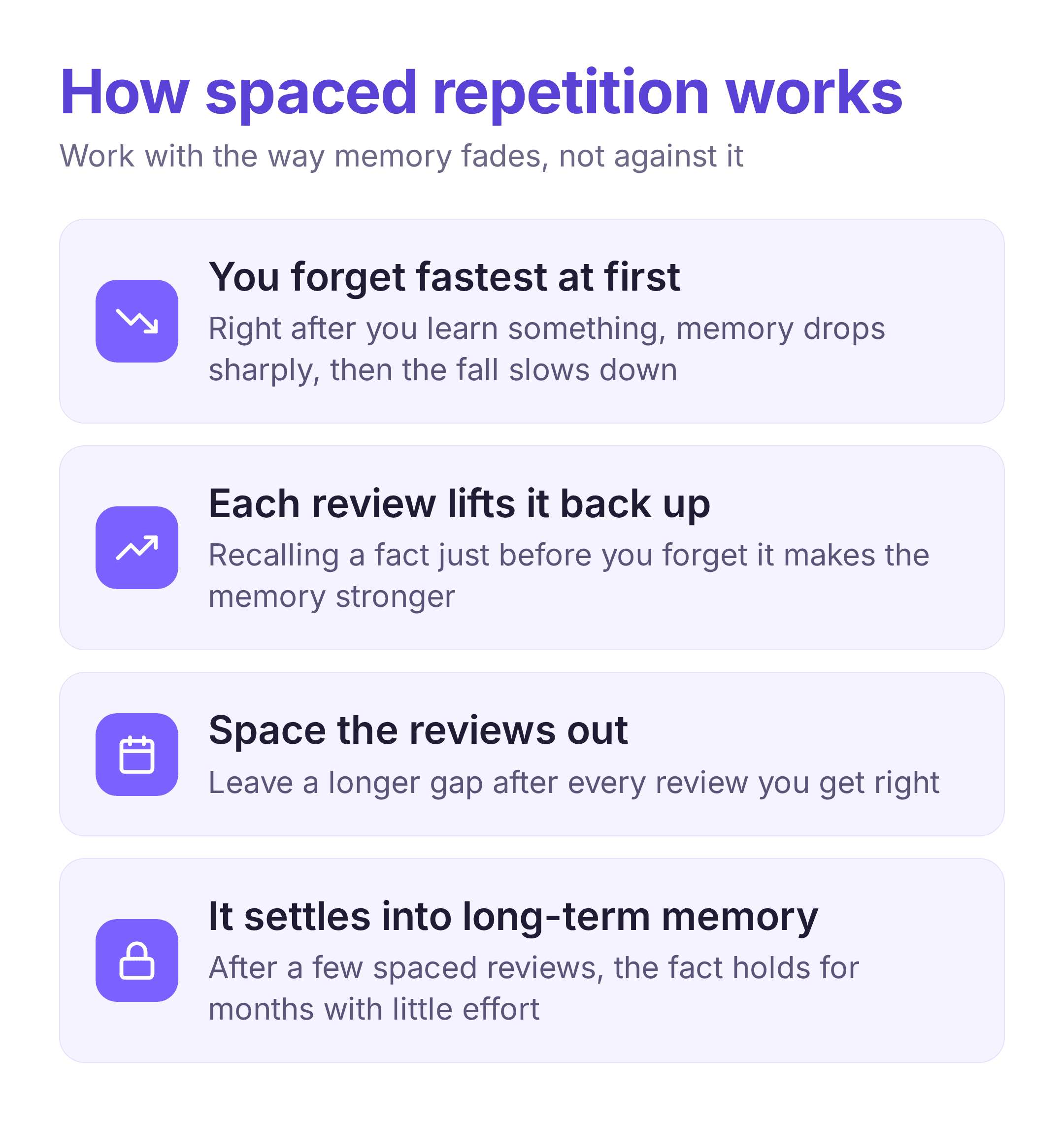
To see why the timing matters, it helps to know how forgetting works. In the 1880s the psychologist Hermann Ebbinghaus tested his own memory and mapped what became known as the forgetting curve, which is simply a graph of how much you remember as time passes. His finding was that memory of something new drops steeply in the first hours and days, then the decline slows down. Researchers replicated his curve in 2015 and saw the same steep early drop more than a century later.
Each time you review something, though, the curve resets a little higher and then falls more slowly. Review at the right moments and the material fades so gradually that it effectively stays put. Spreading the reviews out, rather than bunching them together, is what does this. A large review of 317 experiments found that spreading study across separate sessions produces better long-term memory than the same amount of study crammed into one, across almost every subject and age group.
Ebbinghaus noticed this himself. As he put it:
"With any considerable number of repetitions a suitable distribution of them over a space of time is decidedly more advantageous than the massing of them at a single time." — Hermann Ebbinghaus
Putting it into practice comes down to three things: deciding when to review, making each review an active test, and finding a way to keep the schedule without having to think about it. It is one of several study methods that work, and our post on study techniques covers the wider set if you want the whole toolkit.
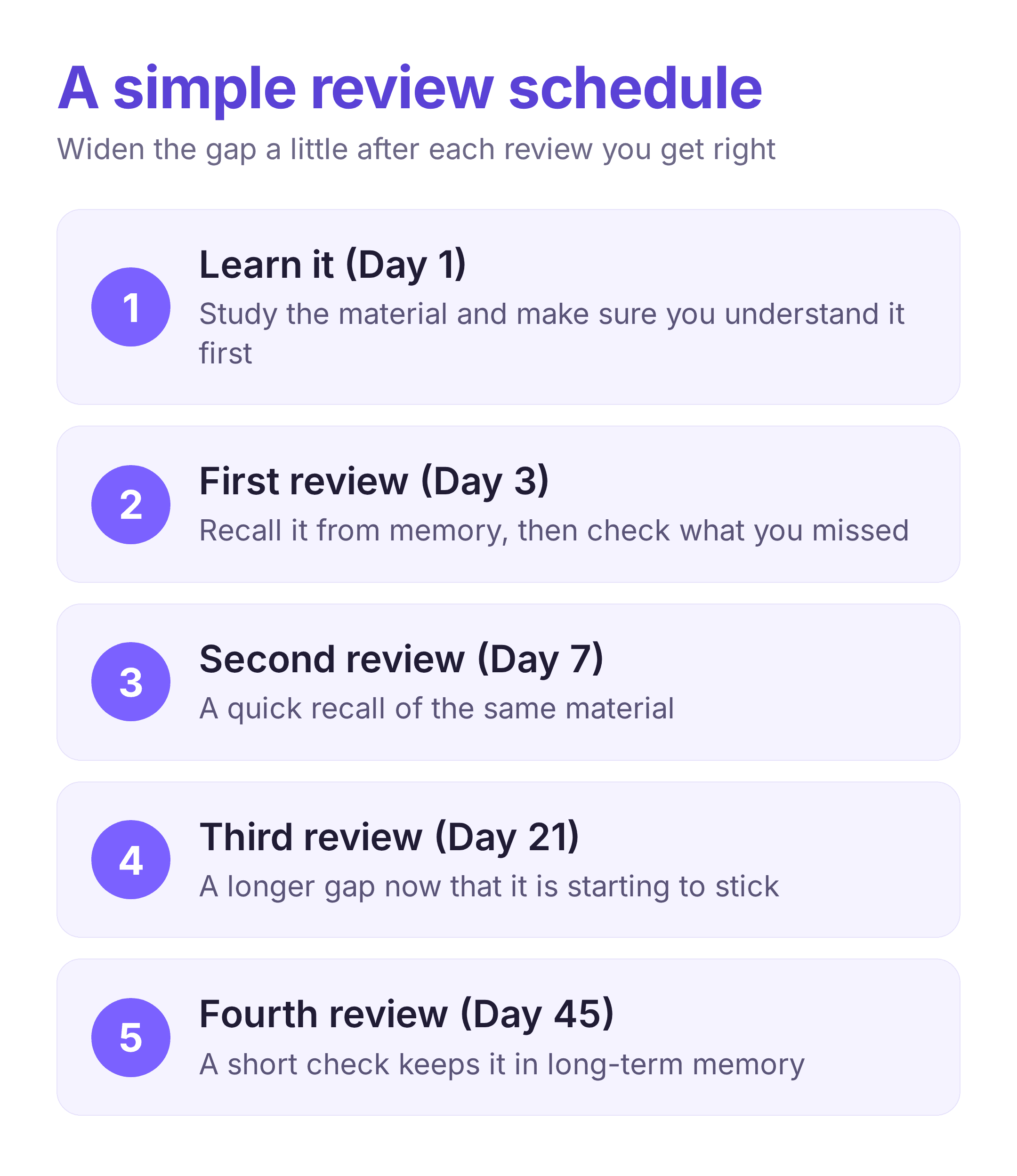
The exact gaps matter less than the pattern: each review should sit a little further from the last. A simple version is to learn something on day one, review it around day three, again about a week later, then after three weeks, then after a month or two. When a review feels easy, stretch the next gap; when you struggle, pull it in closer.
How far to space things depends on how long you need to remember them. In one study on the best spacing, the ideal gap before a test ten days away was about a day, while for material needed six months out the ideal gap was closer to a month. The rule of thumb that falls out of it: the further off you need the memory, the longer the gaps between reviews should be.
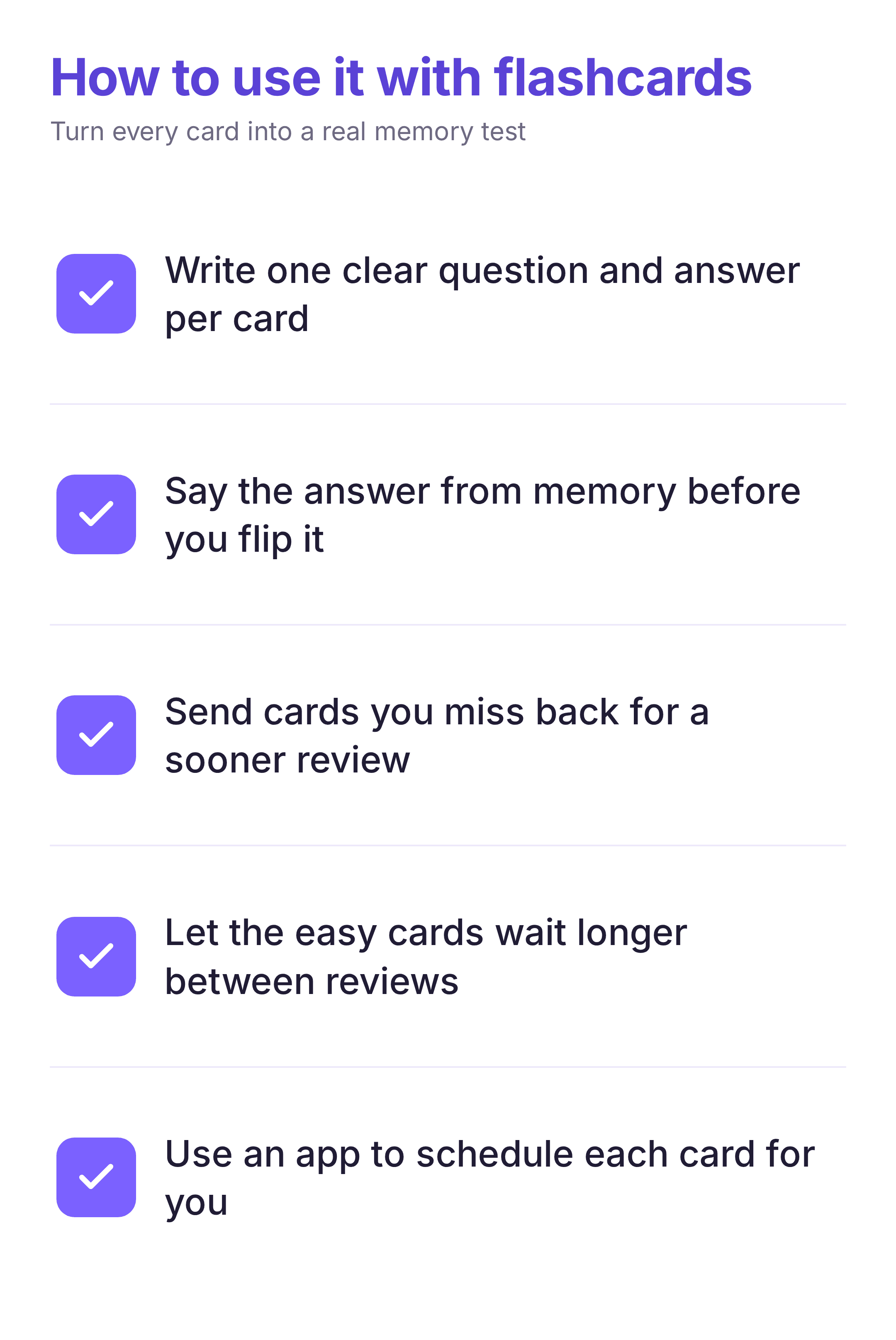
A review only helps if you are recalling the answer rather than just rereading it, which is why spaced repetition flashcards are the most common way people do this. Write a clear question on one side and a short answer on the other, then say or write the answer from memory before you flip the card. Getting one wrong and correcting it is part of how the memory forms, so a few misses are fine.
The classic paper version is the Leitner system: cards you get right move to a pile you review less often, and cards you miss go back to a pile you see sooner. That single rule turns a stack of cards into a rough spacing schedule you run by hand.
Tracking dozens of cards and their due dates by hand gets hard quickly, which is what a spaced repetition system does for you. Apps like Anki, and others built on the same model, show you each card on the day it calculates you are about to forget it, then adjust the next gap based on how easily you answered. You just work through the cards that are due each day. If you are weighing options, our roundup of study apps covers several of these and how they differ.
The most common mistake is reviewing too soon and too often. If a review feels easy every time, you are recognizing material you still know rather than recalling something you had nearly forgotten, and the small effort of recall is the part that builds memory. Let the gaps grow until each review takes a bit of work.
A second mistake is recognizing instead of recalling. Rereading a card and thinking "yes, I knew that" is not the same as producing the answer, so always answer before you check. The third is quitting when the reviews feel effortful. That effort is the method working as intended, and psychologists even have a name for this kind of useful difficulty, calling it a desirable difficulty. To go further on holding things in memory over the long run, our post on how to improve your memory is a good next read.
The method is not complicated to run: learn something, then review it a handful of times at growing gaps, testing yourself each time. Start with one set of flashcards for whatever you are learning now, space the reviews over the next few weeks, and let the ones you know well drift further apart. Consistency on the right days matters more than the length of any single session. If you would rather build the habit of learning a little every day, RiseGuide turns spare minutes into short, interactive lessons built on expert insights, led by its Communication Mastery journey with other skill journeys alongside it.
Learning 20 new French words is a good example. Instead of drilling all 20 for an hour today, you study them today, review them tomorrow, again in three days, then a week later, then two weeks after that. Each review is short, and by the last one most of the words are in long-term memory.
Cramming packs all your study into one long session close to the test. Spacing breaks the same material into short reviews spread over days or weeks. Cramming can get you through a test the next morning, but most of it fades within days, while spaced study holds for the long term.
Start with a review a day or two after you first learn something, then widen the gap each time you get it right: a few days, then a week or two, then a month. If you keep missing something, review it sooner. Apps handle this timing for you.
It works best for material made of facts and connections you need to recall: vocabulary, definitions, formulas, names, dates, anatomy. For skills that are mostly practice, like an instrument or problem-solving, spacing your practice sessions helps too, though the "card" is a practice set rather than a single fact.