RiseGuide Team

To replace Quizlet, start by naming why you're leaving, then pick the study app built for that reason. For a free, familiar flashcard flow, Knowt is the closest swap and can import your old Quizlet sets, with Cram and StudyStack as simpler options. For memory that sticks through active recall and spaced repetition, Anki, Brainscape, and RemNote are built for retention. For an all-in-one AI study tool, Vaia (formerly StudySmarter) builds materials from your documents and Memrise handles languages, while Kahoot! and Wayground (formerly Quizizz) cover live and classroom-style quizzing, and Formester lets you build your own quizzes and tests. The right one depends on whether you want the same flashcard flow back, stronger long-term retention, or a wider study tool, so match the app to that reason rather than to a star score.

Quizlet has been the default flashcard tool for a lot of students, and for plenty of people it still does the job. But when someone goes looking for apps like Quizlet, it's usually because one specific thing stopped working for them: the study modes they relied on, how the app runs on their phone, how much of what they memorize actually stays memorized, or the kind of studying they've moved on to. Different reasons point to different tools, so the most useful thing this post can do is help you figure out your reason first, then send you to the group of apps that solves it.
There's no single best replacement, because people leave Quizlet for different reasons. Before you pick a tool, it helps to name which of these sounds like you. Most searches for Quizlet alternatives trace back to one of five motives.
The first is running into limits on the study modes or content you were using. If the parts of Quizlet you leaned on for creating and reviewing sets have narrowed, a straightforward flashcard replacement that gives you those modes back is what you're after.
The second is performance and reliability. Searches like "why is Quizlet so laggy" and "is Quizlet down" show up constantly, and if the app feels slow or unavailable when you sit down to study, a lighter or more stable tool solves that on its own.
The third is retention. Quizlet is good at helping you recognize answers, but recognizing an answer in the app is not the same as recalling it in an exam. If you want information to hold for weeks rather than hours, you'll want a tool built around active recall and spaced repetition.
The fourth is keeping your notes and cards together. If you're tired of writing notes in one place and rebuilding them as flashcards in another, some newer tools connect the two, and several can import the Quizlet sets you already made.
The fifth is group or classroom review. If you study with other people, or you're a teacher running review sessions, you want live, game-style quizzing rather than a solo flashcard deck.
The eleven apps below are grouped by those jobs. Pick the group that matches your reason and you'll only have three or four options to weigh instead of eleven.
If Quizlet's core flashcard flow is what you want to keep, these three come closest. They're free to use, they'll feel familiar within a few minutes, and one of them can bring your old sets across so you don't start from scratch. This is the group most people mean when they search for a free Quizlet alternative.
Knowt is the nearest thing to a like-for-like swap. It makes flashcards, keeps notes, and generates practice tests, with AI that can turn your notes or a document into a set, and it can import your existing Quizlet decks so migration takes minutes. It runs on the web, iOS, and Android. It fits students who want that free, Quizlet-style flashcard rhythm with a bit of AI help and an easy move over. You'll likely prefer something else if you want a rigorous, algorithm-driven spaced-repetition system rather than standard review modes.
Cram keeps things simple: free flashcards, a few study and test modes, and a large public library of sets other people have already built. It works on the web, iOS, and Android. It fits anyone who wants a plain, no-frills flashcard site in the Quizlet mold without AI features getting in the way. You'll likely prefer something else if AI-generated cards or advanced review scheduling are the reason you're switching.
StudyStack has been around a long time and does one thing other tools don't: it takes a single set of cards and turns it into several games, including matching, crossword, and hangman, alongside the usual study modes. It's available on the web, Android, and iOS. It fits learners who remember better when they see the same material in a few different formats. You'll likely prefer something else if a modern, polished interface matters a lot to you, since its strength is variety rather than design.
Active recall means testing yourself from memory instead of rereading, and spaced repetition means reviewing at widening intervals so you revisit each fact right before you'd forget it. Together they're two of the most dependable ways to move information into long-term memory, which is why serious studiers build their whole routine around them — how to learn anything faster walks through the research. If retention is your reason for leaving Quizlet, start here.
Anki is the reference standard for spaced repetition. Its scheduling algorithm decides when you see each card, it's deeply customizable, and it has an enormous ecosystem of shared decks made by other learners. It runs on Windows, Mac, Linux, Android, iOS, and through AnkiWeb in the browser. It fits committed learners — medical, law, and language students especially — who want proven retention and full control over how their reviews work. You'll likely prefer something else if you want a polished, no-setup experience out of the box, because Anki has a real learning curve before it feels smooth.
Brainscape uses confidence-based repetition: you rate how well you knew each card from 1 to 5, and it spaces your next review accordingly. It pairs that with a large library of decks made by subject experts alongside ones you build yourself. It's on the web, iOS, and Android. It fits people studying for exams or certifications who want curated, ready-made decks plus review that adapts to what they find hard. You'll likely prefer something else if you mainly want to build large decks of your own from scratch or you're after game-style formats.
RemNote links notes and spaced-repetition flashcards in one workspace, so cards are generated from and connected to the notes you're already taking — think of it as a hybrid of a note tool and a spaced-repetition system. It works on the web, desktop, iOS, and Android. It fits students who want their flashcards tied directly to their own notes rather than kept in a separate app. You'll likely prefer something else if you just want a simple flashcard-only tool, since the connected-notes approach takes a little while to get used to.
This last group goes wider than flashcards. Some of these build entire study materials from your documents, one focuses on languages, two are made for live, group review, and one is for building your own quizzes. If your studying has outgrown a single deck of cards, look here.
Vaia, which used to be called StudySmarter, is an AI study app: you upload your notes and it generates flashcards, summaries, and practice exams, with spaced repetition and a shared library of study resources. It runs on the web, iOS, and Android. It fits university students who want their study materials built automatically from their own documents. You'll likely prefer something else if you'd rather make your cards by hand and keep control over exactly what goes on each one. Worth knowing both names, since older reviews still call it StudySmarter.
Memrise is built for vocabulary and language learning, with clips of native speakers using words in context, spaced repetition, and AI-powered speaking practice across more than 140 languages. It's on the web, iOS, and Android. It fits the very common case of someone who used Quizlet mainly for language vocab and wants a tool made for exactly that. You'll likely prefer something else if you study non-language subjects, since that's where its design is focused.
Kahoot! is best known for game-based quizzes with live multiplayer, and it also has self-paced modes and flashcards. It works on the web, iOS, and Android. It fits teachers and study groups who want fast, competitive review that a whole room can join at once. You'll likely prefer something else if you study alone and want deep, individual practice rather than a group game.
Wayground, which rebranded from Quizizz in late 2025, offers gamified, curriculum-aligned quizzes and self-paced study, with AI that can generate questions for you. It runs on the web, iOS, and Android. It fits classrooms and self-paced quizzing where students work through material at their own speed. You'll likely prefer something else if you want a personal flashcard deck rather than quiz-style questions. Searchers still call it Quizizz, so that's the name to look for in the app store.
Formester is an AI form and quiz builder rather than a flashcard deck, so it covers a different job: making the quizzes and tests other people take. You describe the topic and question types and it drafts the questions, adds answer checking, and scores responses for you, with conditional logic that changes what comes next based on an answer. It runs in the browser and has a free plan to start. It fits teachers, tutors, and study-group leaders who want to build their own quizzes and see how people did, rather than review a personal deck of cards. You'll likely prefer something else if you're studying solo and just want flashcards to memorize from, since that's not what it's built for.
Here's the whole list side by side, so you can scan by the job you need done rather than by name.
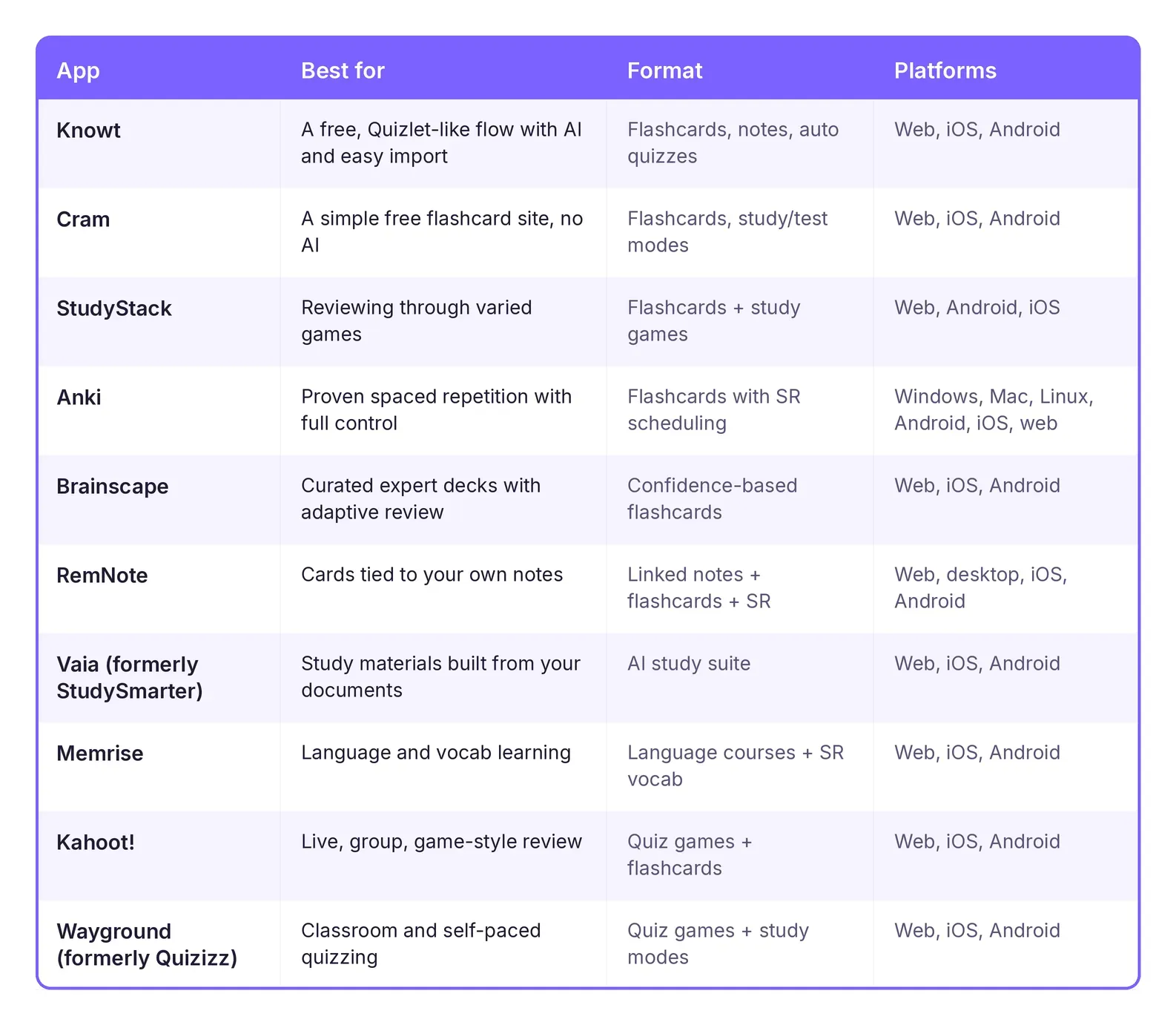
Go back to the reason you named at the top. If you wanted the familiar flashcard flow back, Knowt, Cram, or StudyStack will feel like home, and Knowt is the one to try first if you want to bring your old sets across. If retention is the problem, Anki, Brainscape, or RemNote are built for it, with Anki for full control, Brainscape for ready-made expert decks, and RemNote if you want cards connected to your notes. If you've outgrown plain flashcards, Vaia turns your documents into study material, Memrise handles languages, Kahoot! or Wayground cover group and classroom review, and Formester lets you build your own quizzes and tests.
One thing worth checking before you switch: whether you're trying to memorize facts for a test, or actually learn a skill. These apps are all made for the first job. If what you really want is to build something like communication, leadership, or better study habits, that's a different category — a microlearning app or a broader self-improvement app fits better.
Knowt, Cram, and StudyStack are the closest free options. Knowt gives you flashcards, notes, and AI-generated quizzes and can import your existing Quizlet sets; Cram is a simple free flashcard site with a big public library; and StudyStack turns your cards into study games. Anki is also free on most platforms if you want spaced repetition.
They're built for different habits. Quizlet is quick to set up and easy to review casually, while Anki is built around spaced repetition and is stronger for making information stick over weeks and months. If you're studying heavily for exams and want long-term retention, most people find Anki better; if you want speed and simplicity, Quizlet's flow is easier to start.
It depends on what you need. For fast, casual flashcard review it still works well. If you've hit limits on the study modes you used, want stronger retention, or want your notes and cards in one place, one of the alternatives to Quizlet above will likely serve you better. The right question is which specific thing you want that Quizlet isn't giving you.
Yes. Knowt generates flashcards and quizzes from your notes or documents, Vaia (formerly StudySmarter) builds flashcards, summaries, and practice exams from files you upload, and Wayground can generate quiz questions for you. Each pairs AI creation with its own study modes.
Knowt is the most direct option — it's designed to import existing Quizlet sets so you don't rebuild them. Several other tools let you paste or upload card lists to recreate a set, so if keeping your current material is important, that's worth checking on each app before you commit.