RiseGuide Team
To study effectively, the most useful change is to test yourself on the material instead of rereading it, and to spread your sessions out over several days rather than cramming. It also helps to mix related topics in a session, explain each idea in your own words, work in short focused blocks with your phone out of reach, plan your studying backward from the exam date, and get enough sleep for what you learned to settle. These are the methods with the most research behind them, and they tend to take less time than passive rereading, not more.
Most of us were never really taught how to study, so we fall back on rereading the textbook and highlighting a few lines, then feel caught out when little of it comes back during an exam. Researchers have spent decades comparing study methods to see which ones genuinely help people learn and remember, and the findings are consistent enough to be useful. A 2013 review led by psychologist John Dunlosky ranked ten common techniques, and the most effective ones turned out to be different from the ones most students rely on. For the most part, learning how to study effectively means gradually replacing a few passive habits with more active ones, and it usually saves time rather than adding to it.
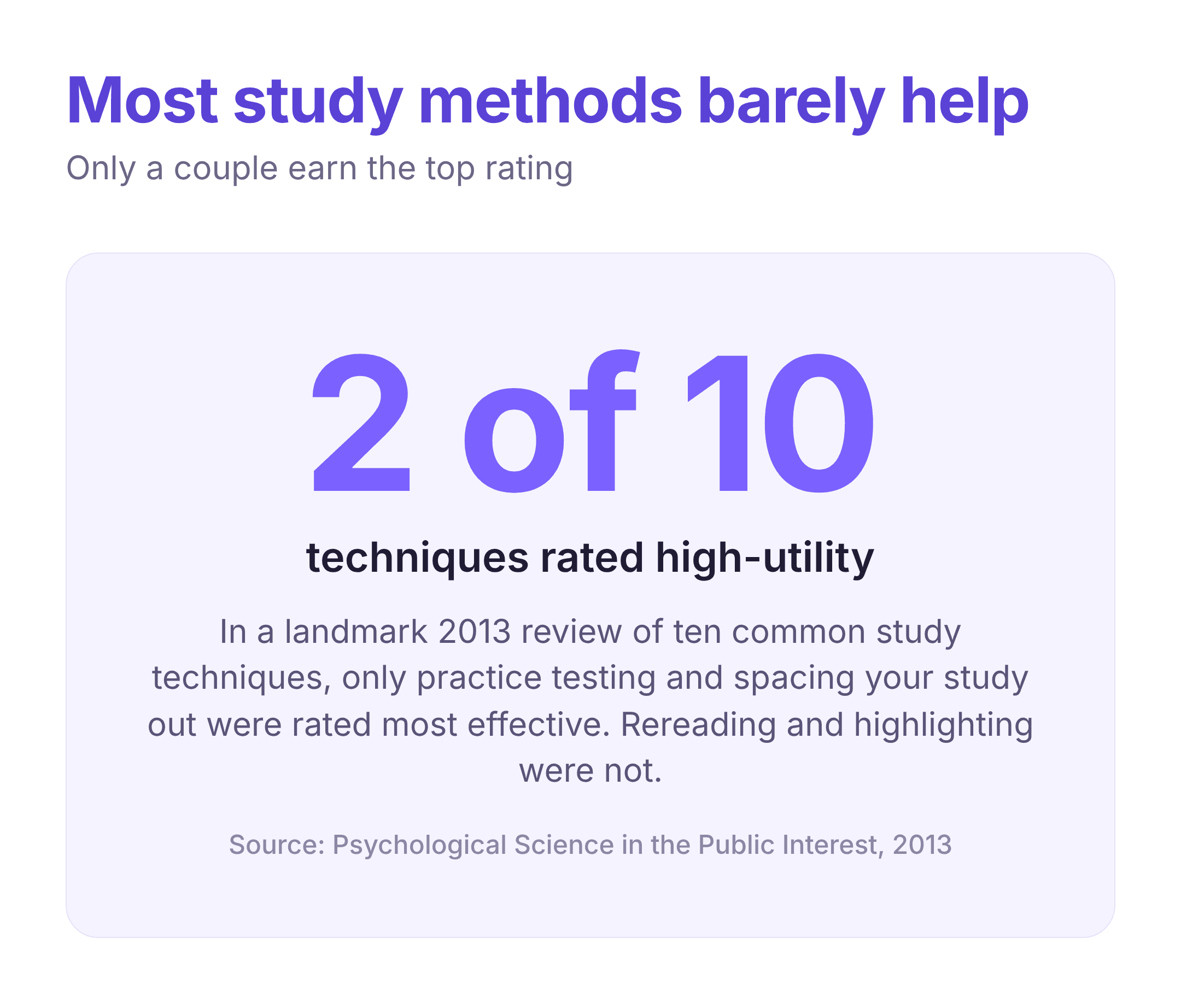
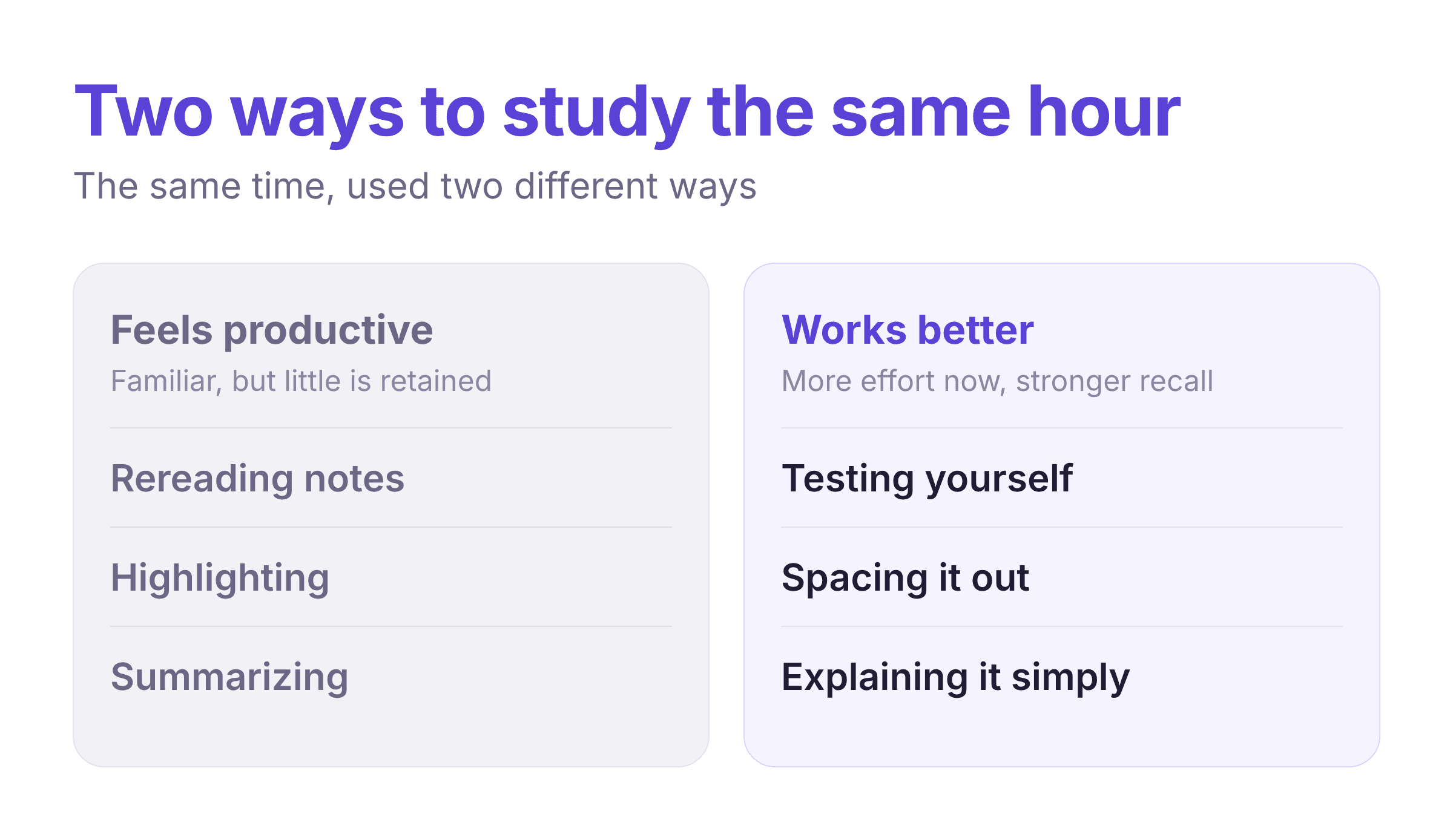
Rereading and highlighting are the most common ways people study, and they are also among the least effective. When you read a page for the second or third time, it begins to feel familiar, and it is easy to take that familiarity for understanding. Psychologists describe this as the illusion of competence, where material feels learned simply because you recognize it, even though you might not be able to recall it on your own.
Highlighting runs into a similar problem. It feels like progress and leaves a tidy trail of color, but marking a sentence is not the same as learning it, and it can draw your attention to isolated lines rather than to how the ideas fit together. In Dunlosky's review, highlighting, underlining, rereading, and summarizing all scored low for how much they improved real learning. The techniques that worked best tend to ask more of you in the moment, which is part of why they lead to stronger memory.
The methods below have the strongest evidence behind them. You don't need to adopt all of them at once; it usually works better to pick one or two, fold them into how you already study, and add others as they become familiar. They apply across almost any subject, from math to medicine to a new language.
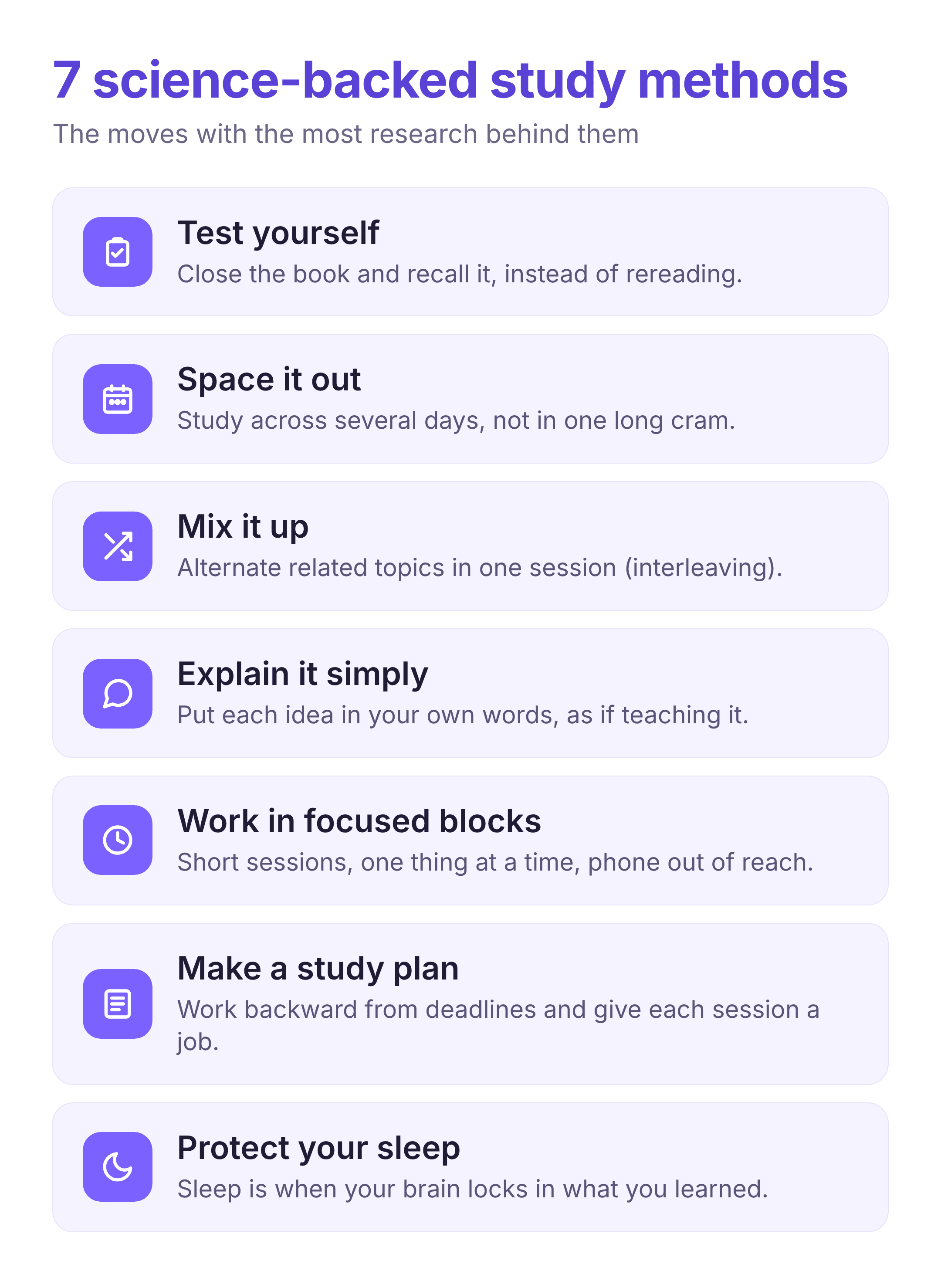
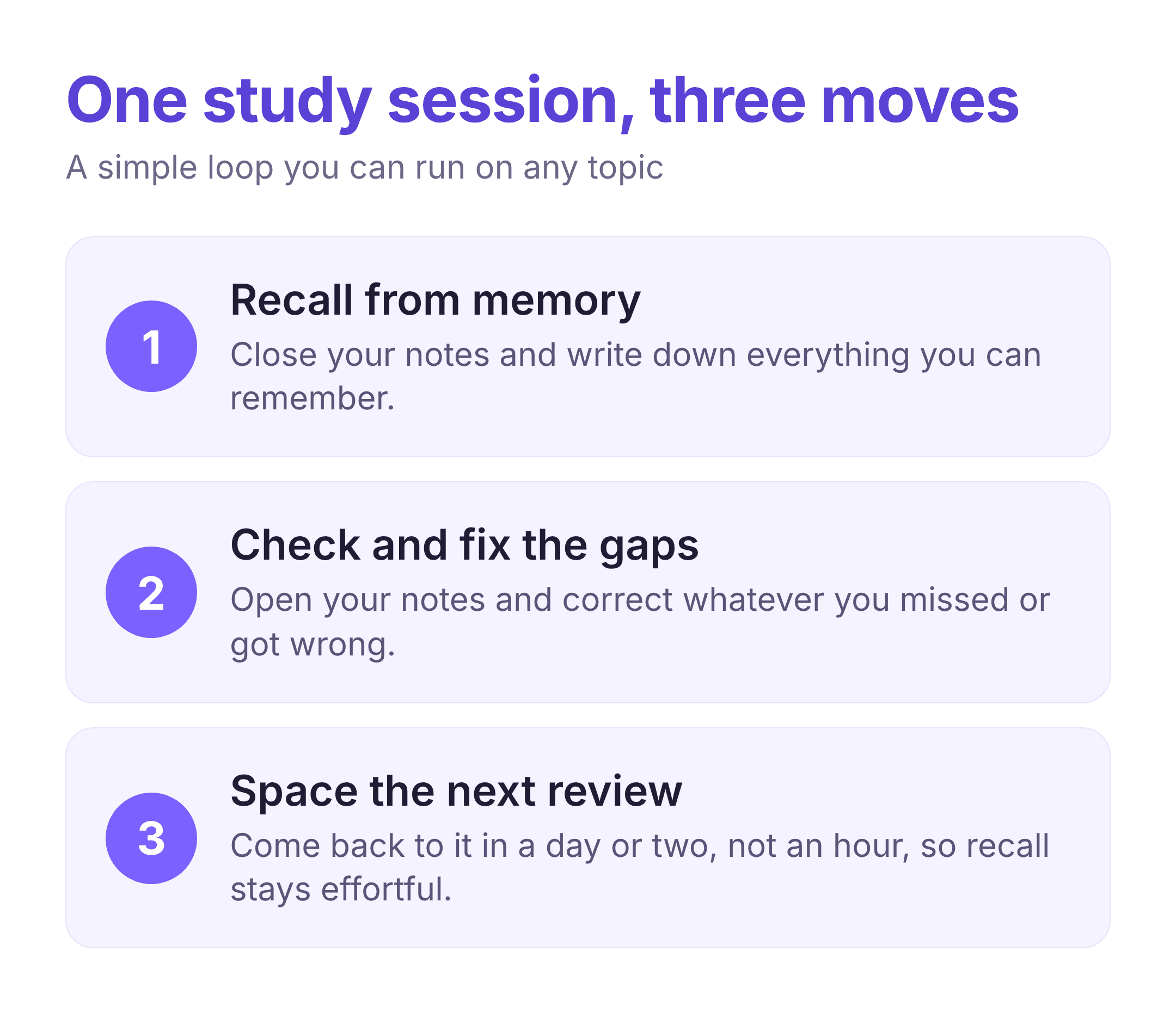
The most effective single change you can make is to close the book and try to recall what you have just read, rather than going over it again. This is usually called active recall or retrieval practice, and in Dunlosky's review, practice testing received the highest rating of all ten techniques. Writing down everything you remember from a chapter, working through practice questions, or using flashcards all ask your brain to pull information back out, and that act of retrieving is what strengthens the memory. It takes more effort than rereading, and that effort is a large part of why it works.
Studying a little across several days tends to beat one long session the night before, even when the total time is the same. Spreading sessions out, known as distributed practice, was the other technique at the top of Dunlosky's ranking. Each time you return to material after a gap, you have to work a little to bring it back, and that mild effort helps it last. If you want a method for timing those reviews, our team's guide to spaced repetition explains how to schedule them.
Many people study in blocks, covering one topic fully before moving on to the next. Mixing related topics or problem types within a session, called interleaving, often works better, even though it can feel less tidy while you do it. Switching between types nudges you to notice what makes each one different and to decide which approach fits, which is closer to what a test actually asks of you.
Putting an idea into plain words, as though you were teaching it to someone who had never seen it, is a good way to find out whether you really understand it. This is the approach the physicist Richard Feynman was known for, and it tends to surface the gaps you would otherwise miss. When you reach a point you cannot explain clearly, you have found exactly what to go back and study.
Attention is what studying runs on, and it tends to drain quickly when your phone is within reach. It helps to work in short, focused blocks on one thing at a time, with a proper break in between. The Pomodoro technique, developed by Francesco Cirillo, is a simple version of this: around 25 minutes of focused work followed by a five-minute break. Much of knowing how to focus on studying is really about removing what pulls at your attention, so it is worth putting the phone in another room and closing extra tabs before you begin.
A plan helps because it settles what you will do before you reach the moment when you would rather not. Work backward from your deadlines, break the material into sessions, and give each session a specific job rather than a vague intention to study. Turning that plan into a regular routine is what makes it hold, and our post on building study habits covers how to make studying more automatic.
Sleep is when your brain consolidates what you learned during the day, so a late night of cramming often takes away more than it adds. Studying while you are exhausted can feel productive while retaining very little. A normal night's sleep, especially before an exam, does real work on the material you have already covered.
For the specific drills that put these methods into practice, our team's roundup of study techniques walks through ten you can start using.
How to study for exams is really the same set of methods, used a little earlier. The most common difficulty is leaving everything to the final days, when cramming becomes the only choice left. It helps to begin as soon as you have the material and to plan backward from the exam date, so each week has a clear focus.
Practice tests are worth leaning on more than anything else here. Past papers, end-of-chapter questions, and flashcards all turn revision into retrieval, which the research points to as the most effective way to prepare. Sitting at least one practice test under real conditions, timed and without notes, means the exam itself is not the first time you perform under pressure. Spreading revision across several weeks rather than a single weekend, and keeping to a normal sleep schedule through the exam period, both tend to leave you recalling more.
Studying effectively has more to do with how you use your time than with how many hours you put in. Testing yourself, spacing your sessions out, explaining ideas in plain words, and looking after your focus and sleep will usually teach you more, in less time, than rereading. A reasonable way to start is to pick one of these, make it a habit, and add the next once it feels natural.
For most people, the best way to study is to test yourself on the material and space those sessions out over time, rather than rereading it all in one go. Self-testing and spacing have the strongest research behind them, and they tend to work even when you spend less total time than you would rereading.
Most focus trouble comes down to distraction. It helps to put your phone in another room, close extra tabs, and work in short blocks of around 25 minutes with a break between them. Deciding in advance what each block is for also makes it easier to begin, which is often the hardest part of focusing on studying.
It is a short review habit: after a lesson or study block, you write down three things you learned, two things you found interesting or want to look into, and one question you still have. It takes only a couple of minutes, turns passive reading into active recall, and shows you where the gaps are.
How you study matters more than the number of hours. Several popular study tips, such as rereading and highlighting, feel productive but add fairly little, while a smaller set of active methods accounts for most of the progress. Studying well is really about how you use the time, not only how much of it you spend.