RiseGuide Team
To outsmart cognitive biases, first learn the common ones so you can catch them while they happen. A cognitive bias is a mental shortcut that skews how you take in information and make decisions. Most of them fall into three groups: biases in what you notice and believe (confirmation bias, anchoring, the availability heuristic), biases in how you see yourself and others (the Dunning-Kruger effect, self-serving bias, the fundamental attribution error, the spotlight effect), and biases in how you judge risk and decisions (the sunk cost fallacy, negativity bias, optimism bias). You can't delete them, but you can reduce their pull with a few habits: slow important decisions down, argue the opposite of your first view on purpose, invite disagreement, run a quick pre-mortem, and decide against set criteria instead of a gut feeling.
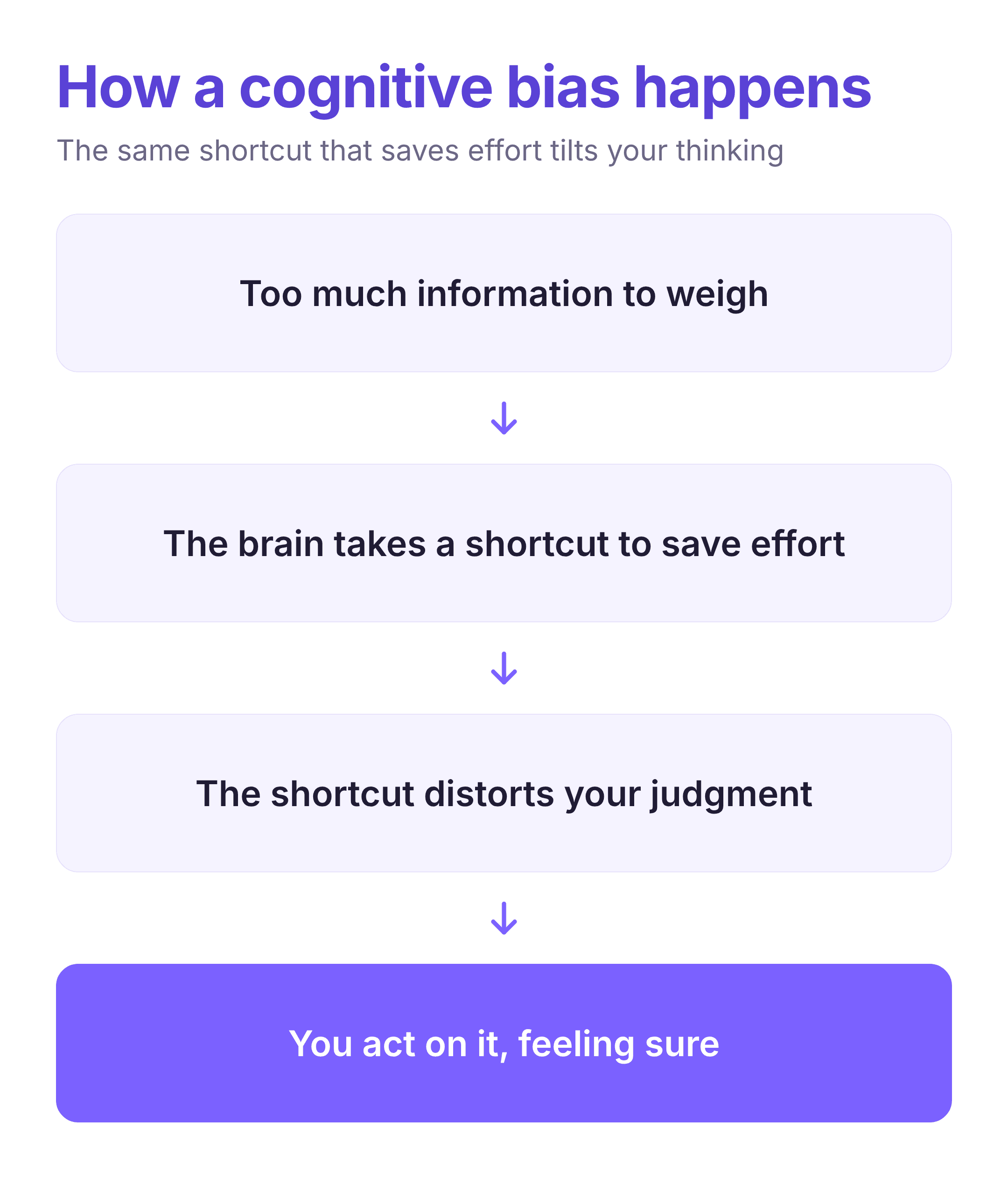
Your brain handles far more information than it can carefully weigh, so it leans on shortcuts. Most of the time those shortcuts are useful, and they let you size up a situation in seconds without stopping to analyze it. The trouble is that the same shortcuts tilt your thinking in predictable directions, and you rarely feel it happening. That tilt is what psychologists call a cognitive bias, and it shapes small calls like which review you trust and big ones like who you hire or how you invest. This guide explains what cognitive biases are, walks through the most common types with everyday examples, and gives you practical ways to outsmart them.
A cognitive bias is a consistent error in how we think, a pattern where the mind takes a shortcut that leads away from a clear, rational judgment. That is the short cognitive bias definition. In plain terms, the meaning of a cognitive bias is simple: your mind reaches for the easy answer instead of the accurate one, whether that shortcut helps you (deciding fast in a real emergency) or hurts you (dismissing a good idea because it came from someone you dislike).
Biases are not the same as being uninformed or unintelligent. Smart, well-read people show the same patterns, because biases come from how the brain is built to save effort rather than from any lack of knowledge. They are also different from logical fallacies, which are flaws in an argument's structure; a cognitive bias is a flaw in perception and judgment that happens inside your own head, often before you have put anything into words.
Biases exist because thinking carefully is slow and costly, and your brain is built to conserve effort. Psychologist Daniel Kahneman, who won the Nobel Prize for his work on judgment, described two modes of thinking: a fast, automatic one that reacts in an instant, and a slow, effortful one that checks and reasons. The fast mode runs most of the day and is very good at routine calls, but it reaches for whatever answer is easiest, not necessarily the one that is true.
A second reason is that the world gives you more information than you can process, so the mind filters it and fills the gaps with assumptions. It favors what is recent, vivid, or already familiar, and it builds a tidy story from whatever happens to be in front of you, even when the facts are thin.
"The confidence that individuals have in their beliefs depends mostly on the quality of the story they can tell about what they see, even if they see little." - Daniel Kahneman, Thinking, Fast and Slow
A bias feels like clear judgment from the inside, so it slips past you.
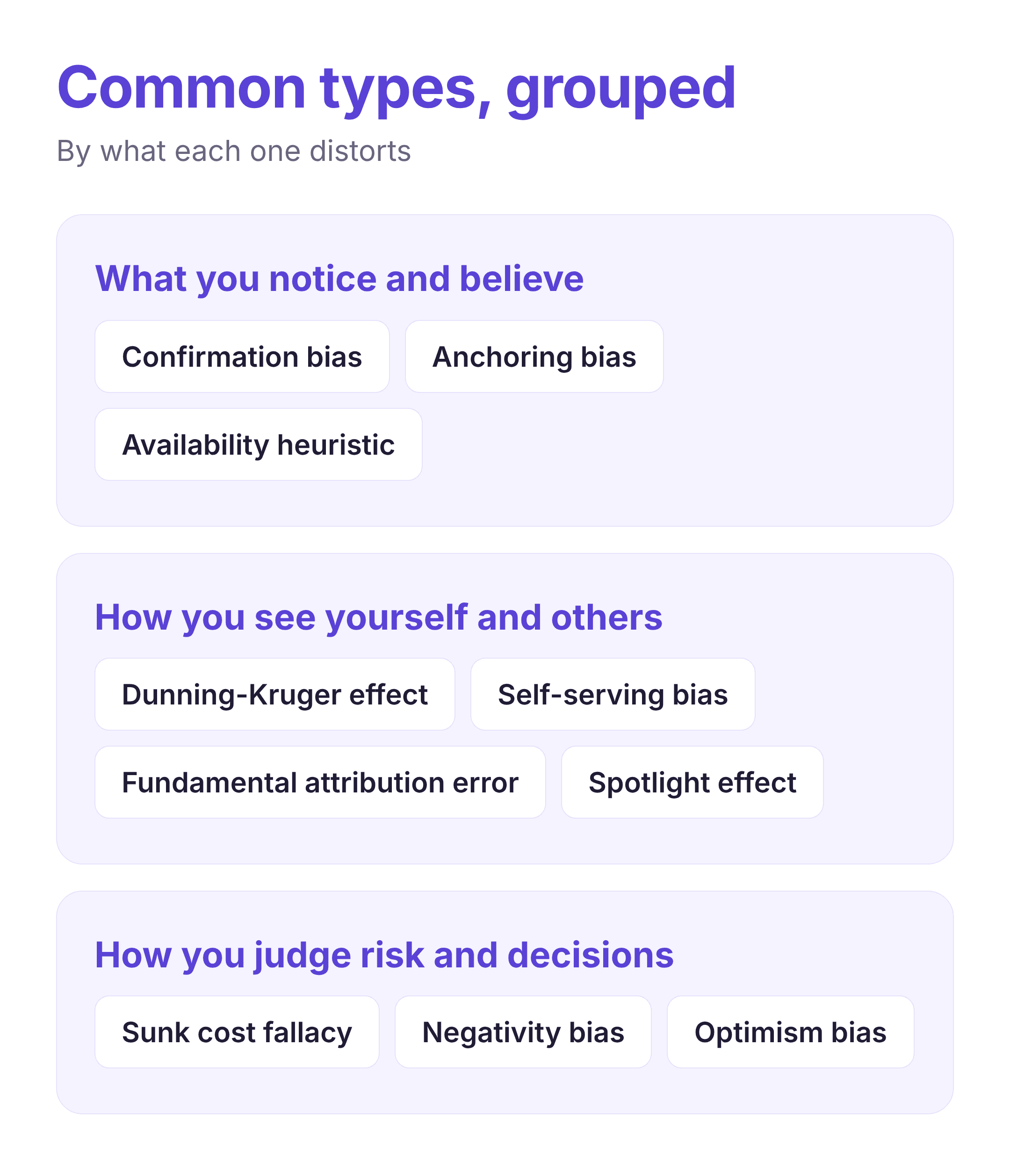
There are well over a hundred documented biases, but you don't need the full catalog. These are the most common types of cognitive bias, grouped by what they distort, each with a plain example so you can recognize it in your own thinking. Together they cover the dozen or so everyday cognitive bias examples that come up most often.
Confirmation bias is the pull toward information that fits what you already think, and away from anything that challenges it. Once you suspect a coworker is unreliable, you notice every late reply and overlook the work they deliver on time. It is probably the most common cognitive bias, and it shapes how you read the news, pick sources, and judge people.
Anchoring bias is leaning too hard on the first number or fact you hear. A jacket marked "was $200, now $80" feels like a deal because $200 set the anchor, even if $80 is still more than the jacket is worth. The first offer in any negotiation works the same way.
The availability heuristic is judging how likely something is by how easily examples come to mind. After seeing news coverage of a plane crash, flying feels dangerous, even though driving carries far more risk. The vivid story is simply easier to recall than the statistic.
The Dunning-Kruger effect is overrating your skill in an area where you actually know very little, because you don't yet know enough to see what you're missing. The less someone understands a topic, the more confident they can sound about it.
Self-serving bias is taking credit for successes and blaming outside forces for failures. You aced the test because you're smart; you bombed it because the questions were unfair. It protects your ego, but it stops you learning from what went wrong.
The fundamental attribution error is explaining other people's behavior by their character while excusing your own by circumstance. A driver who cuts you off is "reckless," but when you do it you were "running late." You judge others by their actions and yourself by your intentions.
The spotlight effect is overestimating how much other people notice you. You feel sure everyone clocked your stumble over a word in the meeting, when most people were busy thinking about their own worries. Each of us sits at the center of our own attention and forgets that others don't.
The sunk cost fallacy is sticking with something because of what you've already put in, rather than what it's worth from here. You finish a bad movie because you paid for the ticket, or stay in a course you dislike because you're "already halfway." The time and money are gone either way; only the choice ahead of you matters.
Negativity bias is giving more weight to bad experiences than good ones. One harsh comment can outweigh ten kind ones, and a single setback can color a whole week. The brain treats threats as more urgent than rewards, which once kept us safe but now skews everyday judgment.
Optimism bias is expecting things to go better for you than the odds suggest, and its close cousin, the planning fallacy, is why projects almost always take longer than planned. You budget two hours for a task that has taken four every previous time, because this time feels different.
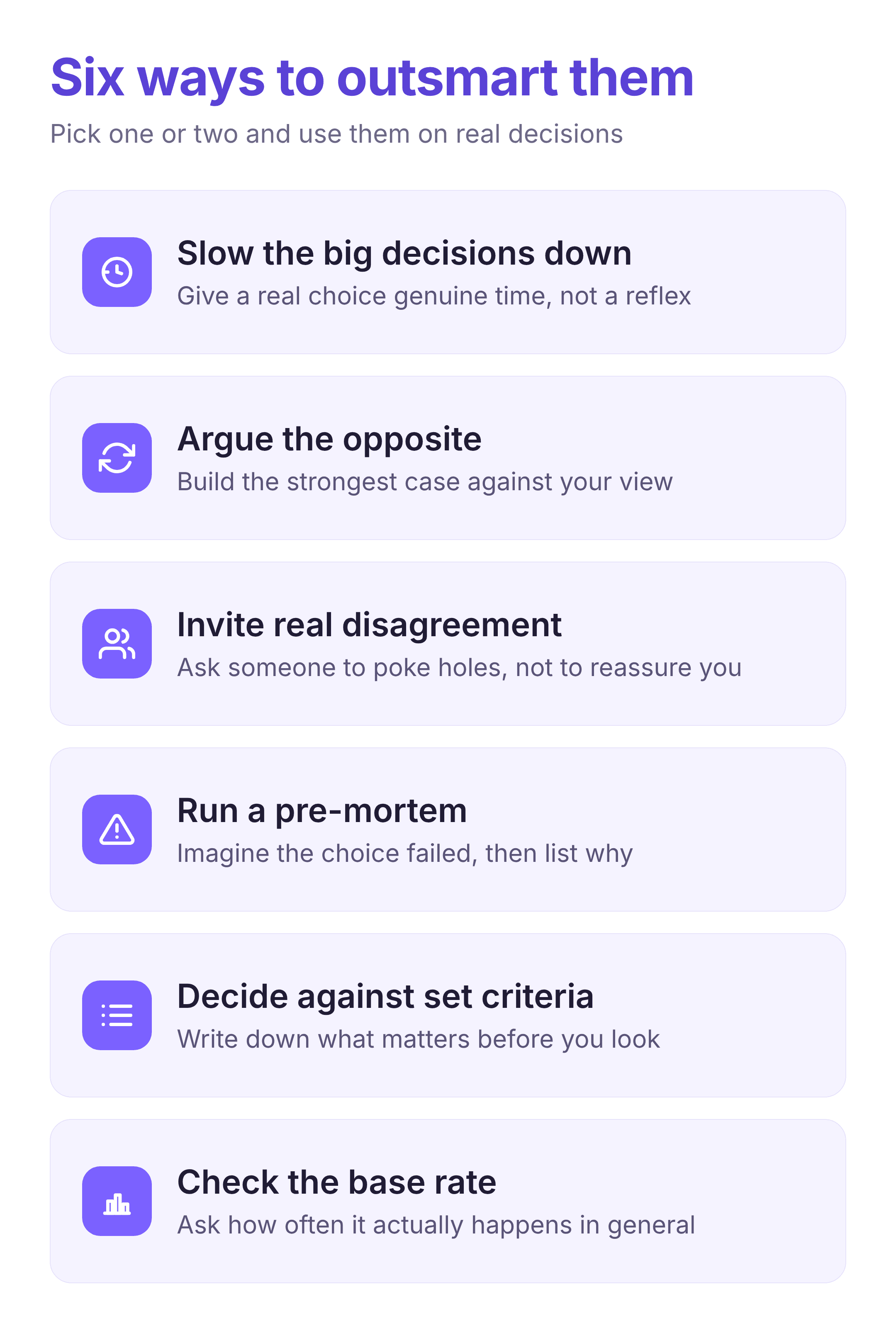
You can't switch biases off. They run automatically, and even knowing about one doesn't stop you having it. What works is building habits that catch a bias before you act on it. Pick one or two and use them on real decisions until they feel natural.
Slow the important decisions down. Biases live in the fast, automatic mode of thinking, so the simplest counter is to give a real decision genuine time and attention instead of answering on reflex. That is far easier when you can actually concentrate, which is a skill in its own right, the subject of our post on deep work.
Argue the opposite on purpose. Before you commit to a view, build the strongest case against it and ask what would have to be true for you to be wrong. Deliberately considering the opposite is one of the best-researched debiasing techniques, because it forces your attention onto the evidence you would otherwise skip. These habits overlap with the ones in our team's guide to critical thinking.
Invite disagreement. Ask someone you trust to poke holes in your reasoning, and make it clear you want the real objection, not reassurance. Other people see your blind spots more easily than you do, which is also why talking a big choice through helps you make better decisions.
Run a pre-mortem. Before a decision, imagine it is a year later and the choice failed badly, then list every reason why. This pre-mortem technique surfaces the risks that optimism bias and the planning fallacy would otherwise talk you out of raising.
Decide against set criteria. Write down what matters before you look at the options, then score each option against that list. Fixing your criteria in advance stops a strong first impression (the halo effect) or a single number (an anchor) from deciding for you.
Check the base rate. When something feels likely because it is vivid or recent, ask how often it actually happens in general. Pulling the real frequency back into view is the direct antidote to the availability heuristic.
Reasoning this way is partly a skill you absorb by watching careful thinkers work, the same way you pick up other skills through observational learning, which our post breaks down. If you'd like that kind of practice built into your day, RiseGuide's short lessons on thinking and decision-making are one way to work on it a few minutes at a time, and the intelligence skills journey is a natural place to start if clearer thinking is what you're after.
Cognitive biases are a normal part of how the mind works, and everyone has them, and no amount of intelligence makes you immune. You are not trying to erase them, which isn't possible. The aim is to know the common ones well enough to catch them in the moment and slow down when the stakes are real. Start with one habit, like arguing the opposite or running a quick pre-mortem, and use it on your next real decision. Over time, catching your own shortcuts gets easier, and your judgment on big decisions gets better.
A cognitive bias is a mental shortcut that skews your judgment in a predictable direction. A common example is confirmation bias: once you believe something, you notice the evidence that fits it and overlook the evidence that doesn't, which is how two people can read the same article and both come away feeling confirmed.
A useful short list of common cognitive bias examples includes confirmation bias, anchoring bias, the availability heuristic, the Dunning-Kruger effect, self-serving bias, the fundamental attribution error, the spotlight effect, the sunk cost fallacy, negativity bias, and optimism bias. Learning even this handful covers most of the everyday situations where judgment goes sideways.
Confirmation bias is often named the most common, because it runs underneath so many others. It is the tendency to seek and favor information that supports what you already believe, and it shapes everything from how you read the news to how you judge people.
There is no single definitive cognitive bias test that measures all of them, but there are well-known tools for specific ones - for example, Harvard's Implicit Association Test for implicit bias. The more practical move is to learn the common types and watch for them in your own decisions rather than rely on a score.
No. Biases are built into how the brain saves effort, and even the experts who study them still have them. What you can do is reduce their effect by slowing down important decisions and using habits like considering the opposite, which catch a bias before it drives the choice.