RiseGuide Team

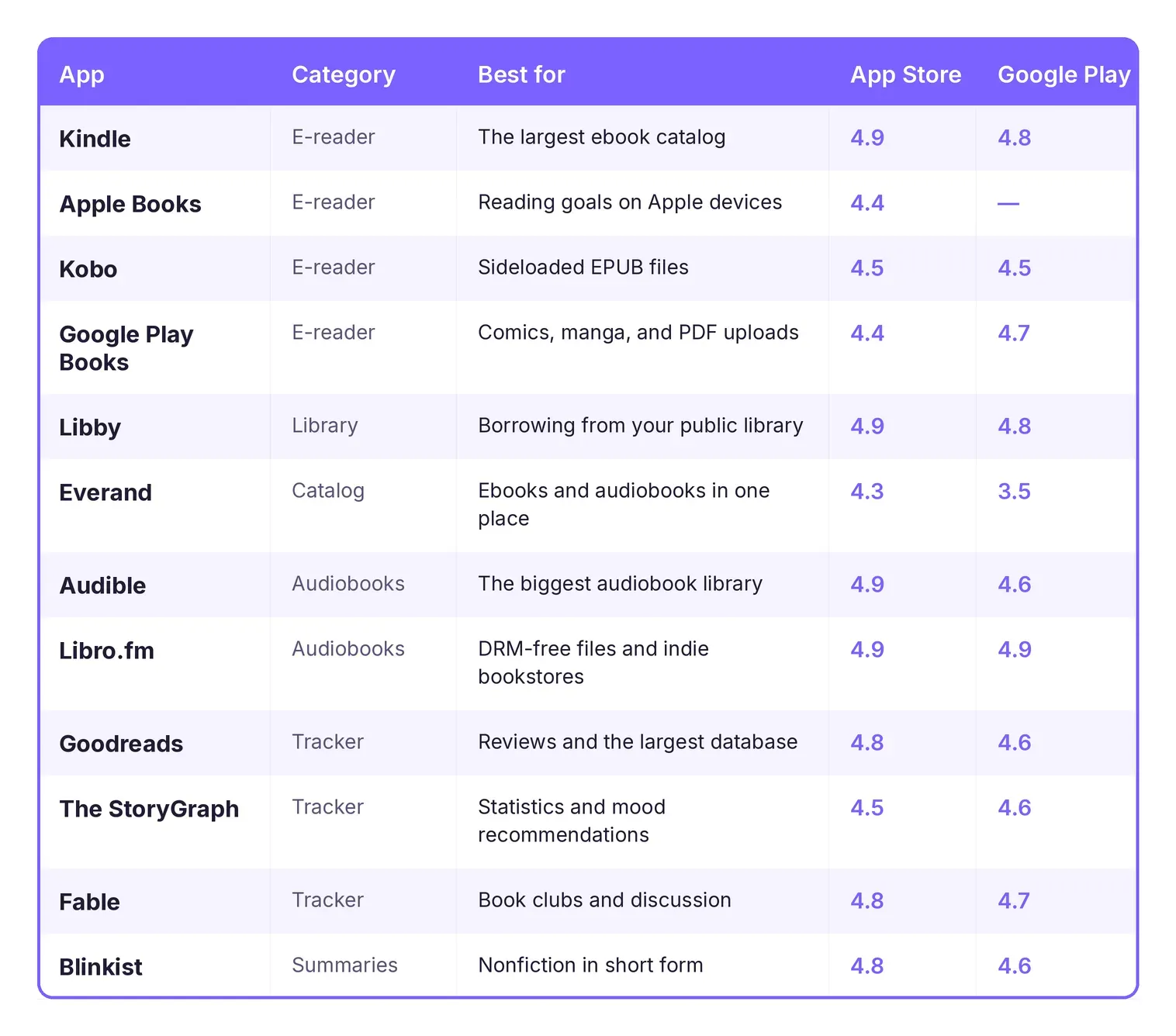
To read more on your phone, you usually need two or three apps rather than one: something to read in, something to listen in, and something to keep track of what you've finished. The 12 best apps for reading below are grouped by that logic.
Read ebooks: 1. Kindle · 2. Apple Books · 3. Kobo · 4. Google Play Books
Borrow and browse a catalog: 5. Libby · 6. Everand
Listen: 7. Audible · 8. Libro.fm
Track and discuss: 9. Goodreads · 10. The StoryGraph · 11. Fable
Nonfiction in short form: 12. Blinkist
If you want one setup to start with: Kindle to read, Libby for anything your library carries, and The StoryGraph to see what you've been reading.
Most people who read on a phone don't pick a single app and stay there. They read in one, listen in another, and keep a running list somewhere else, because no app is strong in all three areas. Pew Research found that 75% of U.S. adults read all or part of a book in the past year, with 31% reading an ebook and 26% listening to an audiobook — so plenty of readers are already moving between formats.
This list is organized around that: what each app is actually built to do, what it does well, and where it gets in your way.
Reading apps fall into four groups, and the right one depends on which part of reading you want help with.
E-readers hold your books and control how they look on screen - font, spacing, background, page turns. The main question here is which store your library lives in, because most ebooks are locked to the app you bought them in. Switching later means leaving books behind.
Borrowing apps connect you to a catalog instead of a purchase history. Libby links to your public library; Everand runs its own catalog across ebooks and audiobooks. What you gain in range you give up in certainty - titles come and go.
Audiobook apps are judged on catalog and playback: speed control, sleep timers, car support, and whether your progress survives switching devices mid-chapter.
Trackers don't contain books at all. They record what you've read, what you thought, and what's next. This is where Goodreads alternatives have grown quickly, because readers wanted better statistics and a database that isn't tied to a retailer.
One thing worth deciding before you install anything: whether you want to read more books or get more out of the ones you read. Those pull in different directions, as the RiseGuide team explored in the reading habit that builds wisdom, which looks at how Warren Buffett and Charlie Munger paired steady reading with time to think.
These four are where your ebooks live. They cover the same core job, so the deciding factor is usually which ecosystem you're already in and how much control you want over files you bring in yourself.
Ratings: App Store 4.9 ⭐ · Google Play 4.8 ⭐
Best for: Readers who want the widest selection and read across several devices.
Kindle carries over six million titles and syncs your place, notes, and highlights across phone, tablet, browser, and Kindle e-readers. X-Ray lets you pull up characters and terms without losing your page, and the built-in dictionary and translation work inline. If you own the Audible edition of a book, you can switch between reading and listening and keep your position.
Strengths:
Limitations:
Ratings: App Store 4.4 ⭐ · not available on Android
Best for: People who read on Apple devices and like a daily target.
Apple Books keeps ebooks and audiobooks in the same place and adds Reading Goals with daily streaks, which some readers find is the thing that gets them past the first chapter. Typography control is unusually detailed - fonts, themes, line height, and letter spacing. It also opens DRM-free EPUB and PDF files directly, so anything you download or receive can go straight into your library alongside purchases. Family Sharing covers up to five people, and audiobooks play through CarPlay and Apple Watch.
Strengths:
Limitations:
Ratings: App Store 4.5 ⭐ · Google Play 4.5 ⭐
Best for: Readers with EPUB files from several sources who want them in one library.
Kobo handles both Adobe DRM and DRM-free EPUBs, so books from independent stores, publisher direct sales, and public-domain archives sit next to Kobo purchases without conversion. The reading settings go deep on typography and Night Mode, and the app syncs with Kobo e-readers if you also read on e-ink. Audiobooks play with a sleep timer and CarPlay support, and the interface runs in 11 languages.
Strengths:
Limitations:
Ratings: App Store 4.4 ⭐ · Google Play 4.7 ⭐ · 1B+ downloads
Best for: Android readers who mix books with comics, manga, and their own documents.
Play Books takes uploads of your own EPUB and PDF files up to a generous limit and treats them like any other book, with offline downloads and custom shelves. Comics and manga get panel-by-panel zoom, which most general e-readers handle poorly. Notes and highlights sync to Google Drive, so they're searchable outside the app, and audiobooks have speed control and a sleep timer.
Strengths:
Limitations:
The two apps here work differently from the e-readers above: you're reading from a shared catalog rather than a shelf you've built. That means more range and less permanence.
Ratings: App Store 4.9 ⭐ · Google Play 4.8 ⭐
Best for: Anyone with a library card who reads widely and doesn't mind waiting.
Libby connects your library card to your library's collection of ebooks, audiobooks, and magazines, and you can hold several cards in one app if you have access to more than one system. Borrow, hold, and renew all happen in the app. Audiobooks play from 0.6x to 3.0x with a sleep timer and CarPlay, ebooks have the usual text and background controls plus notes and highlights, and US libraries can send borrowed ebooks straight to a Kindle.
Strengths:
Limitations:
Ratings: App Store 4.3 ⭐ · Google Play 3.5 ⭐
Best for: Readers who want ebooks, audiobooks, and magazines in one catalog and switch between them often.
Everand, formerly Scribd, puts ebooks, audiobooks, magazines, sheet music, and documents in a single catalog you browse rather than buy from title by title. It works online and offline across devices, with highlights and notes, audio speed control, and a sleep timer. Since Everand acquired Fable in June 2025, Fable's book clubs and social reading features are bundled in as well.
Strengths:
Limitations:
Audiobooks are now a normal part of how people read rather than a separate hobby, and these two take opposite approaches to the same job.
Ratings: App Store 4.9 ⭐ · Google Play 4.6 ⭐
Best for: Heavy listeners who want exclusives and a catalog that covers everything.
Audible holds more than a million audiobooks, podcasts, and Originals you won't find elsewhere. Whispersync for Voice moves you between the Kindle ebook and the audio edition without losing your place, which is the closest thing to reading and listening as one activity. Playback covers variable speed, offline downloads, sleep timer, bookmarks, and clips, with CarPlay and Android Auto for driving.
Strengths:
Limitations:
Ratings: App Store 4.9 ⭐ · Google Play 4.9 ⭐
Best for: Listeners who want DRM-free files and want their purchases to support an independent bookstore.
Libro.fm carries over 600,000 audiobooks and hands you DRM-free downloads, so the files play in whatever app you like and stay yours if you stop using the service. Each purchase is split with an independent bookshop you choose from more than 4,000 stores. The player has bookmarks, a sleep timer, variable speed, cross-device sync, Apple Watch, and CarPlay, and recommendations come from booksellers rather than an algorithm.
Strengths:
Limitations:
None of these three contain books. They keep the record - what you've read, what you thought, what's waiting - and they're where most readers end up spending their reading conversation. Keeping notes as you go also makes what you read easier to recall later, which is the idea behind the memory palace technique.
Ratings: App Store 4.8 ⭐ · Google Play 4.6 ⭐
Best for: Readers who want long reviews and the biggest book database before deciding what to read next.
Goodreads has the deepest database and the most reviews of anything here, which is why most readers check it even when they track elsewhere. You build shelves, scan barcodes to add physical books, follow friends, and run an annual Reading Challenge. The Choice Awards and the groups feature are the closest thing to a general-purpose book club online.
Strengths:
Limitations:
Ratings: App Store 4.5 ⭐ · Google Play 4.6 ⭐
Best for: Readers who want to see patterns in what they read and pick books by mood and pace.
The StoryGraph is the tracker most people move to when Goodreads stops being enough. Recommendations run on mood and pace rather than popularity, and the statistics page breaks your reading down into charts covering genre, length, pace, and how your year is going. It supports half-star ratings, DNF tracking, custom tags, community-sourced content warnings, buddy reads, and a one-click Goodreads import, and it's independent rather than retailer-owned.
Strengths:
Limitations:
Ratings: App Store 4.8 ⭐ · Google Play 4.7 ⭐
Best for: Readers who want conversation attached to the book rather than a review posted after finishing.
Fable is built around clubs. Discussion happens inline, tied to the passage being talked about, so a club reads more like an ongoing conversation than a monthly meeting. It imports from Goodreads and Kindle, tracks goals and streaks, produces year-in-review statistics, and hosts creator-led clubs alongside private ones you set up with friends. Fable is now part of Everand, so the two connect.
Strengths:
Limitations:
One app on this list isn't for reading books at all - it's for getting the argument of a nonfiction book in the time it takes to make coffee. That's a different job from the eleven above, and worth knowing about if your reading list is mostly nonfiction.
Ratings: App Store 4.8 ⭐ · Google Play 4.6 ⭐
Best for: Readers deciding which nonfiction books deserve the full read.
[Screenshot: Blinkist summary player]
Blinkist condenses more than 9,000 nonfiction books and podcasts into roughly 15-minute text and audio summaries. Most people use it as a filter - listen to the summary, then buy the ones worth the hours. Highlights send to Kindle and Evernote, summaries download for offline listening, and there's a curated daily pick.
Strengths:
Limitations:
Ratings are an August 2026 snapshot and shift over time.
Start with where your books already are. If you've bought ebooks before, that store is your reader, and moving means leaving them behind — Kindle if you're in Amazon's catalog, Apple Books on an iPhone, Kobo if you have EPUB files from several places, Play Books if you read comics or upload your own documents.
Add Libby next, whatever else you use. A library card covers a large share of what you'd otherwise buy, and the hold queue is easier to live with once you keep four or five books on hold and read whatever arrives. For audio, Audible has the catalog and the Whispersync link to Kindle; Libro.fm gives you files that stay yours and sends part of each purchase to a bookstore you choose.
The tracker is the one worth thinking about, because it shapes what you read next. Goodreads has the reviews, The StoryGraph has the statistics and the recommendations, Fable has the conversation. Most readers pick one and check Goodreads for reviews anyway.
If your reading is mostly nonfiction and you're trying to get more out of it rather than get through more of it, the format matters less than what happens afterward. Books you don't apply fade quickly, which is the same reason spacing and self-testing beat rereading when you're learning anything. Picking a few titles from a list like the 12 best productivity books and working through them slowly tends to do more than a longer finished-books count.
Kindle, for most people. It has the largest catalog, syncs your position and notes across every device, and lets you switch between the ebook and the Audible edition of the same title. On an iPhone, Apple Books is a reasonable alternative if you want reading goals and finer control over how text looks.
Libby is the strongest option. It gives you your public library's ebooks, audiobooks, and magazines with a library card, and US libraries can send borrowed ebooks to your Kindle. Google Play Books and Apple Books both carry public-domain titles you can add to your library directly.
Goodreads is still the biggest, but The StoryGraph and Fable are the two Goodreads alternatives most readers move to — StoryGraph for reading statistics and mood-based recommendations, Fable for book clubs with discussion attached to the passage. Both import your Goodreads history.
Kindle paired with Audible. Whispersync for Voice keeps your place when you switch between text and audio on a title you own in both formats. Everand and Apple Books both hold ebooks and audiobooks in one app, though they don't move you between editions of the same book that way.
Kobo. It opens Adobe DRM and DRM-free EPUB files alongside its own store books, so titles from independent shops and publisher direct sales sit in the same library. Google Play Books accepts EPUB and PDF uploads, and Apple Books opens DRM-free EPUBs and PDFs directly.