RiseGuide Team

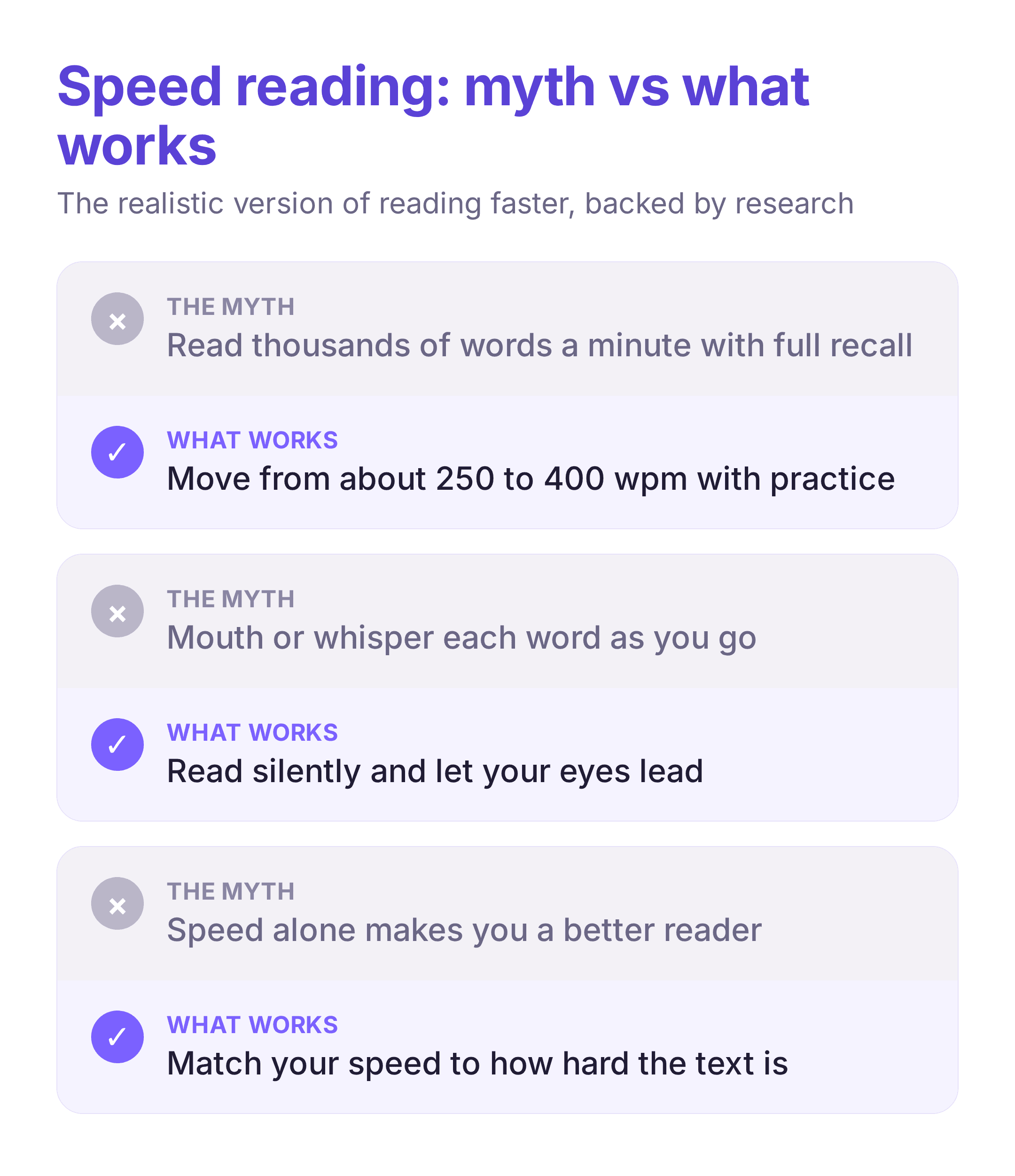
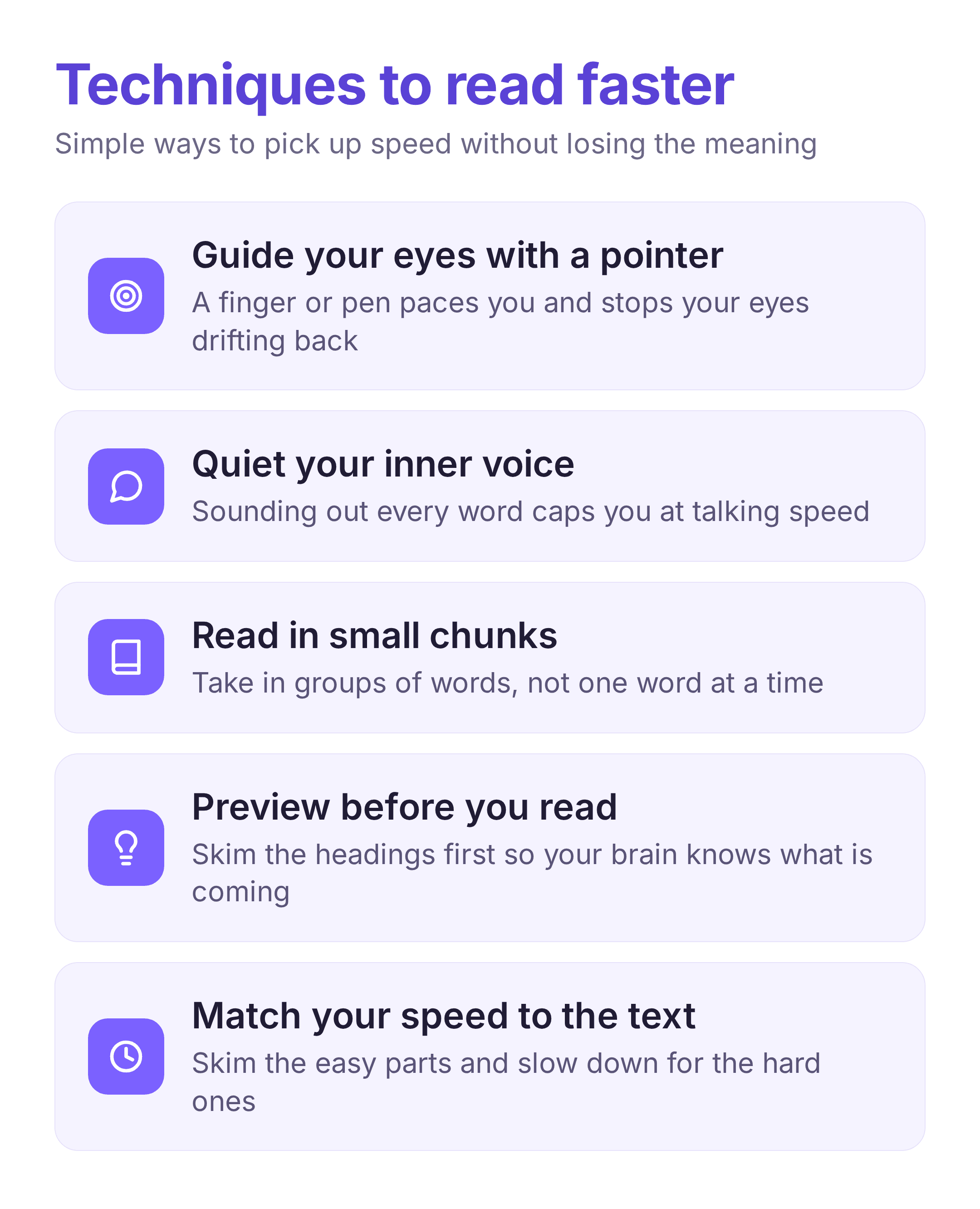
To read faster, guide your eyes with a pointer, quiet the inner voice that sounds out every word, take in small groups of words instead of one at a time, preview a text before you read it, and match your speed to how hard the material is. Practice against a timer to push your pace up little by little. Be realistic, though: the science on speed reading shows you can comfortably move from an average pace to a faster one, but reading many thousands of words a minute with full understanding is not something the research supports. The goal is to read faster and keep what you read.
Most of us have more to read than time to read it: work documents, articles, textbooks, the growing stack of books by the bed. So the promise of speed reading, taking in a page in seconds while remembering all of it, is tempting. The reality is more modest and more useful to know. You can learn to read faster, and a few simple techniques make a real difference, but there is a point where going faster starts to cost you understanding. This guide covers how fast a normal reader goes, what speed reading can and cannot do, and the speed reading techniques that help you get through more without losing the meaning.
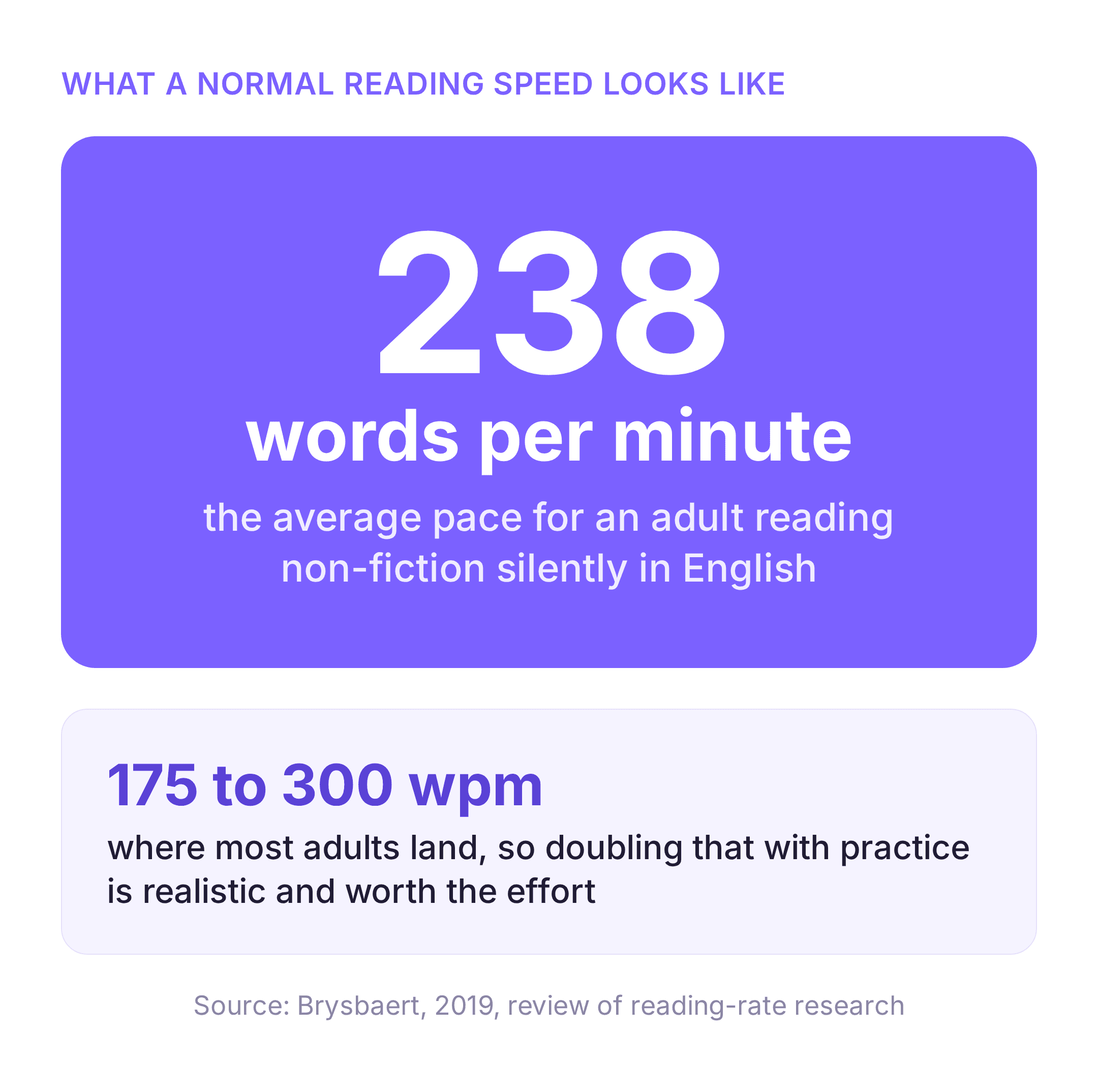
Before you try to speed up, it helps to know where you are starting from. Most adults read about 238 words a minute when reading non-fiction silently, and most people fall somewhere in the range of 175 to 300. That gives you a baseline to measure against. Time yourself on a page, count the words, and see where you land. If you are near that range, you are normal, and there is real room to improve. Doubling a 250 pace to around 500 with practice is a realistic target. The four-figure speeds you see in advertisements are not.
Some of it does, and some of it is marketing. When researchers reviewed decades of studies on how we read, they found a consistent trade-off: as reading speed goes up, comprehension tends to come down, and the dramatic claims, taking in a whole page at a glance with perfect recall, do not hold up. What does hold up is steady, modest improvement through practice. So the goal worth chasing is reading a bit faster while keeping your understanding, and reading at the right speed for each piece of material rather than one flat top speed for everything.
If you mostly want to hold on to what you read rather than race through it, that is a slightly different skill, and our post on how to remember what you read covers it.
These speed reading techniques target the small habits that slow most readers down. Try them on easy material first, where a dip in comprehension costs you little, then bring them to harder texts.
Your eyes do not glide smoothly across a line. They jump in small hops and often skip back to re-read words you already passed. Running a finger, pen, or cursor under the line as you read gives your eyes a steady target to follow and cuts down on that back-tracking, which on its own can lift your pace.
Most of us silently hear each word as we read, a habit called subvocalization. Sounding out every word ties your reading speed to your talking speed. You do not need to switch it off completely, but softening it, by humming quietly or chewing gum while you read, frees you to move faster. Brain coach Jim Kwik teaches this alongside using your finger as a pacer, and suggests turning practice into a timed game to push your speed up.
Skilled readers take in groups of two or three words at a time rather than one. Practice letting your eyes land a couple of times per line instead of stopping on every word, and your brain will fill in the gaps more than you would expect.
Before you read closely, spend thirty seconds skimming the headings, the first line of each section, and any bold text. This gives your brain a map, so when you read properly the ideas land faster because you already know roughly where the text is heading.
Speed is not one setting. Skim a light news article, shift down a gear for a dense contract or a chapter you will be tested on, and slow right down for anything you need to remember word for word. Good readers change gears to fit the material.
Reading faster is a skill, and like any skill it responds to short, regular practice. Time yourself on a page or two most days, note your pace, and try to nudge it up a little without losing the thread. Building it into an existing habit helps it hold, and our post on good habits shows how to make a new routine last. If you like structure, a learning app can give you daily practice and track your progress, and our roundup of the best apps for learning covers options for different goals. RiseGuide takes a similar micro-learning approach across other skills, turning spare minutes into short, interactive lessons built on expert insights, and its SEEK tool lets you pull a specific, cited answer from vetted expert sources when you would otherwise lose twenty minutes searching.
You can read meaningfully faster than you do now, and the techniques here, a pointer, a quieter inner voice, reading in chunks, and previewing, will get you there with a week or two of practice. Keep the goal honest: a comfortable, faster pace that still lets you understand and remember what you read, rather than a big number you cannot really use.
Partly. You can learn to read faster with practice and a few techniques, but the extreme claims, thousands of words a minute with full comprehension, are not supported by research. Aim for steady improvement rather than a miracle.
Start with three habits: run your finger under the line to pace your eyes, stop sounding out every word in your head, and take in small groups of words instead of one at a time. Practice on easy material first, then work up to harder texts.
It can, past a point. Small increases in speed usually keep your understanding intact, but the faster you push, the more detail you tend to lose, so match your speed to how much you need to remember.
Most adults read around 175 to 300 words a minute, averaging about 238. With practice, many people can reach 400 or more on easier material while still following the meaning.
Preview the text first so your mind has a map, read in a quiet spot with your phone away, and use your finger as a pacer to keep your eyes from wandering. A clear target keeps both your speed and your attention steady.