RiseGuide Team

Twelve books, grouped by the kind of conversation you're trying to get better at:
If you want one place to start: pick Difficult Conversations if there's a specific conversation you're avoiding, Supercommunicators if you want the most current research on why conversations go wrong, and How to Win Friends and Influence People if you're building from the ground up.
Most people who go looking for a book on communication have one specific problem in mind — a conversation with a manager that keeps going sideways, a partner who says you never listen, or a meeting where nobody registered your idea. These books all get shelved together as though communication were one skill, but a book about negotiating a contract and a book about repairing a strained relationship share almost no advice.
So the list below is grouped by the four situations people are usually trying to fix: everyday conversation, conflict, persuasion, and being heard at work. Each entry covers what the book teaches, who it fits, and where it stops being useful.
The best books for improving communication skills are the ones aimed at the conversation you keep getting wrong, so it's worth naming that before you buy anything. Four situations cover most of it.
One thing to keep in mind before you start any of them: reading about listening and actually listening under pressure are different skills, and only the second one is the one you want. Books give you the model. What closes the gap is repetition in real conversations - rehearsing an opening line out loud before you use it, asking for feedback from someone who was in the room, or working through short daily practice in one of the apps built for communication skills. If you liked how our productivity books list was organized, this one follows the same logic: start from the friction, not the bestseller ranking.
These three work on the ordinary conversations that fill most of your day - with colleagues, strangers, friends, people you've just been introduced to. None of them are about conflict. They're about attention: what you notice, what you ask, and what the other person walks away feeling.
Carnegie's book is the oldest title on this list and still the most widely read, and its argument is narrower than the title suggests: people respond to being taken seriously. The book runs on thirty principles across four parts, and most of them are small behavioral instructions rather than ideas - become genuinely interested in the other person, remember and use their name, talk in terms of their interests, let them do most of the talking.
The section on disagreement is the part most readers underestimate. Carnegie's advice is to avoid winning arguments outright, admit your own mistakes early, and let the other person save face, because a person who has been proved wrong in public rarely changes their mind in private.
"You can make more friends in two months by becoming interested in other people than you can in two years by trying to get other people interested in you."
Best for: anyone building from the fundamentals, and anyone who finds small talk draining.
Worth knowing: the examples come from American sales and business life in the 1930s, so the anecdotes feel distant. And the principles only work when the interest is real - applied as technique, they read exactly as the manipulation the title implies. Carnegie says this himself, but it's easy to skim past.
Duhigg's central claim is that every discussion is one of three kinds: a practical conversation about solving something, an emotional conversation about how someone feels, or a social conversation about identity and belonging. Trouble starts when two people are in different ones - you offer a solution while the other person wants to be understood, and both of you leave frustrated.
The fix he calls the matching principle: work out what kind of conversation is happening, then meet the other person there. The practical tools include deep questions, which ask about values and experience rather than facts, and looping for understanding - ask, repeat back what you heard in your own words, then check whether you got it right.
"Effective communication requires recognizing what kind of conversation is occurring, and then matching each other."
Best for: people whose conversations go wrong without any obvious reason why.
Worth knowing: it's written as journalism, so the techniques are embedded in long case studies. You'll get more out of it with a pen than by reading straight through.
This one isn't a how-to, and reading it that way will disappoint you. Gladwell is explaining why we're so confident, and so wrong, about people we don't know. Three ideas carry the book: we default to truth and assume honesty until the evidence is overwhelming; we believe faces and demeanor reveal what someone feels, when they often don't; and behavior is coupled to circumstance rather than being a fixed trait.
The cases are the substance - Neville Chamberlain reading Hitler, investors who met Bernie Madoff, the traffic stop that ended in Sandra Bland's death. Each one shows a competent person misreading someone in a way that felt reasonable at the time.
"We think we can easily see into the hearts of others based on the flimsiest of clues. We jump at the chance to judge strangers."
Best for: anyone whose work involves assessing people quickly - interviewing, hiring, sales, teaching.
Worth knowing: there are no techniques in it. What you get is calibration: less certainty about your read on people, which is useful, but you'll need one of the other books for what to do next.
The three books in this group handle the conversation you've been rehearsing in the shower. They overlap in places, and you don't need all three - the difference is where each one puts the emphasis. Difficult Conversations is strongest on preparation, Nonviolent Communication on wording, and Crucial Conversations on what to do when the temperature rises mid-sentence.
Out of the Harvard Negotiation Project, this is the most careful book on the list. Its core idea is that every hard conversation runs on three levels at once: a "what happened" conversation about facts and blame, a feelings conversation nobody names out loud, and an identity conversation about what the exchange says about you. Most conversations fail because people argue the first while the real trouble is in the other two.
The practical moves are concrete. Trade blame for contribution - ask what each person did to build the situation rather than who's at fault. Open with the third story, the version a neutral observer would tell, instead of your own. And shift your stance from I understand to help me understand, which changes what you say next.
"Difficult conversations are almost never about getting the facts right. They are about conflicting perceptions, interpretations, and values."
Best for: a specific conversation you've been avoiding, especially one where you're not sure you're the innocent party.
Worth knowing: it's dense, and the third edition added material on race, culture, gender, power, and communicating through screens, which makes it longer still. This is a book to work through slowly, not to skim the night before.
Rosenberg was a clinical psychologist who spent decades mediating conflict, and his method is a four-part sequence: state the observation, name the feeling, identify the need behind it, then make a request. The discipline is in the first step. "You've been leaving me out of decisions" is an evaluation. "The last two client emails went out without me on them" is an observation, and the difference decides whether the other person defends themselves or answers you.
The second half of the book is about feelings and responsibility - specifically, that another person's behavior can set off your reaction without being the cause of it. Requests have to be specific and doable, which is what separates them from demands.
"What others do may be the stimulus of our feelings, but never the cause."
Best for: conversations that keep collapsing into blame, at home or at work. Pair it with our piece on how to disagree respectfully.
Worth knowing: follow the four-part formula literally and you'll sound like a workshop handout. Readers who get value from it treat the sequence as a way to think before speaking, then say it in their own words.
The other two books in this group prepare you. This one is about the middle of the conversation, when someone has gone quiet or gotten sharp and you have to decide what to do in the next few seconds. The authors' model is a pool of shared meaning: a conversation works when everyone puts their real information into it, and it fails when people either withdraw into silence or push into aggression.
The tools have names, which helps in the moment. Start with heart means checking what you actually want before you speak. The STATE skills give you an order for saying something hard - share your facts, tell your story, ask for the other person's account, speak tentatively, and invite disagreement. There's also a lot on noticing the point where safety drops, which is usually earlier than people think.
"At the core of every successful conversation lies the free flow of relevant information."
Best for: high-stakes conversations at work where opinions differ and feelings are running. It also pairs well with our post on how to stop interrupting people, since most safety drops start there.
Worth knowing: it's written for the workplace and leans on acronyms. If you want this for a conversation with a family member, you'll be translating as you read.
Books like these give you the model for a hard conversation. Getting it to hold when your pulse is up takes practice, which is what the Communication Mastery journey in RiseGuide is built for - short lessons drawn from expert knowledge, plus tools to rehearse before it counts. Start your journey with RiseGuide.
Here the goal isn't mutual understanding - you want someone to agree, concede, or change position. These three come from different worlds: hostage negotiation, academic social psychology, and political polling. Read together, they explain both how to make a case and how a case is being made on you.
Voss spent years as the FBI's lead international kidnapping negotiator, and his method rests on what he calls tactical empathy: naming the other side's position and emotion out loud so accurately that they feel understood, before you ask for anything. It's the opposite of the split-the-difference compromise the title rejects.
The techniques are unusually specific for a book in this category. Mirroring means repeating the last few words the other person said, which reliably gets them to keep talking. Labeling means voicing what you observe - "it seems like the timeline is the real issue here." The accusation audit front-loads their objections before they raise them. And calibrated questions starting with how or what hand the other side the work of solving your problem.
"Negotiation is not an act of battle; it's a process of discovery. The goal is to uncover as much information as possible."
Best for: salary conversations, client and vendor negotiation, any high-stakes ask where you're not the one with leverage.
Worth knowing: the origin story shapes the framing, and the tactics can feel calculated when you use them on your partner or a close colleague. Some readers also find the case studies more entertaining than the drills, and skip the drills.
Cialdini spent three years training as a car salesman, fundraiser, and telemarketer to see persuasion from the inside, then organized what he found into principles. There are seven in the current edition: reciprocity, liking, social proof, authority, scarcity, commitment and consistency, and unity, which he added in 2021 to cover the pull of shared identity.
The book's real use is defensive. Once you can name the principle being applied - the free sample that creates obligation, the small commitment that makes the large one consistent - you can decide whether to comply rather than just complying. Cialdini is explicit that these mechanisms work whether or not the person using them deserves your agreement.
"A well-known principle of human behavior says that when we ask someone to do us a favor we will be more successful if we provide a reason."
Best for: understanding the mechanics behind agreement, in marketing, sales, or your own decisions.
Worth knowing: it's a book about how persuasion operates across situations, not a set of lines for a conversation. Read it for the model, then get your conversational tactics from Voss.
Luntz is a pollster who has spent his career testing how specific words land with specific audiences, and his premise is that the meaning of a message is decided entirely by the person receiving it. The book's spine is ten rules of effective language: simplicity, brevity, credibility, consistency, novelty, sound and texture, aspiration, visualization, asking a question, and providing context.
The consistency rule is the one worth sitting with. Luntz's point is that a message has to be repeated far past the point where the speaker is bored with it, because the audience is hearing it for the first time each time.
"You can have the best message in the world, but the person on the receiving end will always understand it through the prism of his or her own emotions, preconceptions, prejudices, and preexisting beliefs."
Best for: anyone who has to explain something to people who don't already agree - pitches, internal proposals, public messaging.
Worth knowing: the examples are drawn from American political and corporate polling of the 2000s, and Luntz's own political work is part of the material. The rules hold up better than the case studies do.
Books on effective communication in the workplace tend to cluster around three problems: feedback that either doesn't register or wounds, ideas that don't survive the meeting, and the sense that you're doing good work nobody notices. One book per problem.
Scott built this out of managing at Google and Apple, and the framework is two axes: care personally, and challenge directly. Do both and you get radical candor. Care without challenging is ruinous empathy, the most common failure, where you withhold criticism to be kind and let someone keep failing. Challenge without care is obnoxious aggression. Neither, and you're at manipulative insincerity.
The practical chapters are about sequence. Ask for criticism before you give any, because it's the fastest way to prove the feedback is about the work rather than about status. Give praise and criticism in public and private according to what the person can hear. And keep guidance specific enough to act on - vague feedback puts the work of interpretation on the person least able to do it.
"Radical Candor is what happens when you put 'Care Personally' and 'Challenge Directly' together."
Best for: managers, and anyone whose job involves telling colleagues that something isn't good enough.
Worth knowing: it's written for people who lead teams. If you don't, several chapters on hiring, firing, and staff meetings won't apply, though the feedback model still does.
The Heath brothers set out to explain why urban legends spread while carefully prepared presentations evaporate. Their answer is a six-part checklist under the acronym SUCCESs: simple, unexpected, concrete, credible, emotional, and told as a story. Each element has a chapter and a set of before-and-after examples, most of them drawn from real campaigns and classrooms.
The idea that changes how you work is the curse of knowledge. Once you understand something well, you lose access to what it was like not to understand it, which is why experts explain things in abstractions their audience can't use.
"Once we know something, we find it hard to imagine what it was like not to know it. Our knowledge has 'cursed' us."
Best for: presentations, pitches, teaching, and explaining technical work to people outside it.
Worth knowing: this is a book about messages that travel one way. It won't help you in a conversation where someone is pushing back in real time.
Cabane's argument is that charisma is a set of observable behaviors rather than a personality you're born with, which means it can be practiced. She breaks it into three components - presence, power, and warmth - and the diagnosis is usually presence. People read distraction accurately, and half-attention registers as indifference no matter how warm your words are.
She also separates four charisma styles: focus, visionary, kindness, and authority, each suited to different situations and different personalities. The exercises cover physical habits like posture and eye contact, and mental ones for the state you walk in with, since discomfort leaks into how you come across.
"Charisma is the result of specific nonverbal behaviors, not an inherent or magical personal quality."
Best for: people who feel they don't quite register in a room. Our explainer on what charisma is covers the same ground in shorter form if you want a preview.
Worth knowing: a good share of the exercises are visualization and inner-state drills, and they take weeks of repetition before they show up in how others see you. Readers looking for tactics they can use tomorrow tend to lose patience.
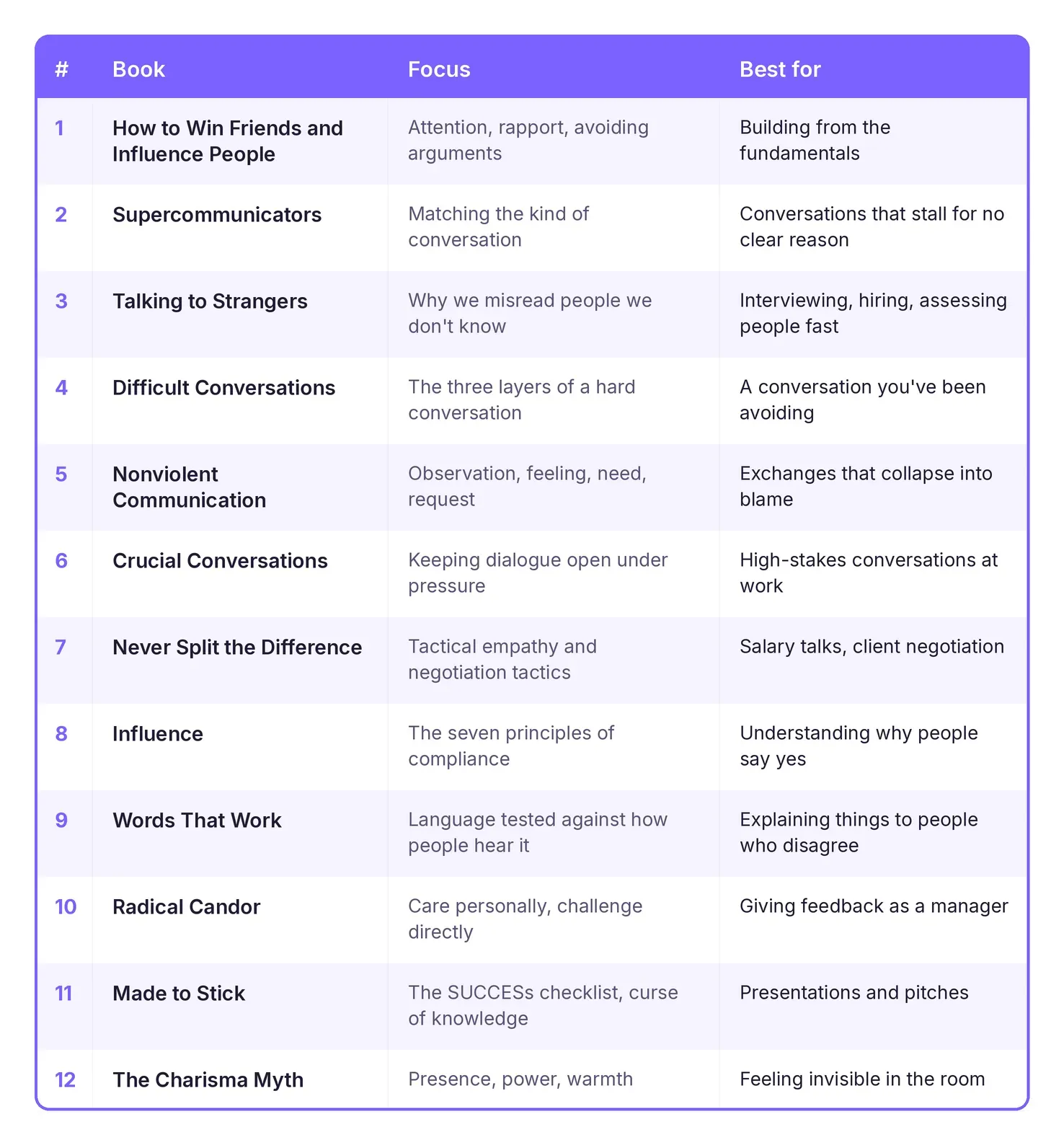
The best books to read for communication skills are the ones aimed at the conversation you keep getting wrong, so start there rather than at the top of the list. If there's a specific person and a specific thing you need to say, read Difficult Conversations and don't read anything else until you've had the conversation. If you want current research on why conversations misfire, Supercommunicators is the newest book here and the easiest to finish. If you're negotiating something this month, Never Split the Difference is the most immediately usable.
Read one at a time, and take one practice out of it rather than trying to apply the whole framework. Most people who read four of these books in a row end up with a vocabulary for communication and no change in how they talk, because the books were never the hard part. Rosenberg's observation-versus-evaluation distinction takes about ten minutes to understand and months to use reliably when you're annoyed. That's true of nearly every technique on this list.
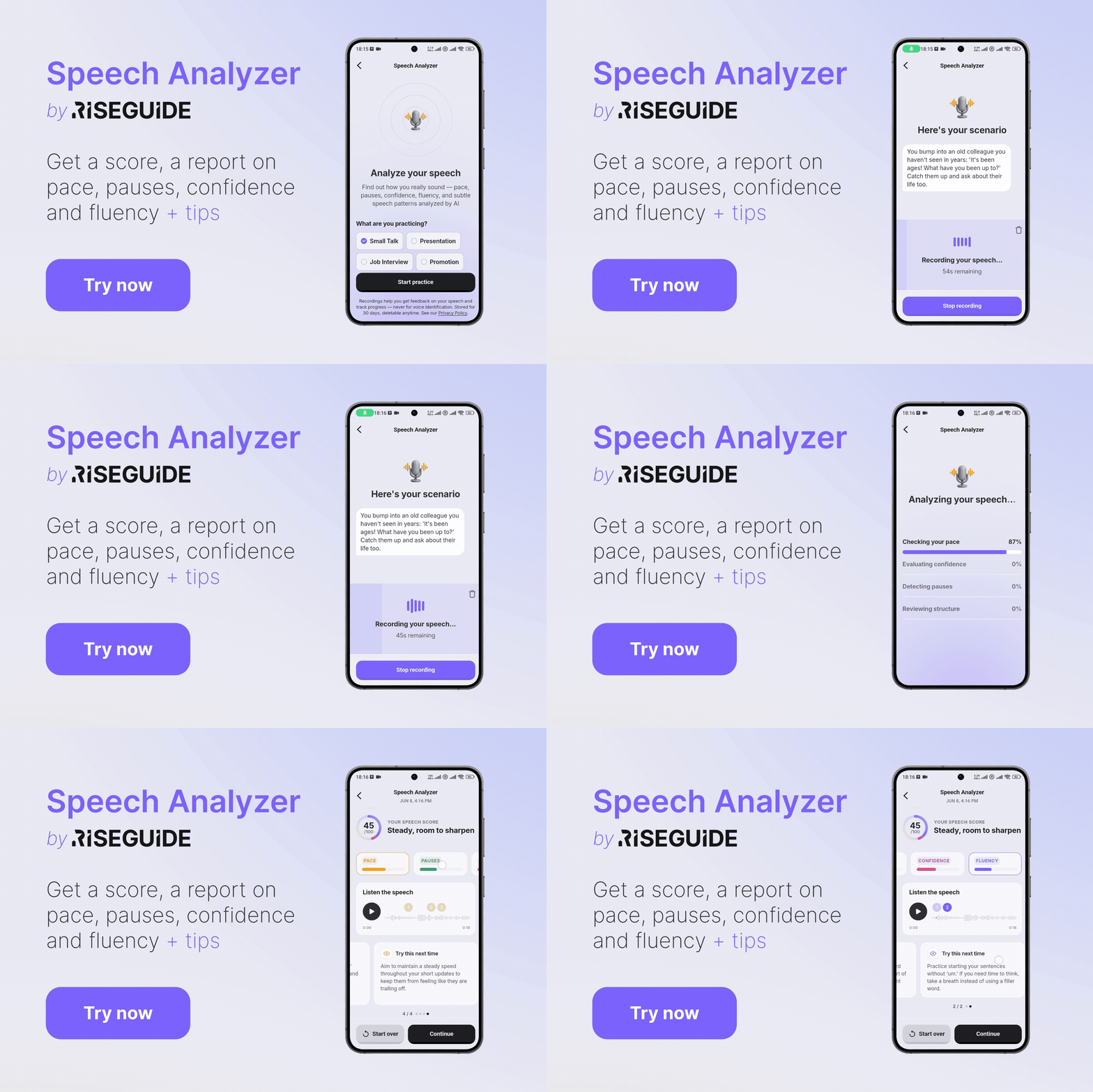
That's also where a book runs out. It can show you what good listening looks like, but it can't tell you whether you did it, and it can't put you in a conversation to try. If you want the practice side alongside the reading, RiseGuide's Communication Mastery journey covers the same ground in short lessons built from expert knowledge, with exercises to rehearse before the conversation that matters. Our post on passive listening is a decent place to test whether the reading is translating yet.
There isn't one answer, because the books split by situation. For everyday conversation, How to Win Friends and Influence People. For conflict, Difficult Conversations. For negotiation, Never Split the Difference. If you want a single current book that covers the widest ground, Supercommunicators (2024) is the one to pick.
Start by naming the conversation that keeps going badly — an argument you avoid, a meeting where you don't get heard, small talk that dries up — and choose the book aimed at that. Reading three books on different problems will leave you with less than finishing one on the right problem.
How to Win Friends and Influence People. The principles are short, concrete, and behavioral, so you can try one the same day you read it. Supercommunicators is a good second, since the three-conversations model gives you a way to make sense of the rest.
They can give you the model and the language, and that's useful — most people can't say what went wrong in a bad conversation, and these books can. What they can't do is give you the reps. The readers who see a change are the ones who take one practice, use it in real conversations, and get feedback on how it went.
Crucial Conversations for tense conversations with colleagues, Radical Candor if you manage people, and Made to Stick if your problem is that good ideas die in meetings.