RiseGuide Team

To find the best app for your mental health, match it to what you need. For meditation and sleep, start with Calm, Headspace, or Insight Timer. To talk with a licensed therapist, use BetterHelp or Talkspace. For anxiety support any time of day, try Wysa. To understand your moods, track them in Daylio. To build gentle self-care habits, Finch makes it feel easy. All eight are free to download and rated 4.3 or higher on the app stores, so pick the one that fits the problem you most want to work on and start there.
More of us are turning to our phones for support with stress, sleep, low mood, and anxiety, and there are now thousands of mental health apps to choose from. Some teach you to meditate, some connect you to a real therapist, and some simply help you notice how you feel day to day. The hard part is working out which one fits your situation, because they do very different jobs.
This roundup covers eight of the best apps for mental health right now, grouped by what they help with, so you can go straight to the type you need. For each one you will find what it does, who it suits, what it does well, and where it falls short.
These apps are made for everyday support, and they are not a replacement for professional care. If you are going through a crisis or thinking about harming yourself, please reach out to a professional or a crisis line like the 988 Lifeline in the US.
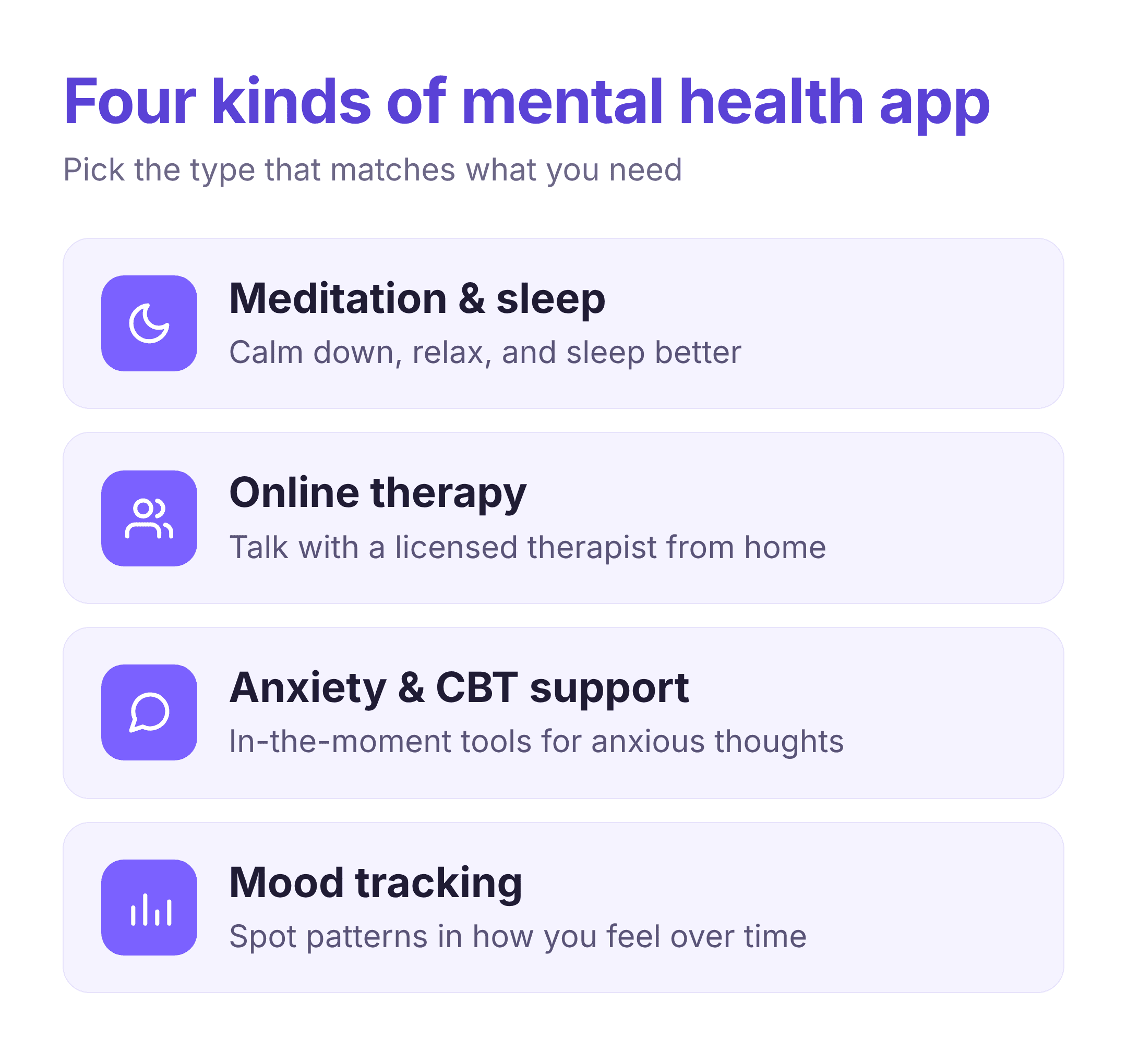
The main thing is to match the app to your goal. Broadly, mental health apps fall into four groups: meditation and sleep apps that help you calm down and rest, online therapy apps that connect you to a licensed professional, anxiety and mood support apps built around techniques like CBT, and mood trackers that help you spot patterns over time. Some of the best mental wellness apps do one of these jobs very well rather than trying to do all four.
Beyond the type, two practical things matter: check that the app runs on your phone (iOS, Android, or both), and read its privacy policy, since these apps handle sensitive information. Price matters too, and the good news is that every app here is free to download, which makes it easy to try a few before you settle on one.
App Store (4.8 ⭐) · Google Play (4.4 ⭐)
Best for: winding down and sleeping better.
Calm is built around rest. Its best-known feature is Sleep Stories, calming bedtime tales read by familiar voices, alongside guided meditations, breathing exercises, and a large library of soundscapes and music. A short Daily Calm session gives you a simple way to start or end the day, and the whole app has a quiet, uncluttered feel that suits people who find other wellness apps busy. If your main struggle is a racing mind at bedtime, this is the one to try first.
Strengths:
Limitations:
App Store (4.8 ⭐) · Google Play (4.3 ⭐)
Best for: beginners who want to build a meditation habit.
Headspace teaches mindfulness in a friendly, structured way. Its courses walk you through the basics step by step, with short animations that explain what you are doing and why, so meditation feels less mysterious. There are focus playlists, quick SOS sessions for stressful moments, and sleep content too. People who have tried to meditate and given up often find Headspace's guided, course-based approach is what finally makes it stick.
Strengths:
Limitations:
App Store (4.9 ⭐) · Google Play (4.7 ⭐)
Best for: variety without paying.
Insight Timer offers one of the largest free libraries of guided meditations anywhere, with tens of thousands of sessions from teachers around the world on everything from anxiety to focus to sleep. It also has a simple meditation timer with ambient bells for people who prefer to sit in silence, plus live sessions and talks. If you like to explore different voices and styles rather than follow one fixed program, this is among the best free mental health apps you can download.
Strengths:
Limitations:
App Store (4.8 ⭐) · Google Play (4.5 ⭐)
Best for: ongoing talk therapy from home.
BetterHelp connects you with a licensed therapist and lets you work with them by message, live chat, phone, or video. You fill out a questionnaire about what you are dealing with, get matched to a counselor, and can switch if the fit is not right. For people who want real professional support but find in-person appointments hard to arrange, it brings therapy into the same phone you already carry. This is a bigger step than a self-guided app, and it is the right step when everyday tools are not enough.
Strengths:
Limitations:
App Store (4.8 ⭐) · Google Play (4.5 ⭐)
Best for: therapy you can fit around your day, plus psychiatry.
Talkspace is another established online therapy service, with licensed therapists you reach by text, audio, or video, and the option of psychiatry for medication support. Its messaging model suits people who process things in writing and want to reach their therapist between sessions rather than only in a weekly slot. It also works with some insurance plans, which can make professional care easier to access. Like any therapy, it works best once you have settled with a provider you trust.
Strengths:
Limitations:
App Store (4.9 ⭐) · Google Play (4.5 ⭐)
Best for: a private place to talk things through when anxiety hits.
Wysa is an AI chatbot that uses techniques from cognitive behavioral therapy to help you work through anxious or low moments. You type how you are feeling and it guides you through exercises to reframe the thought or calm down, all anonymously, which lowers the pressure for people who are not ready to talk to a person. It also has a library of self-help tools and the option to add a human coach. Among apps for anxiety, it stands out for being available the moment you need it, day or night.
Strengths:
Limitations:
App Store (4.8 ⭐) · Google Play (4.7 ⭐)
Best for: spotting what affects how you feel.
Daylio is a mood tracker that takes seconds to use. Instead of writing, you tap how you feel and what you were doing, and over time it builds charts that show patterns, like which activities tend to lift your mood and which drag it down. That record is useful on its own, and it is also something you can bring to a therapist. If you want more words, you can add short journal entries too. For anyone trying to understand their ups and downs, it is one of the easiest habits to keep.
Strengths:
Limitations:
App Store (4.9 ⭐) · Google Play (4.9 ⭐)
Best for: making small self-care steps feel rewarding.
Finch wraps self-care in a gentle game. You care for a small pet that grows as you complete little wellness tasks, like a breathing exercise, a short walk, or a quick mood check-in. The tone is warm and low-pressure, which makes it a favorite for people who find other apps too clinical or who struggle to start at all. It quietly builds journaling, reflection, and healthy routines into something you look forward to opening. Its near-perfect store ratings reflect how much people enjoy it.
Strengths:
Limitations:
| App | Type | Standout feature | Watch-out | App Store | Google Play | Price |
|---|---|---|---|---|---|---|
| Calm | Meditation and sleep | Sleep Stories and soundscapes | No therapy or mood tracking | 4.8 | 4.4 | Free; $14.99/mo or $69.99/yr |
| Headspace | Meditation | Step-by-step meditation courses | Can feel slow if you already meditate | 4.8 | 4.3 | Free; $12.99/mo or $69.99/yr |
| Insight Timer | Meditation | Huge free library of guided sessions | So much choice it can overwhelm | 4.9 | 4.7 | Free; $9.99/mo or $59.99/yr |
| BetterHelp | Online therapy | Licensed therapist by chat, phone, or video | A bigger commitment than a self-help app | 4.8 | 4.5 | Free app; therapy about $70 to $100/week |
| Talkspace | Online therapy | Message your therapist, plus psychiatry | Depends on the right provider match | 4.8 | 4.5 | Free app; plans from about $69/week; Go $29.99/mo |
| Wysa | AI and CBT support | Anonymous CBT chatbot, any time | Support, not a replacement for a therapist | 4.9 | 4.5 | Free; Premium about $99.99/yr |
| Daylio | Mood tracking | Tap to log moods and see patterns | Tracks, but teaches no techniques | 4.8 | 4.7 | Free; $4.99/mo or $35.99/yr |
| Finch | Self-care habits | A self-care pet that grows with you | Playful style, not for treating a condition | 4.9 | 4.9 | Free; $9.99/mo or $69.99/yr |
Ratings and prices are an October 2026 snapshot and will shift over time, so check the current figure before you download. If you want more ways to calm a busy mind, our team's guide to the best meditation apps goes deeper on that category, and our post on stress management covers techniques that work without any app at all.
Start from the problem, not the app. If stress and sleep are the issue, a meditation and sleep app like Calm or Headspace is the easiest place to begin, and Insight Timer gives you the most to explore for free. If you know you want to talk to a professional, BetterHelp or Talkspace put a licensed therapist within reach from home. If anxiety flares and you want something in your pocket for the moment it hits, Wysa is built for exactly that.
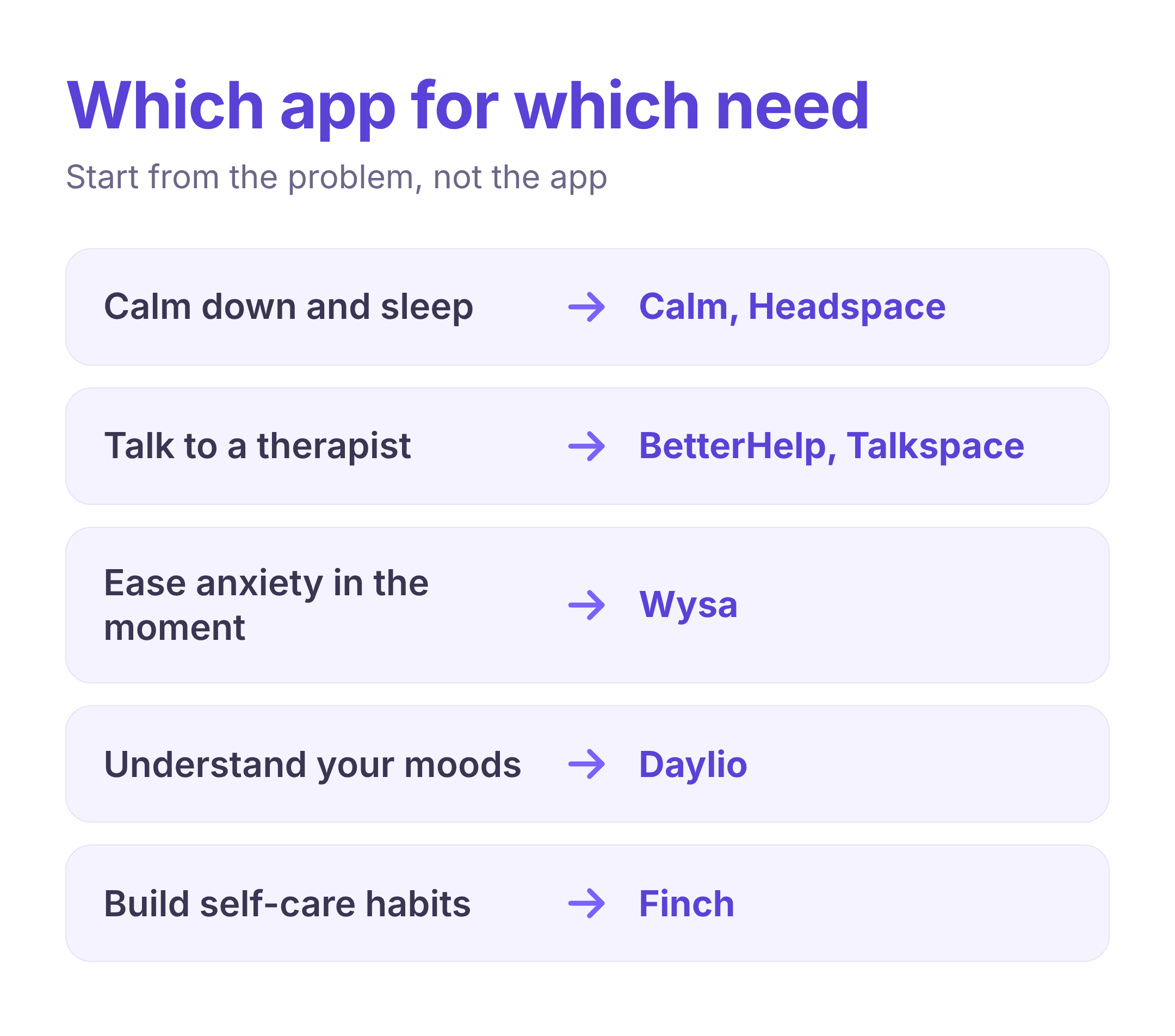
If you are not sure yet, tracking is a good first move. Logging your mood in Daylio for a couple of weeks, or building a daily check-in habit with Finch, often makes it clearer what kind of help would actually move the needle for you. There is no harm in trying two or three, since all of them are free to download, and keeping the one that you reach for without having to remind yourself. Whatever you pick, pairing an app with the everyday habits in our team's guides to the signs of burnout and journaling will get you further than any single download on its own.
The best apps for mental health are the ones that match what you are dealing with, so let your own situation choose for you. Reach for a meditation app to calm down and sleep, an online therapy app to work with a professional, a support app like Wysa for anxious moments, and a tracker like Daylio or Finch to understand yourself over time. Download one that fits, give it a couple of weeks, and keep the one that earns a place on your phone.