RiseGuide Team

To start journaling, you pick a tool you'll keep close (a cheap notebook or a notes app), set aside about five minutes, and choose one simple method to begin: free writing, a short gratitude list, or a single prompt. Write without worrying about spelling or structure, and attach the habit to something you already do each day, like your morning coffee, so it lasts. Once it feels natural, you can try other methods such as bullet journaling or reflective writing, and lean on prompts whenever the page feels blank. The benefits, from a calmer mind to clearer thinking, come from writing regularly, not from writing perfectly.
A blank notebook can feel strangely intimidating. Most people who want to start journaling stall on the same three questions: what do I write, how often, and does any of it help? Journaling for beginners has a lower bar than it looks. You don't need neat handwriting, an expensive notebook, or a spare hour. You need a few minutes, somewhere to put your thoughts, and a little structure so the habit survives past the first week.
Journaling is the habit of writing down your thoughts, feelings, and experiences on a regular basis. It can be a private record of your day, a place to think through a problem, a list of things you're grateful for, or a mix of all three. There are no rules about length or format, which is part of why it works for so many different people.
Some people keep a paper notebook by the bed. Others type into an app during their commute. Because there's no single correct way to journal, the real question of how to journal is about finding a rhythm that fits your life, not copying someone else's. What counts is that you're putting your inner experience into words, where you can look at it more clearly.
The benefits of journaling are a big part of why the habit has lasted for centuries, and modern research supports several of them. Writing regularly can lower stress, lift your mood, and help you make sense of difficult experiences. In a 2018 trial of people with elevated anxiety, those who spent a few minutes on positive journaling reported fewer symptoms of anxiety and depression after a month, and greater resilience, compared with people who received usual care.
Putting a worry into words also loosens its grip. Psychologist James Pennebaker has spent decades studying what he calls expressive writing, and his research links short sessions of writing about hard events to better emotional and physical health.
You don't need a plan for the whole year, just a way to fill the first page and come back tomorrow. These five steps go in order, because each one removes a reason to quit before the habit forms.
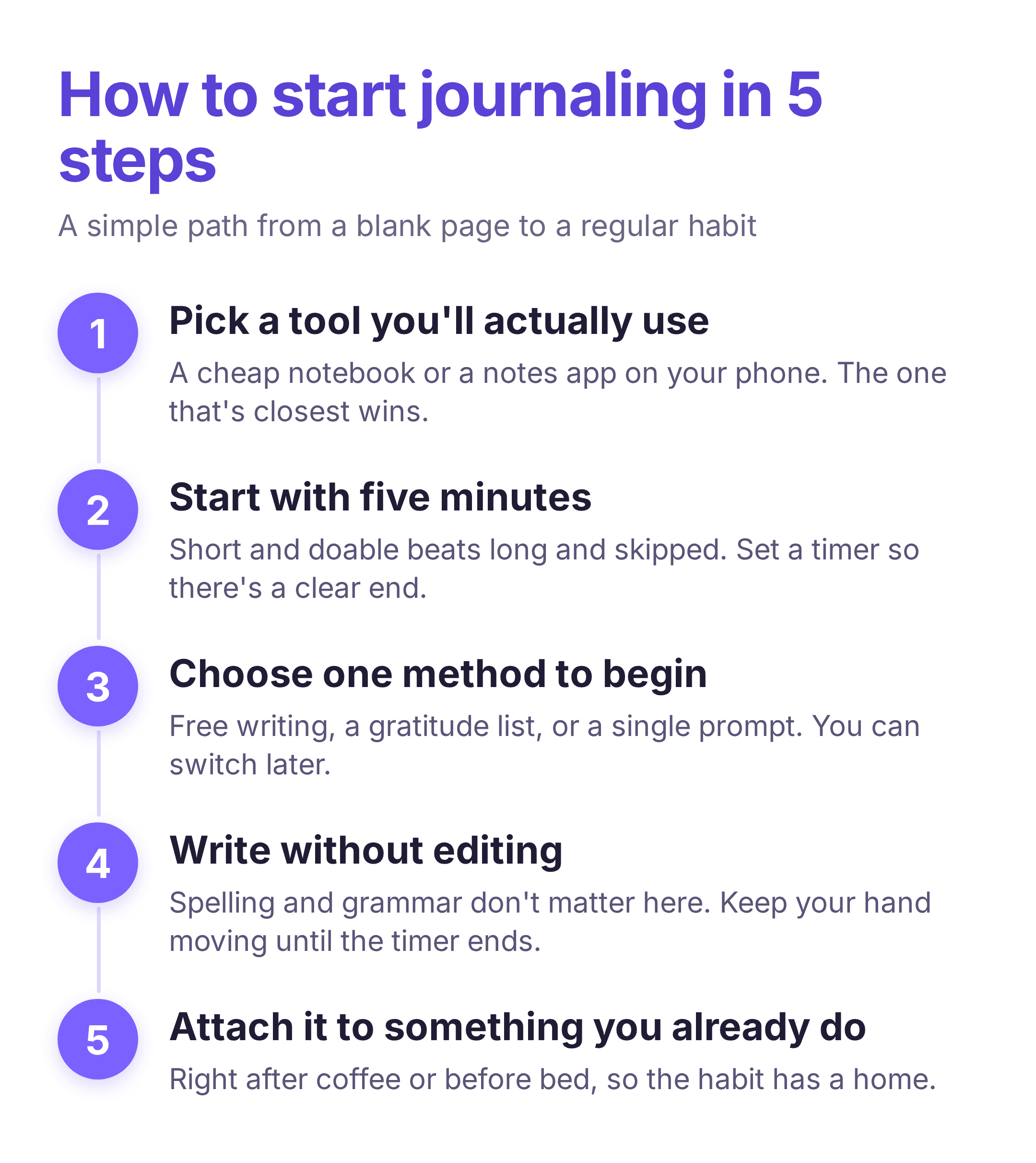
There is no single best way to keep a journal, so it helps to know the main options and pick one that matches what you need right now. You can mix them or move between them as your mood and schedule change.
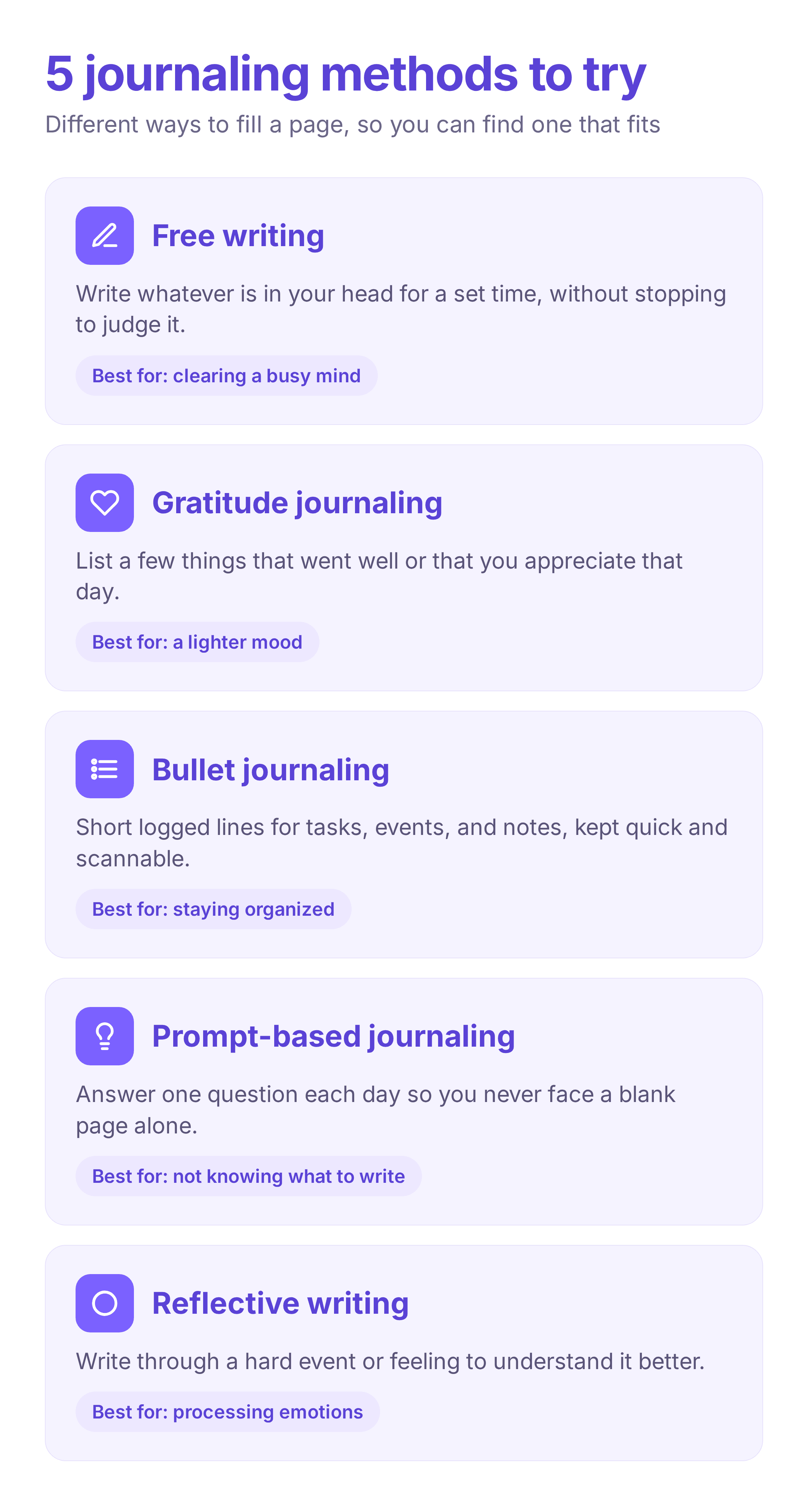
Free writing means writing whatever is in your head for a set time, without stopping to judge it. One well-known version is morning pages, a practice from Julia Cameron's book The Artist's Way: three pages, longhand, first thing in the morning, before the day crowds in. It's a good fit when your head feels busy and you want to clear it.
Gratitude journaling is simply listing a few things that went well or that you appreciate. It takes two or three minutes and tends to shift your attention toward what's working. Many people pair it with the reflective habits in a set of daily affirmations, which our team covers in detail.
Bullet journaling uses short, logged lines for tasks, events, and notes, kept quick and scannable. It suits people who want their journal to double as an organizer. Ryder Carroll, who created the method, frames it as a way to declutter your mind rather than decorate a notebook, which he describes in his TEDx talk:
With prompt-based journaling, you answer one question each day, so you never face a blank page alone. A prompt gives your entry a starting point and a shape, which is why it's one of the most beginner-friendly ways in. There's a full list of prompts in the next section.
Reflective writing is where you write through a hard event or feeling to understand it better. This is the kind of journaling closest to Pennebaker's expressive writing research above. It asks a bit more of you than a gratitude list, so it's worth saving for when you have the space to sit with something.
The most common reason beginners quit is not knowing what to write. A prompt fixes that. Keep a few of these journaling ideas where you can see them, and use one whenever the page feels blank. There's no need to work through them in order.
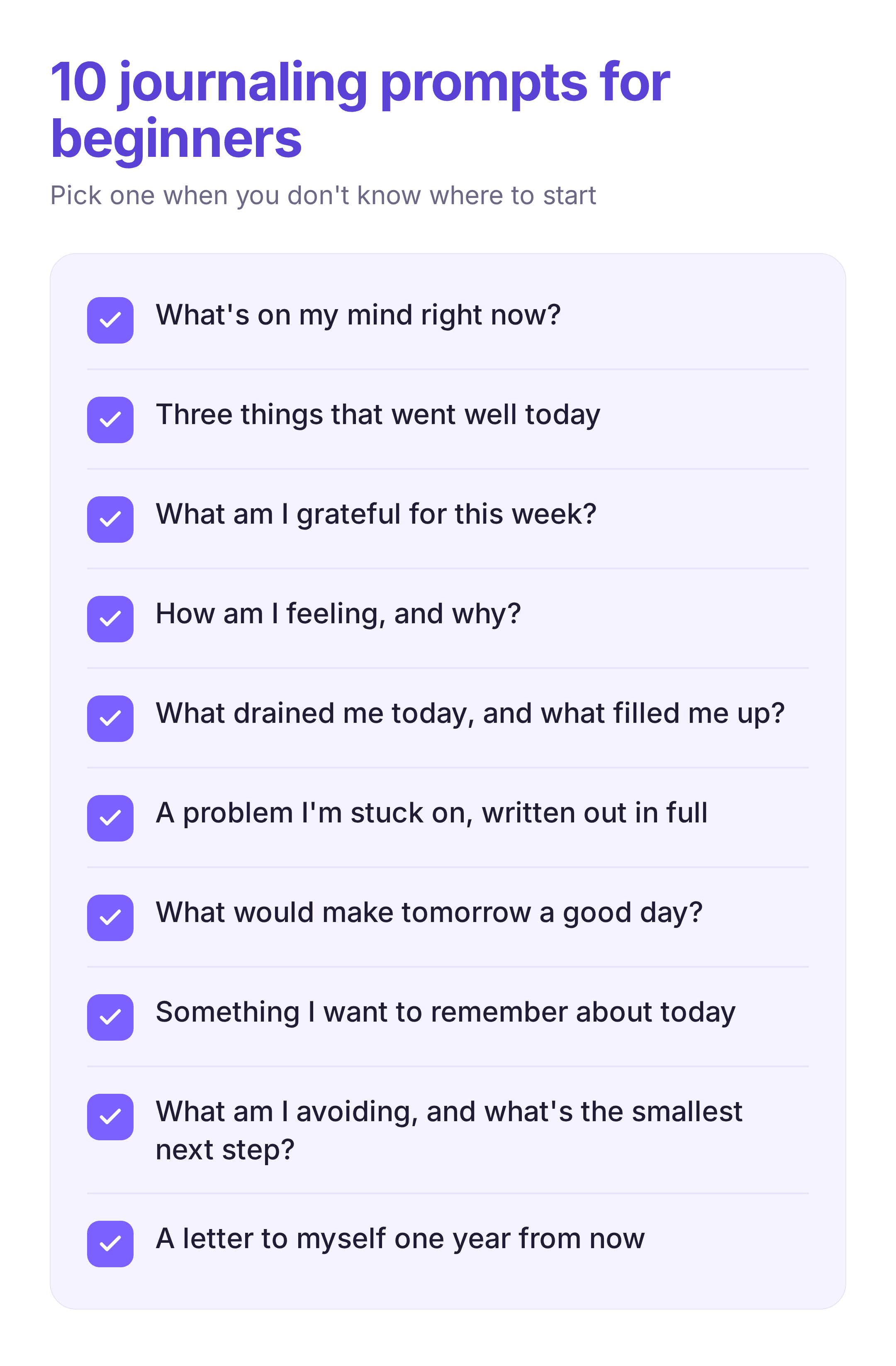
If you want more structure, you can turn any of these into a daily template and answer the same two or three each night.
Getting started is easy; the harder part is coming back. The trick is to make the habit small and consistent rather than ambitious. A single line on a busy night still counts, and it keeps the streak alive. Our team's guide to building good habits has a full framework for this, and the same ideas apply directly to journaling: shrink the habit, tie it to a cue, and make it easy to repeat.
Two things help most. First, lower the bar on hard days, so the choice is between a short entry and a full one, never between journaling and nothing. Second, keep your notebook or app visible, because a habit you can see is a habit you remember. Miss a day without guilt and pick it back up the next; the goal is a long, forgiving practice, not a perfect record.
Learning how to start journaling comes down to lowering the stakes: a tool you'll use, a few minutes, one method, and a cue that brings you back tomorrow. Pick one prompt from the list, set a timer, and write the first entry today. The habit gets easier every time you return to it, and the benefits build from there.
Start with the present moment. Write the date, then answer a simple question like "how am I feeling right now?" or "what happened today?" You don't need a grand first entry. A few honest sentences are enough to get the habit moving.
Five to ten minutes is plenty, especially at the start. Short sessions are easier to repeat, and repetition is what brings the benefits. If you find yourself wanting to write longer, that's fine, but don't set a long minimum you'll dread.
For most people, yes. Daily journaling can support your mood and help you process the day, and the routine makes the habit stick. If writing about hard events ever leaves you feeling worse rather than clearer, it's reasonable to keep entries lighter or take a break, and to talk with a professional if difficult feelings persist.
It's a short, structured entry that's popular with beginners because it gives you a fixed shape. A simple version goes like this: three things you're grateful for, two things that went well, and one thing you're looking forward to. It takes a couple of minutes and works well on days when you don't feel like writing much.