RiseGuide Team

To find the best meditation apps for you, match the app to what you want. Insight Timer has the biggest free library. Headspace is the most structured for beginners. Calm is built for sleep. Balance builds a plan that adapts to you. Healthy Minds Program takes a science-based approach and is free. Waking Up offers a secular, philosophical take. Happier (formerly Ten Percent Happier) keeps things practical for skeptics. Medito is completely free with no ads. Smiling Mind is made for kids and families. If you want to start today with a free app, open Insight Timer or Medito. If you're brand new and want to be shown what to do, start with Headspace. To fall asleep more easily, start with Calm.
Spending a few minutes a day with your attention is a simple practice with real support behind it. In a 2023 meta-analysis of 11 randomized trials with college students, a mindfulness program lowered anxiety, stress, and depression scores compared with no practice at all. An app won't do the sitting for you, but it removes the friction: it hands you a voice to follow, a timer when you want silence, and a reason to come back tomorrow. Whether a meditation app "works" comes down to using it regularly — the research is on guided practice done consistently, not on downloading something and forgetting it.
There are dozens of meditation apps, and the right one depends on why you're here: to fall asleep, to settle anxiety, to build a daily habit, or to get your kids started. The apps below are sorted by what each one does best, with current store ratings, what you get, and where each falls short. Several of them are free.
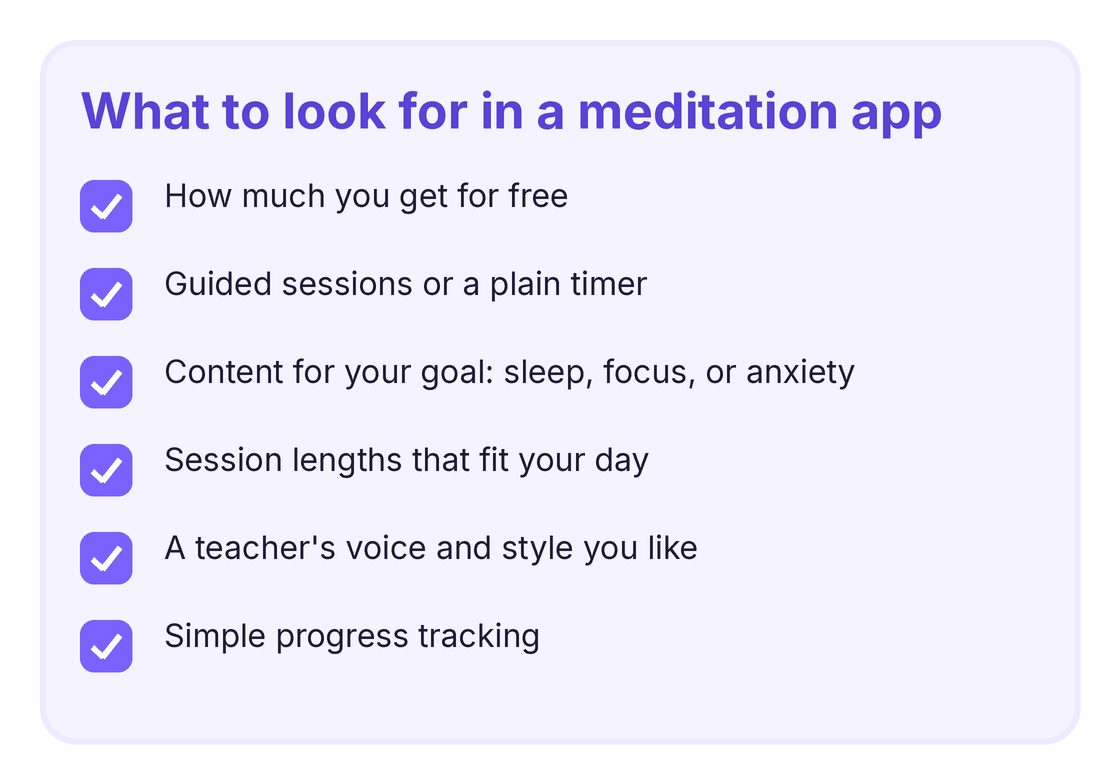
A few things separate an app you'll keep from one you'll delete. Check how much you get for free, since the best free meditation apps give you a real practice without a time limit. Decide whether you want guided sessions with a teacher's voice or a plain timer for silent sitting. Match the app to your goal — sleep, focus, or calming anxiety — because the best meditation apps for anxiety are the ones with dedicated stress courses, while a sleep-first app is a different tool. Look at session lengths that fit your day, whether the teacher's voice and style suit you, and whether simple progress tracking helps you keep going. A regular practice is also one of the steadier ways to improve focus, and what keeps it alive over time is usually the kind of motivation that comes from within rather than willpower.
App Store 4.9 ⭐ · Google Play 4.7 ⭐ Best for: anyone who wants the most content for free. Insight Timer is the largest free meditation app available, with more than 127,000 guided meditations plus a plain timer for unguided sitting, so it works as both a guided meditation app and a silent timer. The free library is the real draw, and it's unusually broad: teachers span secular, spiritual, religious, and philosophical traditions, and there are sleep tracks, ambient music, live sessions, and short courses on top. If you like to browse and follow your own taste, it's hard to run out of material. The trade-off is that the sheer size can be overwhelming when you're new and just want someone to tell you where to begin. Strengths:
App Store 4.8 ⭐ · Google Play 4.3 ⭐ Best for: people new to meditation who want to be guided step by step. Headspace is the most structured of the big apps. It's co-founded and largely narrated by Andy Puddicombe, a former Buddhist monk, and it starts you on a Basics course that teaches the fundamentals in short, friendly lessons before opening into themed courses for stress, anxiety, focus, and sleep. You also get quick SOS sessions for hard moments, a Focus mode with music, and sleepcasts for bedtime. The calm single voice and clear path make it one of the best meditation apps for beginners, and the best guided meditation app for learning how to practice. Strengths:
App Store 4.8 ⭐ · Google Play 4.5 ⭐ Best for: winding down and falling asleep. Calm is built around rest. Its Sleep Stories — bedtime tales read by narrators like Stephen Fry — are the signature feature, and they sit alongside sleep soundscapes, a Daily Calm session, breathing tools, and longer masterclasses. As a sleep meditation app it's hard to beat, and the polished, soothing design is a big part of why people stick with it. It also covers general meditation and has a Calm Kids section, so it stretches beyond bedtime, though rest is clearly where it shines. Strengths:
App Store 4.9 ⭐ · Google Play 4.6 ⭐ Best for: people who want a personalized plan instead of a menu to browse. Balance, made by Elevate Labs, takes a different route: it asks about your experience, your goals, and how each session felt, then assembles your daily meditation from thousands of audio pieces and keeps adjusting as you go. The onboarding teaches technique rather than only pressing play, so it suits people who want to feel their skill improving over time. Because it decides what you practice, it's less of a library to explore and more of a coach that plans your day. Strengths:
App Store 4.9 ⭐ · Google Play 4.8 ⭐ Best for: people who want the evidence and the "why" behind the practice. Healthy Minds Program comes from a nonprofit founded by neuroscientist Richard Davidson, and it's free to use. Instead of a content menu, it organizes practice around four trainable skills — awareness, connection, insight, and purpose — and teaches the research behind each one in short, podcast-style lessons before the guided sits. You can do many of the meditations seated or while walking, which helps if sitting still isn't your thing. It's one of the best free meditation apps, especially if you like understanding what a practice is doing. Strengths:
App Store 4.9 ⭐ · Google Play 4.6 ⭐ Best for: curious, analytical people who want the ideas behind meditation. Waking Up was created by neuroscientist and author Sam Harris, and it pairs guided practice with lessons about the mind, drawing on neuroscience, psychology, and contemplative traditions without any religious framing. A structured intro course gets you going, and from there the app leans into theory as much as practice, with talks on topics like attention, the self, and ethics. It suits people who want to understand what's happening when they meditate, not just follow along. Strengths:
App Store 4.8 ⭐ · Google Play 4.7 ⭐ Best for: no-nonsense people who find meditation a little too soft. Happier, which rebranded from Ten Percent Happier in 2024, keeps the down-to-earth, practical tone it built its name on. You get more than 500 guided meditations from experienced teachers, and the app now builds a personalized plan by checking in each month on your mood, needs, and how much time you have. The teaching is plain-spoken and secular, aimed at stress, anxiety, and sleep, which makes it an easy entry point for anyone who's rolled their eyes at the more spiritual apps. Strengths:
App Store 4.9 ⭐ · Google Play 4.8 ⭐ Best for: anyone who wants a completely free meditation app. Medito is a free meditation app built by a nonprofit foundation, with no ads and nothing locked away. It covers the essentials well, with courses for beginners, sleep, and stress, plus a timer for silent practice. It's simpler than the big commercial apps, but nothing is held back, which makes it an easy first app or a no-strings backup. Strengths:
App Store 4.8 ⭐ · Google Play 4.2 ⭐ Best for: children, teens, and classrooms. Smiling Mind is a free app from an Australian nonprofit, built with educators and organized by age. It has programs for children from about 5 to 12, separate content for teens and adults, and a dedicated hub for primary-school classrooms, covering sleep, calm, and handling everyday ups and downs. The age-specific structure is what sets it apart and makes it the best meditation app for kids and families, with plenty for parents to use alongside their children. Strengths:
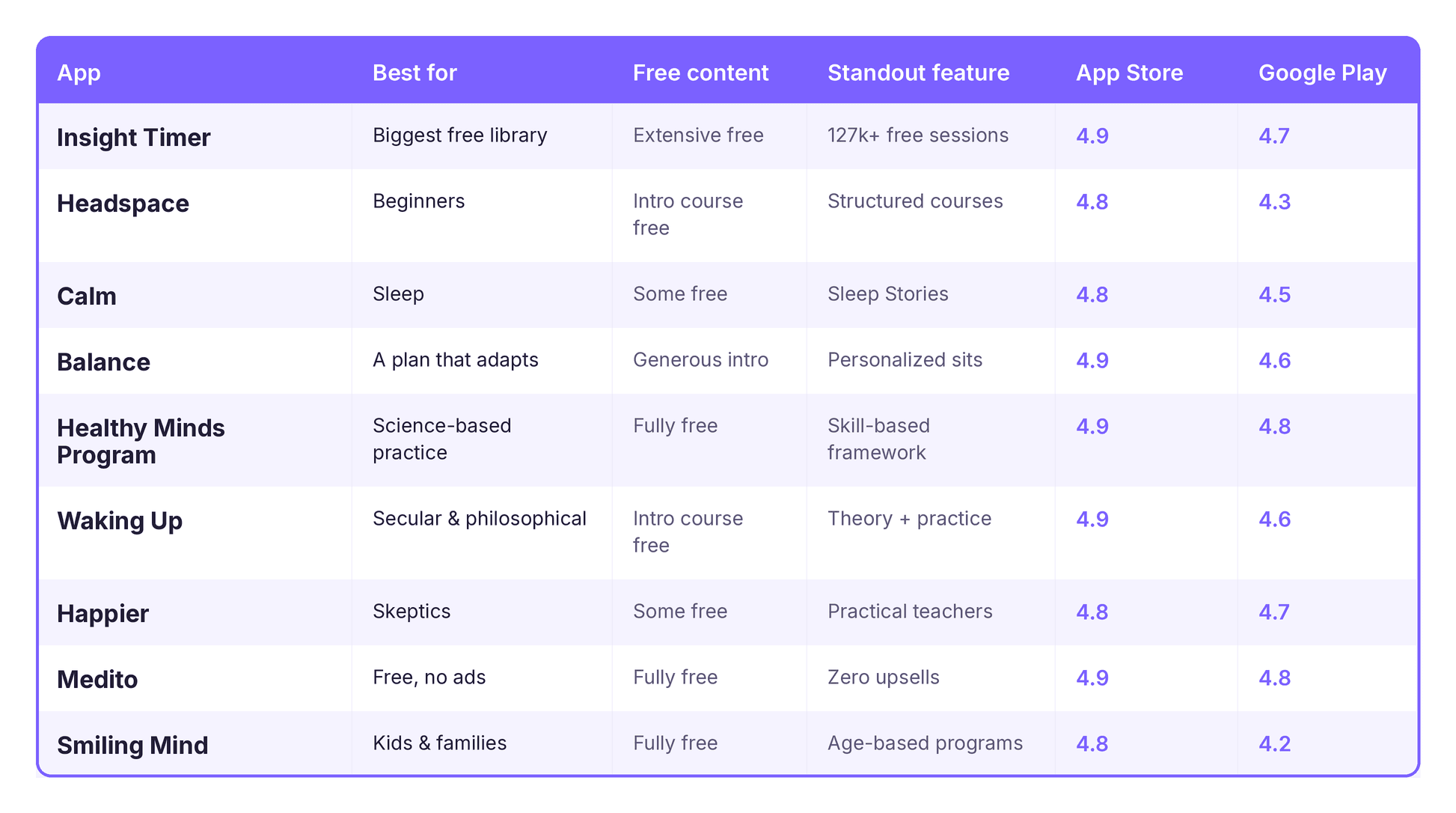
Here's how the picks line up side by side — what each is best for, how much you get for free, and the feature that stands out. Ratings are an October 2026 snapshot and shift over time, so treat them as a guide rather than a fixed score.
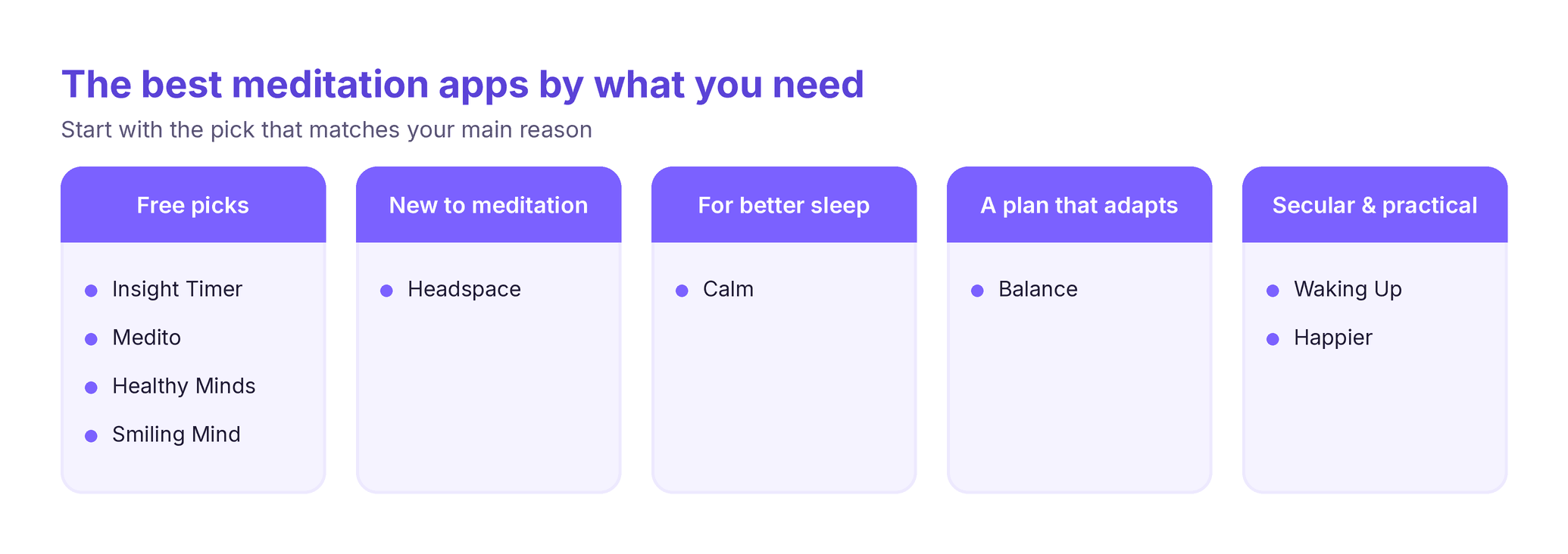
There's no single best meditation app — the right one depends on what you want from it. If a free app is what you need, the free meditation apps — Insight Timer, Medito, Healthy Minds Program, and Smiling Mind — give you a real practice for free. If you're completely new and want a clear path, Headspace walks you through the basics better than anything else. For sleep, Calm is the obvious pick. The common "Headspace or Calm?" question usually answers itself along those lines: Headspace if you want to learn to meditate, Calm if you mainly want to fall asleep. From there, it comes down to style. Balance suits people who want a plan that adapts to them, Waking Up fits those who want the ideas and science behind practice, and Happier is the one for skeptics who want it plain and practical. A good way to make the choice stick is to attach a few minutes of practice to something you already do, like a morning routine, so it has a reliable home in your day.
If your real goal is broader than calm — building focus, discipline, or communication in the same small pockets of phone time — a meditation app is only part of the picture. RiseGuide is a different kind of tool for that: short, interactive lessons built from expert insights that turn idle scrolling into steady self-improvement. The same app-first approach shows up in our roundup of the best apps for learning, too.
The best meditation app is the one you'll open tomorrow. Pick the entry that matches your main reason for starting — a free library, an easy on-ramp, better sleep, or something for your kids — and give it a week of short sessions before deciding. Most of these apps let you use the core experience right away, so there's little downside to trying two and keeping the one that fits.