RiseGuide Team

To improve focus, work on one task at a time, break your work into short timed blocks with real breaks in between, and clear away the obvious pulls on your attention before you start, especially your phone. Give your brain a single clear target so it knows what to hold on to. Over the longer term, protect your sleep, move your body most days, drink enough water, and spend a few minutes training your attention. No single change fixes focus on its own, but used together they make it much easier to concentrate and stay on task.
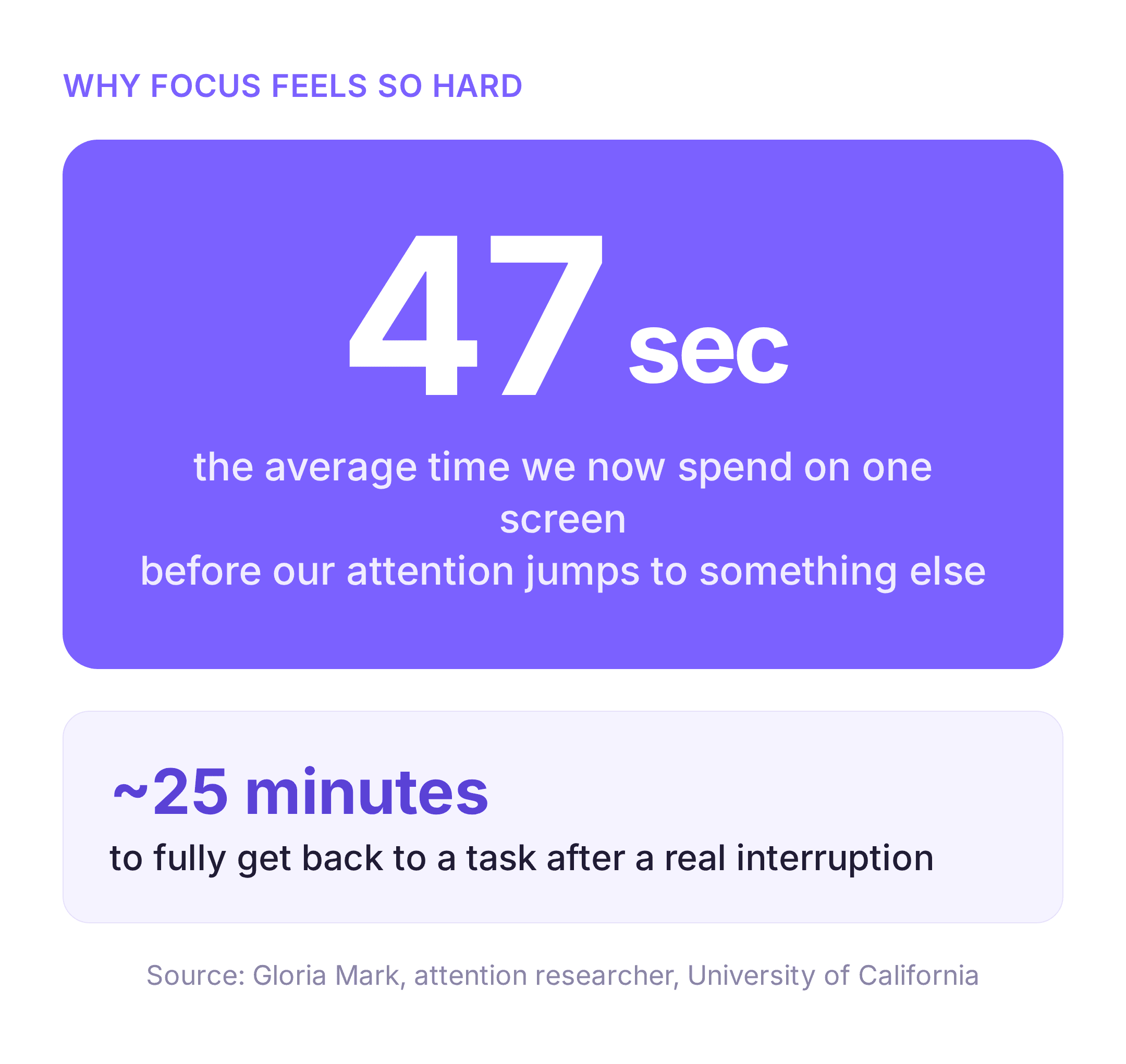
Most of us do not lose focus because we are lazy. We lose it because our attention is being pulled in a dozen directions at once, all day long. Attention researcher Gloria Mark has found that the average person now spends about 47 seconds on any screen before switching to something else, and it takes roughly 25 minutes to fully return to a task after a real interruption. So the real work of improving your focus is changing the conditions around your attention: how you set up your task, your space, and your day. This guide covers what makes focus so fragile right now, and the specific things you can do, both in the moment and over time, to concentrate better and stay with one thing for longer. Learning how to focus is a skill you can build with practice, and the question of how to improve focus usually comes down to a handful of ordinary habits.
Focus is not only willpower. It depends on how your brain is doing and what is happening around you, and several things tend to work against it at the same time.
The biggest one is constant switching. Every notification, open tab, and quick check pulls your attention off task, and because it can take around 25 minutes to fully refocus, a day of small interruptions can eat most of your best attention. Gloria Mark, who has studied attention for more than two decades, explains that our devices have trained us into shorter and shorter bursts of attention, and every switch sets your attention back.
The second reason is a tired or under-fueled brain. Poor sleep, skipped meals, dehydration, and sitting still all day shrink how long you can hold your attention. The third is a vague task: when you are not sure exactly what you are meant to be doing, your mind drifts to something clearer and more rewarding, usually your phone. A busy mind adds to it too. When you keep replaying a worry or a conversation, there is little attention left for the work in front of you, so it helps to learn how to stop thinking about something on a loop before you sit down.
These are the in-the-moment moves. They are techniques rather than strict steps, so start with the one or two that fit your day and add the rest as they help.
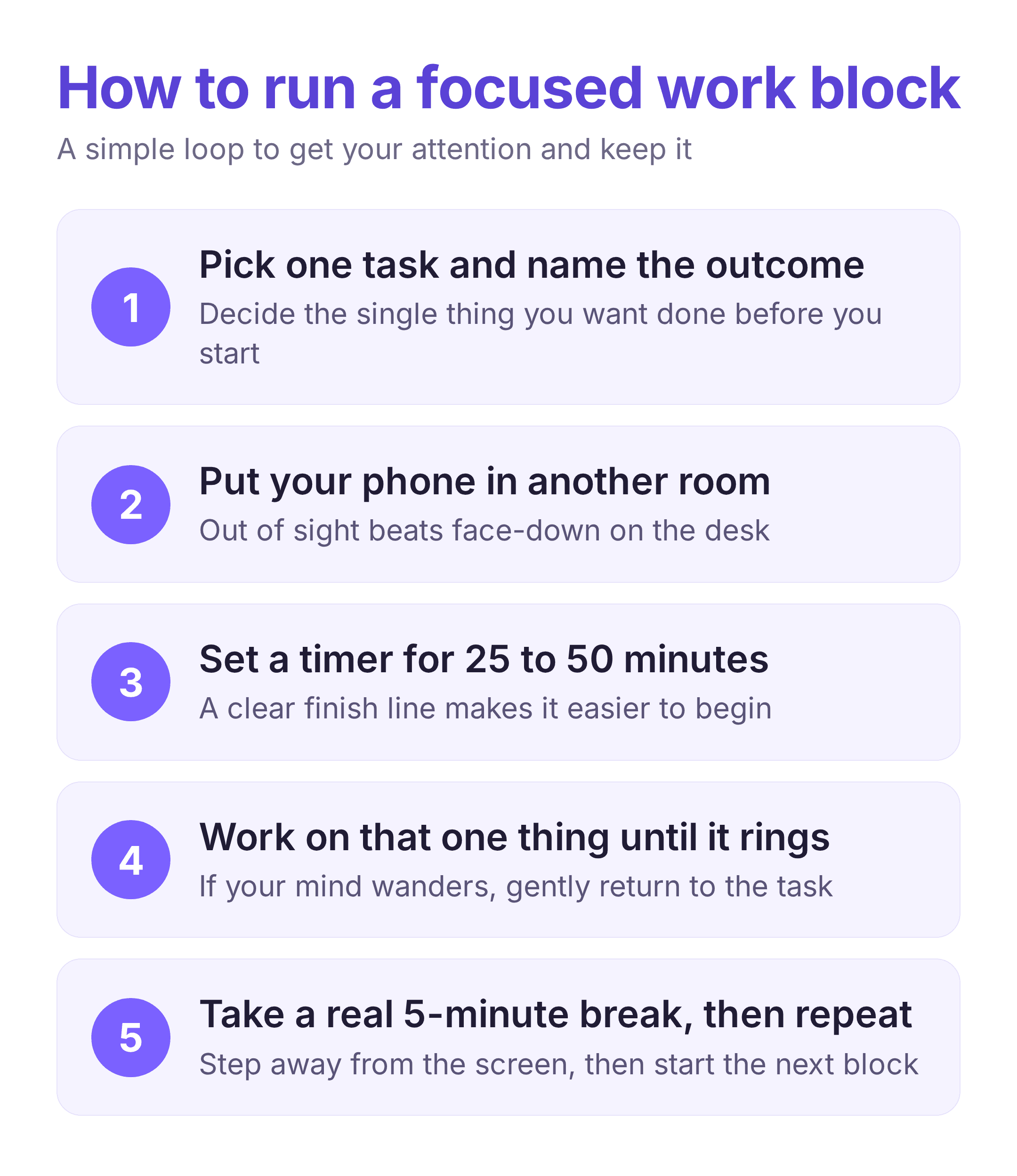
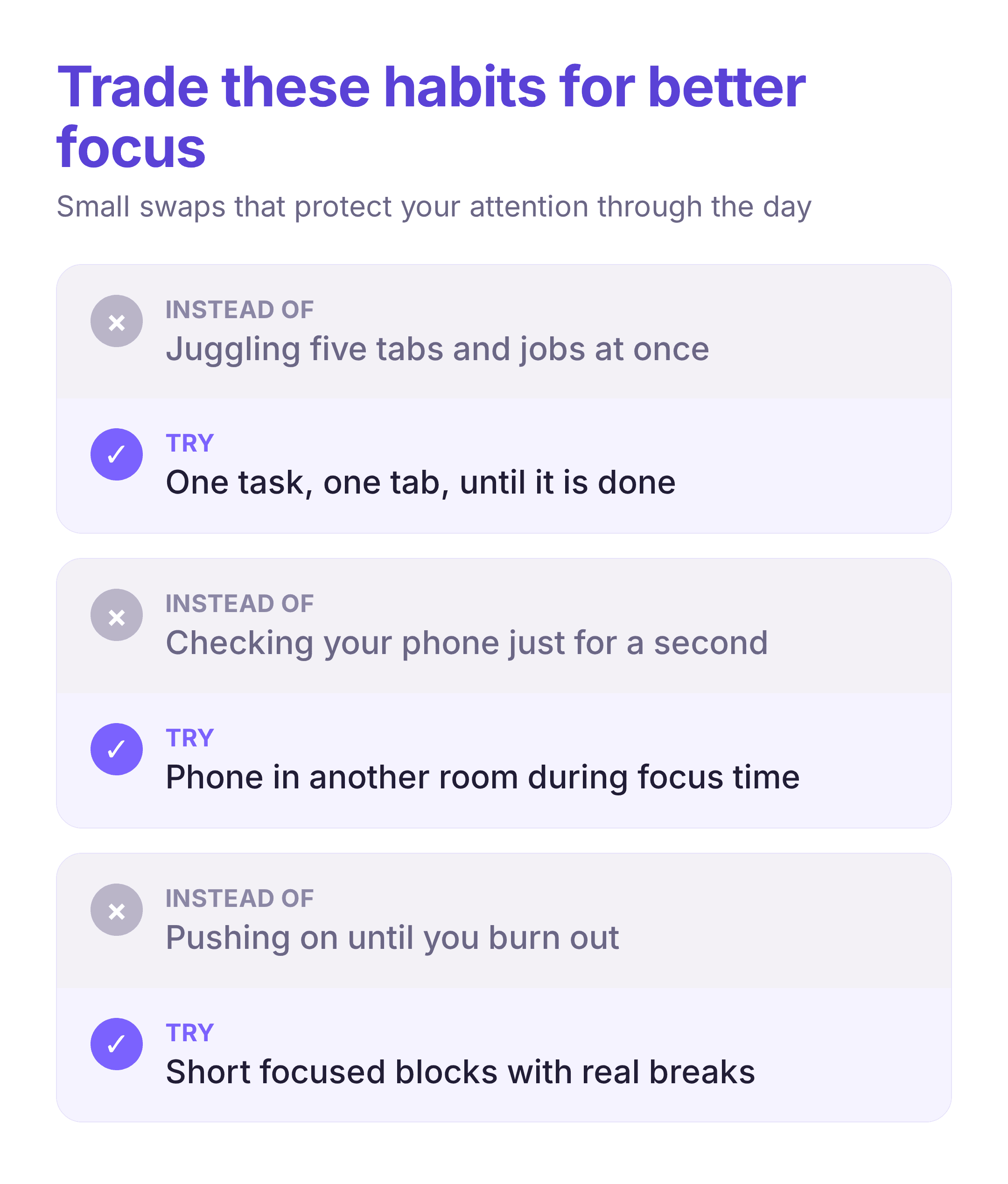
Doing several things at once feels productive, but your brain is just switching quickly between tasks, and each switch has a cost. Pick one task, put the others out of view, and give it your full attention until you reach a natural stopping point. If you tend to read something and realize you took none of it in, that is the cost of that switching, and the techniques in our post on how to remember what you read double as focus practice.
Attention wears down as you use it, so it holds up better in short, protected stretches. Set a timer for 25 to 50 minutes, work on one thing until it rings, then take a real break away from the screen before the next block. Cal Newport, a computer science professor who writes about concentration, calls the ability to work without distraction "deep work," and argues it is becoming both rarer and more valuable.
If you want a little structure around this, a timer or planner app can hold the blocks for you, and our roundup of the best time management apps covers tools that fit different working styles.
The most reliable way to resist your phone is to not have it near you. Put it in another room, close the tabs you are not using, and turn off notifications for the next hour. If silence makes you restless, steady background sound or instrumental music can cover the little noises that keep pulling your ears away.
Attention needs somewhere to land. Before you start, name the single outcome you want, so your brain has one clear thing to hold on to instead of a fuzzy sense that you should be working. Neuroscientist Andrew Huberman describes focus as something you steer from the top down, and points out that narrowing your visual attention to one spot for a moment can help pull your mental attention in with it.
Your attention will drift, even on a good day, and that is normal. Learning how to stay focused mostly means noticing sooner when your mind drifts and coming back without a fuss. When you catch your mind on your phone or three tabs deep, name where it went, then gently return to the one task you chose. Coming back each time, without making a big deal of it, is how the skill improves.
The moves above help in the moment, but focus also rests on how you treat your brain the rest of the day. This is how to improve concentration over the longer term, by building a few ordinary habits that keep your attention steady.
A tired brain cannot hold attention for long, and one short night is enough to make the next day feel foggy. Aim for a consistent sleep and wake time, and give yourself a wind-down before bed. Anchoring your day helps too, and our morning routine checklist walks through a simple start that sets your attention up before the noise begins.
Movement is one of the most reliable ways to sharpen concentration. Even a brisk walk raises blood flow to the brain and can leave your attention clearer for hours afterward. You do not need a workout plan; a short walk between focused blocks counts.
Attention responds to practice. A few minutes a day of sitting quietly and returning your focus to your breath, whenever it drifts, is the same skill you use at your desk, rehearsed in a relaxed setting. If your spare minutes tend to vanish into scrolling, that same time can go toward building habits that make focus easier. RiseGuide turns those small gaps into short, interactive lessons built on expert insights, so a commute or a coffee break becomes a few minutes of focused practice rather than another scroll. Its SEEK tool can also pull a specific answer from a library of vetted expert sources when a nagging question is breaking your concentration, so you get what you need without falling down a search rabbit hole.
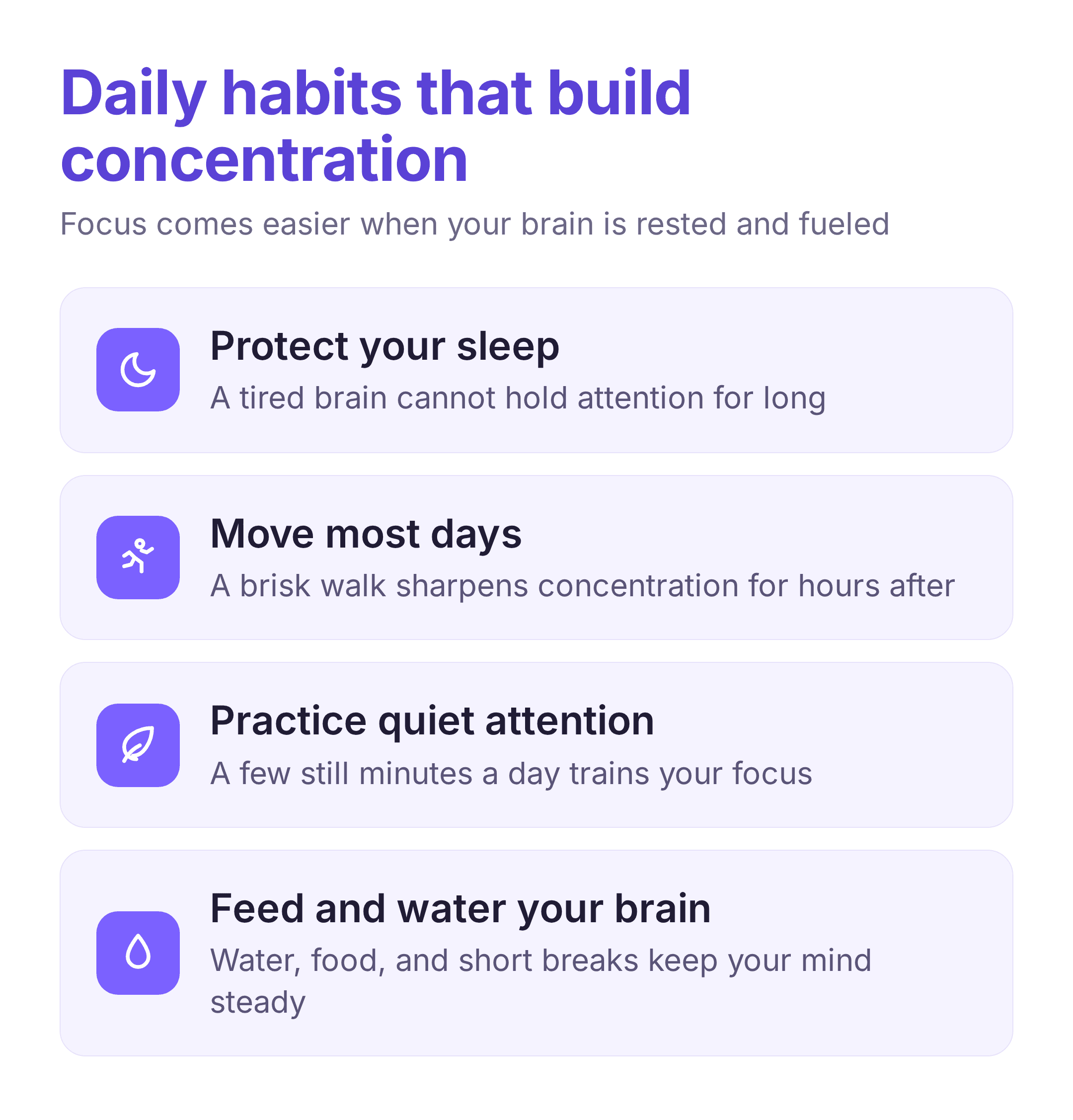
Your brain runs on steady fuel. Even mild dehydration can make it harder to concentrate, so keep water nearby, eat something with protein rather than only fast sugar, and take short breaks before you hit the wall instead of after.
Focus is not a fixed trait, and you do not need to overhaul your life to get more of it. Pick one change from each half of this guide, one for the moment you sit down and one for the rest of your day, and give it a week. Most people find that a phone in another room and a slightly earlier bedtime do more than any productivity trick. From there, you can add the others.
Usually it is a mix of ordinary things rather than one big problem: too little sleep, constant task-switching, a vague or boring task, hunger or dehydration, or a mind full of worry. Look at those first before assuming something is wrong with you.
Do a quick reset. Pick the single most important task, put your phone in another room, set a timer for 25 minutes, and name the one outcome you want before you start. Removing the phone and giving your brain one clear target makes the biggest difference.
Treat it as a set of habits, not a one-time fix. Protect your sleep, move your body most days, work in short focused blocks, and cut the obvious distractions. Concentration improves as those habits stack up over a few weeks.
Focusing is a skill that responds to practice. The most reliable way to focus better is to repeat the same small loop often: one task, a clear target, a protected block, a real break. A few quiet minutes of attention practice a day speeds it up.
If focus is a constant struggle no matter what you change, and it is affecting your work or daily life, it is worth talking to a doctor. Ongoing trouble concentrating can be linked to things like sleep problems, stress, low mood, or attention conditions such as ADHD, and a professional can help you sort out what is going on rather than guessing.