RiseGuide Team
 Free with any plan: the First Impression Formula guideClaim the free guideGet the guide
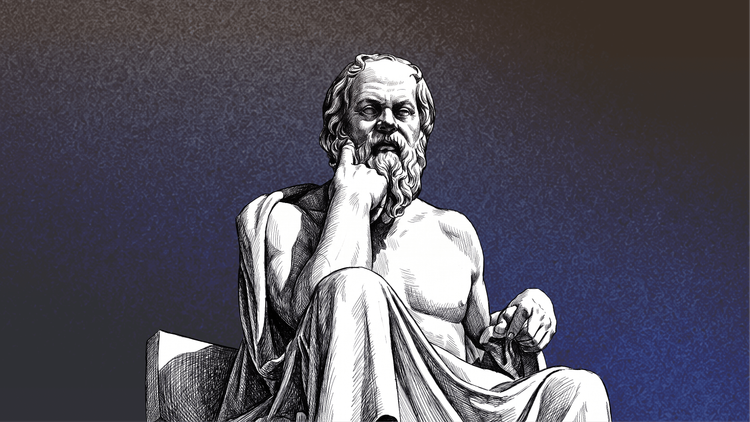
To use the Socratic method, you examine an idea by asking a series of honest, open questions instead of arguing your own case. You ask what a claim really means, what it takes for granted, what evidence sits behind it, how it looks from another point of view, and what follows if it is true. The point is to think more clearly together and to find the weak spots in an idea, including your own, rather than to win an argument. The same handful of questions works whether you are testing your own reasoning, teaching, or trying to understand someone you disagree with.
The Socratic method is one of the oldest thinking tools we have, and it is still one of the most useful. It is named after Socrates, the Greek philosopher who taught by asking questions rather than giving lectures. We know his approach mostly through the dialogues his student Plato wrote down, where Socrates leads people through their own ideas one question at a time until the shaky parts show. Underneath the history is a plain idea you can use today: a good question often does more work than a good argument, because it makes the other person, or you, stop and look closely at what they believe.
The Socratic method is a way of examining an idea through careful questions. Two people, or a whole group, take a claim and test it. One person asks, the other answers, and together they follow the reasoning to see whether it holds up. You will also see it called Socratic questioning or Socratic dialogue. In Plato's accounts it usually looked like a friendly cross-examination: Socrates would ask someone confident to define a word like "justice" or "courage," then keep asking until the definition ran into trouble.
The cross-examination cleared away loose thinking and pushed toward an answer that could survive a second look, and it was never meant to humiliate anyone. Socrates compared himself to a midwife. He did not hand people ready-made ideas, he helped them give birth to their own and then checked whether those ideas were healthy. That is still the spirit of it: you are helping an idea prove itself rather than handing down a verdict.
There is no fixed script, but Socratic questions tend to fall into a handful of types, and teachers of critical thinking have spent years sorting them out. You rarely need all of them at once. Most of the work gets done by five or six moves, and once you know them you can reach for whichever one fits the moment.
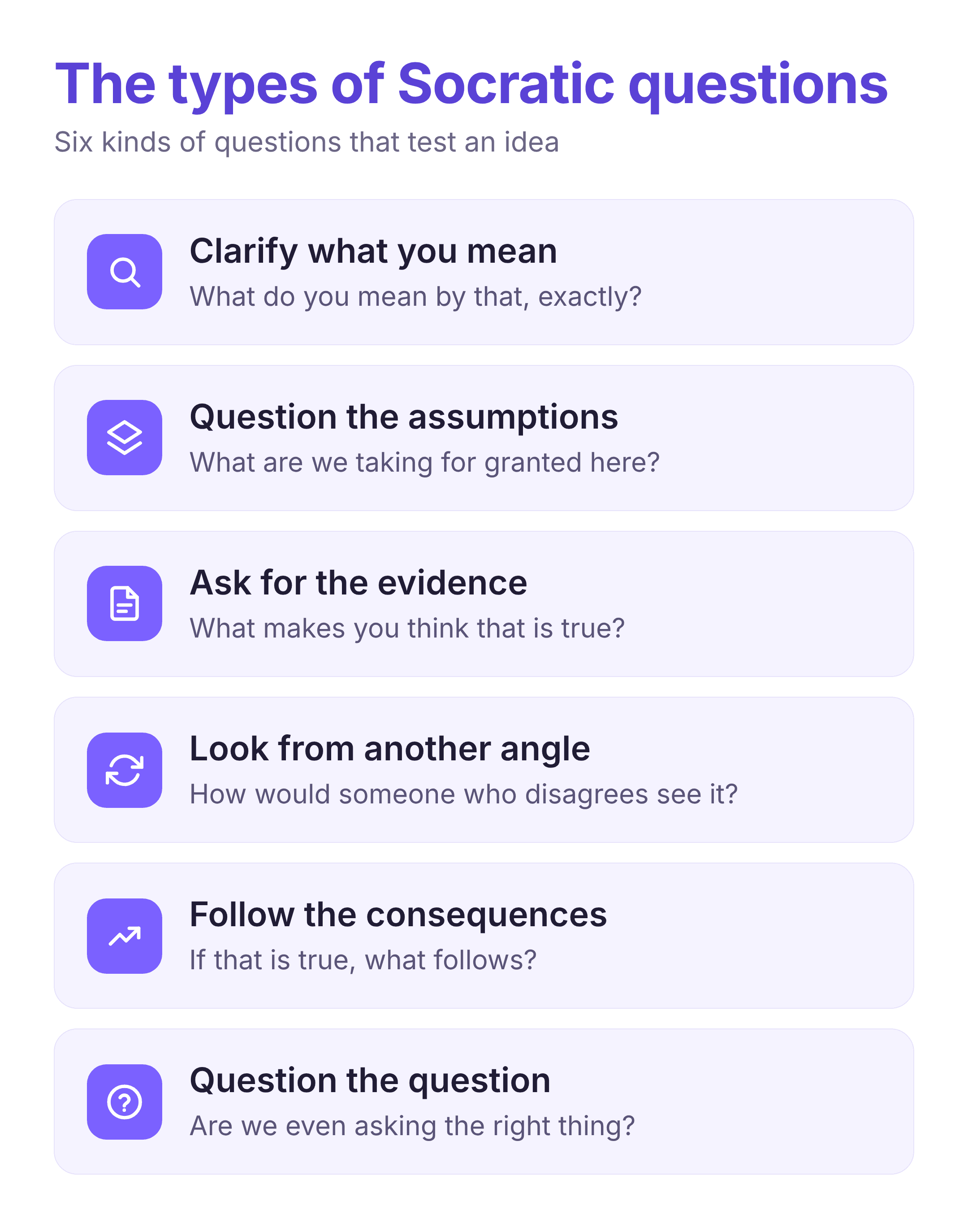
Start by making the claim precise, because a lot of disagreements are really about fuzzy words. Ask things like "What do you mean by that, exactly?", "Can you give me an example?", or "Are you saying X, or something closer to Y?" Half the time the idea gets sharper just from being described carefully, and sometimes the person realizes they meant something narrower than they first said.
Every claim rests on something taken for granted. Bring that to the surface with "What are we assuming here?", "Does this have to be true?", or "What would have to be the case for this to work?" People are usually surprised by how much weight their hidden assumptions are carrying once those assumptions are said out loud.
Once the claim is clear, look at what supports it. "What makes you think that?", "How do we know it is true?", and "Is there anything that points the other way?" move the conversation from opinion to grounds. This is also the honest moment to admit when the real answer is "I read it somewhere" rather than "I checked."
A claim can look obvious from one seat and strange from another. Ask "How would someone who disagrees see this?", "Is there a situation where the opposite holds?", or "Who benefits if we believe this?" Trying on other viewpoints is how you spot the weak points in an idea you would miss from a single angle.
Ideas have consequences, so trace them with "If that is true, what follows?", "What would we expect to see if you are right?", or "Where does this lead if we take it seriously?" Walking a claim forward often shows whether it is practical or whether it breaks the moment you apply it.
Sometimes the most useful move is to step back and check what you are even asking. "Why does this question matter?", "Are we asking the right thing?", and "What would settle this for us?" keep a conversation from running hard in the wrong direction.
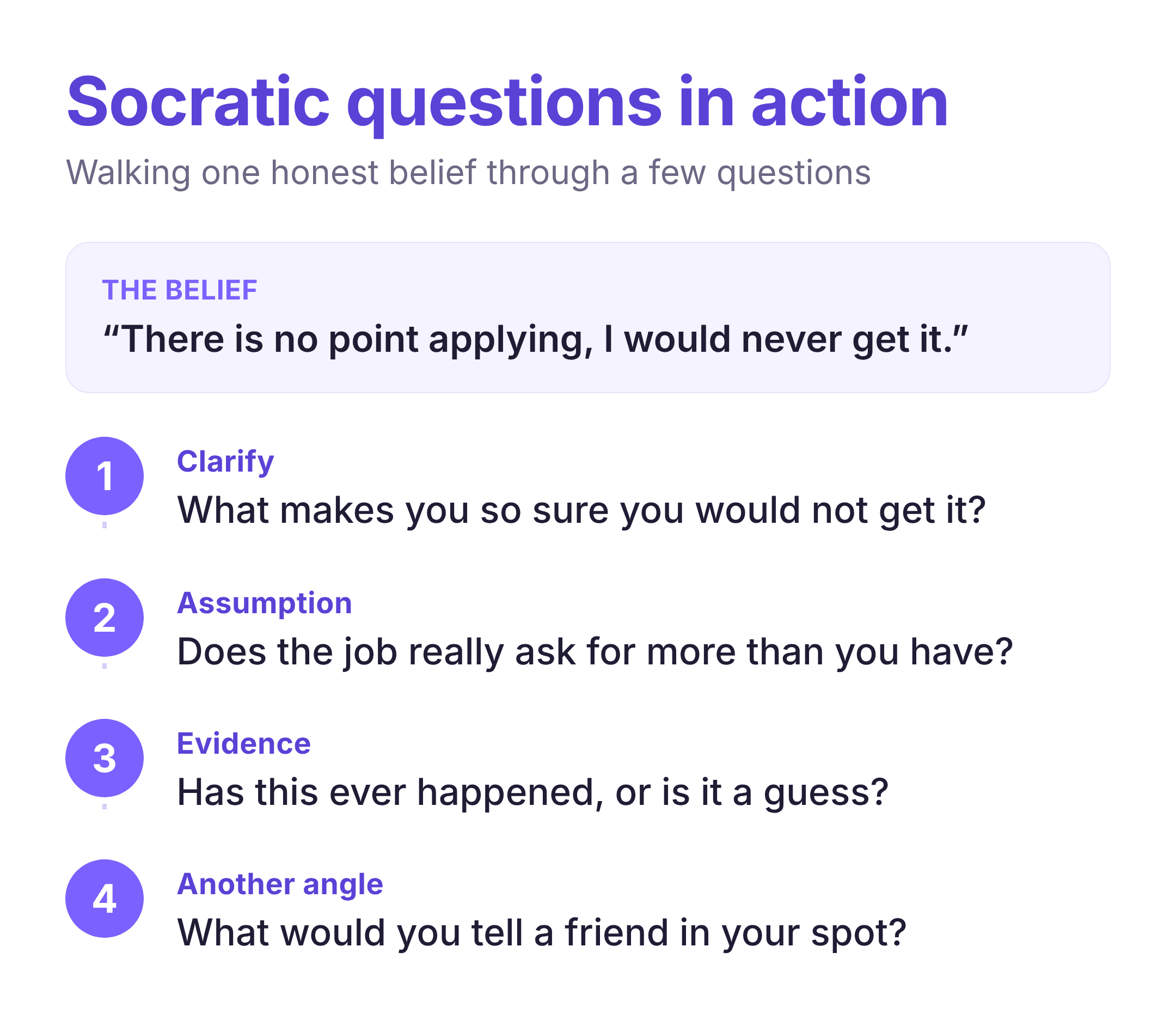
Laid out as a list, these questions can sound stiff. In practice they are closer to ordinary curiosity. Say a friend tells you, "There is no point applying for that job, I would never get it." You could argue back and tell them they are wrong, which rarely works, or you could ask questions instead.
You might start by clarifying: "What makes you so sure you would not get it?" They say they do not have enough experience. You probe the assumption: "Does the posting actually ask for more than you have, or does it just feel that way?" They admit they have not read it closely. You ask for evidence: "Has a job like this ever turned you down for experience, or is this a prediction?" It turns out it is a prediction. Then you look at another angle: "If a friend with your background asked whether to apply, what would you tell them?" Often a question like that gets the person to reconsider the belief on their own.
Nothing in that exchange was a trick. You stayed curious, asked, and listened while the idea met a few honest questions. That is the whole method, and it is why examples of Socratic questions work better in a real conversation than they look on the page.
The method is still widely used. Law schools built their teaching around it: a professor cold-calls a student and asks question after question about a case, pushing the student to reason through it out loud. Many schools run a Socratic seminar, where students discuss a text by questioning each other rather than waiting for the teacher to explain it.
It also shows up in therapy. Socratic questioning is a core method in cognitive behavioral therapy (CBT), where a therapist helps someone examine a harsh or automatic thought by asking about the evidence for it rather than simply disputing it, though clinicians differ on how central the technique should be. A 2021 overview in BJPsych Advances describes it as a way of guiding people to their own conclusions instead of handing them yours. Far outside any classroom or clinic, it is also how careful people think through a decision: they ask themselves the same questions they would ask anyone else.
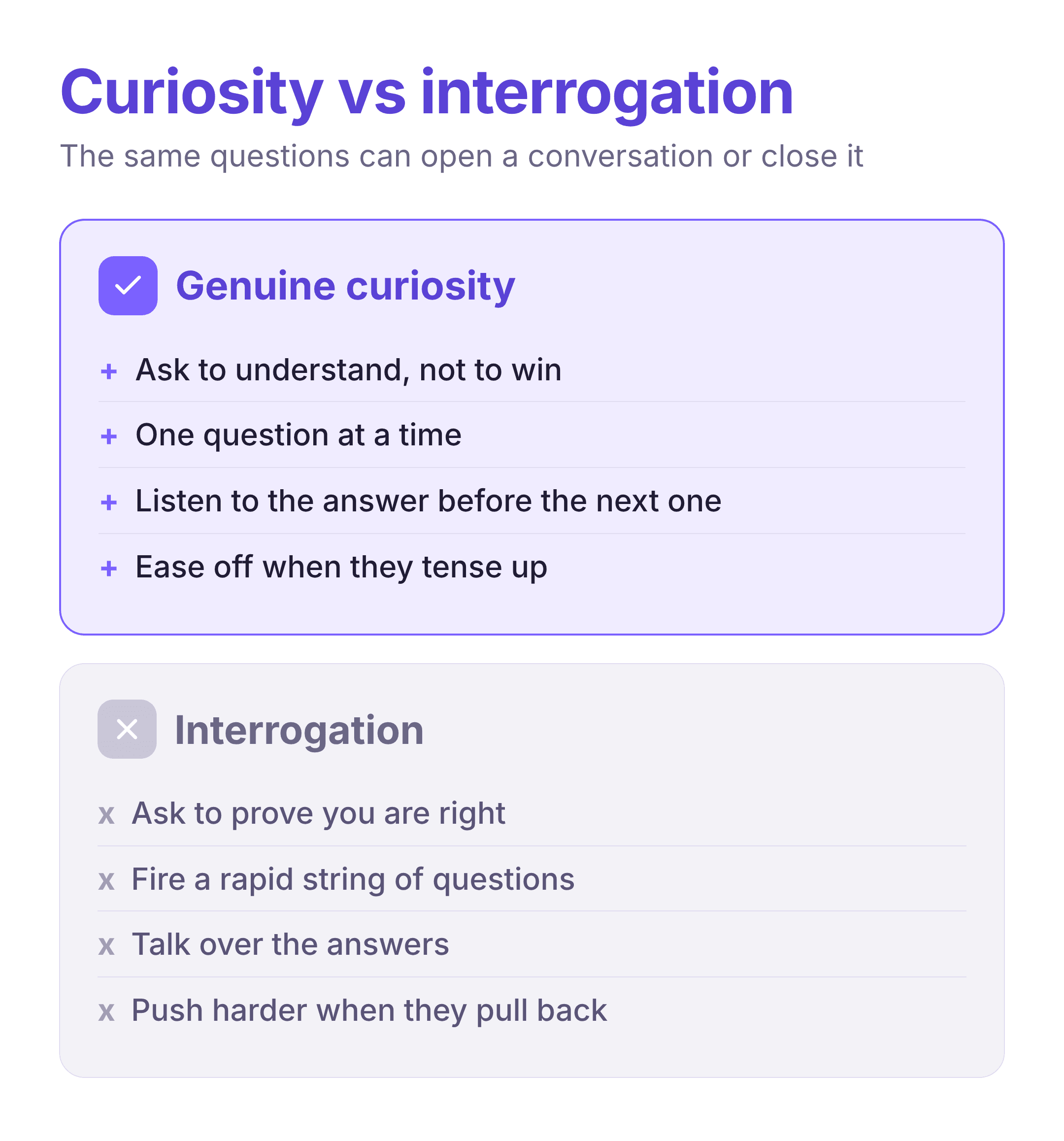
The method has one real failure mode. Pointed questions, asked in the wrong spirit, feel like a trap, and the moment someone feels cornered they stop thinking and start defending. A few habits keep that from happening.
Ask from genuine curiosity, not to spring a verdict you have already reached. People can tell the difference between "help me understand this" and "let me show you why you are wrong," and only the first one keeps them talking. Listen closely to the answer before you ask the next thing, so each question follows from what they actually said rather than from your script. Our team's guide to better listening goes deeper on that half of the exchange, which matters at least as much as the questions themselves.
Watch your tone and pace. One thoughtful question at a time works far better than a rapid string of them, which starts to feel like a deposition. Pay attention to how the other person is taking it, too; reading their reaction and easing off when they tense up is part of the skill, and it leans on the same self-awareness our team covers in emotional intelligence. It also helps to turn the method on yourself first. Running your own confident opinions through these questions, before you aim them at anyone else, builds the habit and keeps you honest. And if you are mostly trying to get to know someone rather than test an idea, a warmer set of openers fits better than a cross-examination, which is where our list of get-to-know-you questions comes in.
If working on how you talk and listen is the area you want to build, RiseGuide's Communication Mastery journey breaks skills like asking better questions, listening, and handling disagreement into short lessons built from expert insights, so you can practice one piece at a time instead of trying to fix everything at once.
The Socratic method is a habit of checking an idea before you accept it, and the first idea worth checking is usually your own. You do not need the full philosophy or any special training to borrow the tool. You need a handful of plain questions and the patience to ask them instead of rushing to conclude. Socrates put the reason for all of it simply:
"The unexamined life is not worth living."
Socrates, as recorded in Plato's Apology
The next time you catch yourself feeling certain about something, try asking what you are assuming, or what would change your mind. That one question is usually where the method starts.
A simple example: a friend says they could never learn a new language as an adult. Instead of arguing, you ask what makes them sure, whether they have actually tried as an adult, what counts as "learning" for them, and how they would advise a friend in the same spot. The questions test the belief without attacking the person, which is the heart of the method.
There is no single official five-step version, but most descriptions follow the same order: clarify what the claim means, bring out the assumptions behind it, ask for the reasons and evidence, consider other viewpoints, and follow the claim to its consequences. Some add a sixth move, questioning whether you are asking the right question in the first place.
Socratic questioning is the questioning technique at the center of the method: a structured set of open questions used to examine an idea rather than assert one. The terms are often used interchangeably, though "Socratic questioning" usually points to the practical skill, while "Socratic method" points to the wider approach to dialogue and teaching.
Yes, widely. Law schools use it to train students to reason about cases, many classrooms run Socratic seminars, therapists use Socratic questioning in cognitive behavioral therapy, and plenty of people use it on their own to think through decisions. The tools and settings have changed, the basic move of testing an idea with questions has not.